What to know before visiting the temple
Dress modestly · Take off your shoes before entering buildings · Don't climb statues for photos
About 07:00–17:00 (some sources say until 19:00); check before you go
Morning, before the sun gets strong
7 days ahead
When to go
this week
Tap a day card to see that day’s weather, rain, haze and hourly forecast
Best time to go Daytime is over · see tomorrow
Holiday — traffic on the way up and parking fills fast; leave early
Hour by hour
Green band = hours used for the score
Best time to go Fine all day little rain through the day
Holiday — traffic on the way up and parking fills fast; leave early
Hour by hour
Green band = hours used for the score
Best time to go Fine all day little rain through the day
No warnings today — normal road and weather conditions
Hour by hour
Green band = hours used for the score
Best time to go Fine all day little rain through the day
No warnings today — normal road and weather conditions
Hour by hour
Green band = hours used for the score
Best time to go Fine all day little rain through the day
No warnings today — normal road and weather conditions
Hour by hour
Green band = hours used for the score
Best time to go Fine all day little rain through the day
No warnings today — normal road and weather conditions
Hour by hour
Green band = hours used for the score
Best time to go Fine all day little rain through the day
No warnings today — normal road and weather conditions
Hour by hour
Green band = hours used for the score
Wat Thung Setthi
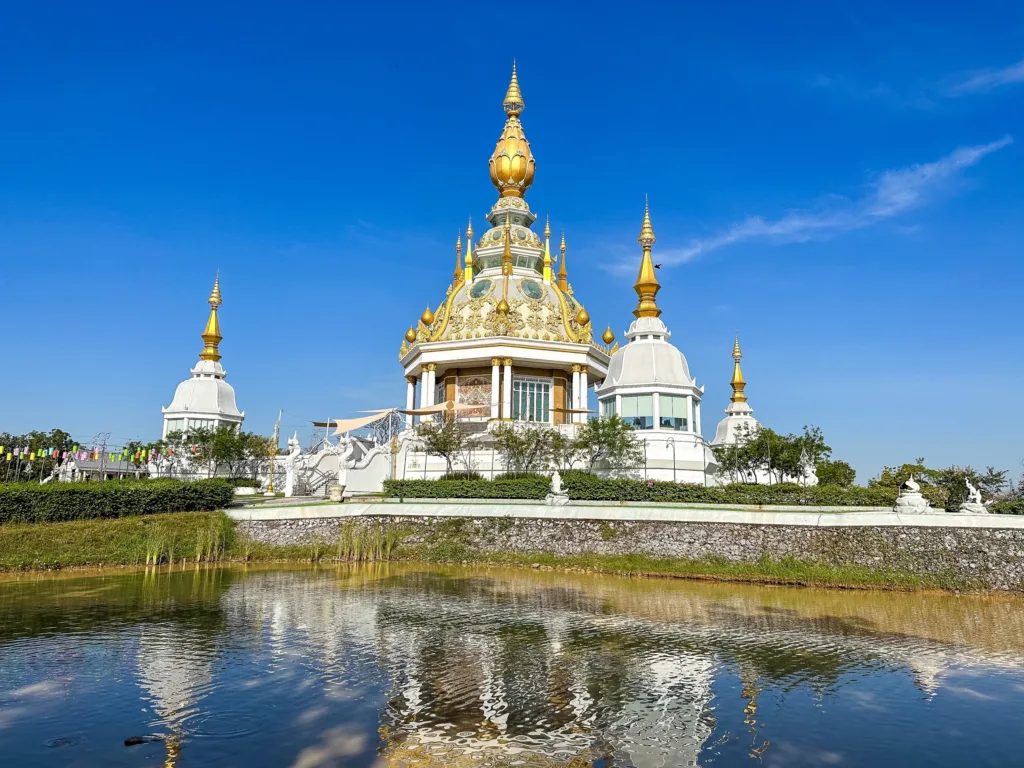
Wat Thung Setthi sits among green rice fields in Phra Lap, Mueang Khon Kaen. Its centrepiece is the Maha Ratana Chedi Si Trai Lok Dhatu, a golden pagoda rising from a lotus pond, designed in a blend of Thai, Tibetan, Chinese and Western styles.The temple began with Luang Ta Yam Daeng (Luang Ta Oi), who invited relatives and followers to build a pagoda on his land, believing the spot joins three realms. The pagoda therefore combines the Chulamani chedi of heaven, the Naga city's chedi and a chedi of the human world. Inside sits Luang Pu Dam, a brass meditating Buddha in Lopburi style.Beneath the pagoda, a dhamma room depicts birth, ageing, sickness and death. Around the grounds you'll find a suspension bridge, a Guan Yin shrine and naga statues, enough for a relaxed half-day.
- Good light, cool
- Strong sun
- Softer light
Arrive Morning, before the sun gets strong
- Lotus pond edgeGolden pagoda reflected in the waterMorning
- Suspension bridgeRice fields and the pagodaEvening
Good to know here
It's a temple; cover shoulders and knees
- Come in the morning for good light and less heat
- Dress modestly
- Don't miss the dhamma room under the pagoda
No data yet check before you go · Time needed 1–2 hours
Weekends and Buddhist holy days
- Kids Open grounds and statues to explore
- Seniors There are stairs up the pagoda
- Dress modestly
- Take off your shoes before entering buildings
- Don't climb statues for photos
- The open grounds have little shade; bring a hat and water
The story of this place
Wat Thung Setthi is a young temple set among the rice fields of Ban Nong Hai in Phra Lap subdistrict, about 15 minutes from central Khon Kaen. Building began around 1999–2000 under Luang Ta Oi, known locally as Luang Ta Yam Daeng (Sawat Sin-udomsap), on just 5 rai of his own land, and the site gradually grew into a large temple centred on the white, gold and blue Maha Ratana Chedi Si Trai Lok Dhatu rising from a pond. The pagoda follows the Traiphum cosmology, based on the belief that this ground is where three worlds meet — heaven, the human world and the underworld — and it has become a new landmark of Khon Kaen.
Read more 10 more paragraphs
According to the history published by the temple, Luang Ta Oi spent many years travelling across the Northeast, assisting meditation masters of the forest lineage of Luang Pu Mun Bhuridatta and encouraging villagers to make merit and practise meditation. Feeling he had helped enough people elsewhere, he decided to return and serve the people of his home province.
The beginning was modest. He planned a small meditation place on his 5 rai and invited relatives and disciples to help build a pagoda. The temple's story says that while the land was being levelled an old sacred sword about a foot long was unearthed; Luang Ta meditated and perceived that this was "the land of the three worlds", so he set out to build a great pagoda over that key point. The temple's website tells it slightly differently: someone offered him land in Phra Lap, and after inspecting it he recognised it as sacred ground and bought it.
The name "Thung Setthi" — "field of the wealthy" — comes from Luang Ta's own explanation that only the wealthy would come here to make merit: the small and the great, and those not yet rich who would become so. Close relatives recall that he often said the pagoda was "built as an offering to the King", dedicating the merit to the nation and the Chakri dynasty, and some studies describe the temple as a tribute to King Rama IX.
Sources differ on some details. The temple's website gives 2000 as the start of construction and an area of 48 rai, while other sources say planning and building began in 1999 and that disciples bought more land until the grounds reached about 73 rai. Today Wat Thung Setthi is a branch of Wat Pa Saeng Arun, a little over 2 km away.
The temple's greatest work is the pagoda. Its foundation stone was laid on 23 October 2005 and its golden spire parasol raised on 17 January 2008. Villagers tell how, after the spire was set, the crane could no longer swing its arm over the top and had to be taken down — a story they regard as a small miracle. Some sources say the main construction was completed around 2012, with the Maha Ratana Chedi as the last major building.
The pagoda was first simply called "Maha Chedi Ratana". Phra Thammadilok, abbot of Wat Pa Saeng Arun, later expanded the name to "Maha Ratana Chedi Si Trai Lok Dhatu" to reflect the idea of three worlds: it brings together three great chedis in one — the Chulamani chedi in Tavatimsa heaven, the chedi of the naga realm, and the Maha Ratana chedi of the human world, the one visitors can climb and worship.
The pagoda stands in the middle of a pond with stairways on all four sides decorated with four families of animals, known as the "four-element stairs", and a guardian at each direction, among them Thao Vessavana. The bell-shaped chedi encloses an open hall and blends Thai, Tibetan, Chinese and Western styles in white with gold and blue, unlike the gold and red common to most Thai temples.
Inside the pagoda are a tooth relic of the Buddha and the principal image, Phra Phuttha Ninlawanno Silotrapyudom, called "Luang Pu Dam" — a brass meditating Buddha in Lopburi style, its body black and its robes gilded and set with coloured stones. The grounds also include the Mondop Ong Pathom, housing likenesses of revered monks from several lineages.
Around the pond and courtyards are sculptures and etched-glass panels carrying Dhamma riddles, some pairing modern pop-culture figures with Buddhist moral tales. There is an open-air hell garden warning of the fruits of bad deeds, naga statues, and a dhamma room beneath the pagoda telling of birth, ageing, sickness and death, so a walk round the temple is both sightseeing and a lesson in the Dhamma.
Today Wat Thung Setthi is one of Khon Kaen's most popular photo stops and merit-making destinations. Its reputation among wish-makers even inspired a research project to build an app guiding visitors to its shrines, and a 2023 academic article used it to study the province's cultural-tourism potential. Phra Thammadilok, later elevated to Phra Phrom Wachiradilok, passed away on 12 August 2026.
- 1978Phra Maha Saman Sumetho (later Phra Thammadilok) becomes abbot of Wat Pa Saeng Arun, the parent temple
- 1999Some sources say Luang Ta Oi begins planning and building on about 5 rai of land
- 2000Start of construction as given by the temple's website
- 200523 Oct — foundation stone of the great pagoda is laid
- 2007The abbot of Wat Pa Saeng Arun receives the title Phra Thammadilok; he later gives the pagoda its full name
- 200817 Jan — the golden spire parasol is raised on the pagoda
- 2012Main construction completed (according to some sources)
See 3 events
- 2023An academic article studies the temple's role in Khon Kaen's cultural tourism
- 2023Phra Thammadilok is elevated to Phra Phrom Wachiradilok
- 202612 Aug — Phra Phrom Wachiradilok, abbot of Wat Pa Saeng Arun, passes away
Check-ins & visitor photos
Arrived? Check in, collect a stamp and tell others what it is like right now
Check your location first, so you do not fill in the form for nothing
Location must be on and within 1 km · One check-in per place per day · come back on other days to check in again
Post photos from anywhere — no need to be here · Up to 20 photos at a time · JPG / PNG / WebP · GPS location data is removed automatically
How to get there
The temple is in Phra Lap, Mueang Khon Kaen, surrounded by rice fields.
Phra Lap, Mueang Khon Kaen · Fuel
Paved road
About 07:00–17:00 (some sources say until 19:00); check before you go
Wat Thung Setthi
FAQ
Before you go: Wat Thung Setthi
Answers travellers want before they go — a one-minute read
Where is Wat Thung Setthi?
Phra Lap, Mueang Khon Kaen, Khon Kaen
What's the main sight?
The golden Maha Ratana Chedi Si Trai Lok Dhatu in a lotus pond
Who founded it?
Luang Ta Yam Daeng (Luang Ta Oi), with relatives and followers
Why 'three worlds'?
The pagoda combines chedis of heaven, the naga realm and the human world in one
When was the pagoda built?
Foundation stone 23 October 2005; spire raised 17 January 2008
What should I wear?
Modest clothing covering shoulders and knees
Nearby places
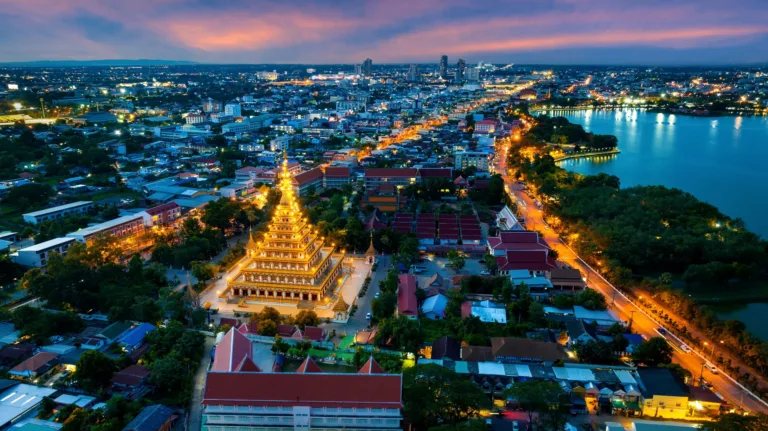 Bueng Kaen Nakhon
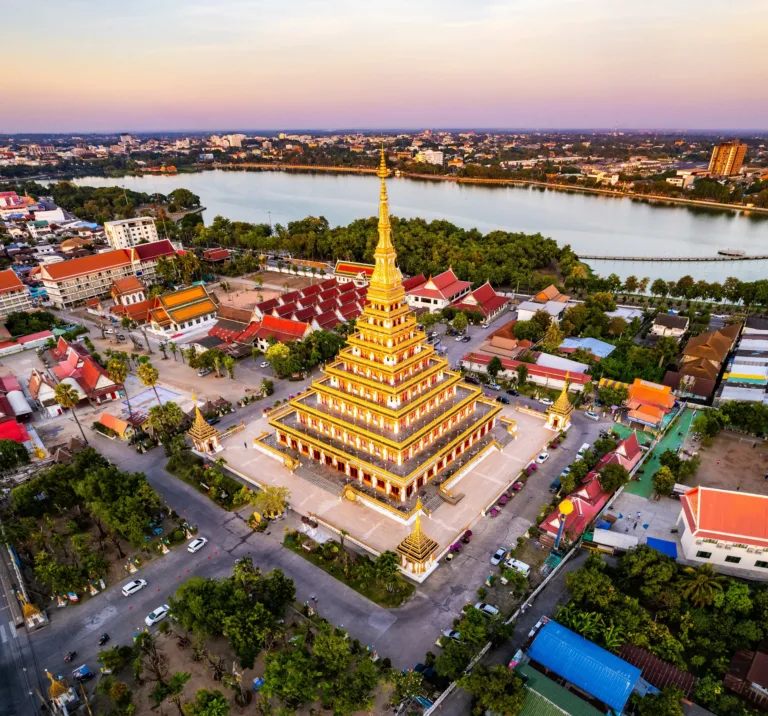 Phra Mahathat Kaen Nakhon (Wat Nong Waeng)
Ready to go to Wat Thung Setthi?
Best day this week: Monday 30 Nov · Check in when you arrive to collect a stamp