Rainy season, safety and preparation
May, Jul – Oct
Monkeys grab things — Keep bags, food, glasses and phones put away; don't hold food out
1–2 hours
7 days ahead
When to go
this week
Tap a day card to see that day’s weather, rain, haze and hourly forecast
Best time to go Daytime is over · see tomorrow
No warnings today — normal road and weather conditions
Hour by hour
Green band = hours used for the score
Best time to go Fine all day little rain through the day
No warnings today — normal road and weather conditions
Hour by hour
Green band = hours used for the score
Best time to go Fine all day little rain through the day
No warnings today — normal road and weather conditions
Hour by hour
Green band = hours used for the score
Best time to go Fine all day little rain through the day
No warnings today — normal road and weather conditions
Hour by hour
Green band = hours used for the score
Best time to go Fine all day little rain through the day
No warnings today — normal road and weather conditions
Hour by hour
Green band = hours used for the score
Best time to go Fine all day little rain through the day
No warnings today — normal road and weather conditions
Hour by hour
Green band = hours used for the score
Best time to go Fine all day little rain through the day
No warnings today — normal road and weather conditions
Hour by hour
Green band = hours used for the score
Starry sky
How likely
Scored from cloud cover at every level and tonight’s moonlight — the darker the sky, the clearer the Milky Way · tap another night below for the next 7 nights
Kosamphi Forest Park
Kosamphi Forest Park is in Hua Khwang, Kosum Phisai District, Maha Sarakham, right next to Kosum Phisai town and about 28–30 km from Maha Sarakham. It is a patch of forest of around 120–125 rai on the bank of the Chi River, declared a forest park on 1 October 1976.It is known for its troop of more than 800 long-tailed macaques, including grey ones and rare golden-furred ones. Kaeng Tat rapids in the Chi alongside make a nice spot to sit.Open daily 08:30–16:30. Don't give the monkeys sweets or soft drinks, keep your things zipped away and give them space.
- Cool; monkeys foraging
- Hot, but shady in the forest
- Softer sun
Arrive Morning, when it's cool and the monkeys are foraging
- Forest pathsMonkeys in the big treesmorning
- Chi riverbankKaeng Tat rapidsafternoon
Good to know here
Keep bags, food, glasses and phones put away; don't hold food out
Snacks and soft drinks make the monkeys ill; give to the monkey food fund instead
- Leave valuables and food bags in the car or in a closed bag
- Don't stare at or tease the monkeys; keep your distance
- To help them, donate to the district's monkey food fund rather than feeding snacks
- Grab food in Kosum Phisai town next door
No data yet check before you go · Time needed 1–2 hours
Weekend afternoons
- Kids Kids love it; hold their hands and keep food out of sight
- Seniors Flat, shady paths
- Wheelchair No information on ramps
- Pets Pets may be harassed by the monkeys; not recommended
- Kosum Phisai townRestaurants and markets
- Keep your distance from the monkeys
- Use the bins
- Don't give monkeys sweets or soft drinks
- Don't tease, grab or chase them
- Monkeys may snatch things or scratch
- Don't carry plastic bags with food
The story of this place
Kosamphi Forest Park is a small patch of forest on the Chi River in Hua Khwang, Kosum Phisai District, Maha Sarakham, almost within walking distance of Kosum Phisai town. The Royal Forest Department declared it a forest park on 1 October 1976 at the request of Maha Sarakham Province. The forest is famous for its troop of several hundred long-tailed macaques, which have lived alongside the townspeople for generations and include rare yellow-golden individuals. Once revered public land, Kosamphi is today both a place where locals come to relax and a study site that Thai and foreign researchers have followed since around 1989.
Read more 10 more paragraphs
Locals call it "Bung Ling" or "Nong Bung". In the Isan language "bung" means a pond or damp low-lying ground, which fits the place well: there is a marsh called Nong Bung in the middle of the forest, and a landscape study from Chulalongkorn University classifies the area as "pa bung pa tham", a riverside lowland forest that floods with the seasons. That explains both the local name and the floods that return in most high-water years.
Sources do not quite agree on its size. Most say about 125 rai, which matches the 0.2 square kilometres given in research papers, while some give 120 or 130 rai. The forest type is also described differently: the government tourism directory calls it dry evergreen forest and a natural breeding ground for yang na trees, while some studies describe mixed deciduous or dipterocarp forest. Notable trees include large yang na, tabaek, kratum, wa, wild fig, krabao and bamboo, and the "Lan Khoi" area has more than 200 naturally grown khoi trees trimmed into dwarf shapes.
To the north and east the forest meets a stretch of the Chi known as "Kaeng Tat", a broad bed of flat sedimentary rock in the river. It shows best when the water is low, roughly November to May, and has long been a favourite spot for locals to sit by the water and cool off.
Before it became a forest park, this was natural forest on public land beside the Chi River, with a shrine to the ancestral guardian spirit (Pu Ta) revered by the people of Kosum Phisai. Many locals believe the monkeys are bound to this guardian spirit, and local sources see that belief as one reason the community has always protected both the forest and the monkeys. A Buddha image known as Luang Pho Ming Mueang, also worshipped by townspeople, stands in the same area.
After the declaration, Kosamphi became one of the province's popular attractions, and nearby communities have taken part in developing it. A 2009 Chulalongkorn University thesis noted that some buildings did not suit a flooded forest and proposed ways to restore the landscape. Later researchers note that farmland and town growth have cut the forest off from other forest for more than 45 years, leaving the whole macaque population in a closed area.
Recorded counts show how fast the troop has grown. A 1989 survey found about 158 monkeys; in 2003 researchers counted 287 in three troops; at the end of 2016 a Thai–American team counted about 734 in five groups of 67 to 217 animals each; and unpublished data put the number at nearly 950 in 2019. News reports and officials in recent years usually cite "more than 800".
Yellow-golden macaques were already recorded in the 1989 survey. In 2003 there were 15 of them, about 5.2 percent, which researchers said was lower than about ten years earlier. A 2016 media report put their number at around 200. Researchers from several universities suggest the colour comes from a recessive gene made more visible by inbreeding in this isolated population. In 2018 veterinarians from Mahasarakham University took blood samples to study the troop's genetic diversity together with Khon Kaen University and US universities. Some media call this the only golden macaque site in Thailand, others the largest in the region, so these claims are best read as description rather than confirmed fact.
As the troop grew, living with people became more complicated. A 2016 study found the monkey density far above what the forest can support. Three villages with about 1,077 households border the southern edge, a temple and a school sit right next to the park, and some 50,000 to 80,000 people visit each year. Residents reported monkeys taking food and damaging roofs, so in 2018 the Protected Area Regional Office 8 (Khon Kaen) trapped monkeys for sterilisation, aiming at 50 animals, to slow population growth.
Floods are a recurring test. In 2011 staff had to string ropes so the monkeys could climb out to find food. In 2017 the Chi rose until about 800 monkeys moved onto the road beside the forest. In 2021 the forest stayed under water for more than two weeks and ropes were needed again for the first time in ten years, and in 2022 the water rose about 40 centimetres higher than the year before, reaching the park sign; some monkeys crossed on ropes behind the Phra Ming Mueang image to reach food left by the municipality and donors.
The dry season brings the opposite problem. In April 2026, with temperatures above 40°C, the monkeys went looking for food along roads and in temples and homes, and Kosum Phisai District opened a monkey food fund for anyone wishing to donate. Bung Ling remains a symbol of the town and an example of a small forest where people, monkeys and the Chi River have to find a way to live together.
- 19761 Oct: the Royal Forest Department declares the riverside forest locals call "Bung Ling" as Kosamphi Forest Park, at Maha Sarakham Province's request
- 1989A survey finds about 158 long-tailed macaques and already records yellow-golden individuals
- 2003Researchers count 287 monkeys in three troops, 15 of them yellow (about 5.2%)
- 2005The survey of Kosamphi's yellow macaques is published in an international primate journal
- 2009A Chulalongkorn University thesis proposes landscape restoration for this seasonally flooded forest
- 2011Major flood; staff string ropes so the monkeys can climb out to find food
- 2015A survey finds about 800 monkeys, around 200 of them golden
See 8 events
- 2016A Thai–US research team counts about 734 monkeys in five groups and estimates 50,000–80,000 visitors a year
- 2017The Chi floods the forest; about 800 monkeys move onto the road beside the park
- 2018Protected Area Regional Office 8 (Khon Kaen) traps monkeys for sterilisation, aiming at 50
- 2018Mahasarakham University veterinarians take blood samples to study genetic diversity
- 2019The population is estimated at about 941 (unpublished data cited by researchers)
- 2021The forest is flooded for more than two weeks; ropes are strung for the monkeys again after ten years
- 2022Floodwater rises about 40 cm higher than the year before, reaching the park sign
- 2026April: drought drives monkeys into the community; the district opens a monkey food fund
Check-ins & visitor photos
Arrived? Check in, collect a stamp and tell others what it is like right now
Check your location first, so you do not fill in the form for nothing
Location must be on and within 3 km · One check-in per place per day · come back on other days to check in again
Post photos from anywhere — no need to be here · Up to 20 photos at a time · JPG / PNG / WebP · GPS location data is removed automatically
How to get there
The park is in Hua Khwang, Kosum Phisai, next to Kosum Phisai town.
Highway 208 Maha Sarakham–Kosum Phisai · Fuel
Maha Sarakham–Khon Kaen bus, get off in Kosum Phisai · Standard fare
Highway 208 to Kosum Phisai, then about 450 m in
Parking at the park entrance
Kosum Phisai town
Daily 08:30–16:30
about 28–30 km from Maha Sarakham town
Kosamphi Forest Park
FAQ
Before you go: Kosamphi Forest Park
Answers travellers want before they go — a one-minute read
Where is Kosamphi Forest Park?
Hua Khwang, Kosum Phisai, beside the town, about 28–30 km from Maha Sarakham
What are the opening hours?
Daily 08:30–16:30
How many monkeys are there?
More than 800 long-tailed macaques
Are there really golden monkeys?
Yes, they are the park's highlight
Can I feed the monkeys?
Don't give sweets or soft drinks; donate to the food fund instead
Is it good for kids?
Yes, but keep them away from the monkeys and don't let them tease them
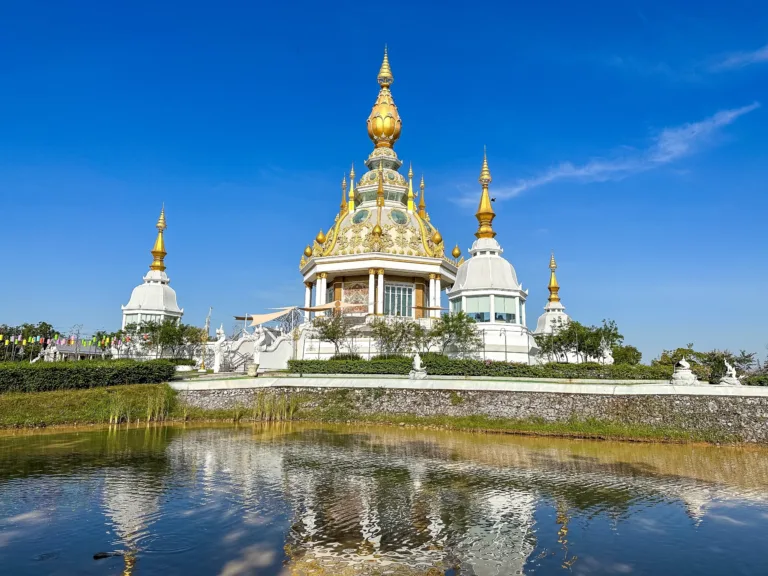 Wat Thung Setthi
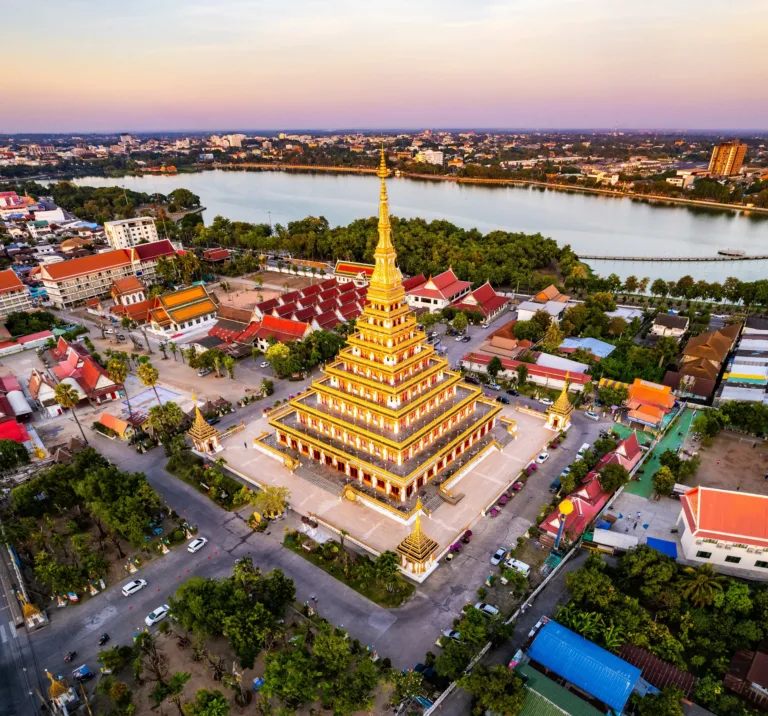 Phra Mahathat Kaen Nakhon (Wat Nong Waeng)
Ready to go to Kosamphi Forest Park?
Best day this week: Saturday 28 Nov · Check in when you arrive to collect a stamp