What to know before visiting the temple
Dress modestly · Remove shoes before entering the hall · Don't climb on or touch the carvings
Daily, around 06:00–18:00
Morning, for nice light on the wood
7 days ahead
When to go
this week
Tap a day card to see that day’s weather, rain, haze and hourly forecast
Best time to go Daytime is over · see tomorrow
No warnings today — normal road and weather conditions
Hour by hour
Green band = hours used for the score
Best time to go Fine all day little rain through the day
No warnings today — normal road and weather conditions
Hour by hour
Green band = hours used for the score
Best time to go Fine all day little rain through the day
No warnings today — normal road and weather conditions
Hour by hour
Green band = hours used for the score
Best time to go Fine all day little rain through the day
No warnings today — normal road and weather conditions
Hour by hour
Green band = hours used for the score
Best time to go Fine all day little rain through the day
No warnings today — normal road and weather conditions
Hour by hour
Green band = hours used for the score
Best time to go Fine all day little rain through the day
No warnings today — normal road and weather conditions
Hour by hour
Green band = hours used for the score
Best time to go Fine all day little rain through the day
No warnings today — normal road and weather conditions
Hour by hour
Green band = hours used for the score
Wat Sawang Hua Na Kham
Wat Sawang Hua Na Kham is in Tambon Hua Na Kham, Yang Talat District, Kalasin. It dates back to around 1729, and locals once simply called it the village temple or the big temple.The draw is the 'Sim Isan Mai Phan Chat', a new ordination hall built from many kinds of donated hardwood. Designed under Phra Khru Si Pariyat Chotitham, it mixes Isan's Lan Xang style with northern Lanna, with huge carved wooden doors and a revered Lan Xang-style Buddha inside.The Wihan Ho Phra holds Luang Pho Sila, a large stone replica of the main Buddha. Dress modestly and keep your visit calm.
- Cool, good light
- Strong sun
- Softer light
Arrive Morning, for nice light on the wood
- In front of the wooden hallThe whole building and gablesMorning
- The wooden doorsClose-ups of the carvingLate morning
Good to know here
It's an active village temple
- Look closely at the carving on the doors and gables
- Come in the morning for good light and cooler air
- Dress modestly and remove shoes before entering the hall
No data yet check before you go · Time needed 1 hour
Weekends and Buddhist holy days
- Kids Open grounds to walk around
- Dress modestly
- Remove shoes before entering the hall
- Don't climb on or touch the carvings
- The courtyard gets hot at midday
The story of this place
Wat Sawang Hua Na Kham is the old village temple of Ban Hua Na Kham in Yang Talat District, Kalasin, with a history going back to around 1729, nearly three hundred years. Villagers long knew it simply as the "village temple" or the "big temple", but today it is famous for the Sim Isan Mai Phan Chat, a new wooden ordination hall that villagers and monks spent about nine years building, finishing in 2018, from many kinds of wood donated by the faithful. Its story is partly about an old Lan Xang-style sandstone Buddha and partly about a community that brought its temple back to life.
Read more 10 more paragraphs
Most sources say the temple was founded around 1729; one gives the exact date as 9 December 1729. It stands in Moo 1 of Ban Hua Na Kham and belongs to the Maha Nikaya order. Its old nicknames, Wat Ban and Wat Yai, show that it was the centre of village life from the start: the place for merit-making, festivals and spiritual support for generations of Hua Na Kham families.
In 1799 the temple received its first royal grant of consecrated land (wisungkhamsima), the formal permission to build an ordination hall, which allowed it to hold key ceremonies such as ordinations. Having that grant more than two centuries ago shows the temple has long mattered in the area.
The temple's oldest image is Luang Pho Phra Phutthawichaiyan, known affectionately as "Luang Pu Yai". It is the principal Buddha, in the subduing-Mara posture and seated in half-lotus, made of old sandstone in the Lan Xang style, and now sits on a busabok throne inside the new hall. Sources date it slightly differently: some say about 300 years old, others place it in the 22nd–23rd Buddhist century.
Over the years the temple has had 19 abbots, and portraits of former abbots Luang Pu Chiam and Luang Pu Li are still honoured here. Between 1987 and 1989, however, the temple had no one to lead it and fell into decline. The villagers met and invited Phra Khru Si Pariyat Chotitham (Chonchai Akkhathammo) to become abbot, and the temple has been steadily developed ever since.
In Isan an ordination hall is called a "sim". Traditional sim are small buildings with few doors and windows and a dim interior, and architectural studies note that many old sim were later replaced by modern standard ordination halls. The old sim here also wore out with time, and by around 2008 it could no longer be used for ceremonies.
Shortly before that, in 2007, the temple and villagers created "Luang Pho Sila", a replica of Luang Pu Yai carved from a large stone, 80 inches across the lap and 2.6 metres tall. It sits in the Wihan Ho Phra, an old wooden building in the Lan Xang style. There is also a gilded bronze replica of the same image.
When the old sim became unusable in 2008, the abbot discussed it with the villagers and they agreed to build a new one. He asked for donations of "phan chat" wood and other hardwoods, and timber arrived from the village, neighbouring villages and other provinces; some sources mention teak among the hardwoods. The name "Mai Phan Chat", roughly "a thousand kinds of wood", refers to the many species and many donors brought together in one building.
Construction began in 2009, to a design by Phra Khru Si Pariyat Chotitham based on his own vision. The style is mainly Isan Lan Xang with Lanna touches, and the carving was done by craftsmen from both the North and Isan, while villagers and monks provided most of the labour. The hall was finished in 2018 after about nine years, at a cost of around 30 million baht. Look for its tiered roofs and the large wooden doors carved with Buddhist motifs, guarded by a pair of naga at the front.
During construction, in 2013, Phra Ajarn Mahawat Witthanamethi brought Luang Pho Pho Si Wilai, also called Luang Pho Somprathana, to the temple. Travel sources say this old Buddha image was once found buried at Wat Si Wilai in Sakon Nakhon and was restored with lacquer and gold leaf; it is usually brought out only on special occasions.
After the hall was completed, in 2019 the temple received royal permission to expand its consecrated boundary. Today the grounds also hold a sermon hall, an alms hall built entirely on wooden posts, the Wihan Lan Pho, drum and bell towers, an old wooden gate, a statue of Somdet Phra Phutthachan (To Phrommarangsi) and a large Thao Wessuwan. Umbrellas in pha khao ma check and woven tung banners decorate the courtyard, making this village temple a destination for temple lovers in Kalasin while it remains the heart of Hua Na Kham.
- 1729Temple founded, known locally as Wat Ban or Wat Yai (one source gives 9 Dec)
- 1799First royal grant of consecrated land
- 1987–1989The temple has no abbot and declines; villagers invite Phra Khru Si Pariyat Chotitham to lead it
- 2007Luang Pho Sila, a stone replica of Luang Pu Yai, is carved
- 2008The old sim can no longer be used; wood donations begin
- 2009Construction of the Sim Isan Mai Phan Chat begins
- 2013Luang Pho Pho Si Wilai (Luang Pho Somprathana) is brought to the temple
See 2 events
- 2018The wooden hall is completed after about nine years, costing around 30 million baht
- 2019Royal permission to expand the consecrated boundary
Check-ins & visitor photos
Arrived? Check in, collect a stamp and tell others what it is like right now
Check your location first, so you do not fill in the form for nothing
Location must be on and within 1 km · One check-in per place per day · come back on other days to check in again
Post photos from anywhere — no need to be here · Up to 20 photos at a time · JPG / PNG / WebP · GPS location data is removed automatically
How to get there
The temple is in Tambon Hua Na Kham, Yang Talat District, Kalasin.
Head to Tambon Hua Na Kham, Yang Talat; search the temple name on Google Maps · Fuel
Daily, around 06:00–18:00
Wat Sawang Hua Na Kham
FAQ
Before you go: Wat Sawang Hua Na Kham
Answers travellers want before they go — a one-minute read
Where is Wat Sawang Hua Na Kham?
Tambon Hua Na Kham, Yang Talat District, Kalasin
How old is it?
It was founded around 1729
What is the Sim Isan Mai Phan Chat?
A wooden ordination hall built from many donated woods, mixing Lan Xang and Lanna styles
Where is Luang Pho Sila?
In the Wihan Ho Phra; a stone Buddha with an 80-inch lap width, 2.6 m tall
How long should I allow?
About an hour
Nearby places
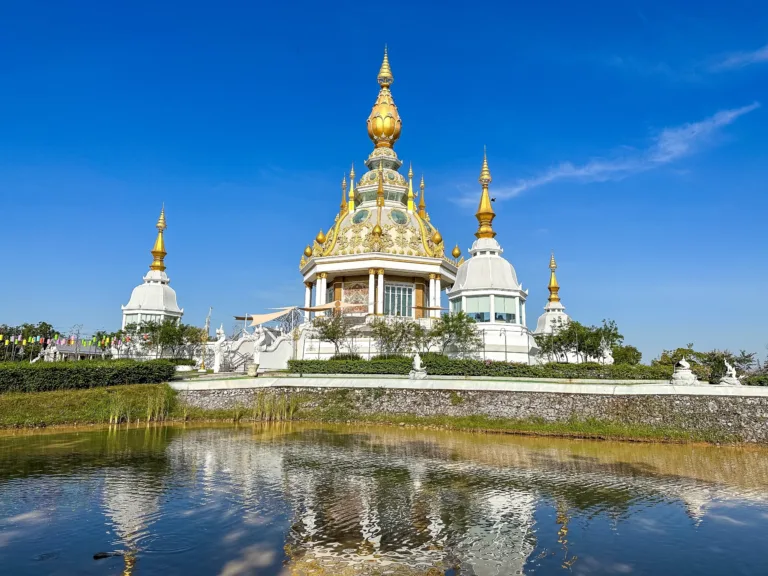 Wat Thung Setthi
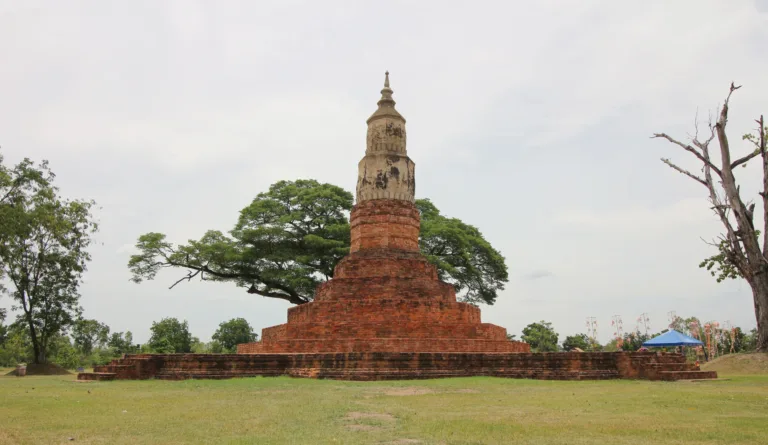 Phra That Ya Khu
Ready to go to Wat Sawang Hua Na Kham?
Best day this week: Saturday 28 Nov · Check in when you arrive to collect a stamp