 01
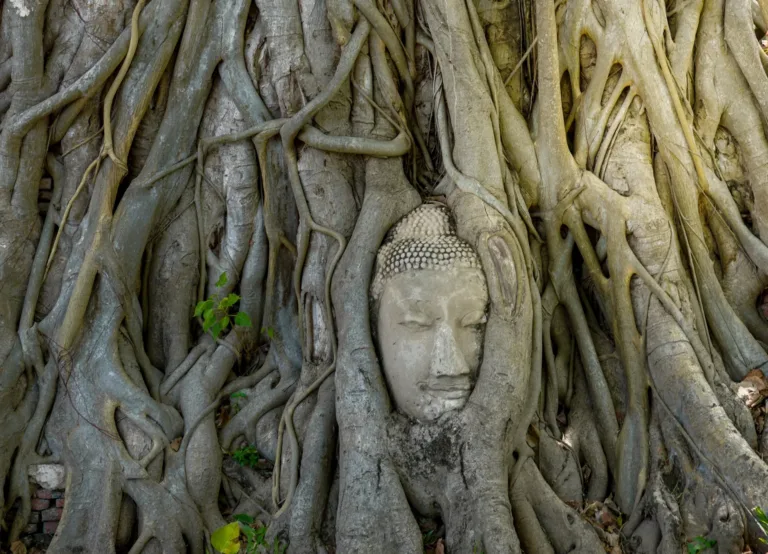
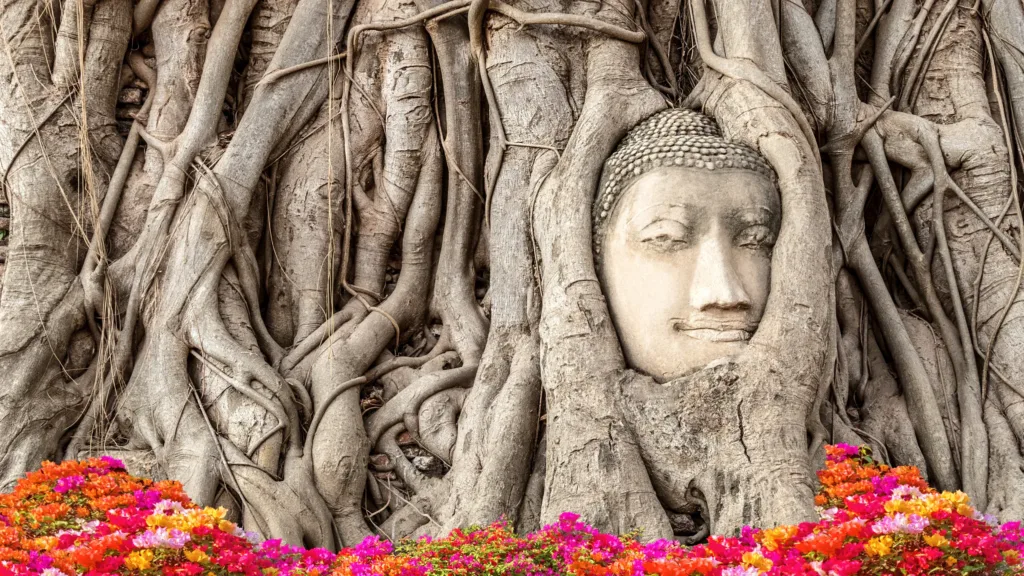
Buddha head in the rootsA sandstone Buddha head embraced by tree roots
Early Ayutthaya royal temple · Ayutthaya Historical Park
A major royal temple in the heart of Ayutthaya's island, built around 1374, famous for the Buddha head wrapped in tree roots and the relic crypt beneath its prang. Part of the World Heritage Site.
Holiday / event — crowded
Dress modestly, covering shoulders and knees · Don't stand higher than the Buddha head in photos · Don't climb ruined chedis or sit on Buddha images
Daily 08:00–18:00 (tickets until 17:00)
08:30, before the photo queue builds
01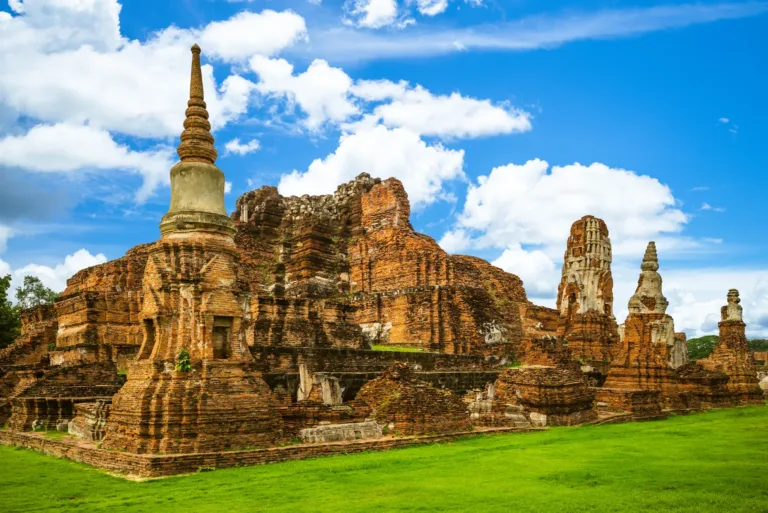 02
 03
Tap a day card to see that day’s weather, rain, haze and hourly forecast
Best time to go Daytime is over · see tomorrow
Holiday — traffic on the way up and parking fills fast; leave early
Green band = hours used for the score
Best time to go Fine all day little rain through the day
Holiday — traffic on the way up and parking fills fast; leave early
Green band = hours used for the score
Best time to go Fine all day little rain through the day
No warnings today — normal road and weather conditions
Green band = hours used for the score
Best time to go Fine all day little rain through the day
No official warnings, but watch for: Hot (Afternoon) feels like 38°C
Green band = hours used for the score
Best time to go Fine all day little rain through the day
No official warnings, but watch for: Hot (Afternoon) feels like 38°C
Green band = hours used for the score
Best time to go Fine all day little rain through the day
No warnings today — normal road and weather conditions
Green band = hours used for the score
Best time to go Fine all day little rain through the day
No warnings today — normal road and weather conditions
Green band = hours used for the score
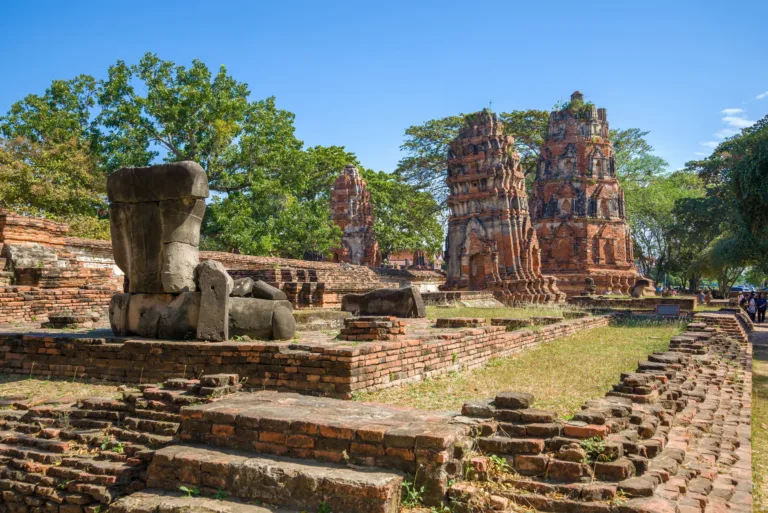
Wat Mahathat sits on Naresuan Road near Bueng Phra Ram in the middle of Ayutthaya's island. It was one of the most important royal temples from the early Ayutthaya period and is part of UNESCO's Historic City of Ayutthaya.Its signature sight is a sandstone Buddha head cradled in tree roots. Around it are the huge base of the main prang, whose top has collapsed, and rows of ruined chedis, halls and Buddha images.It's open daily, with tickets sold 08:00–17:00 and visits until 18:00. Wat Ratchaburana is only about 300 m away, an easy walk.
Arrive 08:30, before the photo queue builds
Sit or crouch so you're lower than it for photos; don't touch the roots
Little shade; bring water and a hat
Thais 10 THB · Foreigners 80 THB · Time needed 1–1.5 hours
Weekends 10:00–14:00
| Entry, Thai | 10 ฿/person |
| Entry, foreign | 80 ฿/person |
| 7-site combined ticket, Thai optional | 40 ฿/person |
| 7-site combined ticket, foreign optional | 300 ฿/person |
Mostly cash · Prices may change by season — check with the venue
Wat Mahathat was one of the most important temples of the Ayutthaya kingdom. It stands in the middle of the city island, east of the old Grand Palace, and its main prang once enshrined relics of the Buddha. Throughout the Ayutthaya period it was the seat of the Supreme Patriarch of the town-dwelling (khamavasi) order. Over more than 600 years it was built, enlarged, restored and collapsed several times, leaving the brick ruins you see today: the huge base of the main prang, the relic crypt found in 1956, and the sandstone Buddha head in the roots of a bodhi tree that has become Ayutthaya's best-known image.
Sources give different founding dates. The Luang Prasoet chronicle says that in the year of the tiger, 736 of the Lesser Era (1374), King Borommarachathirat I (Khun Luang Pha Ngua) and the senior monk Thammakanlayan built the Phra Si Rattana Mahathat east of the palace. Later chronicles date it to 1384 and credit King Ramesuan, while the Dutch merchant Jeremias van Vliet, writing his history of Siam around 1640, named King U Thong as the founder.
Most provincial and Thai media accounts combine these: Khun Luang Pha Ngua began the temple in 1374 but died before it was finished, and King Ramesuan completed it and enshrined the relics beneath the prang in 1384. Scholars still debate the date. A Silpakorn University architect has suggested the foundation may date to around 1388, in Ramesuan's reign, perhaps modelled on the great prang of Lopburi, which he had governed. The first prang was an early Ayutthaya design influenced by Khmer prangs, with a laterite lower section.
As the royal temple at the heart of the capital, Wat Mahathat hosted major state ceremonies and housed the Supreme Patriarch of the town-dwelling monks, while his forest-dwelling counterpart lived at Wat Pa Kaeo (Wat Yai Chai Mongkhon). The chronicles also record that in 1431, after King Borommarachathirat II (Chao Sam Phraya) took the Khmer capital at Angkor, he brought some of its sacred animal and lion statues to this temple.
Foreign visitors noted its importance. The Portuguese-Flemish trader Jacques de Coutre, in Ayutthaya around 1595, counted it among the city's three most important pagodas. Van Vliet, writing in 1638–1640, described the royal Kathin procession to the temple and claimed it was so rich that its treasure could restore a ruined kingdom.
The chronicles mention the prang during the palace coup at the start of King Songtham's reign: Phra Si Sin and Khun Si Sorarak hid their men at the prang before entering the palace by the Mongkhon Sunthon gate to seize King Si Saowaphak. In the same reign the laterite top of the prang collapsed almost halfway down, to the Garuda tier. Silpakorn University research dates this to 1610, while Van Vliet placed the collapse in the third year of King Prasat Thong's reign, around 1631.
In 1633 King Prasat Thong had the prang rebuilt taller than before. Researchers estimate it at about 44 m, or about 50 m with its spire; some sources give 25 wa. The original finial was reused, brick porches were added on three sides, small stupas were set on the porch roofs and the top was sheathed in gilded metal. The temple was restored again under King Borommakot (1733–1758), and a Sri Lankan embassy around 1750–1751 described five gold-topped prangs rising over the complex.
When Ayutthaya fell for the second time in 1767, Burmese troops set the temple on fire and it was abandoned, though much of the structure survived; most of today's ruins date from the 17th and 18th centuries. Looters dug through the site for a long time afterwards, and under King Rama III a governor of the old capital moved a green-stone Dvaravati Buddha from here to Wat Na Phra Men.
The restored prang did not last. The timbers set into its brickwork rotted, and some sources say it collapsed before dawn on 25 May 1904, under King Chulalongkorn, and fell further around 1911 under King Vajiravudh; others give only 1911. It was never rebuilt, leaving just the base and porch level. In 1935 the Fine Arts Department registered the temple, along with dozens of other monuments on the island, as a national historic site.
Before official excavation, looters stripped much of the gold from the crypt in 1946–1950. In 1956 the Fine Arts Department excavated the prang and found the crypt beneath its base. Deep inside was a stone casket holding seven nested stupas of pewter, silver, nak alloy, black wood, red sandalwood, crystal and gold, the innermost containing relics of the Buddha, along with a solid gold lion in a fish-shaped case, jewellery, bronze Buddha images and votive tablets. They are now kept and displayed at Chao Sam Phraya National Museum.
Accounts of the sandstone Buddha head in the bodhi roots differ. Many Thai media say it fell at the foot of the tree when the city was sacked and the roots slowly grew around it; one popular belief holds that Burmese soldiers cut off the head. Some Ayutthaya historians, however, say the head was placed at the foot of the tree during restoration work around 1968–1970.
In modern times the temple has been part of the survey and restoration programme for Ayutthaya's monuments begun in 1969 and the Ayutthaya Historical Park project begun in 1976. On 13 December 1991 the World Heritage Committee inscribed the Historic City of Ayutthaya on the World Heritage List, and today Wat Mahathat is one of the first stops for visitors to the island.
Arrived? Check in, collect a stamp and tell others what it is like right now
Check your location first, so you do not fill in the form for nothing
Location must be on and within 0.2 km · One check-in per place per day · come back on other days to check in again
Post photos from anywhere — no need to be here · Up to 20 photos at a time · JPG / PNG / WebP · GPS location data is removed automatically
Wat Mahathat is on Naresuan Road, Tha Wasukri, in the middle of the island near Bueng Phra Ram.
Onto the island via Naresuan Road · Fuel
Ayutthaya station, then ferry or tuk-tuk to the island · By distance
Rent in town and ride over · About 50 baht/day
Naresuan Road on the island, flat
Parking in front of the temple
Good
Daily 08:00–18:00 (tickets until 17:00)
Wat Mahathat
80 THB
Answers travellers want before they go — a one-minute read
Daily 08:00–18:00, tickets until 17:00
10 baht for Thais, 80 baht for foreigners, or a 7-site ticket for 40 / 300 baht
In the temple grounds near the entrance, with staff overseeing photos
Sit or crouch lower than the head and don't touch the roots
Chao Sam Phraya National Museum
Wat Ratchaburana, about 300 m away
Best day this week: Monday 30 Nov · Check in when you arrive to collect a stamp
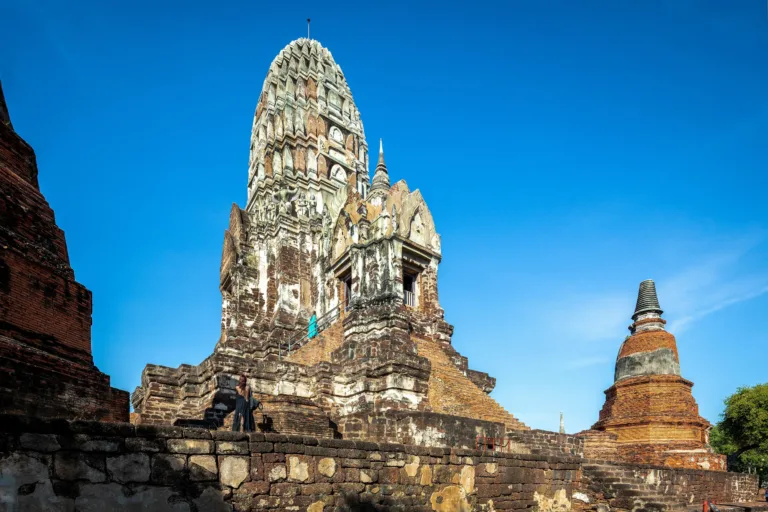 Wat Ratchaburana
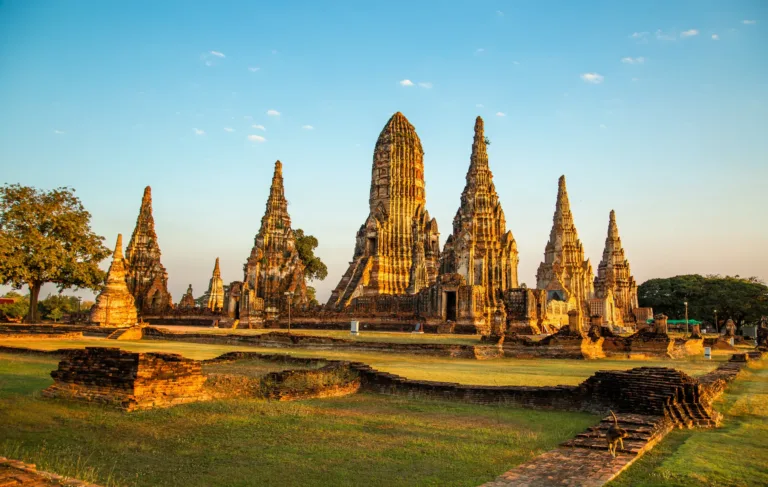 Ayutthaya Historical Park
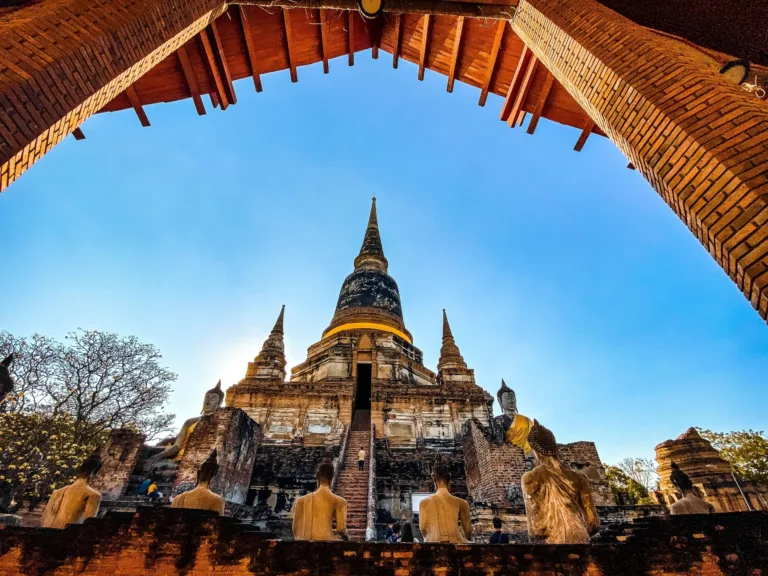 Wat Yai Chai Mongkhon
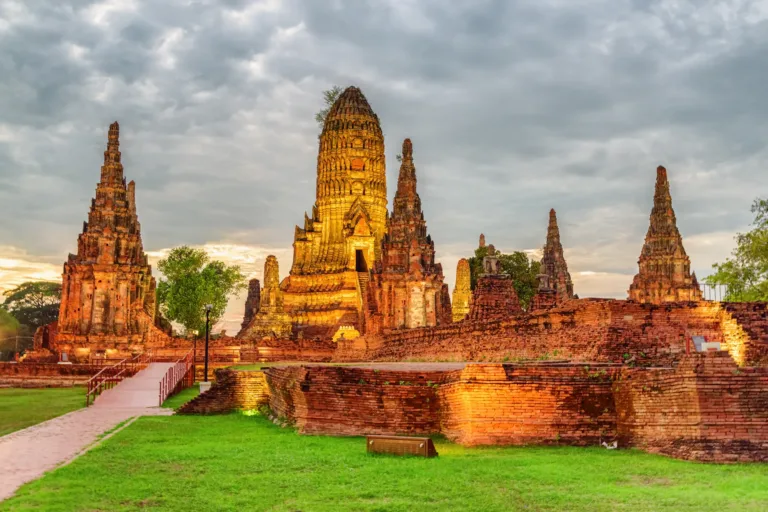 Wat Chaiwatthanaram