 01
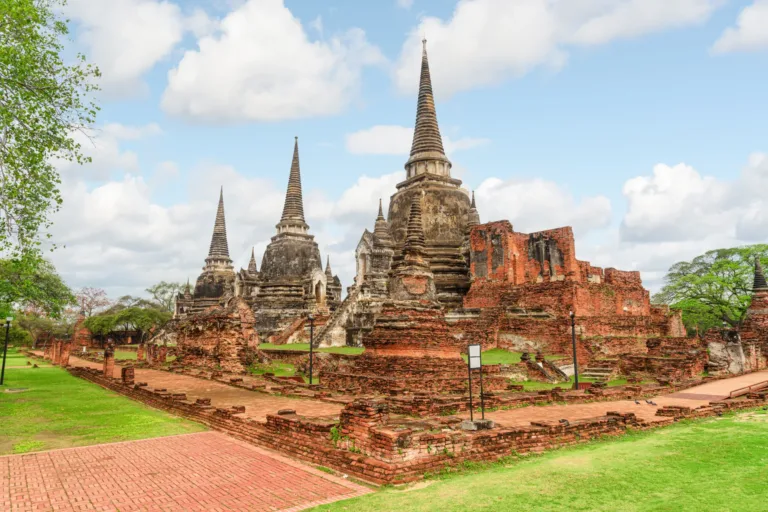
Wat Phra Si SanphetThree Sri Lankan-style chedis in the old palace grounds
World Heritage · Siam's former capital
The ruins of Siam's capital for over 400 years, a UNESCO World Heritage Site since 1991. Wat Phra Si Sanphet, Wat Mahathat, Wat Ratchaburana and Wat Chaiwatthanaram; explore by bike or boat.
Holiday / event — crowded
Daily 08:00–18:00 (main temples)
A full day
Buddha head in the roots, Wat Mahathat — Crouch so you stay below it
Thais 10 THB · Foreigners 80 THB
01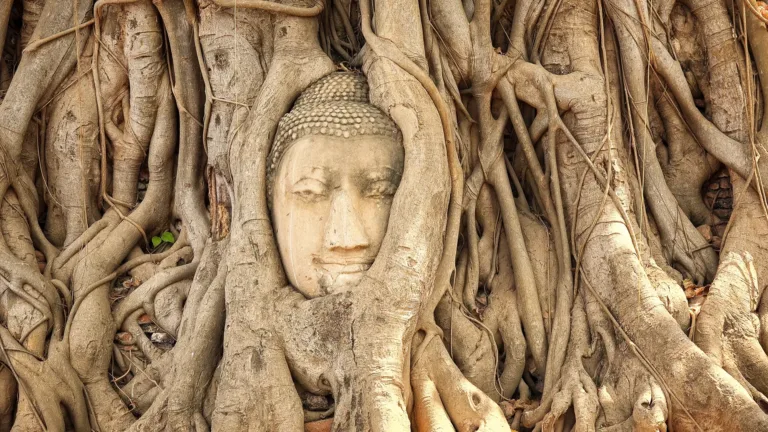 02
 03
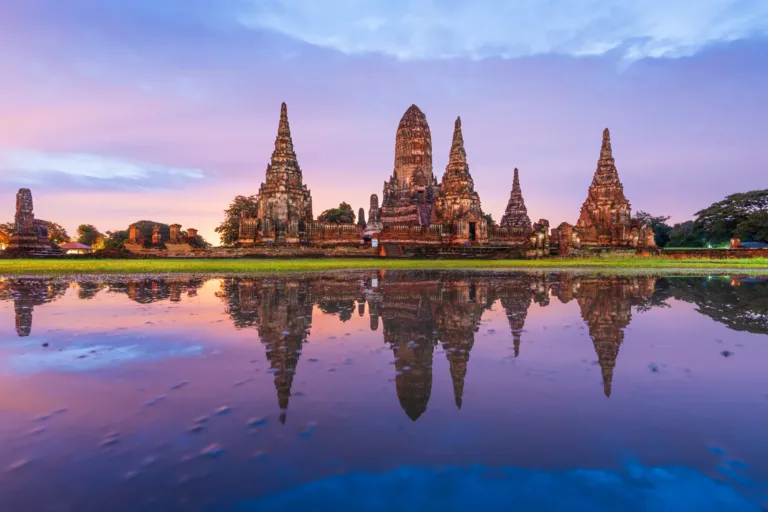 04
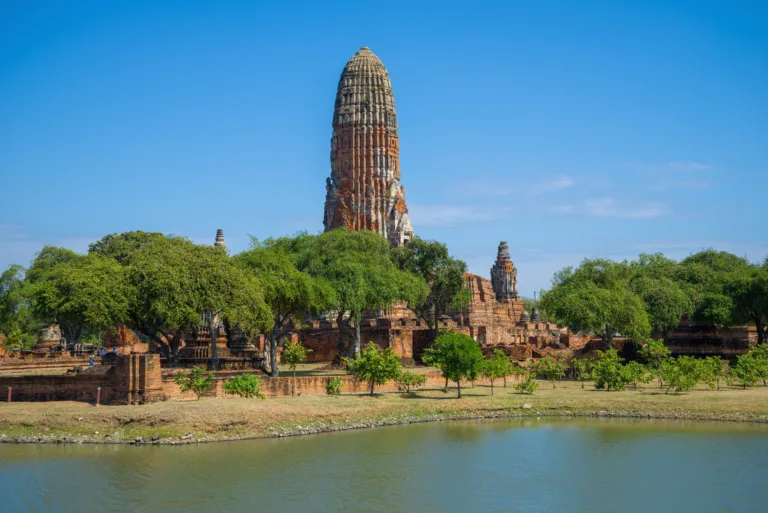 05
Tap a day card to see that day’s weather, rain, haze and hourly forecast
Best time to go Daytime is over · see tomorrow
Holiday — traffic on the way up and parking fills fast; leave early
Green band = hours used for the score
Best time to go Fine all day little rain through the day
Holiday — traffic on the way up and parking fills fast; leave early
Green band = hours used for the score
Best time to go Fine all day little rain through the day
No warnings today — normal road and weather conditions
Green band = hours used for the score
Best time to go Fine all day little rain through the day
No official warnings, but watch for: Hot (Afternoon) feels like 38°C
Green band = hours used for the score
Best time to go Fine all day little rain through the day
No official warnings, but watch for: Hot (Afternoon) feels like 38°C
Green band = hours used for the score
Best time to go Fine all day little rain through the day
No warnings today — normal road and weather conditions
Green band = hours used for the score
Best time to go Fine all day little rain through the day
No warnings today — normal road and weather conditions
Green band = hours used for the score
Ayutthaya Historical Park covers the ruins of the old royal capital of the Ayutthaya Kingdom, on an island ringed by the Chao Phraya, Pa Sak and Lopburi rivers. UNESCO listed it as the Historic City of Ayutthaya in 1991.The big names are Wat Phra Si Sanphet and the old palace, Wat Mahathat with its Buddha head in tree roots, Wat Ratchaburana, Wat Phra Ram and riverside Wat Chaiwatthanaram. The seven main sites each charge entry (10 baht for Thais, 80 baht for foreigners), and there's a seven-site combined ticket.Most temples are open daily 08:00–18:00. Early morning and late afternoon are cooler, and evening boat trips take in the riverside temples.
Arrive 08:30, before the heat and tour buses
Little shade at the ruins; bring water and a hat
Chedis and Buddha bases are protected monuments
Thais 10 THB · Foreigners 80 THB · Time needed A full day
Weekends 10:00–14:00
| Main site entry, Thai (each) | 10 ฿/person |
| Main site entry, foreign (each) | 80 ฿/person |
| 7-site combined ticket, Thai optional | 40 ฿/person |
| 7-site combined ticket, foreign optional | 300 ฿/person |
| Bike rental (per day) optional | 50 ฿/bike/day |
| Evening river boat tour optional | 200 ฿/person |
Mostly cash · Prices may change by season — check with the venue
Ayutthaya Historical Park holds the ruins of Ayutthaya, the royal capital at the heart of Siam for 417 years, from its founding in 1351 until it fell in 1767. Set on an island ringed by the Chao Phraya, Pa Sak and Lopburi rivers, it was once one of the busiest international port cities in Asia, before it was burned and left in ruins for almost two centuries. The temples and palace remains you see today have been excavated and restored by the Fine Arts Department over many decades, and UNESCO listed them as a World Heritage Site in 1991.
People lived here before the capital was founded, in an older community known as "Ayodhya". The evidence most often cited is the Luang Prasoet version of the Royal Chronicles, which records that the great Buddha image at Wat Phanan Choeng was made in 1324, 26 years before U Thong founded Ayutthaya.
According to the chronicles, U Thong built a palace at Nong Sano, around today's Bueng Phra Ram, then founded Ayutthaya and took the throne as King Ramathibodi I. The Fine Arts Department dates this to 4 March 1351. The island site between three rivers, above the reach of the sea tides, protected the city from seagoing warships and seasonal floods.
Several great temples went up within a few decades. The Luang Prasoet chronicle says King Ramesuan built Wat Phra Ram in 1369 on the site where his father had been cremated. For Wat Mahathat, the same chronicle names King Borommaracha I (Khun Luang Pha-ngua) as builder in 1374, while other chronicles credit Ramesuan, so scholars suggest it was begun in one reign and finished in another.
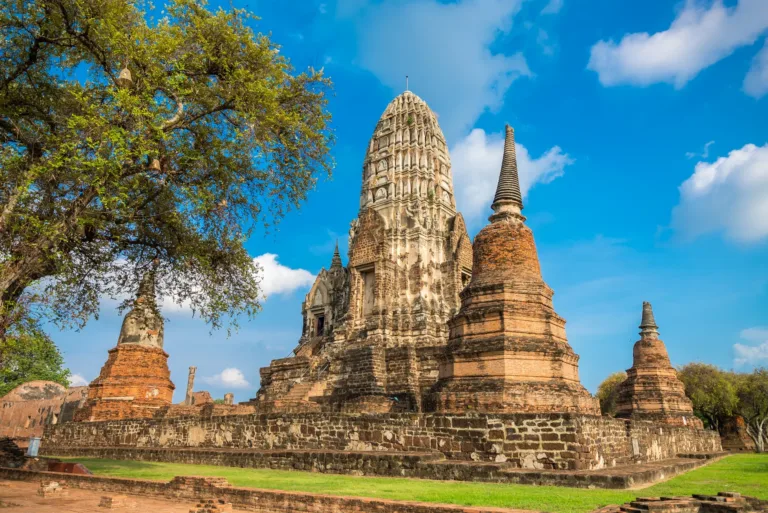
Wat Ratchaburana grew out of a succession struggle. After King Intharacha died, his sons Ai Phraya and Yi Phraya fought each other on elephants near the Pa Than bridge, and both were killed. Their younger brother Chao Sam Phraya became King Borommaracha II and, according to the Luang Prasoet chronicle, built Wat Ratchaburana in 1424 on the site where the two princes were cremated.
In 1448 King Borommatrailokanat moved the royal palace north towards the Lopburi River and turned the old palace grounds into a royal temple, Wat Phra Si Sanphet. In 1492 King Ramathibodi II built two Sri Lankan-style chedis there for the ashes of his father and elder brother, and King Borommaracha IV later added a third for Ramathibodi II himself, creating the row of three chedis that has become Ayutthaya's signature view. Around 1500 Ramathibodi II also had the Phra Si Sanphet cast, a standing Buddha about 16 metres tall covered in roughly 340 kilograms of gold.
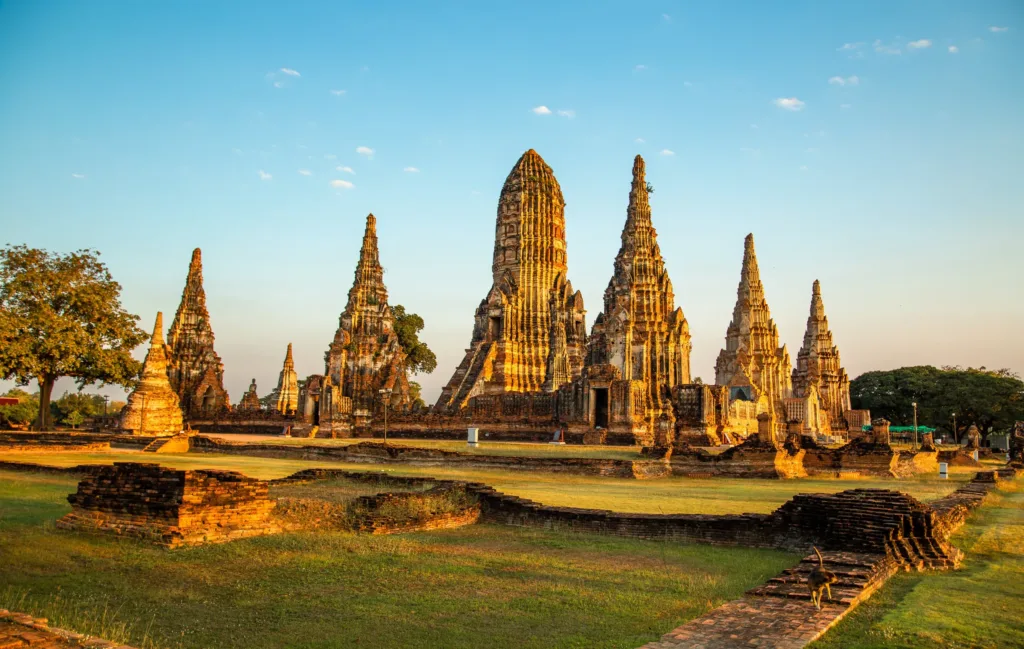
At its height Ayutthaya was a cosmopolitan city. Portugal sent envoys after taking Malacca in 1511, the Dutch opened a trading post in 1608, and the court exchanged embassies with France, the Mughal court and the courts of Japan and China. Foreign traders and missionaries lived in their own quarters downriver from the palace. In 1630 King Prasat Thong built Wat Chaiwatthanaram on the Chao Phraya, on land that had belonged to his mother, with a central prang showing Khmer influence.
Ayutthaya faced two great wars. In the first, the army of King Bayinnaung entered the city on 30 August 1569, but it was not destroyed and went on to flourish again. In the second, Burmese forces besieged the capital for about 14 months and took it on 7 April 1767. Temples and palaces were burned, and the gold covering the Phra Si Sanphet was stripped away, leaving only a bronze shell that King Rama I later had enshrined in the first of the great chedis at Wat Pho in Bangkok.
After the fall, the capital moved to Thonburi and then Bangkok, and bricks from the ruins were carted away to build the new capital. In 1895 the city walls were pulled down and U Thong Road was laid along their line, and on 25 May 1904 the main prang of Wat Mahathat collapsed. In December 1906 King Chulalongkorn ordered the old palace surveyed and protected. Phraya Boran Ratchathanin, the commissioner of Krung Kao, led the clearing down to the original floor level before the Ratchamongkhon ceremony was held at the old palace from 29 November to 4 December 1907.
Modern conservation began when the Fine Arts Department registered 69 monuments on the city island in 1935. Excavation at Wat Mahathat in 1956 revealed a relic casket in the crypt beneath the prang. The following year looters broke into the crypt of Wat Ratchaburana, and much of its gold was never recovered. The department's official excavation the next year found Buddha images, gold regalia and many votive tablets, which led to the Chao Sam Phraya National Museum, opened in 1961.
In 1969 the Fine Arts Department began a full programme of survey, excavation and restoration, which became the Ayutthaya Historical Park project in 1976, covering about 1,810 rai (around 290 hectares). On 13 December 1991 the 15th session of the World Heritage Committee, meeting in Carthage, Tunisia, inscribed the Historic City of Ayutthaya on the World Heritage List.
Water is the modern challenge. In mid-October 2011 severe floods topped the embankments and swamped the island, leaving Wat Chaiwatthanaram under about two metres of water. One estimate put the damage at around US$20 million, while a Japanese survey team found that most direct damage to the ruins was relatively minor. Wat Chaiwatthanaram then went through 12 years of conservation with the World Monuments Fund and US support, formally completed in 2024.
Arrived? Check in, collect a stamp and tell others what it is like right now
Check your location first, so you do not fill in the form for nothing
Location must be on and within 0.6 km · One check-in per place per day · come back on other days to check in again
Post photos from anywhere — no need to be here · Up to 20 photos at a time · JPG / PNG / WebP · GPS location data is removed automatically
The park is on Ayutthaya's island, bounded by the Chao Phraya, Pa Sak and Lopburi rivers.
Rent in town or outside the main temples · About 50 baht/day
Hire for a temple circuit · About 200 baht/hour, negotiable
Evening trip stopping at Wat Chaiwatthanaram · About 200 baht/person
Flat roads across the island, good for cycling
Parking at the main temples
Good
Daily 08:00–18:00 (main temples)
Ayutthaya Historical Park
80 THB
Answers travellers want before they go — a one-minute read
Main temples open daily 08:00–18:00
10 baht for Thais and 80 baht for foreigners per site, or a 7-site ticket for 40 / 300 baht
Wat Phra Si Sanphet, Wat Phra Ram, Wat Mahathat, Wat Ratchaburana, Wat Chaiwatthanaram, Wat Maheyong and Wat Kudi Dao
1991
Bike, motorbike, tuk-tuk or a boat around the island
A full day
Best day this week: Monday 30 Nov · Check in when you arrive to collect a stamp
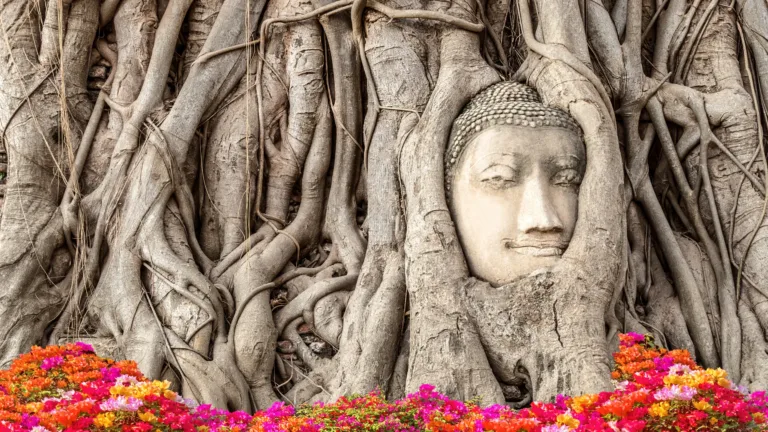 Wat Mahathat Ayutthaya
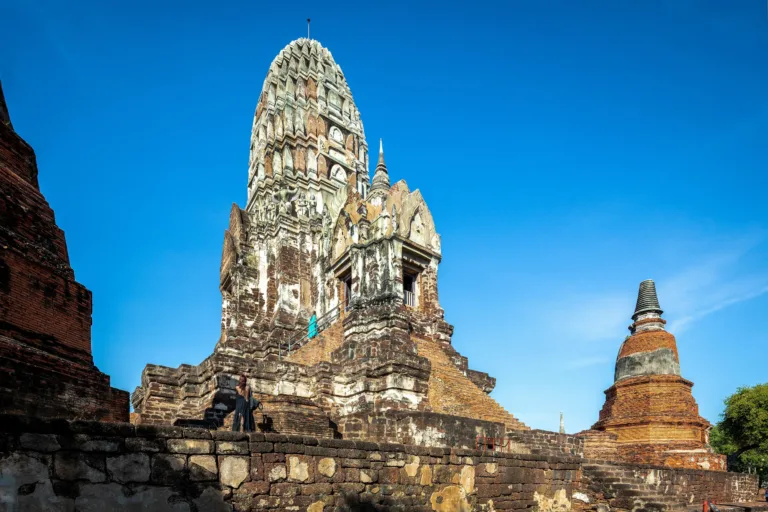 Wat Ratchaburana
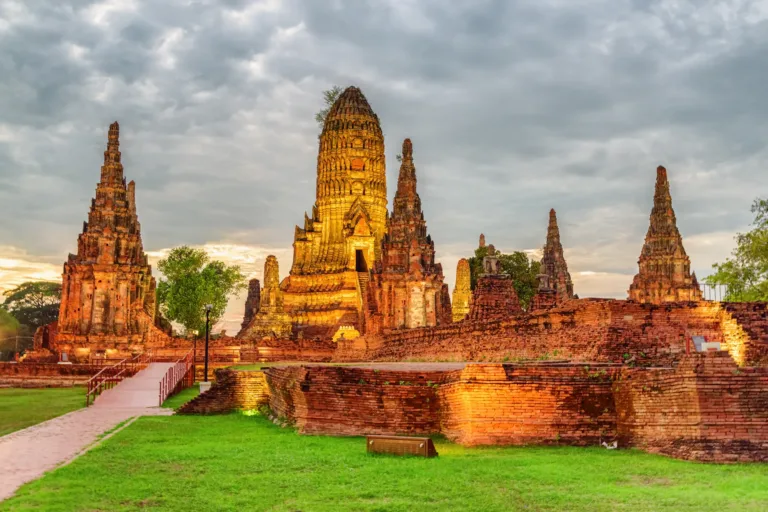 Wat Chaiwatthanaram
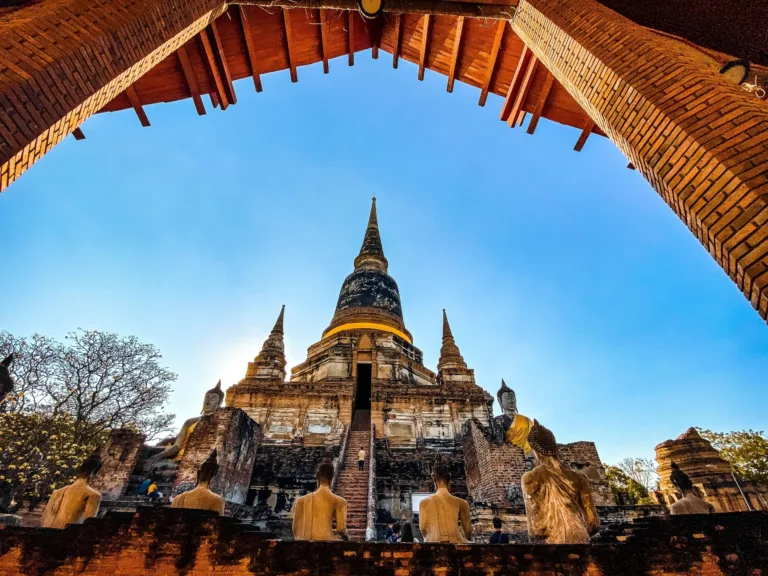 Wat Yai Chai Mongkhon