 01
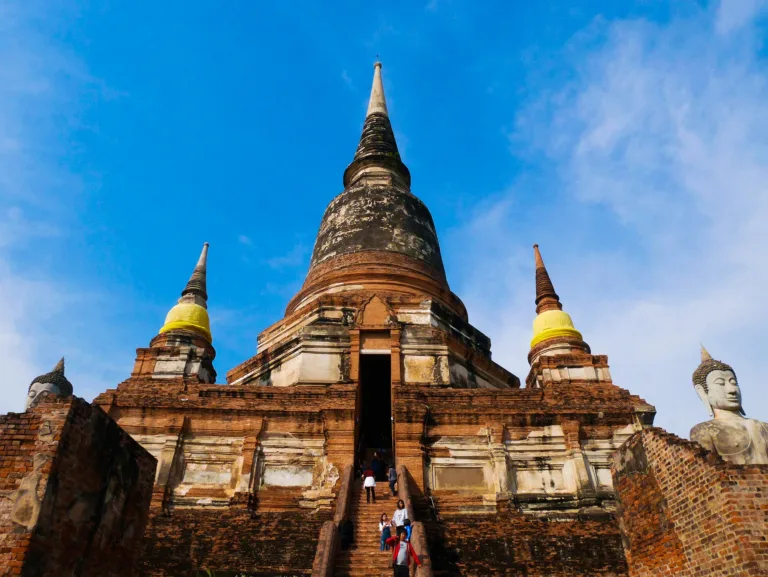
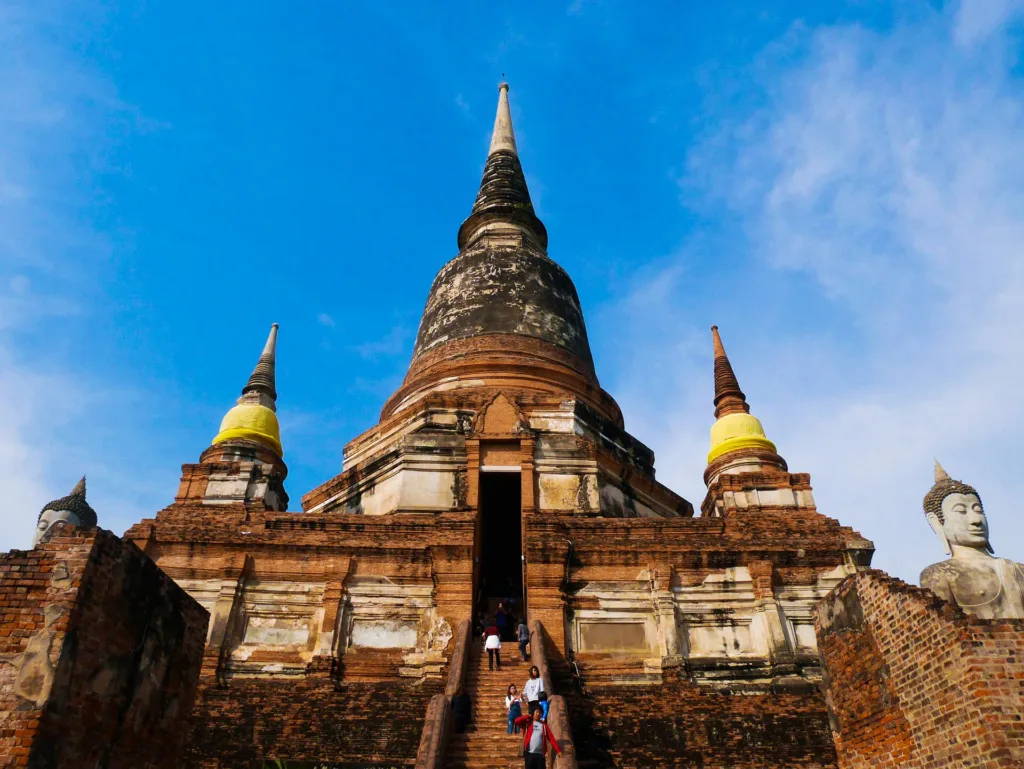
The Chaiya Mongkhon chediA bell-shaped chedi about 70 m tall with a chamber inside
AYUTTHAYA · KHLONG SUAN PHLU
Ayutthaya temple founded in 1357, famed for its 70-m great chedi linked to King Naresuan’s elephant-duel victory, a reclining Buddha and rows of saffron-robed Buddhas.
Holiday / event — crowded · Hot (Afternoon) feels like 41°C
Dress modestly, covering shoulders and knees · Remove shoes in the ordination hall and vihara · Do not climb on Buddha images or ruins
Daily, about 08:00–17:00
Come before 10:00 or after 15:00 for fewer people and better light
Tak Bat Thewo (first day of the waning moon, 11th lunar month) with monks descending the chedi; Visakha Bucha
01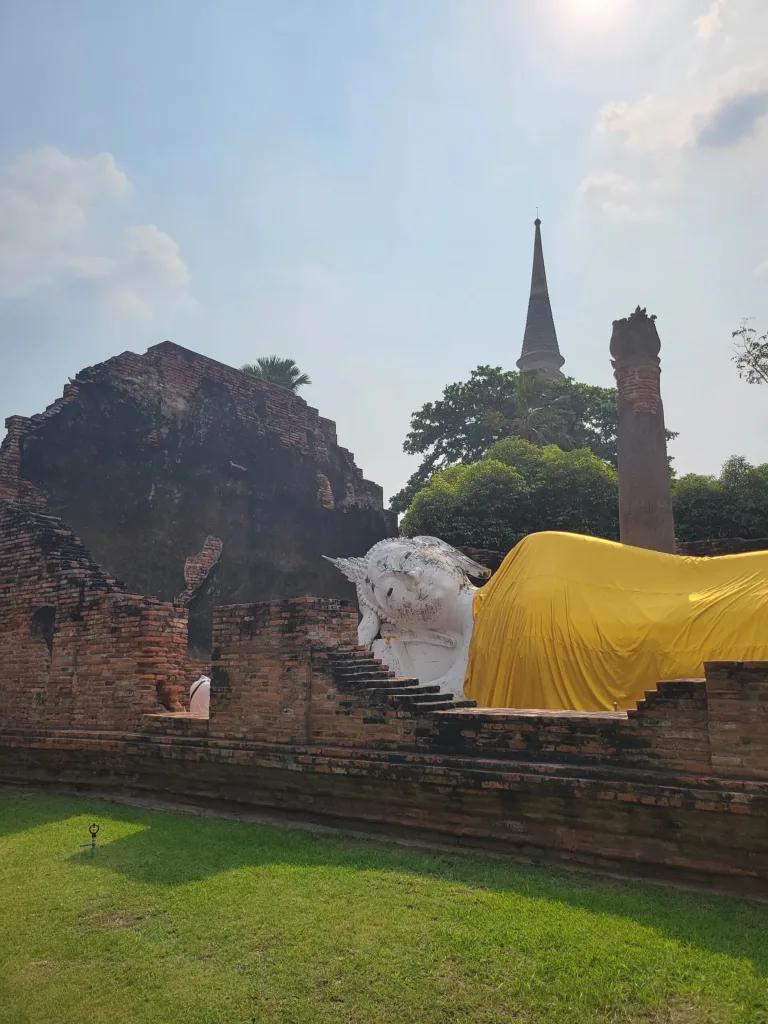 02
 03
 04
Tap a day card to see that day’s weather, rain, haze and hourly forecast
Best time to go Fine all day little rain through the day
Holiday — traffic on the way up and parking fills fast; leave early
Green band = hours used for the score
Best time to go Fine all day little rain through the day · light drizzle possible at times
Holiday — traffic on the way up and parking fills fast; leave early
Green band = hours used for the score
Best time to go Best window 06:00–16:00 Little rain · light drizzle possible at times
Holiday — traffic on the way up and parking fills fast; leave early
Green band = hours used for the score
Best time to go Best window 06:00–15:00 Little rain
No warnings today — normal road and weather conditions
Green band = hours used for the score
Best time to go Best window 06:00–15:00 Little rain · light drizzle possible at times
No warnings today — normal road and weather conditions
Green band = hours used for the score
Best time to go Fine all day little rain through the day
No warnings today — normal road and weather conditions
Green band = hours used for the score
Best time to go Fine all day little rain through the day
No warnings today — normal road and weather conditions
Green band = hours used for the score
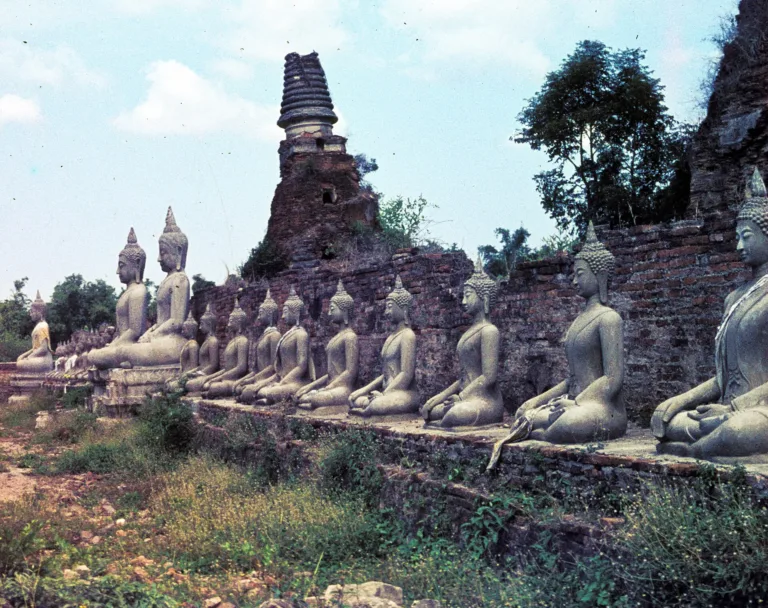
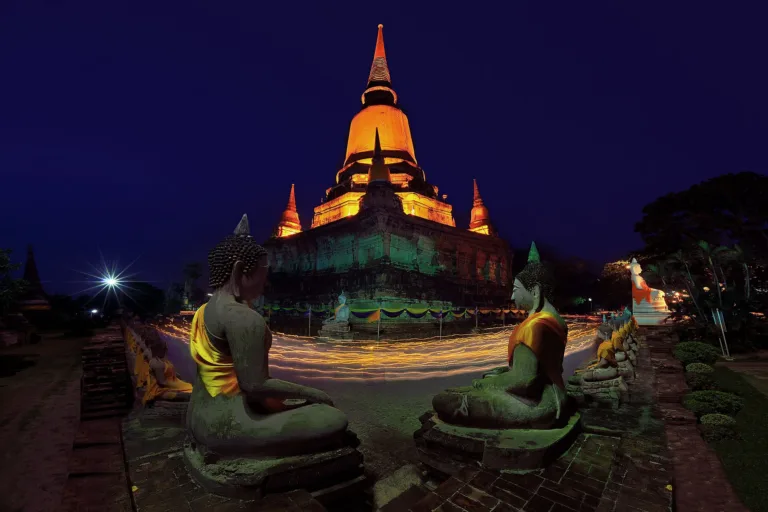
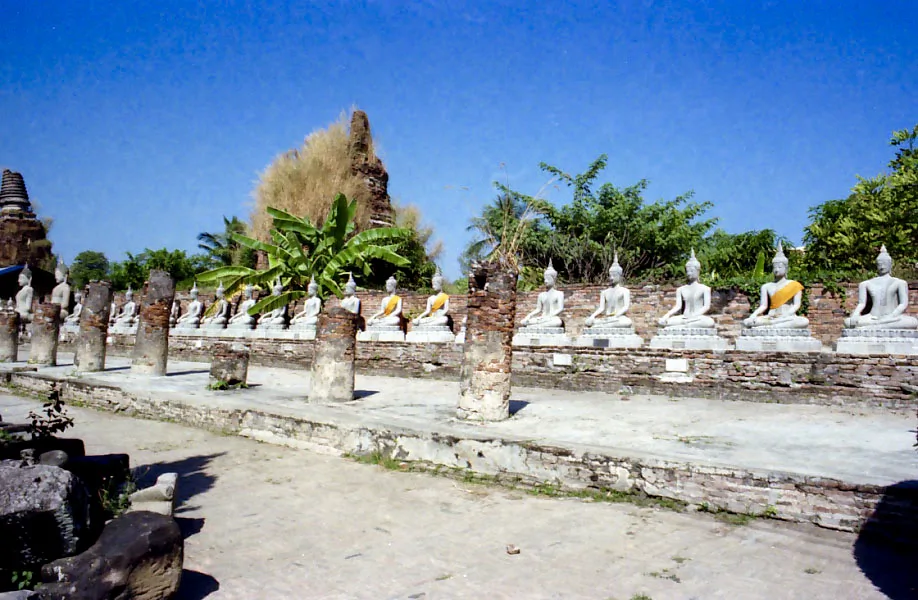
Wat Yai Chai Mongkhon, founded in 1357 as Wat Pa Kaeo, is one of Ayutthaya’s most visited temples, known for its towering bell-shaped chedi, reclining Buddha and galleries of saffron-robed Buddha images.
Arrive Come before 10:00 or after 15:00 for fewer people and better light
Photos from Wikimedia Commons and contributors · full credits inClassic page
Cover shoulders and knees
Steep; hold the rail and watch children
The terrace is hot at midday
Adults 0 THB · Time needed 1–1.5 hours
Weekends and major Buddhist holy days; tour groups late morning
| Temple entry (Thai visitors) | Free |
| Temple entry (foreign visitors) | 20 ฿/person |
| Flowers, incense / robe offering optional | 20 ฿/set |
Mostly cash · Prices may change by season — check with the venue
Tak Bat Thewo (first day of the waning moon, 11th lunar month) with monks descending the chedi; Visakha Bucha
Tap a month on the wheel to see weather, rain, haze and crowds from 10 years of records
Best time · Nov – Feb is cool with clear skies, ideal for walking around the chedi.
Watch out · Mar – May is very hot in the open; Sep – Oct brings heavy rain and possible flooding around the island.
Oct by the records 24–31°C · avg rain 218 mm (20 rainy days) · clear 2 days · avg PM2.5 20
Wat Yai Chai Mongkhon Worawihan is in Khlong Suan Phlu subdistrict, Phra Nakhon Si Ayutthaya, off the island to the southeast on Highway 3059. Its great chedi is one of Ayutthaya’s most prominent, and on 23 March 2025 it was raised to a third-class royal temple of the worawihan grade.
The temple dates back to the start of the Ayutthaya kingdom. In 1357 King Ramathibodi I (U Thong) had the remains of Princes Chao Kaeo and Chao Thai, who had died of cholera, exhumed and cremated, then built a stupa and vihara at the cremation site, called Wat Pa Kaeo. Some royal chronicles date the founding to 1363.
The temple lies in old Ayodhya, southeast of the island, a settlement that predates the founding of Ayutthaya. Ayutthaya Historical Research notes traces of an ancient baray (reservoir) near its southwestern corner and suggests the temple may sit on an earlier Khmer sanctuary, although no excavation has confirmed this. It was linked to the city by Khlong Khao San, which joined Lam Khu Khue Na and Khlong Thanon Tan.
It housed monks ordained under Phra Wanarat Thera’s school in Sri Lanka, who focused on meditation. The king appointed their head “Somdet Phra Wanarat”, Supreme Patriarch of the Right, so the temple became known as Wat Chao Phraya Thai, a royal forest-dwelling monastery.
The monks trained under Phra Wanarattana Mahathera in Sri Lanka called their order “Khana Pa Kaeo” in Thai, so their temple became Wat Khana Pa Kaeo or simply Wat Pa Kaeo. This forest-dwelling office continued throughout the Ayutthaya period.
Wat Pa Kaeo was caught up in major political events. At the end of 1548 conspirators consulted an oracle in its sermon hall before overthrowing Khun Worawongsathirat and Queen Si Sudachan; Prince Thianracha was crowned King Maha Chakkraphat in January 1549. In 1561 the temple’s patriarch set the auspicious time for Prince Si Sin’s rebellion against Maha Chakkraphat; when it failed, Si Sin died in the palace and the patriarch was executed.
In 1592 King Naresuan defeated the Burmese crown prince in the elephant duel at Nong Sarai. On his return he meant to punish commanders who had failed to keep up, but Somdet Phra Wanarat of Wat Pa Kaeo pleaded for clemency and the king pardoned them. He is believed to have then restored and enlarged the chedi as a victory memorial, “Phra Chedi Chaiya Mongkhon”, giving the temple its name, Wat Yai Chai Mongkhon, although the chronicles do not mention building the chedi directly.
Local tradition says Somdet Phra Wanarat advised building a victory chedi instead of executing the commanders, and gives its height as “1 sen 1 wa”. Amulet collectors also believe Phra Khun Phaen amulets were enshrined in it around 1592–1593. Neither account appears in the royal chronicles.
The chedi’s date is debated. Prince Damrong wrote in Phra Phuttha Chedi Sayam that it was built under Naresuan, but Assoc. Prof. Dr. Rungroj Phiromanukul of Ramkhamhaeng University argues in his 2024 book on pre-Sukhothai Ayodhya that it likely dates to 1363 under Ramathibodi I, per the Phra Chakkraphatphong (Chat) chronicle, citing its resemblance to the chedi at Wat Phra Kaeo, Sankhaburi (13th–14th centuries), a layout derived from Wat Phra Si Rattana Mahathat in Lopburi, and the shortage of manpower after the Burmese wars.
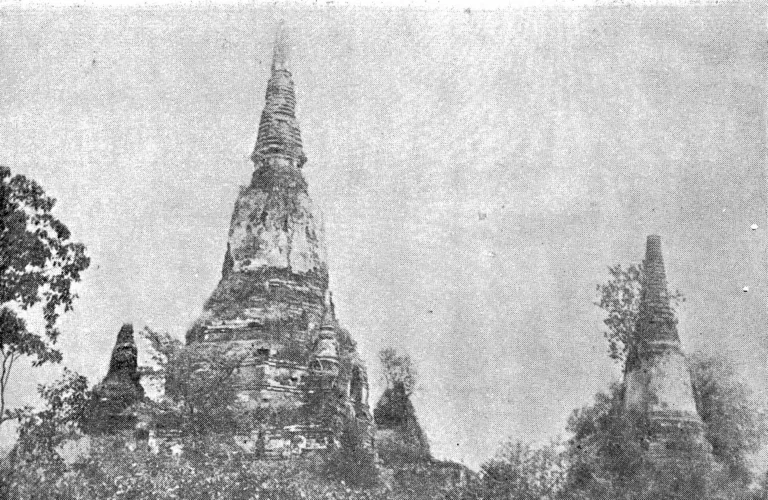
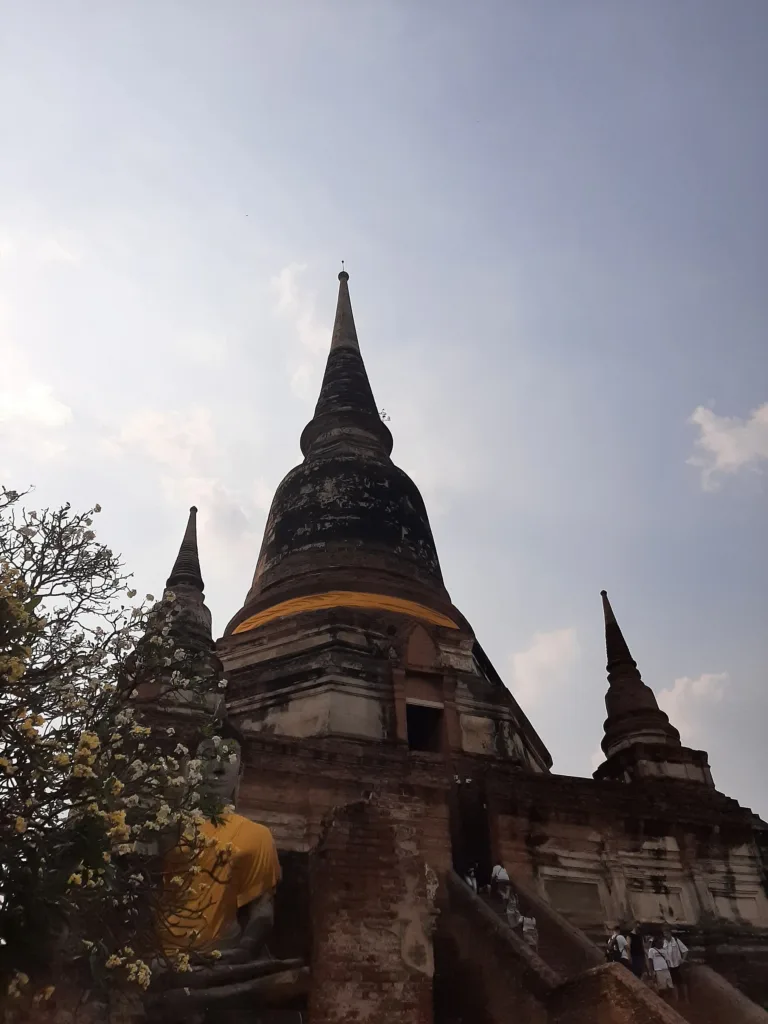
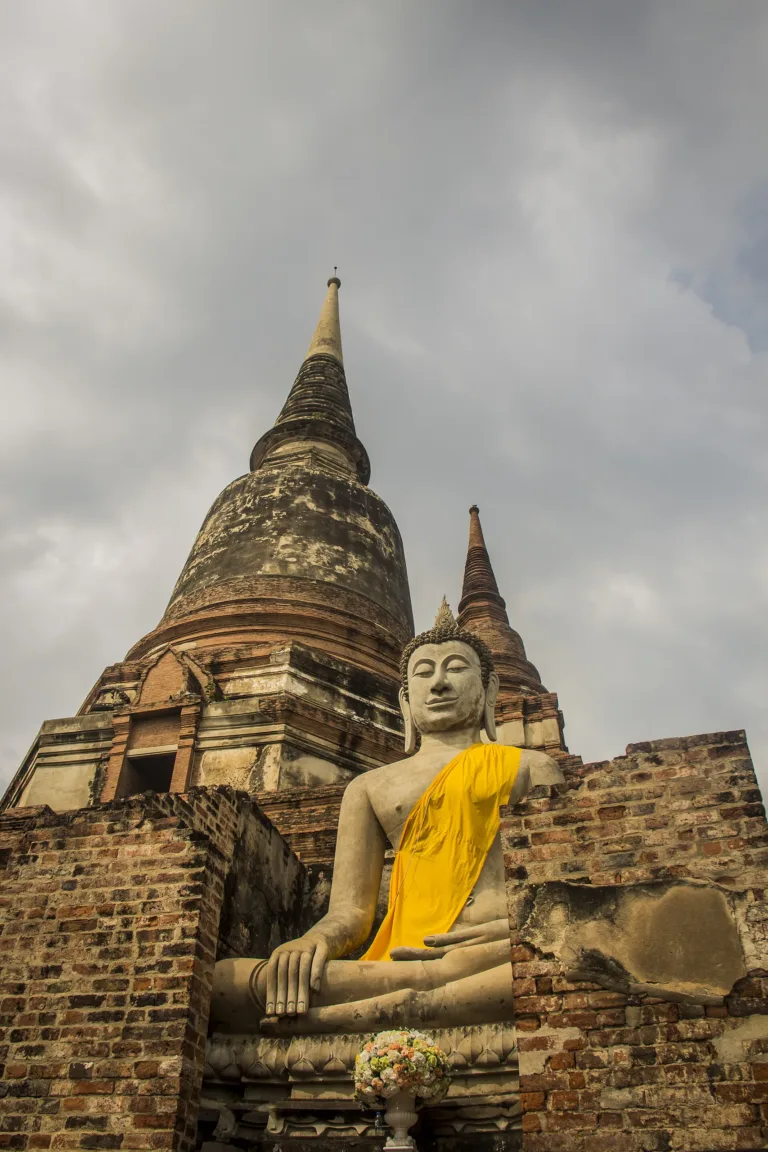
The great chedi is a Sri Lankan-style bell on a raised square base with corner chedis and an octagonal pedestal; eastern stairs climb to the circumambulation terrace and a chamber inside the bell. A 2017 Thammasat University study gives its height as about 70 m and notes visible ageing and tilt caused by weather, ground settlement and flooding.
In the mid-Ayutthaya period the temple was well known to foreigners. The Dutch merchant Van Vliet listed it among the kingdom’s four principal temples and mentioned an abbot who had helped the Dutch in a dispute, and Kaempfer’s map of around 1690 labels it “Tiampiatay”.
Van Vliet, writing in King Prasat Thong’s reign (1629–1656), mentions a “ruby” on the top of the victory chedi. Ayutthaya Historical Research suggests it may have been a glass crystal finial and says the original spire was decorated with glass, possibly a gift from China.
At the end of 1766, before the city fell, Phraya Tak, whom King Ekathat had promoted to Phraya Kamphaeng Phet, was ordered to form a boat army at the temple to resist the Burmese. When Ayutthaya fell in 1767 the temple was burned and long abandoned.
The chronicles say that around November 1766 the Siamese fleet gathered at Wat Pa Kaeo went out to fight the Burmese. Phraya Phetchaburi was captured and killed near Wat Sangkhawat, while Phraya Kamphaeng Phet (Phraya Tak) and Luang Si Saraseni withdrew to Wat Phichai and Wat Krachom. Some sources say Burmese troops later used the temple as a base. Phraya Tak soon broke out to the east.
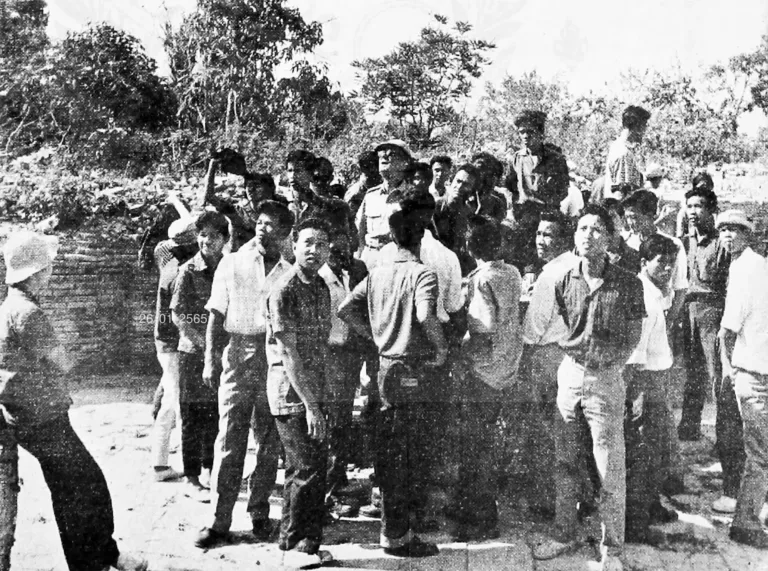
While the temple lay abandoned, treasure hunters dug into the chedi many times; amulet lore says its Khun Phaen Bai Phutsa and glazed Khun Phaen amulets first surfaced in 1902. In 1935 the Fine Arts Department registered Wat Yai Chai Mongkhon as a national ancient monument. Around 1957 the department drilled into the chedi to survey its structure and foundations. It found evidence of looting at the centre, such as bamboo poles for climbing and candle stubs, and a slate chamber of about 1 × 1 × 1 m holding nothing but a monkey skull. Local opposition stopped the work and the shaft was filled with concrete.
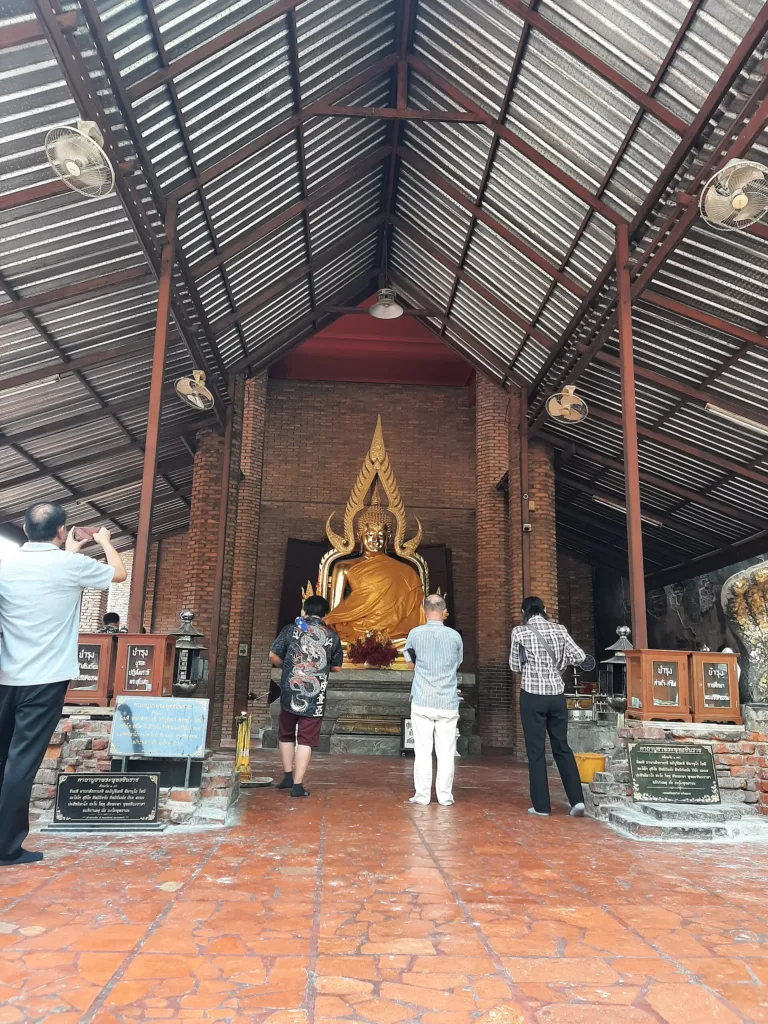
The reclining Buddha in the eastern vihara is believed to date from Naresuan’s reign; it lies with its head to the south, facing east. The original was wrecked by treasure hunters and rebuilt around 1965; travel sources give its length as about 28 m.
The modern revival began with Phra Chaluai Suthammo, who brought monks, novices and nuns to clear the jungle and meditate for about four years before moving on. Luang Pho Plueang Wisattho (born 1902 in Bang Ban), who had revived Wat Yom and stayed there 15 rains retreats, then carried out a major restoration of Wat Yai Chai Mongkhon in 1951, after which the Sangha allowed monks to reside there. He repaired a damaged Buddha image that villagers came to call “Luang Pu Chai Mongkhon”, and set a routine of evening sermons and meditation after chanting. In 1957 he received the title Phra Khru Phawanarangsi, and in 1970–1974 the temple’s school had 114 monks and novices, the most in the province. Khaosod says he died on 21 January 1985, aged 83 after 62 rains, though another source gives 1993. For the 40th anniversary of his death in 2025 a wax likeness was installed in the ordination hall.
Sources date the temple’s recognition as a residential monastery differently: 1951, 1956 or 1957, the last used by the provincial tourism site. In 1979 the temple and the Fine Arts Department built a new ordination hall on the old ruins, preserving parts of the ancient site. It houses Phra Phuttha Chaiya Mongkhon, and the temple school is named Wat Yai Chai Mongkhon (Phawanarangsi) School after Luang Pho Plueang.
The Fine Arts Department’s survey plan, published in 1968, records the following. The wall around the great chedi measures 60.60 × 71.60 m and is 4.40 m thick. The chedi stands on a square platform 32.40 m per side and about 14 m high, with four corner chedis and an octagonal base with eight niches. The old ordination hall was 15.90 × 44 m, the rear vihara 15.30 × 39 m and the reclining-Buddha hall 12.50 × 24 m. There were 11 minor chedis on the north and 13 on the south, mostly ruined and probably later additions. The sandstone principal Buddha found beneath the old ordination hall was restored and partly gilded around 1987.
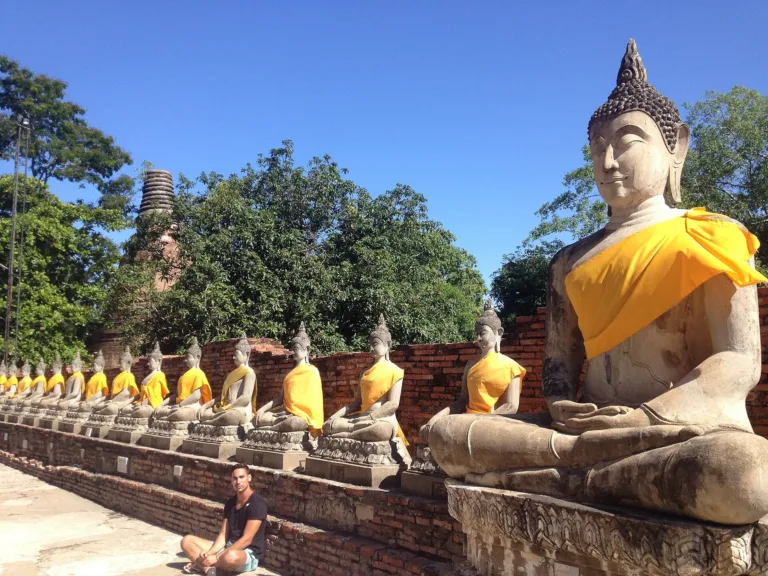
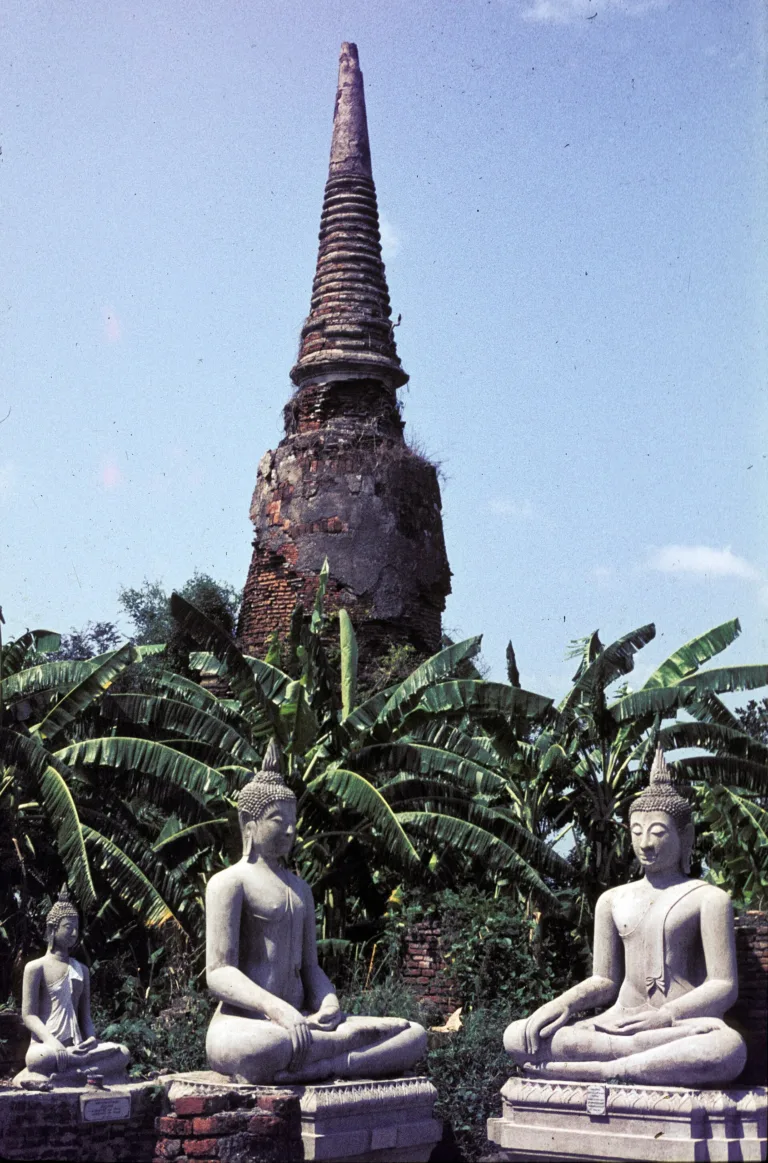
The ordination hall stands east of the chedi, about 16 x 44 m, and the vihara to the west, about 15 x 39 m. The gallery around the chedi survives only as pillar bases, now lined with newly sculpted Buddhas in saffron robes; two mondops stand before the chedi, and more than 20 satellite chedis hold the ashes of past patrons. The temple was once reached by Khlong Khao San, which flowed into the Pa Sak River, and may have had a moat.
The grounds include a monument to King Naresuan, where people offer thousands of fighting-cock statues, after stories linking the king to cockfighting.
On 3 March 2023 then-Prime Minister Prayut Chan-o-cha inspected the damaged Chaiya Mongkhon chedi ahead of restoration and offered a cloth to the reclining Buddha.
After Luang Pho Plueang, Phra Palat Kaen Punnasampanno (later Phra Khru Phisut Bunsan) became abbot and developed the temple into a model temple and the province’s third official meditation centre. The current abbot, Phra Khru Siri Chai Mongkhon, is also deputy head of the district Sangha. The grounds include a shrine hall to King Naresuan. On 17 October 2024 the temple held the end-of-Lent Pavarana ceremony, followed the next day by Tak Bat Thewo with monks descending the chedi. That year it also received a royal Kathin robe for the first time, and the 2025 royal Kathin raised 3,420,956 baht.
The temple remains a centre of local tradition. On 8 October 2025, the first day of the waning moon of the 11th month, it held a traditional Tak Bat Thewo, with 35 monks and novices descending the great chedi to receive alms while pupils dressed as angels scattered puffed rice and flowers. On 20 January 2026 it celebrated its 669th anniversary with more than 100 monks chanting.
The temple is open daily about 08:00–17:00. Thai visitors enter free; foreigners pay 20 baht. Dress modestly with shoulders and knees covered and remove shoes in the ordination hall and vihara. Early morning (08:00–10:00) or late afternoon (15:00–17:00) is quieter, with better light.
Arrived? Check in, collect a stamp and tell others what it is like right now
Check your location first, so you do not fill in the form for nothing
Location must be on and within 1 km · One check-in per place per day · come back on other days to check in again
Post photos from anywhere — no need to be here · Up to 20 photos at a time · JPG / PNG / WebP · GPS location data is removed automatically
From Bangkok take Highway 32 then Highway 3059; good roads a…
Highway 32 / 3059 · Fuel
Ayutthaya station, then tuk-tuk · Fare + tuk-tuk
Ayutthaya terminal, then tuk-tuk or rented bicycle · About 60–100 baht
From Bangkok take Phahonyothin / Highway 32 to Ayutthaya, then Highway 3059 southeast of the island.
Large temple car park
Petrol stations on the Asian Highway and in Ayutthaya town
Good mobile signal
Daily, about 08:00–17:00
around 80 km fromBangkok
Wat Yai Chai Mongkhon, Ayutthaya
20 THB
Approx. nightly price for 2 adults (next week) · final price depends on your dates
Answers travellers want before they go — a one-minute read
In 1357 under King Ramathibodi I, originally as Wat Pa Kaeo
Tradition credits King Naresuan after his 1592 elephant-duel victory, though some scholars argue it may date to 1363
Free for Thais, 20 baht for foreigners
Daily, about 08:00–17:00
Best day this week: Thursday 29 Oct · Check in when you arrive to collect a stamp