 01
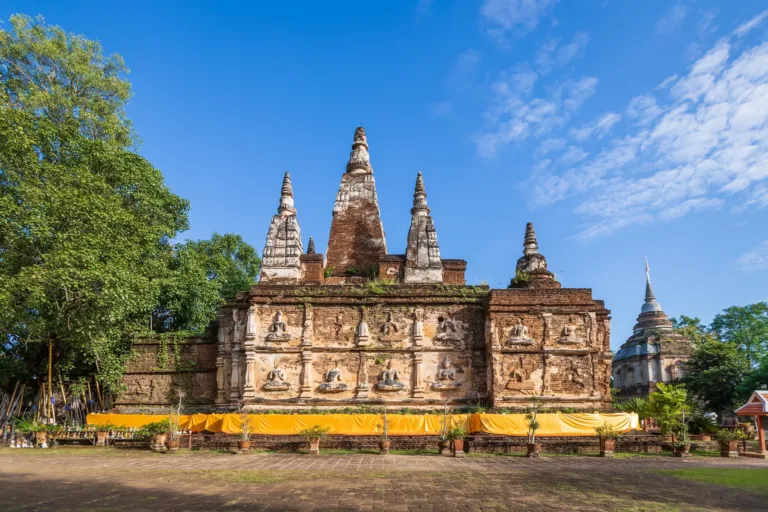
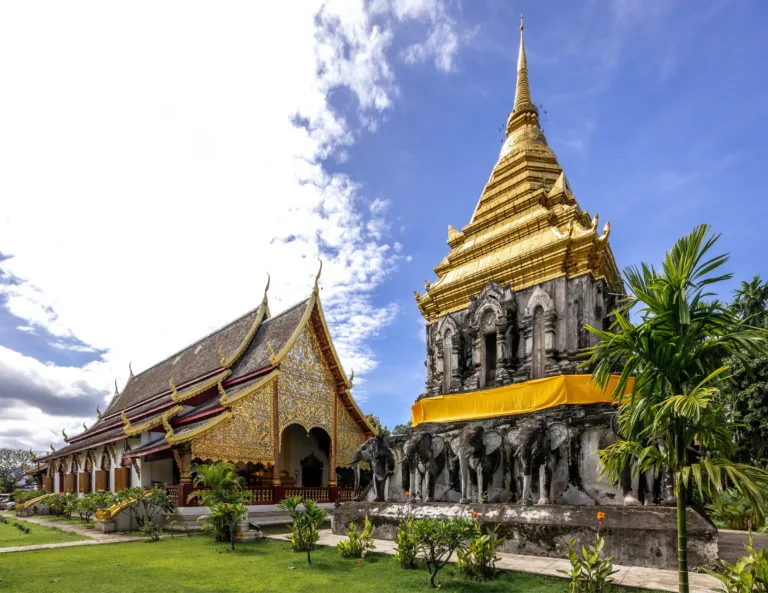
Seven-spired great hallA laterite hall modelled on the Mahabodhi Temple at Bodh Gaya, with five spires and two round chedis on the roof
Royal temple of King Tilokarat · Chiang Mai
A royal monastery from King Tilokarat's reign on Chiang Mai's Superhighway, with a seven-spired hall modelled on Bodh Gaya, ancient stucco deities and the site of the 1477 Buddhist council.
Good weather, little rain
Dress modestly, covering shoulders and knees · Take off your shoes before entering the ordination hall and any building with Buddha images · Follow the temple's signs about going up onto the great hall's roof · Don't climb on, touch or lean against the stucco deities and old walls
Daily, about 08:00–17:00 (some sources say 07:00–17:00)
Before 10:00, while the morning sun lights the great hall and it is still cool
On the night of 31 December the temple holds its regular New Year's Eve chanting
01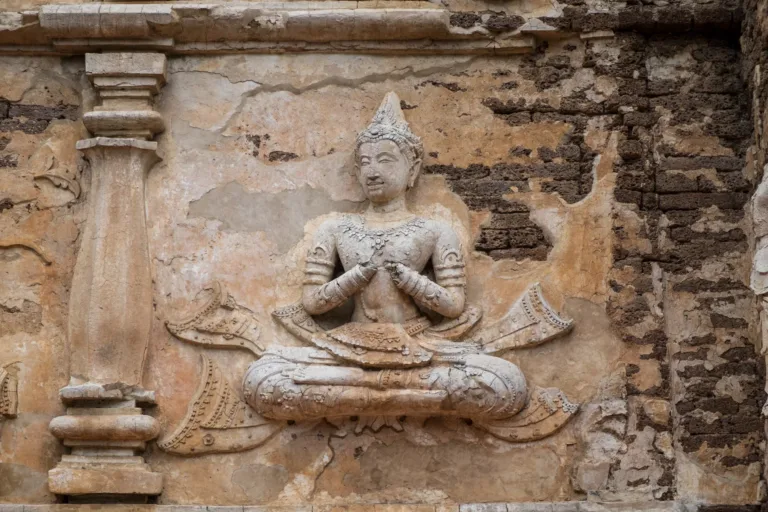 02
 03
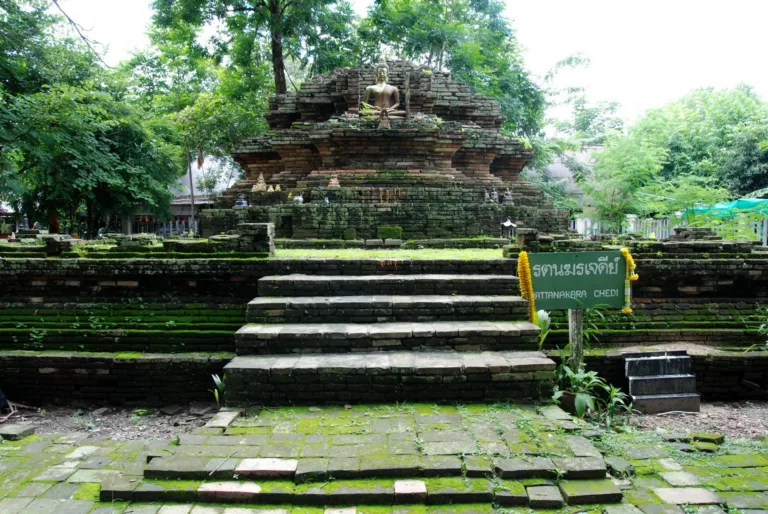 04
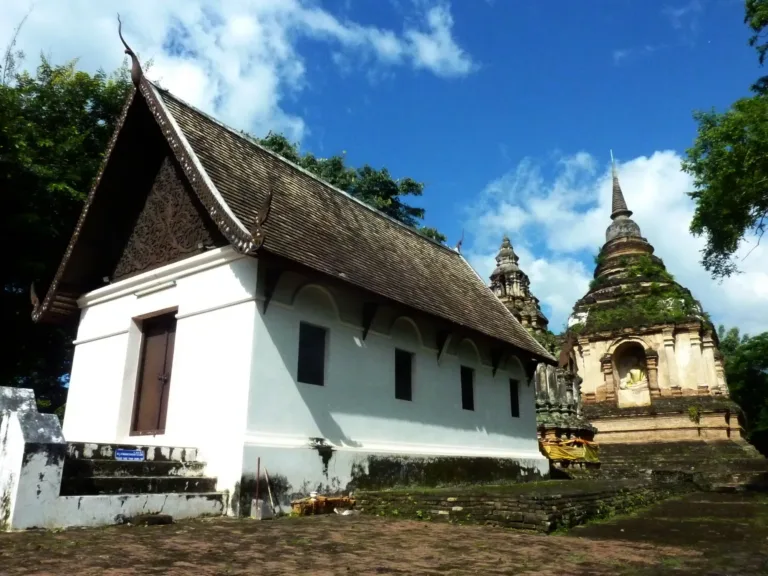 05
Tap a day card to see that day’s weather, rain, haze and hourly forecast
Best time to go Daytime is over · see tomorrow
No warnings today — normal road and weather conditions
Green band = hours used for the score
Best time to go Fine all day little rain through the day
No warnings today — normal road and weather conditions
Green band = hours used for the score
Best time to go Fine all day little rain through the day
No warnings today — normal road and weather conditions
Green band = hours used for the score
Best time to go Fine all day little rain through the day
No warnings today — normal road and weather conditions
Green band = hours used for the score
Best time to go Fine all day little rain through the day
No warnings today — normal road and weather conditions
Green band = hours used for the score
Best time to go Fine all day little rain through the day
No warnings today — normal road and weather conditions
Green band = hours used for the score
Best time to go Fine all day little rain through the day
No warnings today — normal road and weather conditions
Green band = hours used for the score
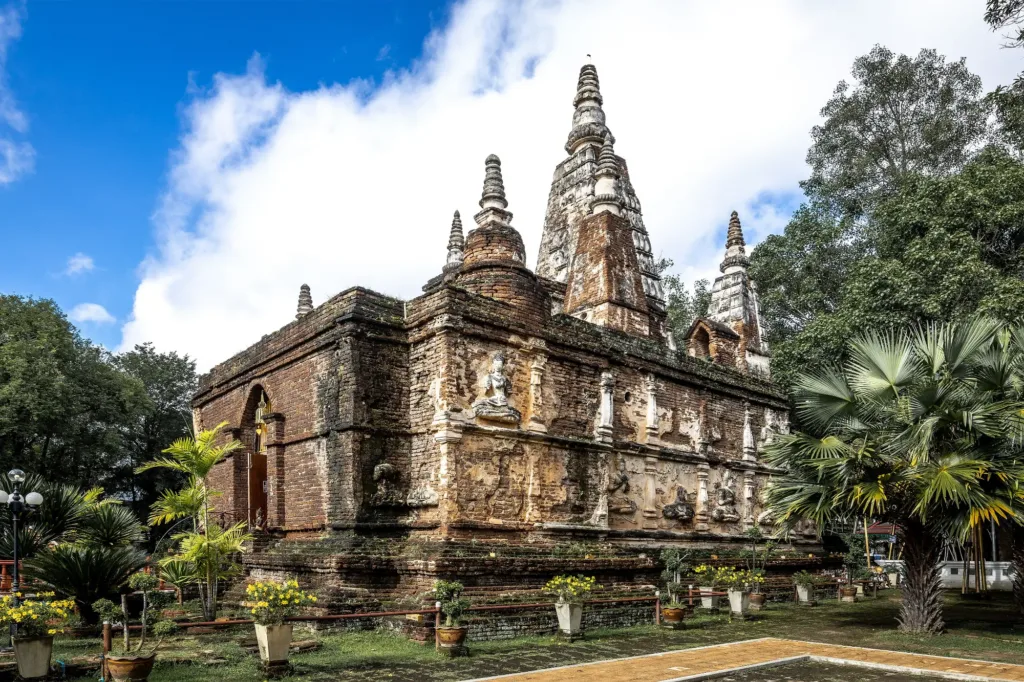
Wat Chet Yot, formally Wat Photharam Maha Wihan, is an old royal monastery in Chang Phueak, Mueang Chiang Mai, on the Superhighway just north of the Rin Kham intersection and close to the Chiang Mai National Museum. King Tilokarat founded it in 1455 and planted a bodhi tree in the grounds, which gave it the name Maha Photharam. The everyday name, "seven spires", comes from the seven chedis on the roof of its great hall.The highlight is that great hall, modelled on the Mahabodhi Temple at Bodh Gaya in India. Its outer walls are decorated with stucco deities, seated and standing, about 40 of which can still be made out. In Lanna tradition it is the relic shrine for people born in the Year of the Snake. Nearby are the stupa holding King Tilokarat's ashes, an ordination hall with a carved wooden gable and the bodhi tree.In 1477 senior monks gathered here to revise the Buddhist scriptures, a task that took about a year and is often described as the eighth Buddhist council in the world and the first in what is now Thailand. Today the Wat Chet Yot complex is one of the components of Thailand's World Heritage nomination, "Monuments, Sites and Cultural Landscape of Chiang Mai, Capital of Lanna".Allow 45 minutes to an hour. Dress modestly and come in the morning, when the sun lights up the east-facing front of the great hall. The hall and its stucco are a registered ancient monument, so please don't climb on, touch or lean against them.
Arrive Before 10:00, while the morning sun lights the great hall and it is still cool
The stucco deities are over 500 years old and worn by damp and sun, so don't touch or lean on them
The stairs inside the walls are narrow and by tradition only men may go up; follow the temple's signs
Traffic outside the temple is fast and heavy, so take care turning in and out or crossing
On the night of 31 December the temple holds its regular New Year's Eve chanting
Wat Chet Yot, formally Wat Photharam Maha Wihan (also Wat Maha Photharam), is a royal monastery in Chang Phueak subdistrict, Mueang Chiang Mai, on the Superhighway just north of the Rin Kham intersection, northwest of the old city. It was built under King Tilokarat, in what is often called the golden age of Lanna. The temple is famous for its seven-spired great hall modelled on the Mahabodhi Temple at Bodh Gaya, the ancient stucco deities on its walls, the stupa holding King Tilokarat's ashes, and as the place where the Buddhist scriptures were revised in 1477. In Lanna tradition it is the relic shrine for people born in the Year of the Snake, and today the Wat Chet Yot complex is part of Thailand's World Heritage nomination.
King Tilokarat ruled Chiang Mai from 1441 to 1487. He backed the Sri Lankan (Sinhalese) order of monks and encouraged scriptural study, so that Lanna monks became masters of Pali. Most of what we know about Wat Chet Yot comes from the Jinakalamali, a Pali chronicle written by the monk Ratanapanna Thera. A 2026 article in Mahamakut Buddhist University's social sciences journal argues that the chronicle set out to portray Tilokarat as a righteous Dhamma king in order to legitimise his rule, so some of its stories are best read with that purpose in mind.
A 2015 article by Preeda Boonyarat in Thammasat University's fine arts journal, along with sources citing the Fine Arts Department, agree that in 1455 Tilokarat founded the temple for Phra Uttamapanna Thera, a monk he deeply respected, and had a bodhi tree planted in the grounds, which is how it came to be called Maha Photharam, the monastery of the great bodhi tree. Wikipedia, citing the Jinakalamali, gives the same year for the planting of the tree. One source instead names Phra Bodhirangsi as the first abbot, which does not match the others.
Construction was overseen by an official named Muen Dam Phra Khot. According to Preeda, he took 30 craftsmen to see the Mahabodhi Temple at Bodh Gaya so they could copy it, and the Muang Boran Museum also says he was sent to copy the Bodh Gaya design in 1455. Wikipedia, however, says monks were sent to study the design in Bagan, Burma. A 2022 paper by Phra Phongrawi Uttarabhaddo and colleagues at Mahamakut Buddhist University's Lanna campus suggests the builders may have travelled to Bodh Gaya by way of Pagan and brought back one of the carved stone models of the Mahabodhi shrine that were popular at the time.
Besides the great hall, the king built the Sattamahasathan, replicas of the seven places where the Buddha stayed in the weeks after his enlightenment, such as the Bodhi throne, the Animisa chedi, the jewelled walkway, the jewelled house, the Ajapala banyan and the Rajayatana tree. According to Posttoday (2018), three of these survive: the Animisa chedi, the Ratanaghara chedi and the Mucalinda shrine. The 2022 paper explains that recreating the site of the enlightenment grew out of venerating the bodhi tree as a stand-in for the Buddha, casting Chiang Mai as the land where a universal monarch appears, and that this set of replicas became a model for others across Southeast Asia.
The Jinakalamali, as cited by Wikipedia, says that in 1476 the king built a great sanctuary in the monastery, and Preeda dates the laterite and stucco great hall to 1477. That same year Tilokarat invited senior monks to revise the Tipitaka here, a task that took about a year. It is often described as the eighth Buddhist council in the world and the first held in what is now Thailand. A scholarly article on ThaiJO mentions Phra Dhammadinna, Phra Nanakitti Thera and Phra Sirimangalacariya as the leading Pali scholars of the period, but does not say which of them presided over the council.
The great hall is a cave-like rectangular building about 10 m wide and 22 m deep. Its arched doorway faces east, a seated Buddha sits inside, and passages within the walls lead up to the roof. On the roof stand five chedis on square bases, the central one the largest with smaller ones at the four corners, plus two round chedis, making seven spires in all. Posttoday describes them as five in the Bodh Gaya style and two in the Sri Lankan style. According to Wikipedia, only men may go up onto the roof.
The stucco deities around the outer walls are a masterpiece of Lanna art. Preeda estimates there were originally about 70, of which about 40 can still be made out. Some are seated and seem to float in mid-air, while others stand on lotus bases; some hold their hands together in prayer and others appear to walk or dance. He sees a blend of Pagan-Mon, Sukhothai, Sri Lankan and Ming Chinese influences. The popular story that the deities' faces were modelled on the king's relatives is no more than a legend.
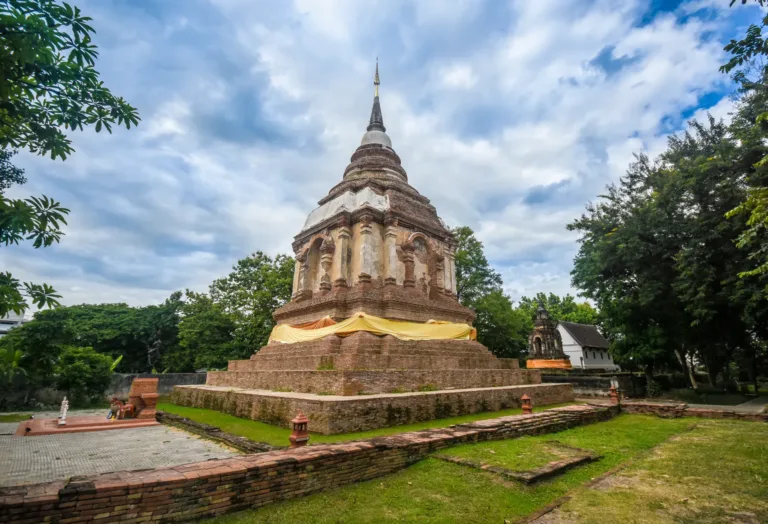
Tilokarat died in 1487, and his grandson and successor, King Yot Chiang Rai, had a stupa built here to hold his ashes. The Princess Maha Chakri Sirindhorn Anthropology Centre's database dates it to 1491 and describes it as a castle-shaped chedi with a single spire, inspired by the great chedi of Wat Chedi Luang. Later, during the reign of King Muang Kaeo (about 1495–1525), the first ordination hall was built, according to Posttoday, on the spot where King Yot Chiang Rai had been cremated.
From 1558 to 1774 Lanna was under Burmese control, and little is recorded about the temple in that period. Some sources say that King Kawila restored its buildings when he revived Chiang Mai, though no date is given. Wikipedia notes that in 1910 a bodhi tree growing on the roof of the great hall had to be removed to stop the building from collapsing. Preeda also points out that the stucco has been worn down by damp, moss, sun and vibration from the nearby road.
On 8 March 1936 (BE 2478 in the old Thai calendar, whose year began in April) the site was listed as an ancient monument in the Royal Gazette (volume 52, part 75), according to the Sirindhorn Anthropology Centre. Today it is a royal monastery, and Posttoday (2018) reported that its abbot is also the head of the Sangha for Chiang Mai province. In the northeast corner stands a small ordination hall with a carved wooden gable, ringed by double boundary stones, with King Tilokarat's stupa behind it, and at the southern end a pavilion beside a pond holds a Buddha sheltered by the serpent king Mucalinda.
The Wat Chet Yot complex is the third group in the nomination "Monuments, Sites and Cultural Landscape of Chiang Mai, Capital of Lanna", which has been on UNESCO's Tentative List since 2015. Thailand's Cabinet approved the dossier on 13 January 2026 and it was submitted to the World Heritage Centre on 1 February 2026. ICOMOS experts visited from 3 to 8 August 2026, after local agencies cleaned up the temple grounds ahead of their arrival, and the World Heritage Committee is expected to decide in mid-2027.
Arrived? Check in, collect a stamp and tell others what it is like right now
Check your location first, so you do not fill in the form for nothing
Location must be on and within 0.6 km · One check-in per place per day · come back on other days to check in again
Post photos from anywhere — no need to be here · Up to 20 photos at a time · JPG / PNG / WebP · GPS location data is removed automatically
The temple is on the Superhighway (Highway 11), just north of the Rin Kham intersection with Huay Kaew Road, about 2–5 km from the old city moat.
From the Hua Lin corner take Huay Kaew Road to the Rin Kham intersection, then turn right onto the Superhighway; the temple is just north of the junction
Easy to find in town; agree the fare before you get in
Search for Wat Chet Yot; easy both ways as it is in the city
Paved city roads; the Superhighway is busy at rush hour
In the city, with good mobile coverage
Daily, about 08:00–17:00 (some sources say 07:00–17:00)
about 2–5 km from Central Chiang Mai (old city moat)
Wat Chet Yot
Answers travellers want before they go — a one-minute read
On the Superhighway just north of the Rin Kham intersection with Huay Kaew Road, Chang Phueak, Mueang Chiang Mai, near the Chiang Mai National Museum
It means "temple of seven spires", after the seven chedis on the roof of its great hall: five on square bases modelled on Bodh Gaya and two round ones
No. This is Wat Photharam Maha Wihan in Chiang Mai; the other Wat Chet Yot is in Chiang Rai town
In 1477 King Tilokarat had senior monks revise the Tipitaka at this temple over about a year; it is often counted as the eighth Buddhist council in the world
In Lanna tradition Wat Chet Yot is the relic shrine for people born in the Year of the Snake
Narrow stairs inside the walls lead up, but by tradition only men may go, and access may be closed during restoration; follow the temple's signs
Best day this week: Saturday 28 Nov · Check in when you arrive to collect a stamp
 Ristr8to
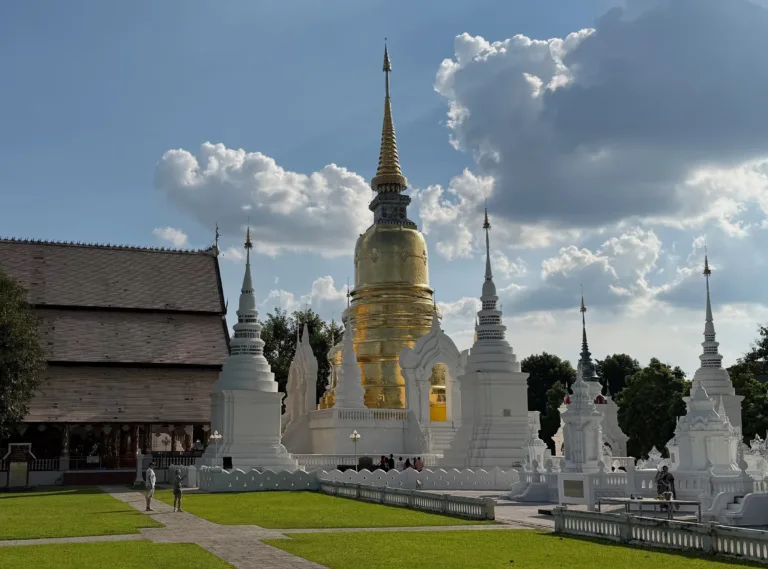 Wat Suan Dok
 Wat Chiang Man