 01
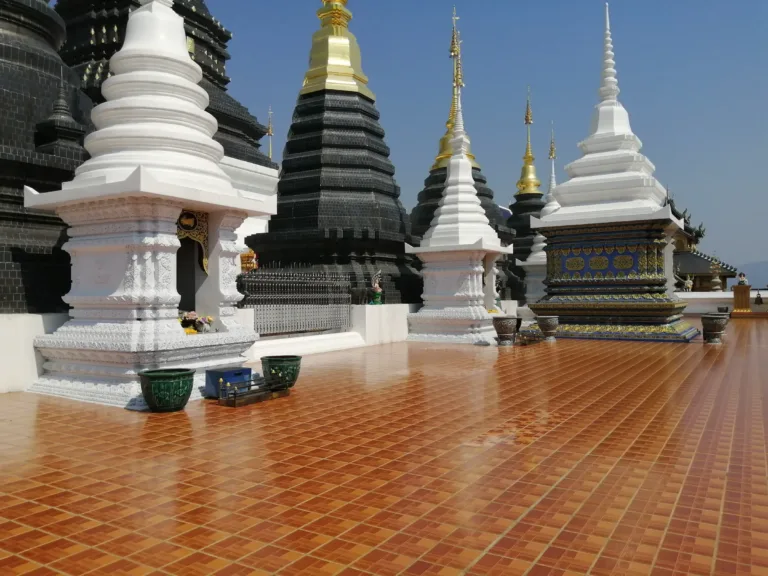
Twelve zodiac relic chedisReplicas of all twelve birth-year relic chedis, honoured in one place
Applied-Lanna temple · Mae Taeng, Chiang Mai
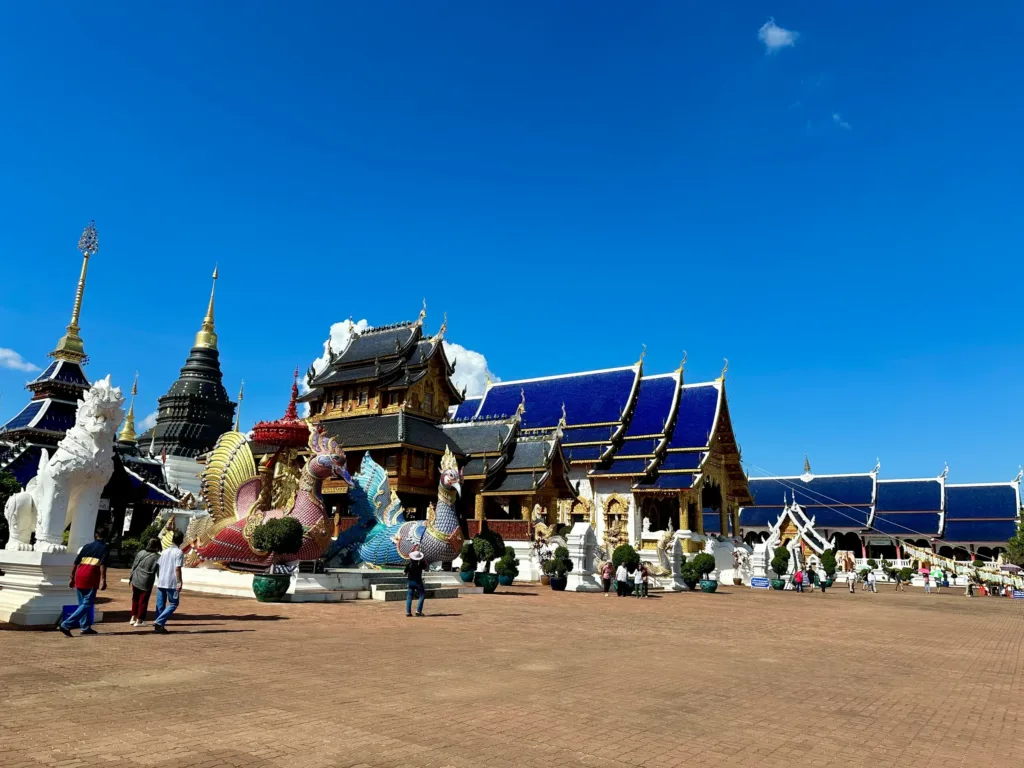
A hilltop temple in Mae Taeng that the monk Khruba Thueang turned from a small village wat into a sprawling applied-Lanna complex, with replicas of all twelve birth-year relic chedis in one place.
Holiday / event — crowded
Dress modestly, covering shoulders and knees · Remove shoes before entering buildings with Buddha images · Keep your voice down · Don't point your feet at Buddha images
Daily, about 08:00–18:00 (sources vary)
Before 10:00, when it is cooler and the tour buses have not arrived
Annual merit-making event in February, around Khruba Thueang's birthday (check exact dates with the temple)
01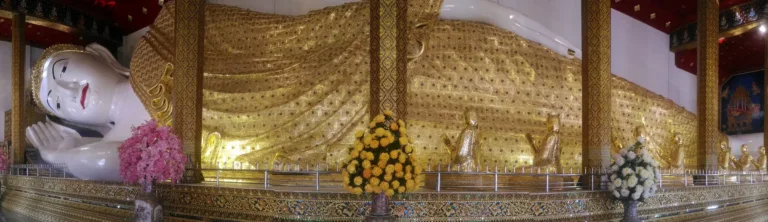 02
Tap a day card to see that day’s weather, rain, haze and hourly forecast
Best time to go Daytime is over · see tomorrow
Thick morning fog with visibility under 1 km — use headlights and drive slowly
Holiday — traffic on the way up and parking fills fast; leave early
Green band = hours used for the score
Best time to go Fine all day little rain through the day
Holiday — traffic on the way up and parking fills fast; leave early
Green band = hours used for the score
Best time to go Fine all day little rain through the day
No warnings today — normal road and weather conditions
Green band = hours used for the score
Best time to go Fine all day little rain through the day
No warnings today — normal road and weather conditions
Green band = hours used for the score
Best time to go Fine all day little rain through the day
No warnings today — normal road and weather conditions
Green band = hours used for the score
Best time to go Fine all day little rain through the day
No warnings today — normal road and weather conditions
Green band = hours used for the score
Best time to go Fine all day little rain through the day
No warnings today — normal road and weather conditions
Green band = hours used for the score
Wat Ban Den, formally Wat Den Sali Si Mueang Kaen, sits on a low hill among rice fields and longan orchards in Inthakhin, Mae Taeng district, about 40–50 km north of Chiang Mai. "Ban Den" refers to its prominent hilltop site, visible from afar, with a cave below that villagers consider sacred; "Sali" is the northern Thai word for the Bodhi tree, and Mueang Kaen is the old name of the area.For about a century it was a small village temple, said by most sources to date from 1894. That changed when the monk Khruba Thueang Nathasilo took charge of construction around 1988–1991. Funded entirely by donations, he rebuilt it across some 80 rai (about 13 hectares) as a place meant to be beautiful and to carry moral lessons, drawing people in to rest their minds. Building work is still going on.Inside you will find wooden halls and applied-Lanna buildings covered with colourful mythical creatures, stair rails shaped like the elephant-headed nok hatsadiling bird, a large white reclining Buddha, an ordination hall lined with carved wooden Buddhas and the temple's own Inthakhin pillar shrine. The main draw is a set of replicas of all twelve birth-year relic chedis, so visitors can honour the relic of their zodiac year in one stop.The temple is just off the road to Mae Ngat Somboon Chon Dam, about an hour's drive from town, and there is no public bus. The grounds are large and hilly, so allow one to two hours, cover shoulders and knees, and avoid midday, when parts of the site have little shade.
Arrive Before 10:00, when it is cooler and the tour buses have not arrived
Some buildings are unfinished, so stay on open paths and keep clear of work areas
Parts of the hilltop are exposed and very hot at midday; bring water and a hat
The temple covers about 80 rai on a hill, with a fair amount of walking up and down
No data yet check before you go · Time needed About 1–2 hours
Late morning to afternoon at weekends when tour groups stop, and the February merit-making event
Annual merit-making event in February, around Khruba Thueang's birthday (check exact dates with the temple)
Wat Ban Den, formally Wat Den Sali Si Mueang Kaen (also spelled Sari), stands at 119 Moo 8, Inthakhin subdistrict, Mae Taeng district, Chiang Mai, on a low rise among rice fields and longan orchards. Its grounds cover about 80 rai (roughly 13 hectares). Today it is known for a sprawling complex of applied-Lanna halls decorated with colourful mythical creatures, and for replicas of all twelve birth-year relic chedis gathered in one place. For most of its life, though, it was a small village temple. The grandeur you see now dates from the era when the monk Khruba Thueang Nathasilo took charge of construction, from around the late 1980s onwards, and building work is still going on.
The name explains itself. "Den" means prominent: the temple sits on a mound higher than the surrounding village and can be seen from far away; beneath the mound is a cave that villagers regard as sacred. "Sali" (or "Sari") is the northern Thai word for the Bodhi tree, an auspicious tree, and "Mueang Kaen" is the old town in which the temple stands. Before taking its present name, the temple was called Wat Hri Bun Rueang (one source writes Sahri Si Bun Rueang).
The name Mueang Kaen reflects the area's administrative history. A sub-province called Khwaeng Mueang Kuet was created in 1892 and renamed Khwaeng Mueang Kaen in 1894. It became San Maha Phon district in 1907 and was renamed Mae Taeng in 1939. The old name lives on in the Mueang Kaen Phatthana town municipality, which covers Cho Lae and part of Inthakhin.
Most sources say the original temple was built in 1894, the same year the sub-province took the name Mueang Kaen, as a small temple on the mound above the sacred cave, and that it stayed an ordinary village temple for about a century. A few sources, including the English Wikipedia article, describe it as more than 500 years old, but no inscription or primary document has been found that settles the founding date.
Many sources, including several Thai sites and the English Wikipedia article, say that Khruba Thueang restored or transformed the temple in 1894, which cannot be right: news coverage of a long-life ceremony in February 2025 says he had just turned 61, with 41 years as a monk. The statement most likely merges the founding year with the later rebuilding. Accounts of the modern era say that Khruba Chaiya of Wat Pa Pong in Doi Saket began the project and invited Khruba Thueang, from Wat Hua Dong (also spelled Hua Khong) in Saraphi, to lead all the construction. One source dates the invitation to 1988, matching some English-language accounts, while several others say the major rebuilding began in 1991.
Khruba Thueang, whose ecclesiastical title is Phra Khru Phaisan Phatthanakowit, is a builder-monk who follows the path of the revered Khruba Siwichai and emphasises vipassana meditation. A 2019 article from Khon Kaen University sums up his idea: a temple that is beautiful and carries moral lessons, drawing people in for reflection and rest of mind rather than ritual alone. Everything was paid for by donations from devotees, and the temple quickly became well known. A 2024 news report said he had spent about 30 years developing it.
The grounds are divided into a ritual zone, a monks' living quarter and open space for the public. The style is applied Lanna mixed with Burmese motifs. Many stair balustrades take the form of mythical creatures such as naga serpents, makara and the nok hatsadiling, a bird with an elephant's head, in place of the plain naga found at most temples, while lions, elephants and peacocks stand around the courtyards. Travellers' accounts note that the main hall's pillars are each cut from a single teak trunk and that coloured glass mosaic is used lavishly.
There are many buildings to explore. The ordination hall has a golden principal Buddha, murals of the Buddha's life and carved wooden Buddhas lining the pillars. The Ma Tam Na Bun viharn houses the Phra Kaew Klao Chao Bun Rueang image, the Phra Chao Nipphan viharn holds a large white Lanna-style reclining Buddha, the Phra Chao Thanjai viharn is a large wooden hall, and the Phra Chao Phan Ton viharn keeps a silver Buddha image. You'll also find a pavilion for the Phra Setthi Nawakot image, a scripture library, a drum tower, a dhamma hall, teak Lanna-style monks' quarters and a shrine for the temple's own Inthakhin pillar, which is separate from the famous city pillar in Chiang Mai. There is a gilded statue of Khruba Thueang, wax figures of revered monks, and a ku (reliquary) he built to hold his own ashes one day.
What draws most visitors is the set of twelve replica birth-year chedis: Si Chom Thong (Rat), Lampang Luang (Ox), Cho Hae (Tiger), Chae Haeng (Rabbit), Wat Phra Singh (Dragon), Wat Chet Yot (Snake), Phra Borommathat Tak (Horse), Doi Suthep (Goat), That Phanom (Monkey), Hariphunchai (Rooster), Wat Ket Karam (Dog) and Doi Tung (Pig). Foreign travel writers report that Khruba Thueang built them together because many of the originals are far away, so believers can honour their birth-year relic in one visit.
The birth-year relic belief, known in northern Thailand as chu that, holds that a person's spirit is linked to the relic of their zodiac year. A 2014 study by Manawat Promrat argues that it blends the Siamese zodiac tradition with Lanna relic worship, probably took shape in the mid-to-late 19th century, and has recently revived alongside pilgrimage tourism. In the traditional list the Snake, Horse and Dog are tied to Bodh Gaya, the Shwedagon in Yangon and a relic in heaven, so Wat Ban Den, like many modern sets, uses relic shrines in Thailand instead.
Parts of the temple are still unfinished, and a 2023 source noted that construction was continuing. The temple holds an annual merit-making event in February, around Khruba Thueang's birthday; on 16 February 2025 it held a long-life ceremony for him, presided over by Somdet Phra Maha Thirachan, the senior monk who heads the Sangha's northern region. Today Wat Ban Den serves both as the local community temple and as a popular stop on the road from Chiang Mai to Chiang Dao, and it has even been the subject of academic research on temple tourism management.
Arrived? Check in, collect a stamp and tell others what it is like right now
Check your location first, so you do not fill in the form for nothing
Location must be on and within 1 km · One check-in per place per day · come back on other days to check in again
Post photos from anywhere — no need to be here · Up to 20 photos at a time · JPG / PNG / WebP · GPS location data is removed automatically
The temple is in Inthakhin subdistrict, Mae Taeng, near the road to Mae Ngat Somboon Chon Dam, about 40–50 km from central Chiang Mai.
North on Highway 107 to Mae Taeng, turn towards Mae Ngat Dam, then about 1 km down a lane · Fuel
No public bus reaches the temple; agree a round-trip fare including waiting time
Many tours combine Wat Ban Den with other Mae Taeng sights
Highway 107 (Chiang Mai–Fang), then the road towards Mae Ngat Dam; flat paved roads, ending with a narrow lane of about 1 km
Large car park at the front, a short walk from the temple
Daily, about 08:00–18:00 (sources vary)
about 40–50 km from Central Chiang Mai
Wat Den Sali Si Mueang Kaen (Wat Ban Den)
Answers travellers want before they go — a one-minute read
In Inthakhin subdistrict, Mae Taeng, Chiang Mai, near the road to Mae Ngat Dam, about 40–50 km from town
Yes. Wat Ban Den is the name locals use; the full name is Wat Den Sali Si Mueang Kaen (also spelled Sari)
Most sources say the original temple dates from 1894, but most of what you see was built under Khruba Thueang from around 1988–1991 onwards
They are replica chedis modelled on the birth-year relic shrines around Thailand, built so people can visit them all in one place
There is no public bus to the temple; drive yourself, hire a songthaew or taxi for the round trip, or join a tour
About one to two hours, as the site is large with many buildings
Best day this week: Monday 30 Nov · Check in when you arrive to collect a stamp
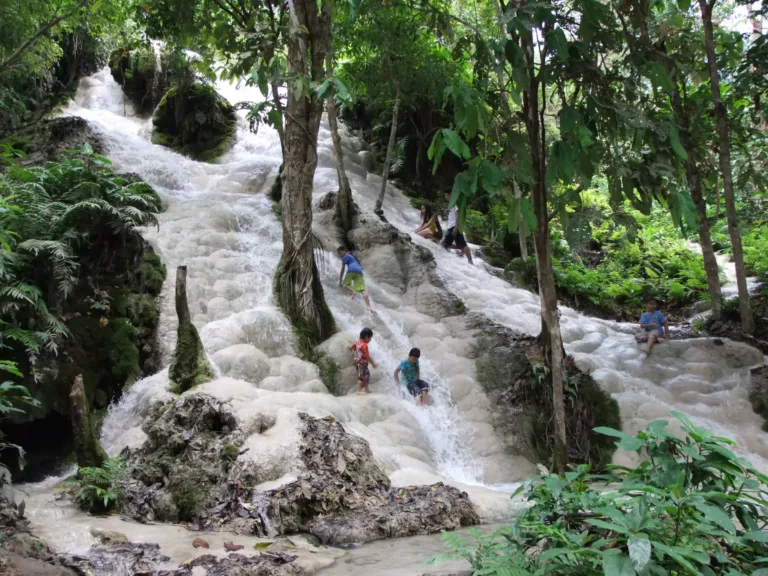 Bua Tong Sticky Waterfall & Chet Si Spring
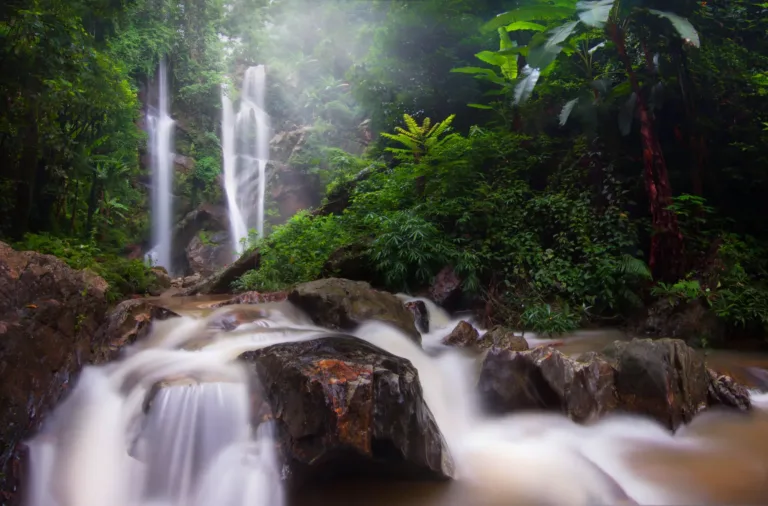 Mok Fa Waterfall
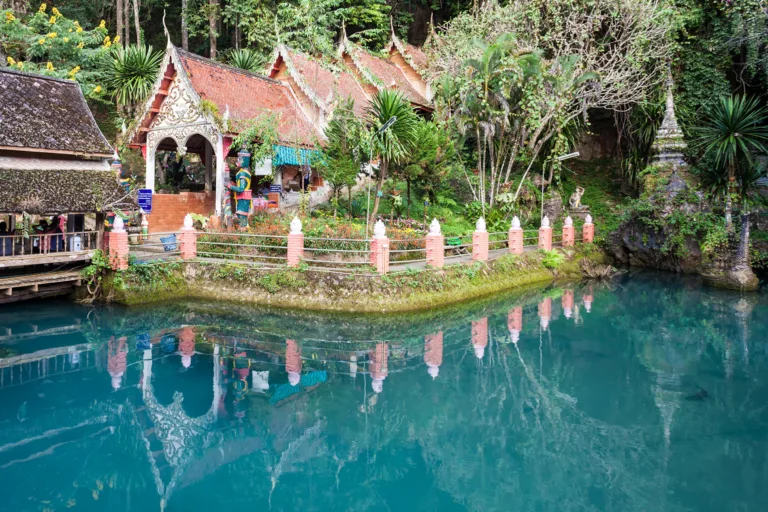 Chiang Dao Cave
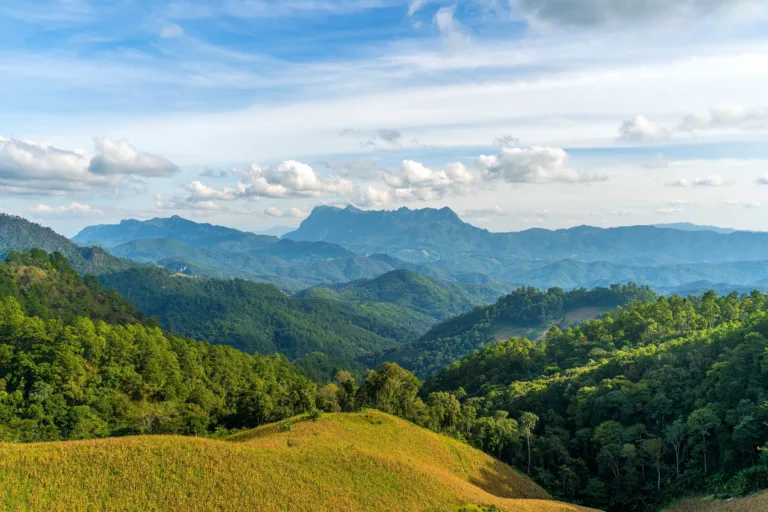 Doi Luang Chiang Dao