 01
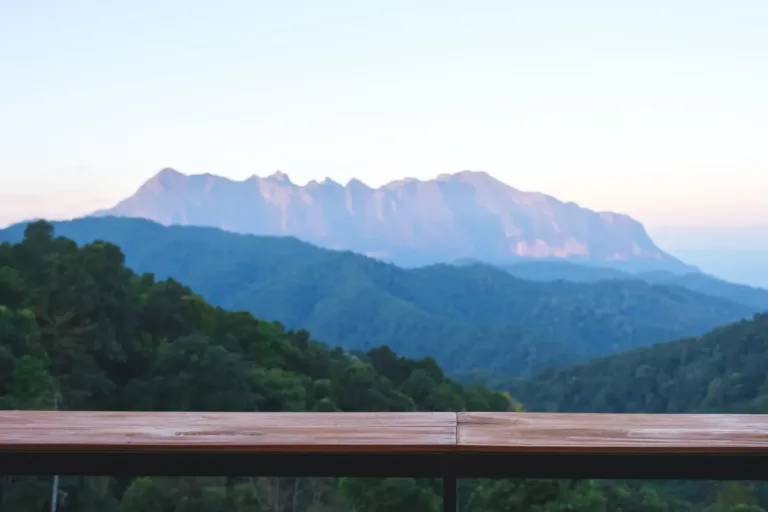
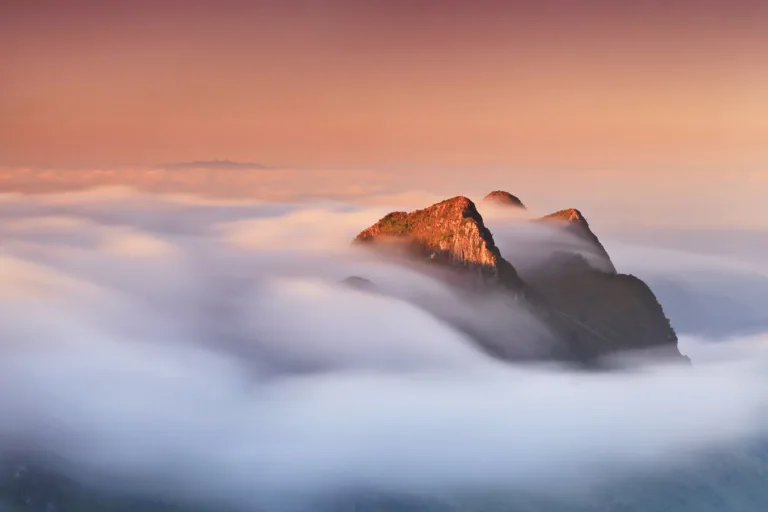
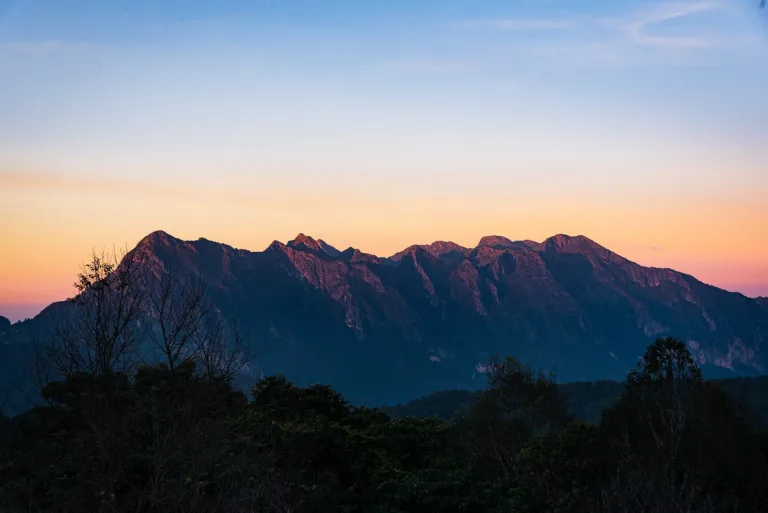
Three limestone peaksThailand's highest limestone mountain
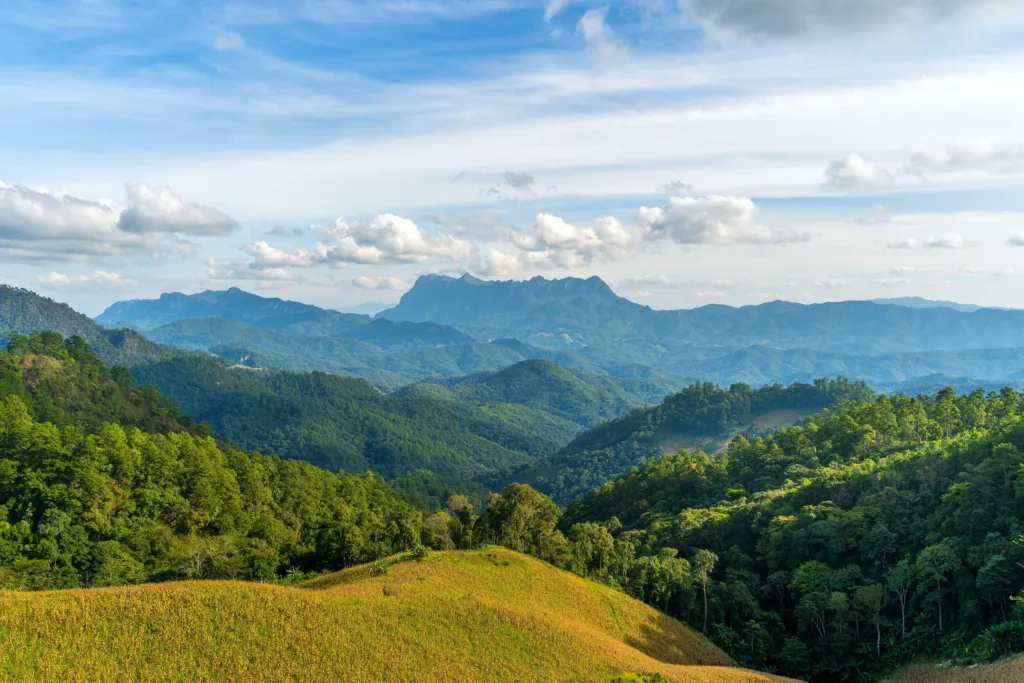
Limestone summit · Chiang Dao
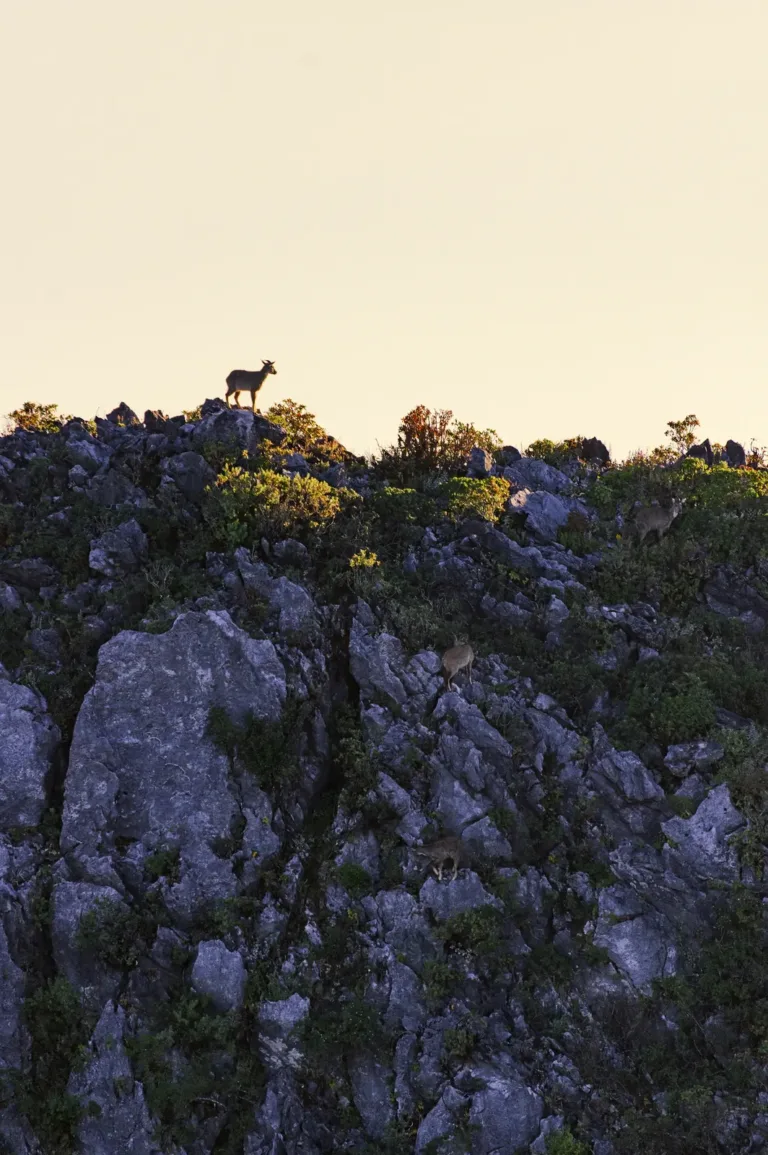
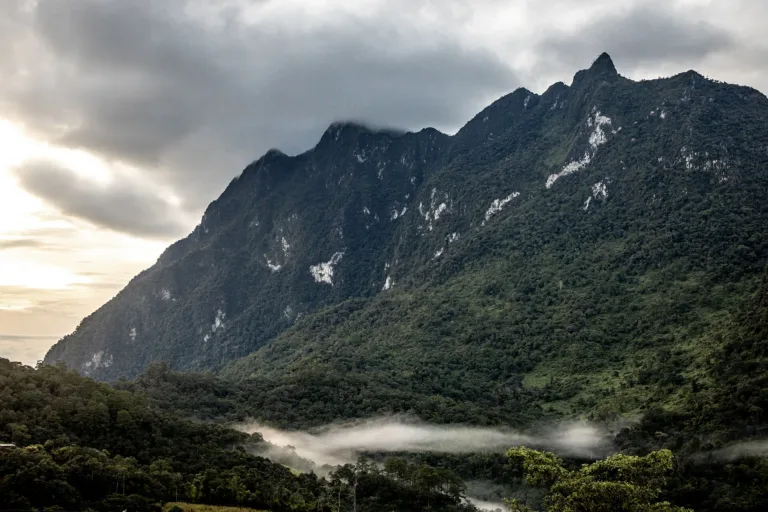
Thailand's third-highest peak, a limestone mountain of about 2,225 m in the Chiang Dao Wildlife Sanctuary and a UNESCO biosphere reserve — home to sub-alpine plants, goral and the legend of Chao Luang Kham Daeng. Climbing is allowed only Nov–Feb, 100 people a day.
Holiday / event — crowded · Chance of a sea of mist 5/10
sea-of-mist places: morning matters most
Sea of mist at Kiw Lom on mornings Dec–Jan
Arrive in Chiang Dao the day before for orientation
Highway 107 (Chiang Mai–Fang) to Chiang Dao, turn left to Ban Tham, register at the sanctuary office, then take the shuttle to the Den Ya Khat trailhead
Patchy on the trail; none in places
01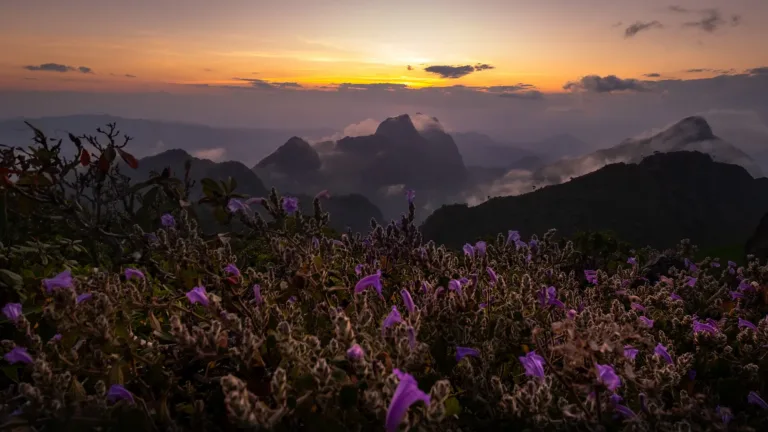 02
 03
 04
Tap a day card to see that day’s weather, rain, haze and hourly forecast
Best time to go Daytime is over · see tomorrow
Holiday — traffic on the way up and parking fills fast; leave early
Green band = hours used for the score
Best time to go Fine all day little rain through the day
Holiday — traffic on the way up and parking fills fast; leave early
Green band = hours used for the score
Best time to go Fine all day little rain through the day
No official warnings, but watch for: Low cloud at eye level may block the view at times
Green band = hours used for the score
Best time to go Fine all day little rain through the day
No warnings today — normal road and weather conditions
Green band = hours used for the score
Best time to go Fine all day little rain through the day
No warnings today — normal road and weather conditions
Green band = hours used for the score
Best time to go Fine all day little rain through the day
No official warnings, but watch for: Low cloud at eye level may block the view at times
Green band = hours used for the score
Best time to go Fine all day little rain through the day
No warnings today — normal road and weather conditions
Green band = hours used for the score
Scored from cloud cover at every level and tonight’s moonlight — the darker the sky, the clearer the Milky Way · tap another night below for the next 7 nights
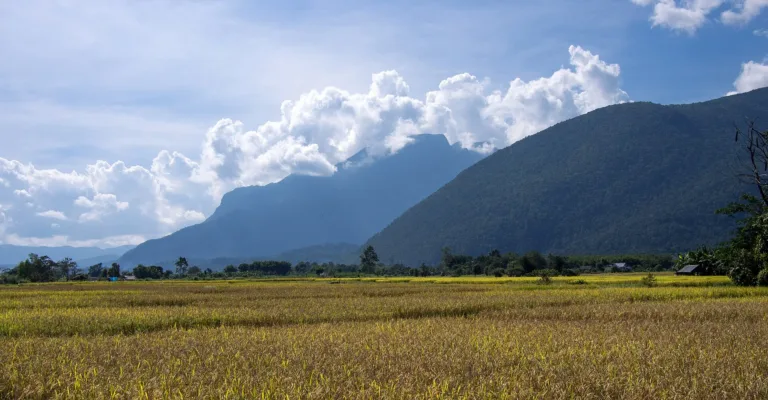
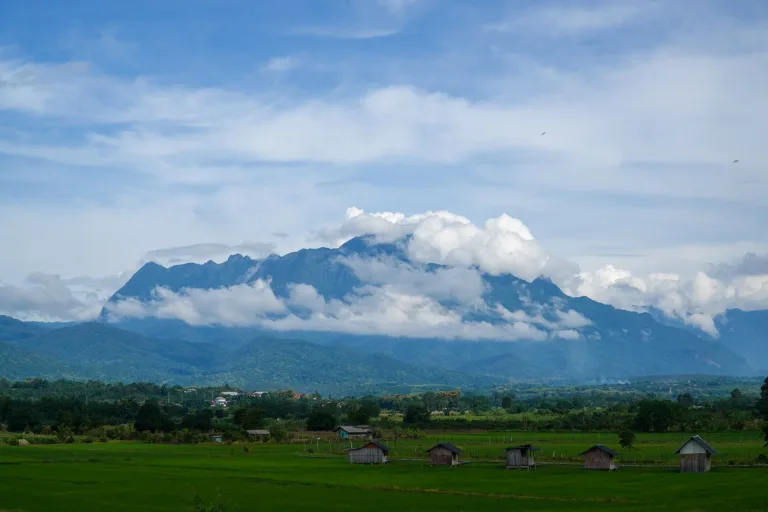
Doi Luang Chiang Dao, Chiang Dao district, Chiang Mai — Thailand's third-highest peak and highest limestone mountain, inside the Chiang Dao Wildlife Sanctuary.
Arrive Arrive in Chiang Dao the day before for orientation
Sea of mist at Kiw Lom on mornings Dec–Jan
Photos from Wikimedia Commons, Shutterstock and contributors · tap a photo to see its credit
Book only on the sanctuary's website; beware fake agents
Ages 10–70 only, with a medical certificate no older than 7 days
There is no water on the trail; carry your own
No fires, no alcohol, carry all rubbish down
Thais 30 THB · Foreigners 400 THB · Time needed 2 days 1 night (+ 1 orientation day)
Weekends and long holidays Dec–Jan sell out on the first booking day
| Entry, Thai | 30 ฿/person |
| Entry, foreign | 400 ฿/person |
| Orientation | 100 ฿/person |
| Campsite | 30 ฿/person |
| Accident insurance | 60–100 ฿/person |
| Emergency toilet kit | 250 ฿/person |
| Local guide | 200 ฿/person |
| Return shuttle (5 per car) | 560 ฿/vehicle |
| Porter (per kg) optional | 70 ฿/kg |
| Litter deposit (refundable) | 500 ฿/person |
Pay by QR within 24 hours of booking · Prices may change by season — check with the venue
Tap a month on the wheel to see weather, rain, haze and crowds from 10 years of records
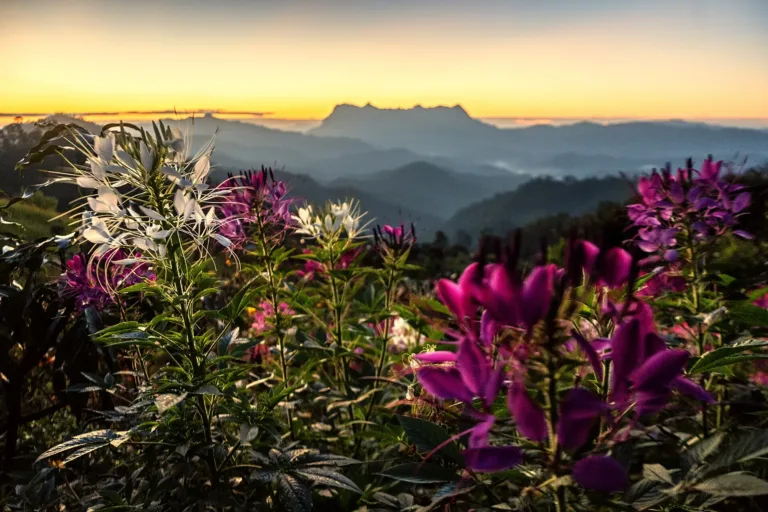
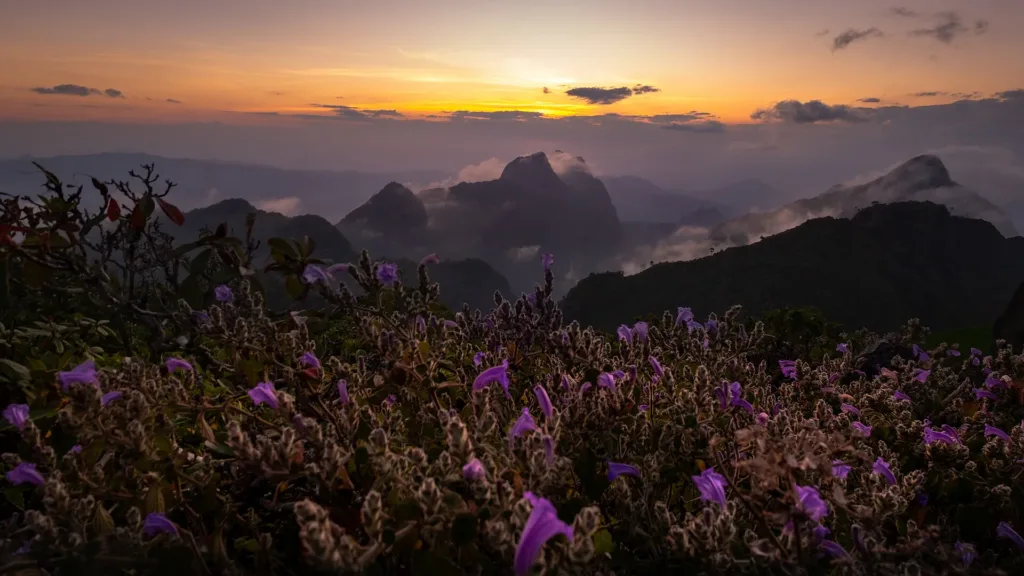
Best time · Nov–Dec sub-alpine wildflowers · Dec–Jan coldest, with the clearest sea of mist at Kiw Lom
Watch out · Closed to climbing from about mid-Feb to mid-Nov, through fire season and the rains
Nov by the records 9–16°C · avg rain 86 mm (14 rainy days) · clear 14 days · avg PM2.5 8
Doi Luang Chiang Dao, also called Doi Chiang Dao or Doi Ang Salung, is a limestone mountain in the Daen Lao range about 6 km west-northwest of Chiang Dao town and about 70 km from Chiang Mai. It is Thailand's third-highest peak after Doi Inthanon and Doi Pha Hom Pok, and the country's highest limestone mountain. Height figures vary: the wildlife sanctuary and the Thai Journal of Forestry use 2,225 m, satellite measurements give about 2,175 m, and some older tourism sources say 2,275 m.
The limestone formed as reefs on seamounts in the Paleo-Tethys ocean during the Carboniferous and Permian, more than 250 million years ago, in layers over 1,000 m thick, and shell fossils can be seen along the trail. Thai tourism sources often simply say the area was sea some 230–250 million years ago. Millions of years of rain dissolving the rock created many caves, the largest being Chiang Dao Cave, and there is almost no surface water above about 910 m.
The Buddha's Travels chronicle, thought to have been written in Lanna 500–600 years ago, says the Buddha bathed on this mountain, so it was called "Ang Song" (the royal bath), later "Ang Salung" after the salung, a large Lanna metal water bowl. One version has the Buddha and his disciples bathing in a golden tub. He foretold that the mountain was as high as the stars and that a city called "Phiang Dao" (level with the stars) would arise, which became "Chiang Dao". "Doi Luang" simply means great mountain.
Doi Luang Chiang Dao is the home of Chao Luang Kham Daeng, or Suwanna Kham Daeng, the great guardian spirit of Lanna. The belief is shared by Tai Yuan, Tai Lue and Tai Yai peoples from northern Thailand to Sipsong Panna, Shan State, Assam's Ahom and Laos. He appears in the chronicle of the founding of Chiang Mai, the Old Chiang Mai Chronicle, which lists 56 ancestral spirits, and the Suwanna Kham Daeng or Inthakhin chronicle.
The core story tells of a god disguised as a golden deer. Prince Suwanna Kham Daeng chased it for two or three months to the foot of Doi Ang Song. The deer was Nang In Lao, the cave's spirit queen, who invited the prince and his followers into Chiang Dao Cave. Later he followed the deer to Doi Suthep, where a hermit told him to stop and found a city; omens on the Ping River led to Wiang Chet Lin and Wiang Nopburi. He is thus counted as Lanna's first ruler, long before King Mangrai. In old age, or after death, he returned to the cave with Nang In Lao and became Lanna's great guardian, dwelling on Doi Luang Chiang Dao.
Other versions differ. A 2018 Matichon Weekly retelling says Indra sent him from the north to found Lanna and teach the precepts, while a 2020 version makes him a son of King Chorani of Phayao — though palm-leaf texts transcribed by scholars do not mention Phayao. In 2007 Phaitoon Phrommawichit and a Chiang Mai University team transcribed many versions. Thai Wikipedia cautions against assuming the legend's Doi Ang Song is Doi Chiang Dao, even though local tradition does.
Villagers around the mountain say that on Buddhist holy days all of Chiang Mai's town spirits gather on Doi Luang, with the cave's great hall as their meeting room; the spirits eat farmers' rice offerings and leave the husks in the Husk Cave. On clear nights a glowing orb is said to rise from the cave and fly east with a bang — Kham Daeng visiting Phayao. Some stories tell of a hermit summoning gods and nagas to hide a golden Buddha, a golden bodhi tree and the elephant Erawan deep in the cave, and of thieves who tried to steal them and got lost.
Kham Daeng is still the first spirit named when Chiang Mai's guardian spirits are honoured at Lanna New Year. Chiang Dao has four shrines to him, with spirit-feeding rites on the full moon of the ninth northern month. The legend was registered as national intangible cultural heritage in 2012 and has been cited in opposition both to splitting off a Fang–Chiang Dao province and to a cable car up Doi Luang Chiang Dao.
At the foot of the mountain, Wat Tham Chiang Dao was founded in 1767 by Khruba Pathom Panya; wandering monks and hermits meditated in the cave before that. In 1913 the hermit U Khantha made the Phra Thanjai Buddha and Tai Yai people built the 25-spired chedi at the cave entrance. Khruba Siwichai restored the temple in 1934. A statue of Kham Daeng stands in front of the temple, which in recent seasons has hosted the pre-climb orientation. In the 1930s an elevated walkway was built to the cave mouth, and in 1934 followers of Khruba Siwichai built a viharn near the entrance. The surveyed cave system runs about 9.4 km, divided into the Horse, Water, Leopard, Crystal and Reclining Buddha caves, and many of the cave's Buddha images are thought to be Burmese work from the period of Burmese rule. English-language versions call the cave's hermit "Phra Rama Rishi", said to have lived there for a thousand years and made seven wonders; anyone who takes even a stone from the cave, the story goes, will lose their way.
People have lived around the mountain for more than 600 years: Tai Yai, Tai Yuan, Hmong, Lahu, Lisu, Mien and Pgaz K'nyau. The muang fai gravity irrigation at Ban Pang Ma-O carries about 800 years of local water knowledge and is cited as a model of payment for ecosystem services.
Chiang Dao was once a small Lanna frontier town. Before the district existed, the area held several border towns under Chiang Mai — Mueang Ngai, Mueang Haeng, Mueang Khong and Mueang Na. Chronicles say Mangrai sent Khun Khruea to rule Mueang Nai on the Tai Yai side, and King Tilokaraj brought Mueang Nai and eleven other Tai Yai towns under Lanna, but no chronicle found names Chiang Dao itself in Mangrai's time. Bayinnaung's wars emptied many Tai Yai border towns, and the Doi Chom Muak relic chedi near Chiang Dao village survives from that era.
In 1884 a Tai Yai caravan led by Nai Upingyama travelled from Mueang Mok Mai through Mueang Ngai and Chiang Dao toward Chiang Rai, while Chao Fa Khun Ching's larger caravan crossed the headwaters of Doi Chiang Dao down to Mueang Ngai and followed the Kok River to Fang and Chiang Rai. Tai Yai gem miners from the Salween basin also settled in Chiang Dao and Fang. Under the Thesaphiban administrative reforms Chiang Dao became a minor district and then a full district on 12 July 1908 (one local account says 1909), merging Mueang Ngai, Haeng, Khong and Na.
Local tradition holds that King Naresuan camped at Mueang Ngai on his march to Ava — a story without documentary proof. The Fine Arts Department designed the King Naresuan memorial chedi at Ban Mueang Ngai, built between 1959 and 1971, some tens of kilometres north of Doi Luang.
In science, the American ornithologist Herbert Deignan taught in Chiang Mai in 1928–1932 and 1935–1937, collecting birds across the region and publishing "The Birds of the Chiengmai Region" in the Journal of the Siam Society in 1931. A babbler collected on Doi Chiang Dao then became Deignan's Babbler, which some authorities treat as a species endemic to the mountain. A.F.G. Kerr, Siam's government botanist, described Alstonia rupestris, known in Thailand only from here.
Foreign botanists had come even earlier. Tem Smitinand recorded in the Siam Society's natural history bulletin (1966) that the first scientific visitor was the German botanist C.C. Hosseus in 1904–05. A.F.G. Kerr collected here in 1913 and 1921, probably the source of Alstonia rupestris, and the ornithologist R. Meyer de Schauensee made a brief visit in 1937 — about ten botanical excursions in fifty years.
Smitinand himself led six expeditions between 1958 and 1962, including a Thai-Danish expedition with Th. Sørensen and Kai Larsen. He recommended the eastern slope, where vegetation changes most clearly with height, and put the summit at about 2,200 m. The white Chiang Dao rose hikers see on the limestone ridges is Rosa helenae, found in Thailand at 1,700–2,000 m.
Plant discoveries continued. In 1966 Tem Smitinand studied the mountain's vegetation; in 1995 the ginger Hedychium tomentosum, found only on the limestone ridges at about 2,000 m, was described; researchers recorded 10 Dioscorea species, over 20% of Thailand's total; and in 2017 the orchid Dendrobium chiangdaoense was named.
A royal decree created the Chiang Dao Wildlife Sanctuary on 25 August 1978, covering about 521 km² in Chiang Dao and Wiang Haeng. The Chiang Dao Wildlife Research Station has spent over 40 years on restoration, especially breeding and releasing goral, one of Thailand's 19 reserved wild animals. A 2017 survey counted 90 goral on the mountain, which locals call "horses of the gods".
Long-lost large animals are returning. On 5 April 2022 a camera trap caught a leopard in the sanctuary for the first time, and on 8 October 2025 the Zoological Park Organization released its fourth pair of great hornbills at the research station, after the species had been absent from these forests for nearly 20 years.
Before about 2019 there was no daily cap; hikers only needed a written permit about 15 days ahead. Numbers rose from 4,961 in 2015 to 17,216 in 2017, and litter on the mountain got out of control. There were two routes: Pang Wua, about 6.5 km and steep, and Den Ya Khat, about 8.5 km and gentler.
From 27 to 31 March 2019 a large fire on Doi Luang near Ban Tham burned more than 400 rai. About 200 people from 14 agencies in the "Hak Chiang Dao" network fought it, with 23 helicopter water drops and a 6 km firebreak, and images of the mountain as "a sea of fire" spread on social media. The trail then closed to recover and stayed shut throughout 2020.
Fire returns almost every year. On 13 April 2020 a fire on Doi Luang near Ban Yang Thung Pong needed helicopter water drops, and on 1–2 April 2021 Chiang Mai's governor named Doi Luang Chiang Dao and Doi Suthep–Pui the province's two "strategic mountains" for fire defence, closing the forests and running patrols through March and April.
On 23 June 2020 the Cabinet approved nominating Doi Chiang Dao to UNESCO, and on 15 September 2021 the 33rd session of the Man and the Biosphere council designated it Thailand's fifth biosphere reserve, covering 85,909 ha or about 536,900 rai — a biosphere reserve, not a World Heritage Site as some websites claim. It holds Thailand's only sub-alpine plant community on limestone, with over 2,000 plant species, about 20% of the national flora, and 672 animal species.
On 2 December 2021 Doi Luang reopened under a new system: 100 people a day, online booking, a mandatory orientation the day before, no Wednesday nights and a 500-baht litter deposit. The next season, weekend places sold out on the first booking day; QR codes were placed along the trail, the Doi Chiang Dao Biosphere app offered 28 learning stations, and urine-gel bags and mobile toilets were introduced. Since the 2023 season only the Den Ya Khat route has been allowed.
In 2024 Doi Nang, near the main peak, burned for the third time. On 26 April 2024 Director-General Attapol Charoenchansa closed the whole sanctuary indefinitely over burning, encroachment, hunting and unlicensed homestays. After hearings and drone surveys, a memorandum signed on 9 August 2024 set out four points — firebreaks, return of land encroached after 2014 and a freeze on new lodgings — and the sanctuary reopened on 11 September 2024.
The 2024/25 season (11 Nov 2024–12 Feb 2025) switched to individual bookings for ages 10–70, with porters carrying up to 10 kg per hiker. The 2025/26 season (15 Nov 2025–12 Feb 2026) required a medical certificate no more than 7 days old. The 2026/27 season is set for 16 November 2026 to 12 February 2027, booked only through the sanctuary's website, with orientation at Wat Tham Chiang Dao.
For the 2026/27 season, Kapook and Chillpainai report that booking runs from 08:00 on 26 October to 16:00 on 30 October 2026, only on the sanctuary's website, with up to two people per booking, 100 a day, no Wednesdays, and no changes or refunds. The first hiking day is 16 November 2026; check the sanctuary's website again before you go.
Arrived? Check in, collect a stamp and tell others what it is like right now
Check your location first, so you do not fill in the form for nothing
Location must be on and within 2.7 km · One check-in per place per day · come back on other days to check in again
Post photos from anywhere — no need to be here · Up to 20 photos at a time · JPG / PNG / WebP · GPS location data is removed automatically
Highway 107 to Chiang Dao, then Ban Tham · Fuel
From Chang Phueak terminal about every 30 min · About 40–80 baht
Charter from Chiang Mai · 1,000–1,200 baht
Office to trailhead · 560 baht/person (return)
Highway 107 (Chiang Mai–Fang) to Chiang Dao, turn left to Ban Tham, register at the sanctuary office, then take the shuttle to the Den Ya Khat trailhead
At the Chiang Dao Wildlife Sanctuary office, Ban Tham
Fill up in Chiang Dao town
Patchy on the trail; none in places
Pre-booked hikers only; 2 days 1 night
about 70 km from Chiang Mai city
Doi Luang Chiang Dao
400 THB
Approx. nightly price for 2 adults (next week) · final price depends on your dates
Answers travellers want before they go — a one-minute read
About 2,225 m (the wildlife sanctuary's figure); Thailand's third-highest
The 2026/27 season runs 16 Nov 2026–12 Feb 2027; otherwise closed
Only at wildlifesanctuaryfca16.com/chiangdao
100
No; you must camp at Ang Salung and attend orientation the day before
No, it is a UNESCO biosphere reserve, designated in 2021
Best day this week: Wednesday 2 Dec · Check in when you arrive to collect a stamp
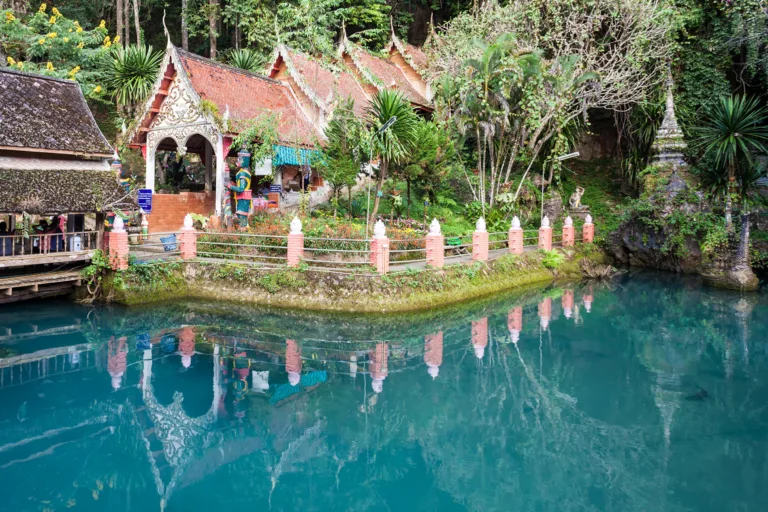 Chiang Dao Cave
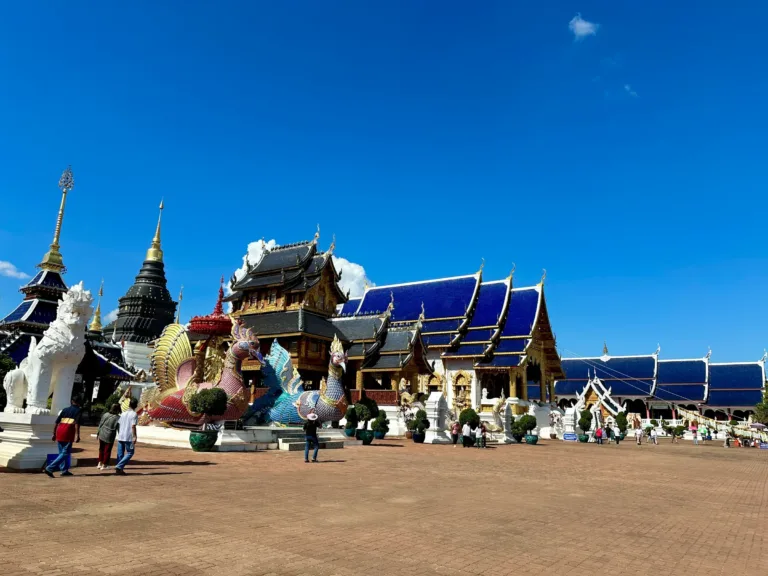 Wat Ban Den (Wat Den Sali Si Mueang Kaen)
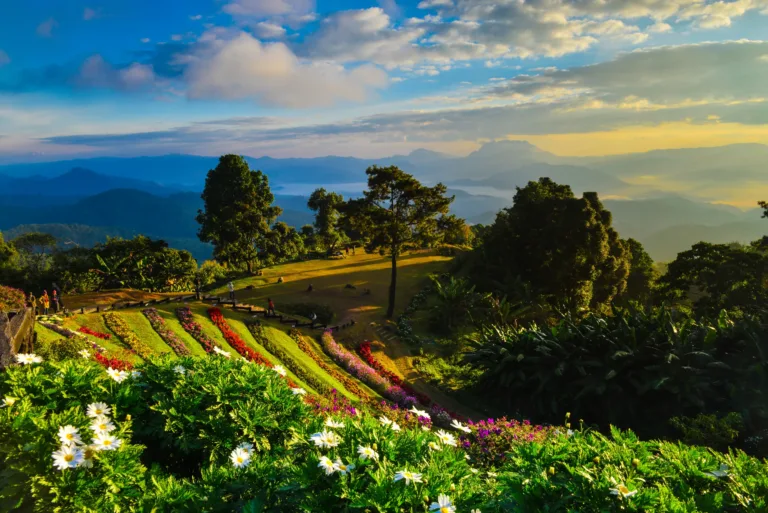 Huai Nam Dang National Park
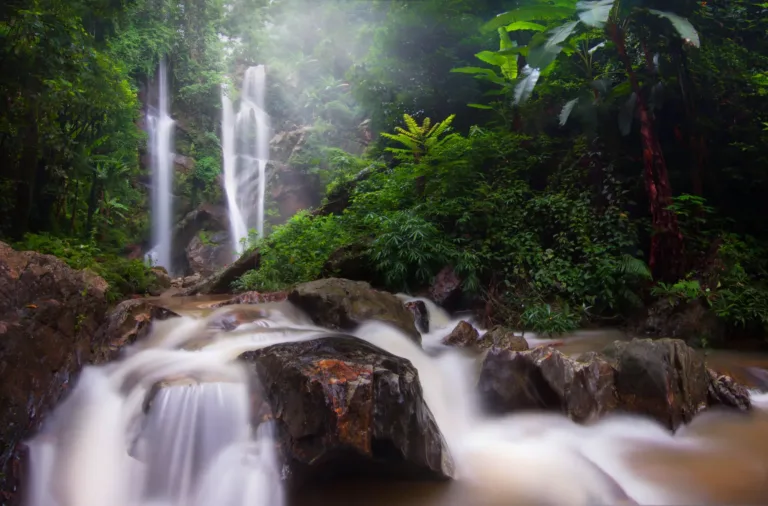 Mok Fa Waterfall