What to know before visiting the temple
Dress modestly · Walk clockwise round the chedi · Take shoes off where signed · Don't climb the base
Daily 05:00–19:00
Morning or evening, when it's cooler
Phra That Renu Nakhon festival (fourth lunar month; dates vary)
7 days ahead
When to go
this week
Tap a day card to see that day’s weather, rain, haze and hourly forecast
Best time to go Daytime is over · see tomorrow
No warnings today — normal road and weather conditions
Hour by hour
Green band = hours used for the score
Best time to go Fine all day little rain through the day
No warnings today — normal road and weather conditions
Hour by hour
Green band = hours used for the score
Best time to go Fine all day little rain through the day
No warnings today — normal road and weather conditions
Hour by hour
Green band = hours used for the score
Best time to go Fine all day little rain through the day
No warnings today — normal road and weather conditions
Hour by hour
Green band = hours used for the score
Best time to go Fine all day little rain through the day
No warnings today — normal road and weather conditions
Hour by hour
Green band = hours used for the score
Best time to go Fine all day little rain through the day
No warnings today — normal road and weather conditions
Hour by hour
Green band = hours used for the score
Best time to go Fine all day little rain through the day
No warnings today — normal road and weather conditions
Hour by hour
Green band = hours used for the score
Wat Phra That Renu
Wat Phra That Renu is on Kaew Komon Road in Renu Nakhon District, Nakhon Phanom, about 50–52 km from Nakhon Phanom town and 15 km from That Phanom. The chedi copies the shape of the original Phra That Phanom, about 35 m tall on a base roughly 8.37 m a side.It was begun around 1918 by the preceptor monk Phra Upatchaya In Bhumiyo together with local people and celebrated in 1920; the Fine Arts Department restored it in 1950. Locals visit it as the stupa for those born on Monday.The ordination hall houses Phra Ong Saen, a Lao-style meditating Buddha. Open daily, free entry.
- Cool and quiet
- Hot courtyard
- Evening light on the chedi
Arrive Morning or evening, when it's cooler
- Chedi courtyardThe full chedievening
Good to know here
Walk clockwise round the chedi three times; don't climb the base
Modest clothes; take shoes off where signed
- Walk clockwise round the chedi three times
- Combine it with Wat Phra That Phanom, about 15 km away
- Check the dates of the fourth-month festival, which change every year
- Dress modestly and take shoes off in the hall
Free · Time needed 30 minutes–1 hour
The annual festival and long weekends
- Kids Fine; keep kids respectful
- Seniors Flat ground in town, easy walking
- Wheelchair No information on ramps
- Pets A temple; best to leave pets at home
- Dress modestly
- Walk clockwise round the chedi
- Take shoes off where signed
- Don't climb the base
- The courtyard gets very hot at midday
Phra That Renu Nakhon festival (fourth lunar month; dates vary)
The story of this place
Wat Phra That Renu is the central temple of Renu Nakhon, a town founded by Phu Tai people who crossed the Mekong from Mueang Wang in Laos some 180 years ago. Its chedi, about 35 metres tall, was begun in 1918 by the preceptor monk Phra Upatchaya In Bhumiyo together with local people, and copies the original shape of Phra That Phanom before the real stupa was heightened and later collapsed. Today it is the stupa for people born on Monday, the heart of the Phu Tai community, and a reminder of how Phra That Phanom once looked.
Read more 10 more paragraphs
The Phu Tai trace their origins to southern China and gradually moved south through northern Vietnam into Laos. Researchers say that around 1707 some ten thousand people settled in Mueang Wang and neighbouring towns. After the war of Chao Anouvong of Vientiane in 1826, the Bangkok court moved Phu Tai and other groups from the left bank of the Mekong to the right bank, which is why Phu Tai communities are found across Nakhon Phanom, Mukdahan, Sakon Nakhon and Kalasin today.
According to local scholarship, around 1841 Thao Phet, Thao Sai and Thao Phai led a group of Phu Tai from Mueang Wang across the Mekong, landing near Tha Phanom. The story goes that they first settled near Nong Han but fell ill so often that they thought of going home, until a monk from Wat Phra That Phanom advised them to settle at Dong Wai Sai Bo Kae, not far from Phra That Phanom. Some sources call this first village Ban Dong Wai or Ban Bung Wai, and some say Phu Tai had already lived in the area before then.
In 1844, under King Rama III, the settlement was raised to the town of Renu Nakhon under Nakhon Phanom, and Thao Sai was appointed its first ruler with the title Phra Kaew Komon. A document of the time records about 2,648 Phu Tai from Mueang Wang. The Phu Tai also called the town "Mueang We", meaning a place you keep coming back to, because relatives from far and wide would circle back here for news. Renu Nakhon became the "elder" community in a Phu Tai network on both banks of the Mekong.
The temple that now holds the chedi was originally called Wat Klang, the "middle temple", because it stood in the centre of town. There is no clear record of when it was founded, but it is believed that the first ruler, his deputy (uppahat), the town officials and residents built it together as the community's main temple. It was renamed Wat Phra That Renu once the chedi stood. The town itself became a district in 1907 under the thesaphiban reforms, and in 1917 the district was renamed That Phanom.
In 1918 Phra Upatchaya In Bhumiyo, with monks, community leaders, local craftsmen and lay Buddhists, began building the chedi, modelling it on the original Phra That Phanom at a smaller scale. It was built of brick and lime in the traditional way, using a mortar locals call "chathai". Some sources date the start to 1917. During the first construction the chedi was struck by lightning and collapsed before it could be celebrated, so villagers and monks rebuilt it more strongly with thicker brickwork, and it was consecrated in 1920.
The chedi is square, about 35 metres tall, on a base about 8.37 metres a side, with false gateways on all four sides. The interior is hollow and closed to visitors. According to the temple's history it holds the Tripitaka, gold and silver Buddha images, valuables and the regalia of former local lords. One academic study sees a mix of Lan Xang art and Burmese influence in its exterior, brought by traders and cattle caravan leaders of the period.
The Fine Arts Department restored Phra That Renu in 1950. Phra That Phanom itself had been heightened by the Fine Arts Department in 1940 and collapsed entirely on 11 August 1975 before being rebuilt, so Phra That Renu, built to the pre-1940 shape, helps later generations picture the older Phra That Phanom. In 1976 relics of the Buddha were added to the chedi, though some sources give a different year.
Phra That Renu has been bound up with the Phu Tai dance from the start. Dance researchers say that more than a century ago the Phu Tai of Renu Nakhon danced at village merit-making festivals, including the celebrations for Phra That Renu. In 1955, when King Bhumibol and Queen Sirikit attended Makha Bucha at Wat Phra That Phanom, the province chose the Renu Nakhon Phu Tai to dance before them. The dance took on a formal shape, became known nationwide, and since 1975 has been part of the Phra That Phanom festival. Surin Phaksiri's song "Nao Lom Thi Renu" also made the town's name familiar across Thailand.
On the administrative side, the name Renu Nakhon returned on 1 May 1970, when a minor district of that name was split off from That Phanom; it became a full district on 21 August 1975. In 2008 the temple built a new ordination hall to house Phra Ong Saen, a Lao-style Buddha in meditation about 50 cm tall, revered as the guardian image of the town. Some sources describe it as gold, while others say it is cast in brass or bronze.
Today people in Nakhon Phanom regard Phra That Renu as the stupa for those born on Monday, and the temple grounds also hold the Phu Tai Cultural Ground and the Mueang Wae Theatre. The Phra That Renu Nakhon festival is held every year in the fourth lunar month, around the 13th to 15th waxing days, for three days and nights, with the invocation of Phra Upakut, the wrapping of the chedi in cloth and khan mak beng processions from local communities. In 2026 it was held on 1–3 March.
- 1707Around ten thousand Phu Tai settle in Mueang Wang in Laos (approximate)
- 1826The Chao Anouvong war leads to Phu Tai being moved from the left bank of the Mekong
- 1841Thao Phet, Thao Sai and Thao Phai lead Phu Tai from Mueang Wang to settle at Dong Wai
- 1844The village becomes the town of Renu Nakhon under Nakhon Phanom; Thao Sai is its first ruler, Phra Kaew Komon
- 1907Renu Nakhon becomes a district under the thesaphiban reforms
- 1917The district is renamed That Phanom
- 1918Phra Upatchaya In Bhumiyo and villagers begin building Phra That Renu at Wat Klang
See 10 events
- 1920The chedi is consecrated after being rebuilt following a lightning strike during construction
- 1940The Fine Arts Department heightens Phra That Phanom, so Phra That Renu keeps its original shape
- 1950The Fine Arts Department restores Phra That Renu
- 1955Renu Nakhon Phu Tai dance before the King and Queen at Makha Bucha at Wat Phra That Phanom
- 19701 May — Renu Nakhon minor district is split off from That Phanom
- 197511 Aug — Phra That Phanom collapses
- 197521 Aug — Renu Nakhon becomes a full district
- 1976Relics of the Buddha are added to Phra That Renu
- 2008A new ordination hall is built to house Phra Ong Saen
- 2026The Phra That Renu Nakhon festival is held on 1–3 March
Check-ins & visitor photos
Arrived? Check in, collect a stamp and tell others what it is like right now
Check your location first, so you do not fill in the form for nothing
Location must be on and within 1 km · One check-in per place per day · come back on other days to check in again
Post photos from anywhere — no need to be here · Up to 20 photos at a time · JPG / PNG / WebP · GPS location data is removed automatically
How to get there
The temple is on Kaew Komon Road in Renu Nakhon town.
About 50–52 km from Nakhon Phanom town, or 15 km from That Phanom · Fuel
Streets in Renu Nakhon town
In the temple and on the street
Renu Nakhon town
Daily 05:00–19:00
about 50–52 km from Nakhon Phanom town
Wat Phra That Renu
FAQ
Before you go: Wat Phra That Renu
Answers travellers want before they go — a one-minute read
Where is Wat Phra That Renu?
Kaew Komon Road, Renu Nakhon, Nakhon Phanom, about 15 km from That Phanom
How tall is the chedi?
About 35 metres
Which day is it for?
Monday
Is there an entry fee?
No; donations are welcome
What are the opening hours?
Daily 05:00–19:00
Where is Phra Ong Saen?
In the temple's ordination hall
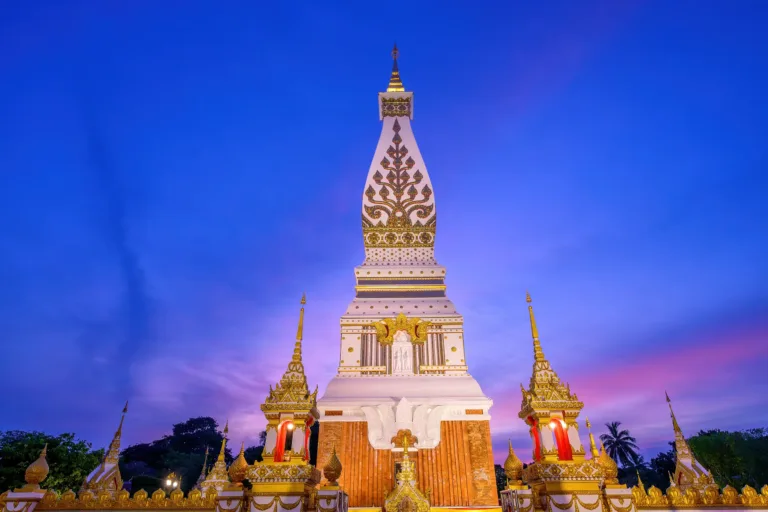 Wat Phra That Phanom Woramahawihan
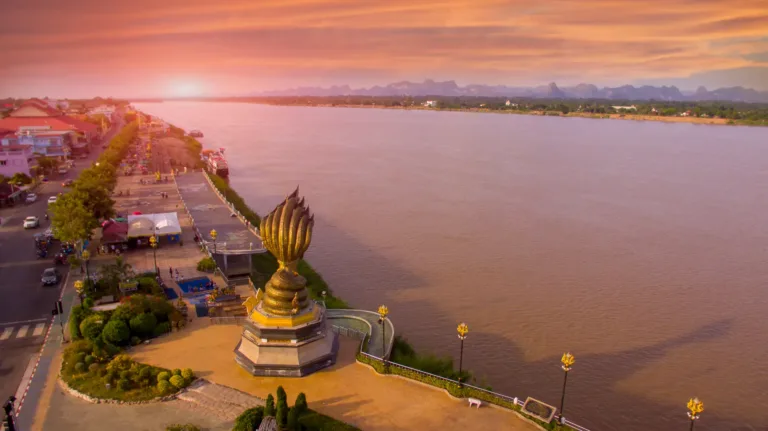 Phaya Si Satta Nakharat (Naga Monument)
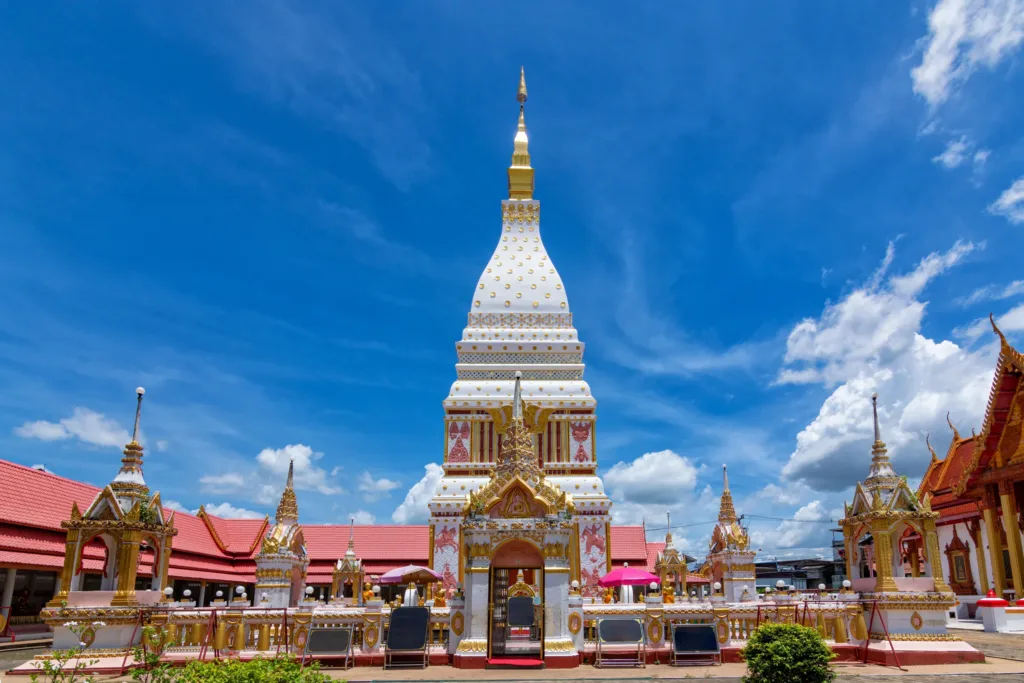
Ready to go to Wat Phra That Renu?
Best day this week: Saturday 28 Nov · Check in when you arrive to collect a stamp