Opening hours, entry fee and time needed
Open all day (public riverside plaza)
Free
30 minutes–1 hour
The July festival and weekend evenings
7 days ahead
When to go
this week
Tap a day card to see that day’s weather, rain, haze and hourly forecast
Best time to go Daytime is over · see tomorrow
Holiday — traffic on the way up and parking fills fast; leave early
Hour by hour
Green band = hours used for the score
Best time to go Fine all day little rain through the day
Holiday — traffic on the way up and parking fills fast; leave early
Hour by hour
Green band = hours used for the score
Best time to go Fine all day little rain through the day
No warnings today — normal road and weather conditions
Hour by hour
Green band = hours used for the score
Best time to go Fine all day little rain through the day · light drizzle possible at times
No warnings today — normal road and weather conditions
Hour by hour
Green band = hours used for the score
Best time to go Fine all day little rain through the day
No warnings today — normal road and weather conditions
Hour by hour
Green band = hours used for the score
Best time to go Fine all day little rain through the day
No warnings today — normal road and weather conditions
Hour by hour
Green band = hours used for the score
Best time to go Fine all day little rain through the day
No warnings today — normal road and weather conditions
Hour by hour
Green band = hours used for the score
Phaya Si Satta Nakharat (Naga Monument)
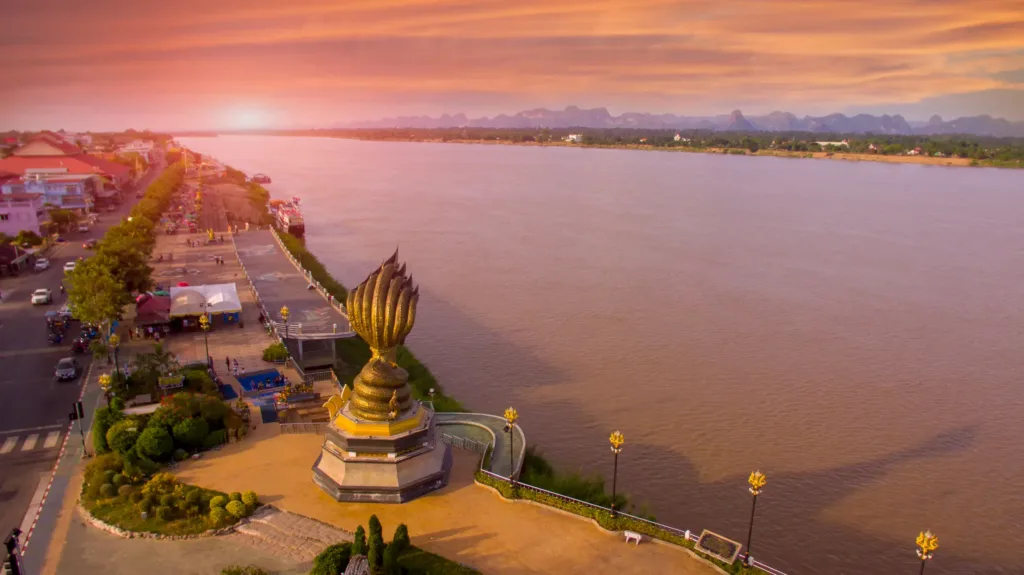
Phaya Si Satta Nakharat stands on a riverside plaza on Sunthon Wichit Road in central Nakhon Phanom. It is a gleaming seven-headed naga cast in brass, facing the Mekong and Laos, and has become the city's landmark.People come to pray for success at work, in business and for luck, and return with baisi offerings or dancers when wishes come true. The base is an octagonal room telling the story of how the statue was made.Every early July the province holds an offering festival with processions, dance offerings and a Thai–Lao market. The plaza is right on the Mekong promenade and good for sunrise.
- Sunrise over Laos
- Open plaza, harsh sun
- Soft evening light
Arrive Dawn for sunrise, or late afternoon
- In front of the nagaThe naga with the Mekong behindmorning
- Riverside promenadeThe whole plazaevening
Good to know here
Dress modestly and queue to enter the octagonal room under the base
Fireworks set fire to the garland on the naga's necklace in Oct 2026
- Come at dawn to see the sun rise over Laos
- Bring flowers or a baisi if you plan to make a wish
- Carry on along the riverside promenade
- Check the dates of the annual festival if you want to see the processions
Free · Time needed 30 minutes–1 hour
The July festival and weekend evenings
- Kids Fine; a wide plaza on the riverside walk
- Seniors Flat ground in town
- Wheelchair The plaza is flat, but no information on access to the room under the base
- Pets A public plaza, but a place of worship; best avoided
- Dress modestly
- Queue for the room under the base
- No fireworks
- Don't climb the statue
- The plaza has no shade
- Big events get crowded; mind your valuables
Phaya Si Satta Nakharat offering festival (early July)
The story of this place
Phaya Si Satta Nakharat is a seven-headed naga cast in gold-coloured brass, rising from a plaza on the Mekong riverbank on Sunthon Wichit Road in the heart of Nakhon Phanom, looking across to Laos's Khammouane Province. Completed in 2016 as part of a provincial riverfront project, it takes its name from the ancient naga legends of the Mekong basin, and within a few years it had become the city's new landmark, drawing visitors who come to pray for blessings and a major ceremony every July.
Read more 11 more paragraphs
The name "Si Satta Nak" appears in the Urangkhathat, the chronicle of Phra That Phanom. According to the legend, when the Buddha reached Doi Nanthakangri, a seven-headed naga called Si Satta Nak begged him to leave a footprint; the Buddha smiled and foretold that a city named "Mueang Si Satta Nak" would one day rise there. Scholars who study the chronicle note that it groups the naga-inhabited cities under Suvarnabhumi, separate from the Si Khottabun cities where Phra That Phanom stands.
Another tale, the Suwannakhomkham legend, says the Mekong is the river that Phaya Si Satta Nak dug out from Nong Krasae. Some versions add that he quarrelled with the naga Phaya Suttho over the sharing of meat, fought him at length and finally led his followers away to the southeast. Stories like these cast Phaya Si Satta Nak as the creator and guardian of the Mekong and of the people on both its banks.
In Nakhon Phanom itself, the belief that nagas guard Phra That Phanom has long been handed down, and a later legend tells of seven nagas watching over the stupa. Luang Pu Kham Phan of Wat That Maha Chai in Pla Pak District taught that each bank of the Mekong has its own naga lord: Phaya Si Satta Nakharat on the Lao side and Phaya Si Suttho Nakharat on the Thai side. Stories shared by the Phaya Si Satta Nakharat Foundation add that his palace lies beneath Pha That Luang in Vientiane and that the two nagas are close friends.
Before it became the naga plaza, this stretch of riverbank was a landing for cross-river barges. When the Third Thai–Lao Friendship Bridge opened on 11 November 2011, the barges stopped running and the site fell into neglect, even becoming a hangout for drug use, so the province worked with the local army command to redevelop it.
The idea of a naga statue came from Anukul Tangkhananukulchai, the 38th governor of Nakhon Phanom; research dates it to 2013, as a way to revitalise the riverfront and create a city symbol, while some news reports say planning began as early as 2011. His successor, Adisak Thep-at, signed the contract, and Governor Somchai Withdamrong carried the work through to completion, nearly five years from planning and design to the finished statue. The auspicious name was given by Phra Thammawachirasophon of Wat Phra That Phanom, who then held the title Phra Thep Woramuni.
The naga is cast in brass, with seven heads and a body coiled in three tiers, and weighs about 9 tonnes. Many sources give its height as 10.90 metres and its width as 4.49 metres, about 16 metres including the pedestal, though some state 9 metres from the base of the body. The statue alone cost about 9 million baht, within a riverfront makeover of around 40 million baht. It faces northeast, an orientation the foundation says was set by coordinates and astrology, and its necklace borrows the emblem above the gate of Phra That Phanom. Beneath it, an octagonal room tells the story of its creation.
The design story says the naga shook off the mud below, a metaphor for defilements such as craving and greed, leaving only golden skin, and then coiled upon the pedestal for the faithful to venerate. The province held the first grand consecration over nine days and nights, from 9 to 18 September 2016, under Governor Somchai Withdamrong.
From 2017 the ceremony moved to 7–13 July, the 7th day of the 7th month, running seven days and seven nights. A Chulalongkorn University study describes it as a "new tradition" built on older beliefs. Mornings feature worship of the birth-day stupas, an idea developed by astrologer Khatha Chinbunchon around 2002 and turned into a pilgrimage route with TAT in 2004, while in the evenings each district takes a turn performing devotional dances and cultural shows.
The plaza soon filled with people praying for success in work, business and luck; those whose wishes come true return with bai si offerings, mor lam singers or dancers to fulfil their vows. News reports say that after the statue appeared, more visitors chose to stay overnight in Nakhon Phanom, and a 2024 report put the province's annual visitors at nearly 2 million, up from 400,000–500,000. Since 2016 the foundation has also made replicas for Wat Phra That Phanom, and in 2025 restored replicas were carried back there in procession.
Nationally, Thailand's cabinet named the naga a national identity in the mythical-creature category on 1 November 2022. The Phaya Si Satta Nakharat ceremony was selected for the Culture Ministry's programme to raise festivals to national and international level in fiscal year 2023, and in 2024 the foundation, the province, Nakhon Phanom Municipality and Nakhon Phanom University signed an agreement to set up a Naga Learning Centre at the plaza.
The 2026 ceremony ran from 7 to 13 July with a procession led by a bai si about 7.7 metres tall, a dance offering by more than 3,000 performers, a gathering of nine Tai ethnic groups and two other communities, and a Thai–Lao market with Khammouane Province. On 28 October 2026 fireworks set alight the garland on the naga's necklace; officials brought the fire under control and asked the public not to set off fireworks at the site.
- 2011The Third Thai–Lao Friendship Bridge opens; the barge landing at this riverside spot later falls out of use
- 2013Governor Anukul Tangkhananukulchai proposes a naga statue to revitalise the Mekong riverfront
- 2016The seven-headed brass Phaya Si Satta Nakharat is completed and becomes a new city landmark
- 20169–18 September: the first grand consecration ceremony, nine days and nine nights
- 2016The Phaya Si Satta Nakharat Foundation begins making replicas for Wat Phra That Phanom
- 2017The annual ceremony moves to 7–13 July (the 7th day of the 7th month), seven days and nights
- 2023The ceremony is selected for the Culture Ministry's programme to raise festivals to national and international level
See 4 events
- 2024An agreement is signed to set up a Naga Learning Centre at the plaza
- 2025Two restored replicas are returned in procession to Wat Phra That Phanom
- 20267–13 July: the annual ceremony, with more than 3,000 dancers
- 202628 October: fireworks set the garland on the naga's necklace alight; the fire is brought under control
Check-ins & visitor photos
Arrived? Check in, collect a stamp and tell others what it is like right now
Check your location first, so you do not fill in the form for nothing
Location must be on and within 0.3 km · One check-in per place per day · come back on other days to check in again
Post photos from anywhere — no need to be here · Up to 20 photos at a time · JPG / PNG / WebP · GPS location data is removed automatically
How to get there
The plaza is on the Mekong at Sunthon Wichit Road, Nai Mueang, Mueang Nakhon Phanom.
In Nakhon Phanom town on Sunthon Wichit Road · Negotiable
Sunthon Wichit Road along the Mekong
Street parking along the riverside road
Open all day (public riverside plaza)
Phaya Si Satta Nakharat
FAQ
Before you go: Phaya Si Satta Nakharat (Naga Monument)
Answers travellers want before they go — a one-minute read
Where is Phaya Si Satta Nakharat?
On the Mekong at Sunthon Wichit Road, central Nakhon Phanom
Is there an entry fee?
No, it's a public plaza
What do people pray for?
Work, business and luck
When is the festival?
Every early July (7–13 July in 2026)
What's under the base?
An octagonal room with a small naga and the statue's story
When should I go?
At dawn for sunrise or in the softer evening light
 Wat Phra That Renu
 Wat Phra That Phanom Woramahawihan
Ready to go to Phaya Si Satta Nakharat (Naga Monument)?
Best day this week: Friday 4 Dec · Check in when you arrive to collect a stamp