 01
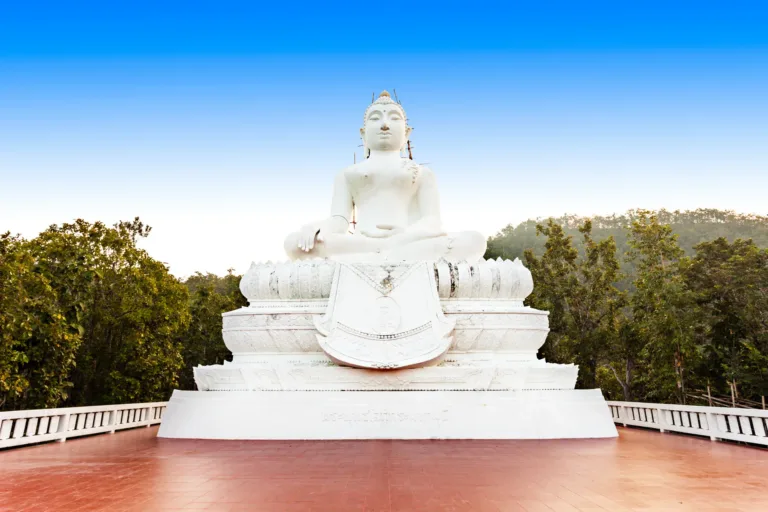
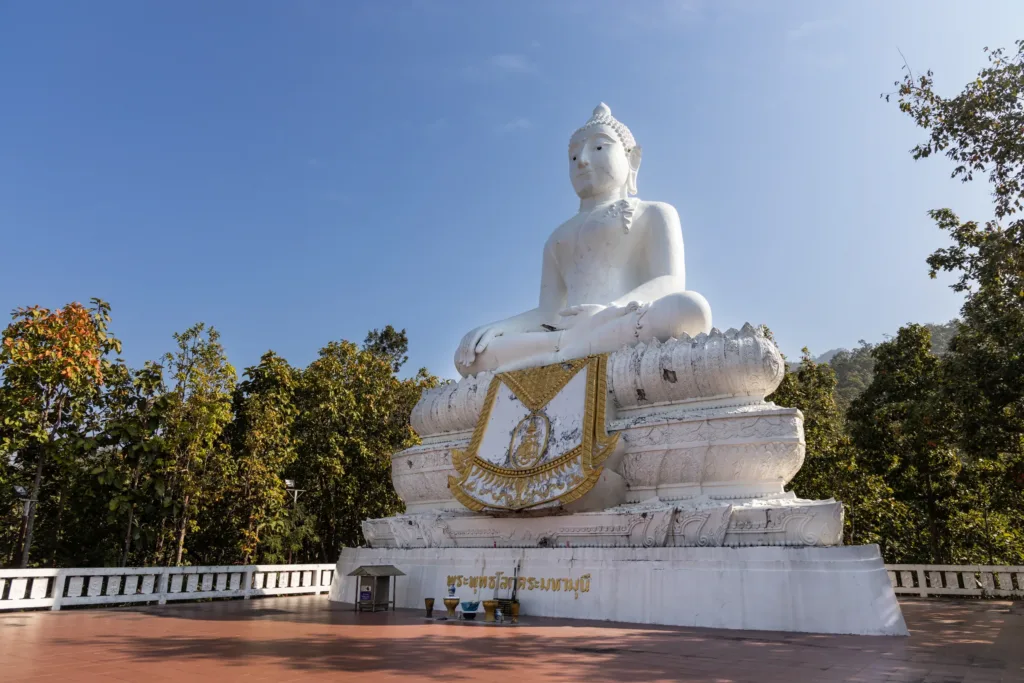
Phra Phuttha Lokuttara MahamuniA huge white Buddha in the Mara-victory posture, facing west
Hilltop Buddha · Pai, Mae Hong Son
A hilltop temple on the east side of Pai, about 2 km from town, with a huge white seated Buddha. Climb more than 300 steps for views over the Pai valley and the sunset.
Holiday / event — crowded
Dress modestly, covering shoulders and knees · Remove shoes before entering the hall · Don't climb or sit on the Buddha's base for photos
Daily, around 06:00–18:00
About an hour before sunset
01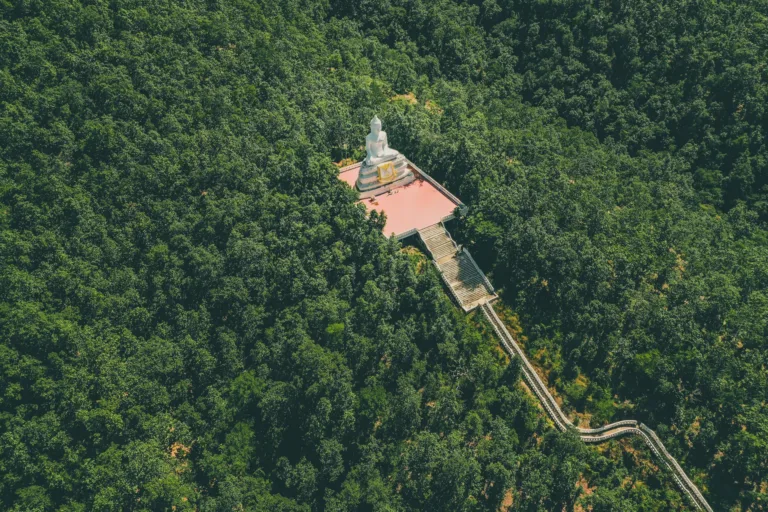 02
 03
 04
Tap a day card to see that day’s weather, rain, haze and hourly forecast
Best time to go Daytime is over · see tomorrow
Thick morning fog with visibility under 1 km — use headlights and drive slowly
Holiday — traffic on the way up and parking fills fast; leave early
Green band = hours used for the score
Best time to go Fine all day little rain through the day
Holiday — traffic on the way up and parking fills fast; leave early
Green band = hours used for the score
Best time to go Fine all day little rain through the day
No warnings today — normal road and weather conditions
Green band = hours used for the score
Best time to go Fine all day little rain through the day
No warnings today — normal road and weather conditions
Green band = hours used for the score
Best time to go Fine all day little rain through the day
No warnings today — normal road and weather conditions
Green band = hours used for the score
Best time to go Fine all day little rain through the day
No warnings today — normal road and weather conditions
Green band = hours used for the score
Best time to go Fine all day little rain through the day
No warnings today — normal road and weather conditions
Green band = hours used for the score
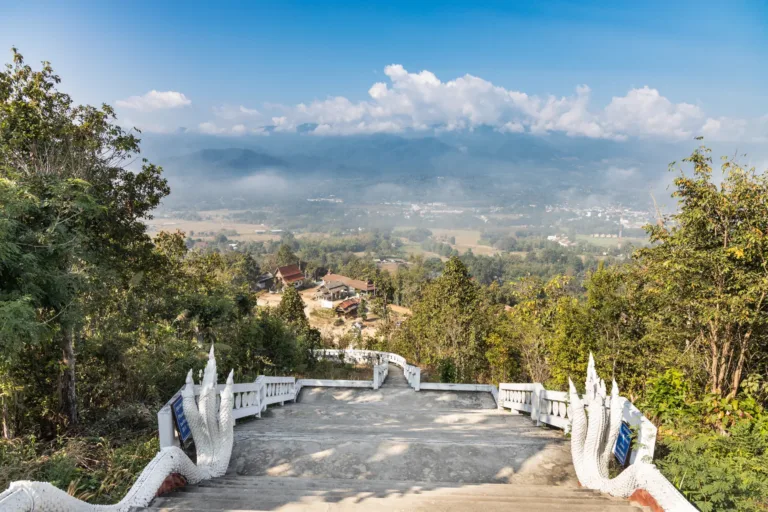
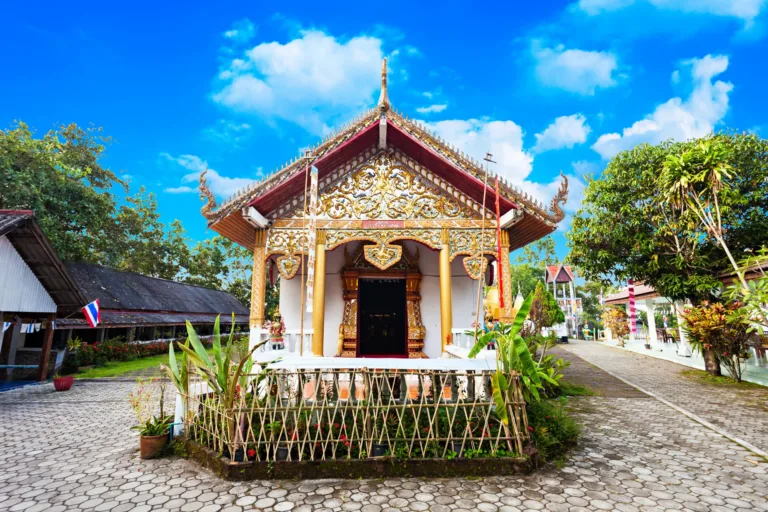
Wat Phra That Mae Yen is near Ban Mae Yen in Mae Hi, Pai, Mae Hong Son, on rural road MS 4024 about 2 km east of the district office. Travellers know it as the Big Buddha or White Buddha of Pai.On the hilltop sits Phra Phuttha Lokuttara Mahamuni, a huge white Buddha in the Mara-victory posture facing west, visible from town. More than 300 steps lead up to it, and from the top the Pai valley opens out below.Evenings bring the sunset crowd. The grounds also hold a Lanna-style hall, twin guardian lions and an old chedi behind the ordination hall. Entry is free.
Arrive About an hour before sunset
Take it slowly and bring water, especially in strong sun
Cover shoulders and knees on the Buddha terrace
Free · Time needed 1–1.5 hours
Sunset
Wat Phra That Mae Yen stands on a hill behind Ban Mae Yen in Mae Hi, on the east side of Pai. Locals have long regarded it as one of the town's oldest temples, yet no clear record says when it was founded or by whom. Its heart is a golden Burmese-style chedi behind the ordination hall. Phra Phuttha Lokuttara Mahamuni, the huge white Buddha on the summit that travellers call the White Buddha, is a later addition that turned a small village temple into Pai's landmark. The past decade or so has brought a tourism boom, a fire that destroyed its hall, and a long wait to have its legal status as an abandoned temple lifted.
People have lived in the Pai basin since prehistoric times; caves around Wiang Nuea such as Tham Phi Maen have yielded skeletons, tools and pottery. Legend says the first ruler was Khun Sang Pai. Later Chao Kaeo Mueang, sent by the ruler of Chiang Mai to inspect the frontier, advised him to move the town to the west bank of the Pai River, where the plain was wider. The new town became Wiang Tai and the old one Wiang Nuea.
In the Lanna era Pai was a frontier town under Chiang Mai, and Buddhism took root early around Mae Hi. Local histories record that Wat Si Koet, with a large chedi and ordination hall, was founded at Ban Mae Hi in 1489; today it is a ruin locals call Wat Nong Bua. The Mae Yen stream that runs past the village is one of the waterways named in Pai's history.
Pai rose and fell more than once. Local accounts say the town was abandoned along with Chiang Mai and revived as a village around 1775–1795. In 1869 it was attacked from the Burmese side, burned and its people carried off. In 1873 Phraya Chai Songkhram restored the town and resettled people from Chiang Mai. Scholars describe the Shan and the Khon Mueang as Pai's two main groups, and that mix shows at Wat Phra That Mae Yen, whose ordination hall blends Lanna and Burmese art.
The Phra That Mae Yen chedi is a bell shape on a round base about 3 metres tall, built of brick and plaster, gilded and crowned with a Burmese-style parasol. Like the temple itself, its date is unrecorded, but villagers have venerated it for generations. Because the golden chedi stands out on the hill, DASTA notes that air passengers used it as the sign they had reached Pai.
The temple also holds important images. A 2012 travel article describes Phra Chao Thong Thip, a bronze Buddha in the third Chiang Saen style more than 100 years old, while the ordination hall enshrines a reclining Buddha locals call Phra Chao Phon Thuk, with murals of the Buddha's life. A long naga staircase leads up, though counts differ: some sources say 353 steps, others more than 300 or nearly 300; a road also reaches the top.
In modern times Pai became a district of Mae Hong Son, though sources disagree on the year: one academic study gives 1900, while local histories say the town was made a district in 1911, with Luang Charoen Khet Khlang Nakhon as the first district officer. During the Second World War the Japanese cut a road through Pai, and the Chiang Mai–Pai–Mae Hong Son route was paved bit by bit over the following decades.
Pai first appeared in Lonely Planet in 1982, and backpackers arrived by word of mouth through the 1980s and 1990s. After the 1997 financial crisis, creatives from Bangkok opened businesses, and from 2001 Thai visitors became the main market, with guesthouses growing from 14 to 98 by 2009. In this period the temple terrace, looking down on Pai in its valley basin, became a sunset spot recommended by travel media.
Phra Phuttha Lokuttara Mahamuni is a white Buddha in the Mara-victory posture, facing west toward town. No reliable source gives the year it was built or who built it. A 2012 travel article does not mention it, but visitor reviews from 2015 already describe a white Buddha on the hill, and in 2017 travel media called its terrace a new viewpoint higher than the old one. Around the same time Pai became better known to Chinese travellers after the film Lost in Thailand.
At about 3:30 a.m. on 6 January 2018, fire destroyed the temple's old viharn completely. Fire crews from Mae Hi and Wiang Tai brought it under control by 5:40 a.m. The village headwoman called it suspicious, and CCTV footage was reviewed to find the cause.
After the fire, the Ban Mae Yen community took the lead in caring for the temple and applied for official temple status on 30 January 2019. In 2021 the village committee briefly closed the road up to vehicles to guard against COVID-19. On 8 May 2022 a merit-making ceremony for a new viharn, presided over by the abbot of Wat Thepsirin, a member of the Supreme Sangha Council, raised about 1.8 million baht. But on 25 June 2022 the community had to put up signs halting donations and construction after the Mae Hong Son Provincial Buddhism Office said the temple was still legally abandoned and the earlier application had lapsed, so a new one had to be filed.
Today Wat Phra That Mae Yen remains one of Pai's favourite viewpoints. Information from 2023 still invites donations toward a new viharn, and no confirmed report on the outcome of the status application has been found since. The temple is at once an old chedi of unknown age, a modern white Buddha, and a community still looking after its village temple.
Arrived? Check in, collect a stamp and tell others what it is like right now
Check your location first, so you do not fill in the form for nothing
Location must be on and within 0.8 km · One check-in per place per day · come back on other days to check in again
Post photos from anywhere — no need to be here · Up to 20 photos at a time · JPG / PNG / WebP · GPS location data is removed automatically
The temple is on rural road MS 4024 near Ban Mae Yen, Mae Hi, about 2 km east of Pai town.
East from Pai town on road MS 4024 · Rental
Follow signs for Mae Yen Waterfall · Fuel
Paved rural road MS 4024
Car park on site
Pai town
Daily, around 06:00–18:00
about 2 km from Pai town
Wat Phra That Mae Yen
Answers travellers want before they go — a one-minute read
Near Ban Mae Yen, Mae Hi, about 2 km east of Pai town
More than 300
No, it's free
Phra Phuttha Lokuttara Mahamuni, in the Mara-victory posture
In the evening before sunset
Cover shoulders and knees
Best day this week: Monday 30 Nov · Check in when you arrive to collect a stamp
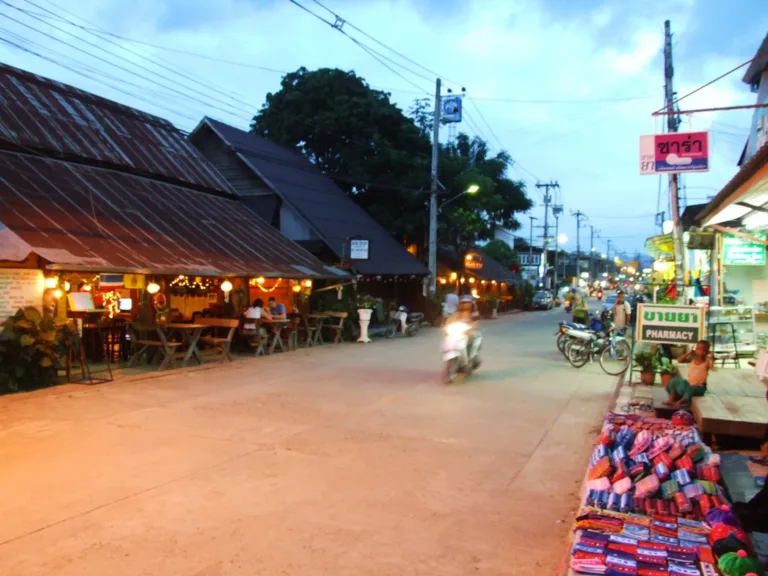 Pai Walking Street
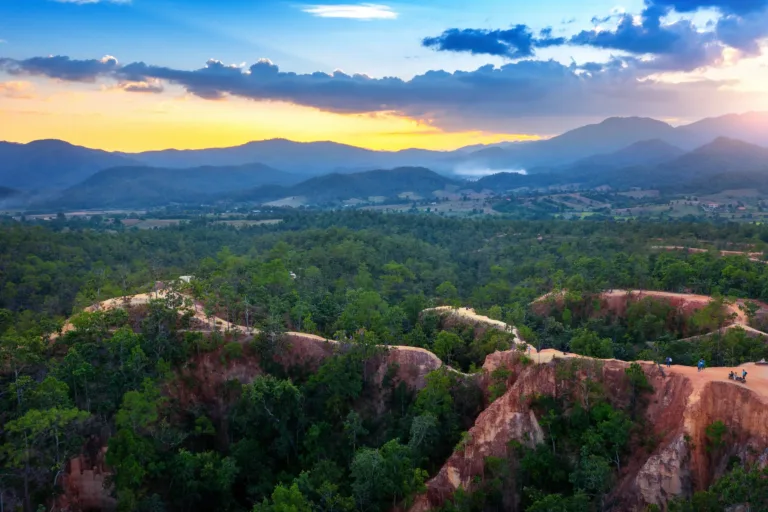 Kong Lan (Pai Canyon)
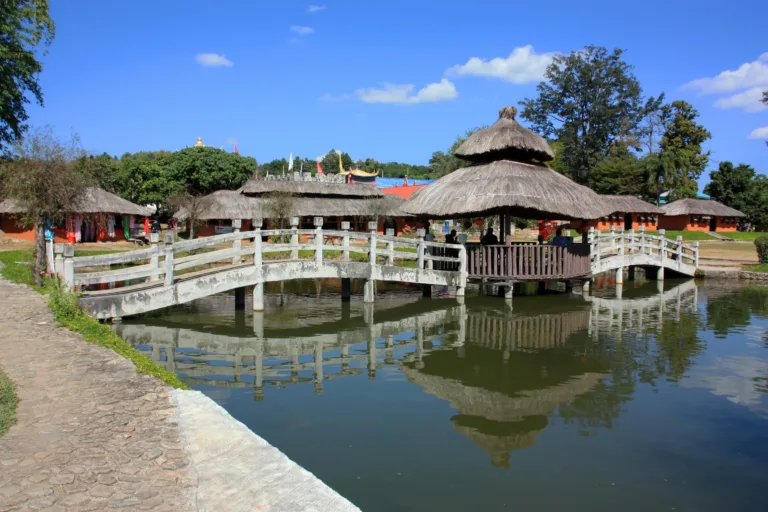 Santichon Village