 01
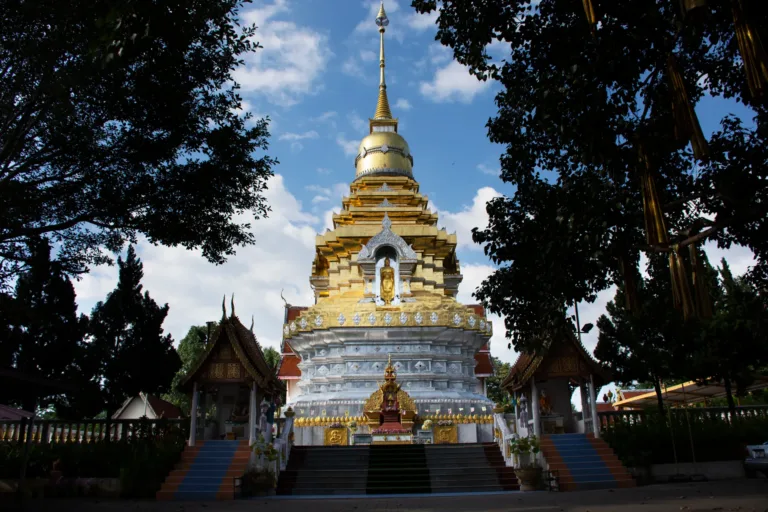
Phra That Doi SaketA golden chedi about 30 m tall built over the original, said to hold a hair relic of the Buddha
Hilltop relic temple · Doi Saket, Chiang Mai
A royal hilltop temple that gave Doi Saket district its name, said to enshrine a strand of the Buddha's hair, with striking modern murals in its four-porched viharn and wide views over rice fields and hills.
Good weather, little rain
Dress modestly, covering shoulders and knees · Remove shoes before entering the viharn and the chedi area · Keep your voice down inside the viharn · Don't point your feet at Buddha images
Daily, about 06:00–18:00 (some sources say 07:00–18:00)
Before 09:00 for cool air, or after 16:00 for the evening light
Relic-bathing at Songkran, 13–17 April · The relic is brought down for bathing on the full moon of the sixth lunar month (Visakha Bucha)
01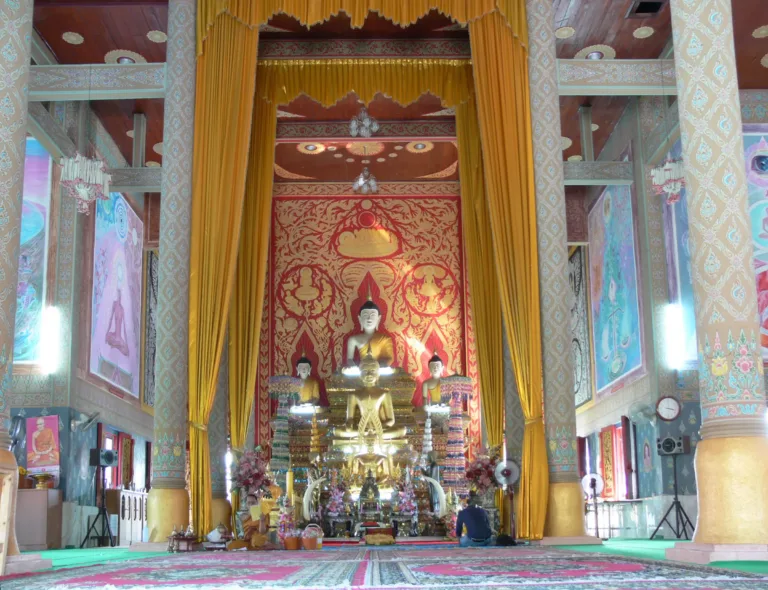 02
 03
 04
Tap a day card to see that day’s weather, rain, haze and hourly forecast
Best time to go Daytime is over · see tomorrow
No warnings today — normal road and weather conditions
Green band = hours used for the score
Best time to go Fine all day little rain through the day
No warnings today — normal road and weather conditions
Green band = hours used for the score
Best time to go Fine all day little rain through the day
No warnings today — normal road and weather conditions
Green band = hours used for the score
Best time to go Fine all day little rain through the day
No warnings today — normal road and weather conditions
Green band = hours used for the score
Best time to go Fine all day little rain through the day
No warnings today — normal road and weather conditions
Green band = hours used for the score
Best time to go Fine all day little rain through the day
No warnings today — normal road and weather conditions
Green band = hours used for the score
Best time to go Fine all day little rain through the day
No warnings today — normal road and weather conditions
Green band = hours used for the score
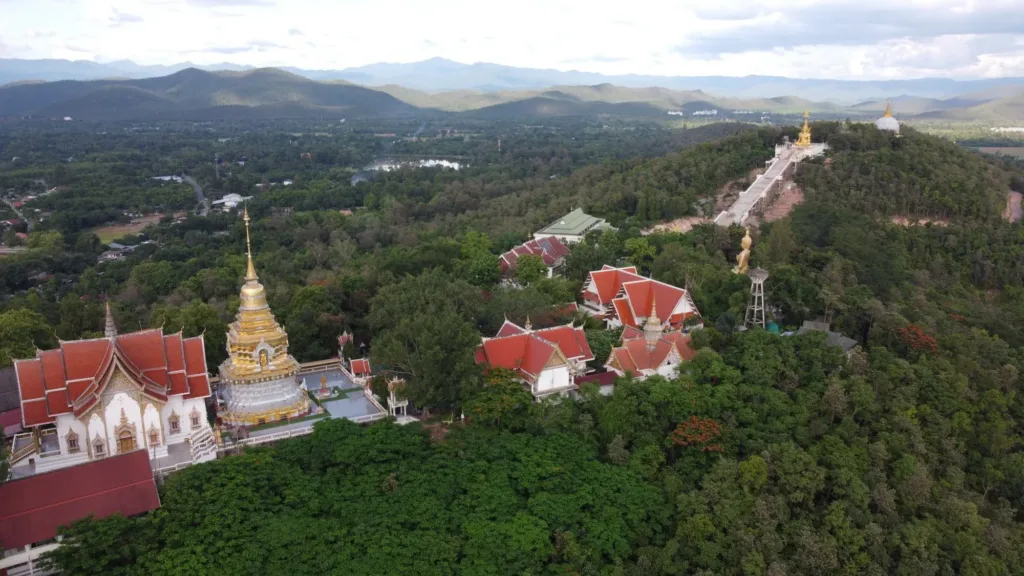
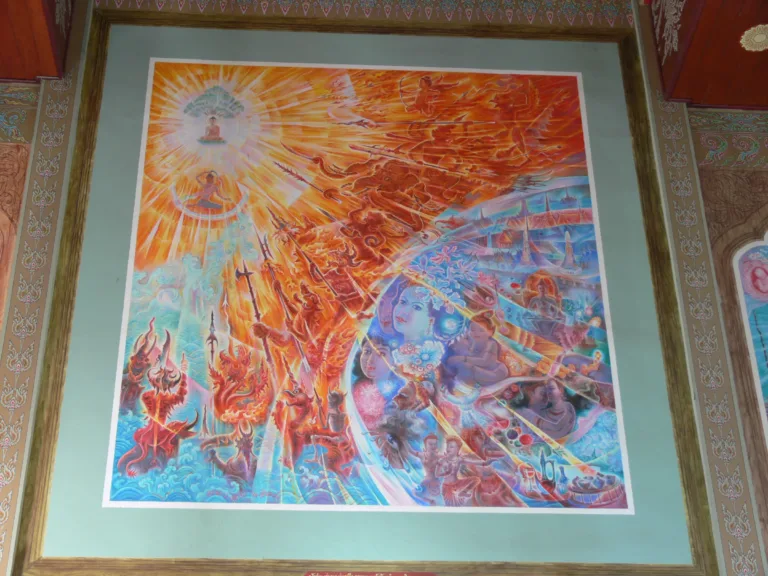
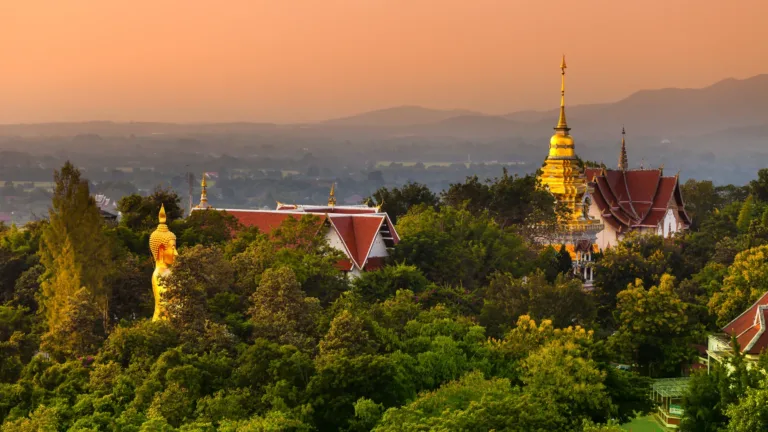
Wat Phra That Doi Saket crowns a low hill on the eastern edge of Doi Saket town, about 20–25 km from Chiang Mai along the Chiang Mai–Doi Saket road (Highway 118). This royal temple enshrines a relic that legend says is a strand of the Buddha's hair, given to a pair of nagas, and the hill and temple gave the whole district its name.The golden chedi, about 30 m tall, was rebuilt in 1993 around the original. Beside it stands the four-porched viharn of 1977, whose walls are covered with 18 sets of vivid modern Dhamma-riddle murals telling the Buddha's life and moral lessons, and these are reason enough for art lovers to make the trip.The hill also holds a cluster of newer sights: a giant Buddha, a crowned Buddha on the summit at the top of a long staircase, a reclining Buddha, a replica of Myanmar's Golden Rock, a footprint shrine and an elevated skywalk. The terraces look out over the town, rice fields and layered ridges, best of all late in the day.You can drive right up to the temple terrace or climb the stairs from the foot of the hill. Allow one to two hours, dress modestly and take off your shoes before entering the chedi area. Mae Kuang Udom Thara Dam and the Huai Hong Khrai study centre are close by if you want to make a half-day of it.
Arrive Before 09:00 for cool air, or after 16:00 for the evening light
Use a low gear on the way down; take it slowly on a motorbike
The stairs to the summit Buddha run to more than 200 steps with little shade, so carry water
Shoes off before entering, and dress modestly
Stucco on the stair archway fell in a 2022 quake, so stick to the paths the temple keeps open
No data yet check before you go · Time needed About 1–2 hours
Songkran, Visakha Bucha and long holidays
Relic-bathing at Songkran, 13–17 April · The relic is brought down for bathing on the full moon of the sixth lunar month (Visakha Bucha)
Wat Phra That Doi Saket is a royal temple on the summit of Doi Saket, a low hill about 425 m high in the Khun Tan range, in Choeng Doi subdistrict, Doi Saket district, Chiang Mai. It lies some 20–25 km from the city along the Chiang Mai–Doi Saket road (Highway 118). The temple enshrines a relic that tradition says is a strand of the Buddha's hair, kept inside a golden concrete chedi about 30 m tall that was built over the original. The district itself takes its name from the hill and its temple. Today it is a third-class royal temple of the common grade, known for its modern Dhamma-riddle murals in the four-porched viharn and for wide views over the town, rice fields and layered ridges.
According to the temple's legend, after his enlightenment the Buddha appeared on this hill and radiated light in six colours. Two nagas living in a lotus pond about 1 km to the northeast saw the glow, climbed up and were so moved that they took the form of a young man and woman and offered him lotus flowers. In return he gave them hair relics and taught them, and the nagas piled stones into a chedi to enshrine the relics on the summit. This part of the story is temple legend with no date attached.
Later, the story goes, a hunter found the stone chedi, restacked it and dreamed that it held a relic, so he encouraged villagers to come and worship. The hill became known as Doi Sen Ket, the hill of the hair strand, which over time became Doi Saket. Another local story links the name to a naga shedding its skin on the hill. Some English sources say the temple was built in 1112, and one Thai article calls the chedi over a thousand years old, but neither says which era or evidence the figure is based on, so these are best treated as tradition.
The dated history starts around 1612 (BE 2155), when a monk from Nan, known as Khruba Ke, built a viharn, restored the chedi and formally established the temple as Wat Phra That Doi Saket. The English Wikipedia gives the date as 6 January 1612, and when the temple applied for a land title in 2022 it stated that it had occupied the land since its founding in BE 2155. Settlers gradually gathered around the hill, and when the government created a district here it was named after it.
In 1835 (CS 1197) a layman known as Pho Noi Inthachak restored the old viharn. Around 1905 Phra Aphiwong and Pho Nan Inthawong brought some of the first families to settle at the foot of the hill and supported the temple. Later Khruba Chai of Wat Luang Nuea (Wat Si Mung) repaired the viharn and enlarged the chedi. Sources disagree on the year: the newspaper Naewna says 1908, the English Wikipedia 1912, and Chiang Mai News gives CS 1247 (1885).
On 7 February 1918 the temple received a royal grant of an ordination boundary (wisungkhamsima). It is now a third-class royal temple of the common grade, and in 2000 it was named an outstanding model development temple. Its recent abbot, Phra Ratchaphothiworakhun, also serves as the district's ecclesiastical head. The grounds are extensive: in 2022 the land office issued a title deed for about 170 rai.
The four-porched viharn beside the chedi was built in 1977. It houses five principal Buddha images known as the Five Lords, and its walls carry 18 sets of Dhamma-riddle murals in a modern Lanna style mixed with special techniques, running from the Bodhisattva in the Tusita heaven and his birth on a lotus to a cautionary scene about monks and the saffron robe. Several English-language sources say the painter spent more than four years on them in the early 1990s, but sources do not agree on who painted them.
The chedi you see today was restored in 1993 as a reinforced-concrete structure about 30 m tall enclosing the original, its gilded upper part visible from far away. Each year on the full moon of the sixth lunar month (the eighth in the northern calendar) the relic is brought down for people to bathe. At Songkran the temple holds relic-bathing, a wooden-prop procession, sand-carrying into the grounds, a water blessing for elders and a long-life ceremony. Another custom, described in a 2015 study from Mahachulalongkorn University as a temple tradition, is pouring fresh milk over the Bodhi tree.
Around 2014 marks resembling a Buddha footprint were found on the summit, about 9–9.5 inches long and 4–5 inches wide with a round wheel-like mark in the sole, and the temple built a small pavilion over them. Naewna noted in 2016 that geological and archaeological study was still needed. The temple also has a museum on King Rama IX's visits to nearby Nong Bua, close to the Huai Hong Khrai Royal Development Study Centre, and a room on the life of the Tai Lue, who came from Chiang Rung and other towns and settled in the area about 200 years ago.
A road southeast of the old temple leads to a cluster of newer sites: the golden Maha Pathimakorn Buddha in the blessing pose, with a lap width of 9.99 m, built to honour the Queen's fifth-cycle birthday, a crowned Buddha in Jambupati style under a golden umbrella on the peak at the top of a staircase of more than 200 steps (227 by one account, matching the number of monastic precepts), a 59.99 m reclining Buddha at the foot of the stairs, a replica of Myanmar's Golden Rock and an elevated skywalk viewpoint.
The temple sits close to local fault activity. The magnitude 6.3 Chiang Rai earthquake of 2014 cracked its office building, and on 20 October 2022 a magnitude 4.1 quake centred in Mae Khue subdistrict of Doi Saket brought down much of the decorative stucco on the archway at the stairs to the chedi, though the chedi itself was undamaged. Today the temple still runs moral-training courses, youth camps and community health work, and its hilltop terraces are a favourite evening stop for both locals and visitors.
Arrived? Check in, collect a stamp and tell others what it is like right now
Check your location first, so you do not fill in the form for nothing
Location must be on and within 1 km · One check-in per place per day · come back on other days to check in again
Post photos from anywhere — no need to be here · Up to 20 photos at a time · JPG / PNG / WebP · GPS location data is removed automatically
The temple sits on a hill on the eastern side of Doi Saket town, about 20–25 km from central Chiang Mai via Highway 118.
Take Highway 118 to Doi Saket and drive up to the temple terrace · Fuel
Shared trucks run from Warorot Market to Doi Saket town; ask the driver to stop near the temple, and check how to get back before you go
Easiest if you are continuing to Mae Kuang Dam or the hot springs; agree the fare first
Highway 118 (Chiang Mai–Doi Saket), flat paved road; the final climb up the hill is steep with hairpin bends
Parking on the temple terrace
Daily, about 06:00–18:00 (some sources say 07:00–18:00)
about 20–25 km from Central Chiang Mai
Wat Phra That Doi Saket
Answers travellers want before they go — a one-minute read
On a hilltop on the east side of Doi Saket town, Choeng Doi subdistrict, about 20–25 km from Chiang Mai via Highway 118
Temple legend says a hair relic the Buddha gave to a pair of nagas; the present chedi was built over the original
Yes, a road goes up to the temple terrace, though the last stretch is steep with hairpin bends; you can also climb the stairs from the foot of the hill
Inside the four-porched viharn beside the chedi: 18 sets of modern Dhamma-riddle paintings
Tradition says the hill was first called Doi Sen Ket, after the hair relic, which later became Doi Saket, and the district is named after the hill
Mae Kuang Udom Thara Dam, the Huai Hong Khrai study centre and San Kamphaeng Hot Springs are all close by
Best day this week: Saturday 28 Nov · Check in when you arrive to collect a stamp
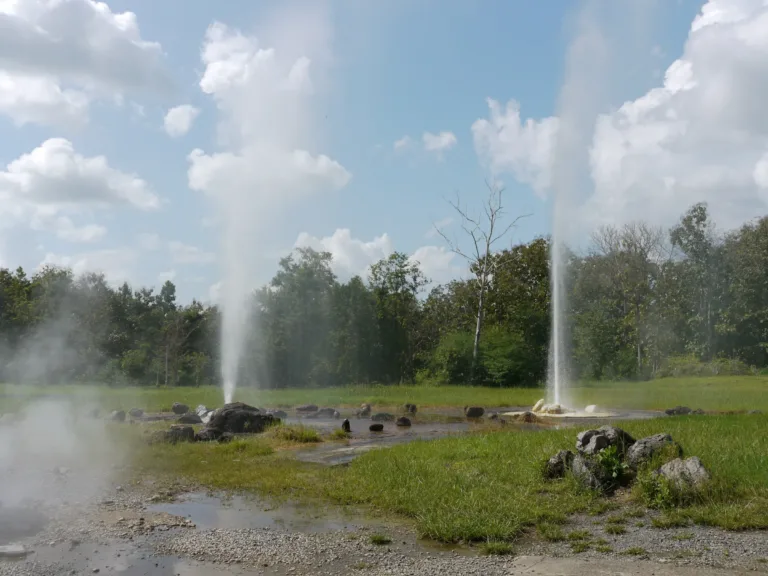 San Kamphaeng Hot Springs
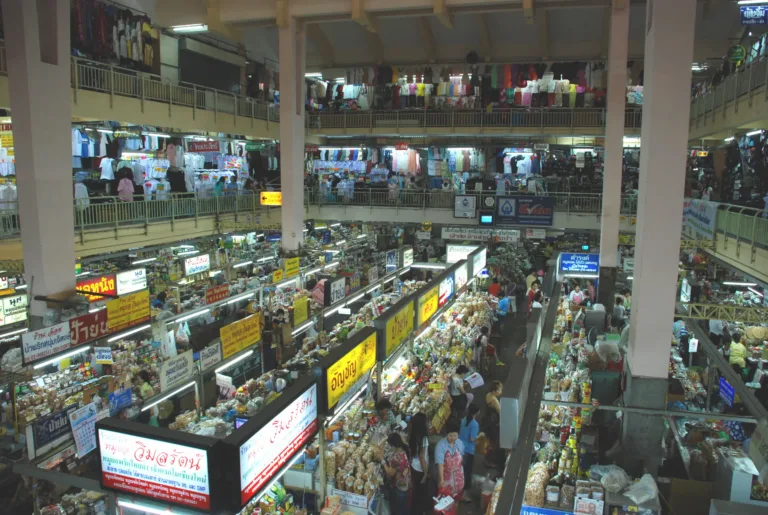 Warorot Market (Kad Luang)
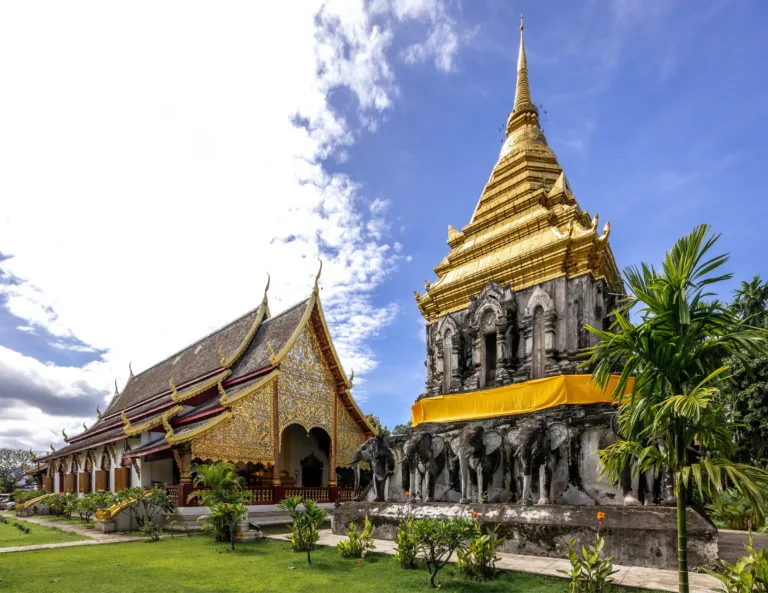 Wat Chiang Man