 01
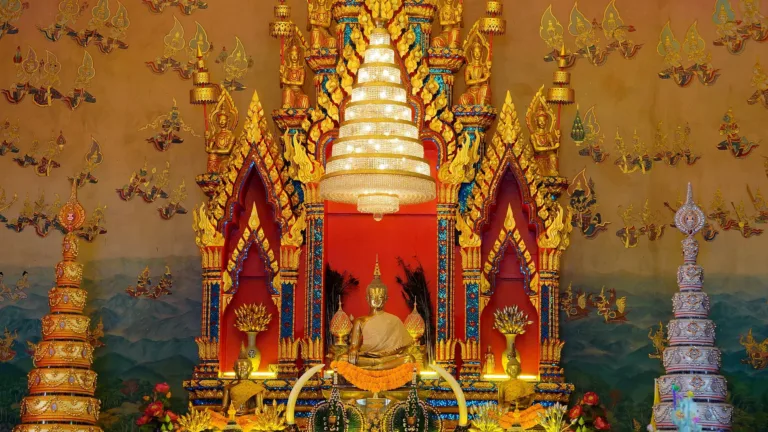
Luang Pho Phra SaiA Lan Xang-style Buddha, Nong Khai's guardian image
Guardian Buddha · Nong Khai
A royal temple in central Nong Khai, home to Luang Pho Phra Sai, the Lan Xang-style Buddha that is the city's guardian image. It is paraded for bathing every Songkran. Free entry.
Holiday / event — crowded
Dress modestly, shoulders covered · Keep your voice down in the ordination hall · Don't touch the image or other people's offerings · Don't take photos that disturb worshippers
Daily 08:00–16:30
Morning, before the heat and crowds
Songkran celebration for Luang Pho Phra Sai (April)
01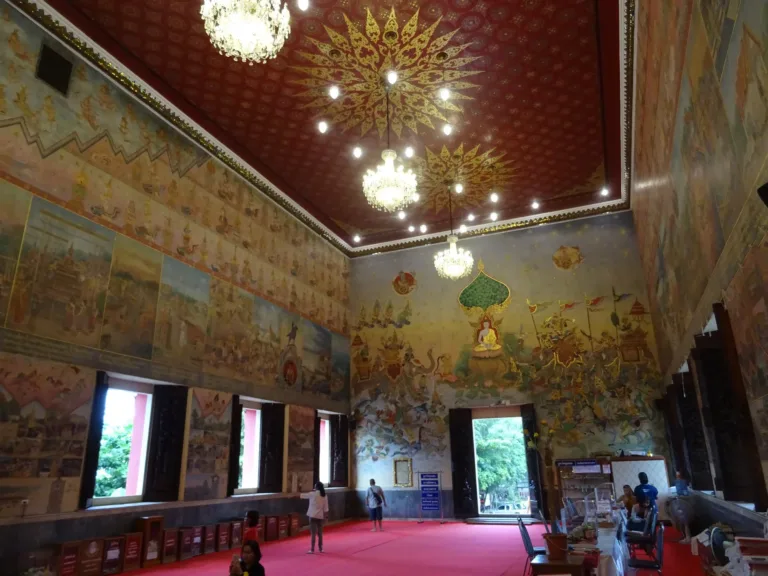 02
Tap a day card to see that day’s weather, rain, haze and hourly forecast
Best time to go Daytime is over · see tomorrow
Holiday — traffic on the way up and parking fills fast; leave early
Green band = hours used for the score
Best time to go Fine all day little rain through the day
Holiday — traffic on the way up and parking fills fast; leave early
Green band = hours used for the score
Best time to go Fine all day little rain through the day
No warnings today — normal road and weather conditions
Green band = hours used for the score
Best time to go Fine all day little rain through the day
No warnings today — normal road and weather conditions
Green band = hours used for the score
Best time to go Fine all day little rain through the day
No warnings today — normal road and weather conditions
Green band = hours used for the score
Best time to go Fine all day little rain through the day
No warnings today — normal road and weather conditions
Green band = hours used for the score
Best time to go Fine all day little rain through the day
No warnings today — normal road and weather conditions
Green band = hours used for the score
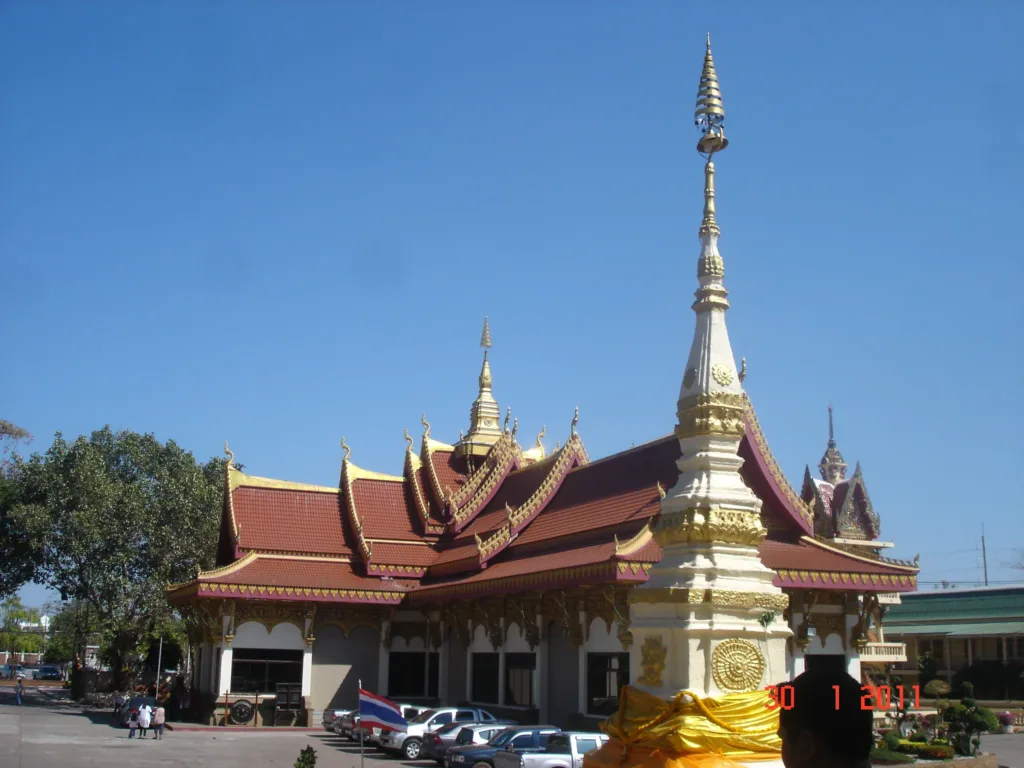
Wat Pho Chai is a royal temple in Nai Mueang, central Nong Khai, a short way from Tha Sadet market on the Mekong. It houses Luang Pho Phra Sai, a Lan Xang-style bronze Buddha in the subduing-Mara posture that locals regard as the city's guardian.Legend says Phra Sai is one of three sibling images, Phra Suk, Phra Soem and Phra Sai, made by three princesses of Lan Xang. Inside the ordination hall, murals tell the life of the Buddha and of people on both banks of the Mekong.Open daily and free to enter. At Songkran the image is paraded around the city for people to bathe.
Arrive Morning, before the heat and crowds
Cover shoulders, nothing too short; be respectful in the ordination hall
Streets close in stages for the procession; allow extra time
Free · Time needed 30 minutes–1 hour
Songkran (13 April) and long weekends
Songkran celebration for Luang Pho Phra Sai (April)
Wat Pho Chai is a third-class royal temple in the heart of Nong Khai and home to Luang Pho Phra Sai, a Lan Xang-style Buddha in the subduing-Mara posture that local people regard as the guardian image of their city. Its story ties together the legend of the three sibling Buddhas of Lan Xang, the war with Chao Anouvong, the founding of Nong Khai on the Mekong, and the Songkran procession of Phra Sai that still fills the streets every April.
Legend says three daughters of a Lan Xang king, usually identified as King Setthathirath, who reigned from about 1550 to 1572 and moved the capital to Vientiane in 1563, together made three Buddha images and named them after themselves: Phra Suk, Phra Soem and Phra Sai. Every telling agrees that Phra Sai belonged to the youngest sister, but sources differ on the elder two; some make Phra Suk the eldest, others Phra Soem.
The casting legend tells how villagers and monks kept the furnace going for seven days without the gold melting. On the eighth day a mysterious white-robed ascetic arrived to help. When people came back, he had vanished and the metal had already been poured into three moulds. It is said the villagers saw many such figures while the monks saw only one.
Some versions of the legend date the casting to around 1566, but art historians, judging from its style, place Luang Pho Phra Sai in the late 22nd to early 23rd century of the Buddhist Era, roughly the 17th century CE. The image is bronze, described as a golden alloy, with clear Lan Xang features: small hair curls, a flame-shaped finial, a round face, arched brows and a gentle smile. The lap is about 83 cm wide and the figure about 107 cm tall, while its high base may reflect later Rattanakosin influence. Locals also call it "Luang Pho Kwian Hak", the Buddha of the broken cart.
After they were made, the three images were kept in the Lan Xang capital. In times of war they were hidden at Phu Khao Khwai and brought back once peace returned. Later they stayed for a long time in Vientiane as some of the kingdom's most important images.
Around 1827–1828 Chao Anouvong of Vientiane tried to win independence from Siam, and Rama III sent the Front Palace prince Maha Sakdiphonlasep to put down the revolt. Afterwards the three images were taken across the Mekong towards Nong Khai, each on its own raft. A storm broke out, Phra Suk's raft came apart and the image sank. The spot is known as Woen Phra Suk, near Ban Nong Kung in Phon Phisai district; another version says the rafts came down from Phu Khao Khwai and calls the place Woen Thaen. Phra Suk has never been found.
In the same period Rama III had Thao Suwo choose a site for a new administrative centre from four candidates, and he chose Ban Phai, today's Nong Khai. One study says Phra Soem and Phra Sai were enshrined at Wat Ho Kong in 1829, while other accounts say Phra Sai was at Wat Pho Chai from the start and Phra Soem at Wat Ho Kong, also called Wat Pradit Thammakhunaporn. A replica of Phra Suk was later made for Wat Si Khun Mueang.
No record shows when Wat Pho Chai itself was founded. It was once an abandoned temple called Wat Phi Phiu, used for cremations, and is thought to have been an important temple when the area belonged to Vientiane. Researchers say it was restored and re-founded as Wat Pho Chai on 21 February 1840, after which it became the town's leading temple; it was later made a third-class royal temple of the Mahanikaya order.
During the reign of Rama IV (1851–1868), Khun Worathani and Chao Men were sent to bring Phra Soem to Bangkok and planned to take Phra Sai as well. Legend says that when the cart carrying Phra Sai reached Wat Pho Chai it broke down again and again, and people believed spirits and nagas were holding the image back. Only Phra Soem went on to Bangkok, where it now sits at Wat Pathum Wanaram, a temple begun in the same reign around 1854, while Phra Sai stayed in Nong Khai.
In the reign of Rama V, around 1885 during the Haw wars, Prince Prachak Silpakhom set up his headquarters in Nong Khai; Prachak Silpakhom Road, which passes the temple, bears his name. In 1979 King Bhumibol presided over raising the roof finial of the ordination hall. Inside, murals show the life of the Buddha, the legend of Phra Sai and local customs, though no record says when they were painted.
The temple is best known for the procession of Luang Pho Phra Sai every 13 April. The image is carried out of the ordination hall, taken three times around it, then placed on a royal chariot for a circuit of more than 10 km through town. It then sits in a pavilion in the temple grounds for people to bathe until it returns to the hall around 18 April. Locals say it often rains on procession day, and many take home the white cloths used to wipe the image as sacred keepsakes. During COVID-19 in 2020, the province had to confer with the temple over whether the procession could be held safely.
On 10 January 2024 the temple held a ceremony to cast a replica of Phra Sai, after the Fine Arts Department found the original had a partly damaged left eye, a cracked crown and corroded metal and prepared to restore it; the replica is now used for the procession and bathing. Faith in Phra Sai is also the subject of several academic studies, from the 2015 "Phra Sai Pha Baramee" amulets to a learning centre on the image at the temple.
Arrived? Check in, collect a stamp and tell others what it is like right now
Check your location first, so you do not fill in the form for nothing
Location must be on and within 0.4 km · One check-in per place per day · come back on other days to check in again
Post photos from anywhere — no need to be here · Up to 20 photos at a time · JPG / PNG / WebP · GPS location data is removed automatically
The temple is in Nai Mueang, central Nong Khai, on Prajak Sillapakhom Road (Soi Phra Sai), near Tha Sadet market.
From Nong Khai train or bus station · Negotiable
Prajak Sillapakhom Road in town
Town streets
Limited space at the temple and on the street; hard during festivals
Daily 08:00–16:30
Wat Pho Chai
Answers travellers want before they go — a one-minute read
A Lan Xang-style Buddha, one of the sibling images Phra Suk, Phra Soem and Phra Sai
No, entry is free
Daily 08:00–16:30
At Songkran, around 13 April, returning to the hall around 18 April
Modest clothing, shoulders covered
Tha Sadet market and the Mekong riverside
Best day this week: Monday 30 Nov · Check in when you arrive to collect a stamp
 Sala Kaew Ku
 Wat Pha Tak Suea
 Kham Chanot