 01
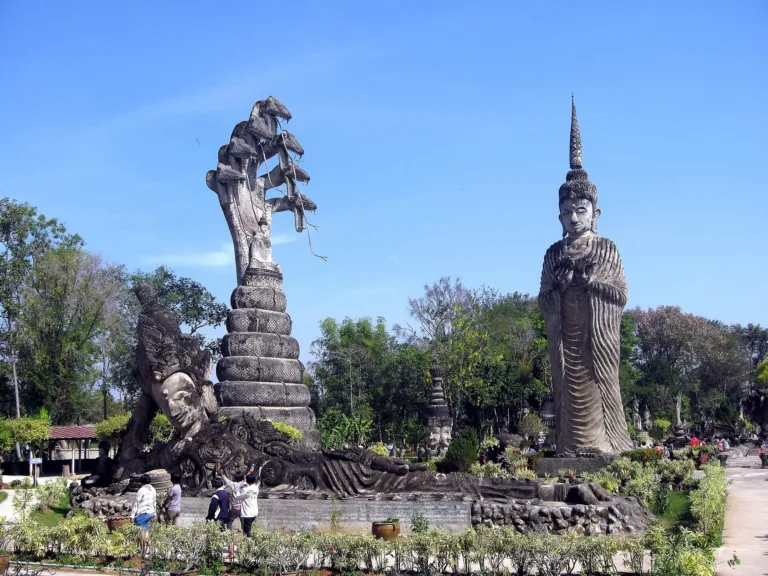
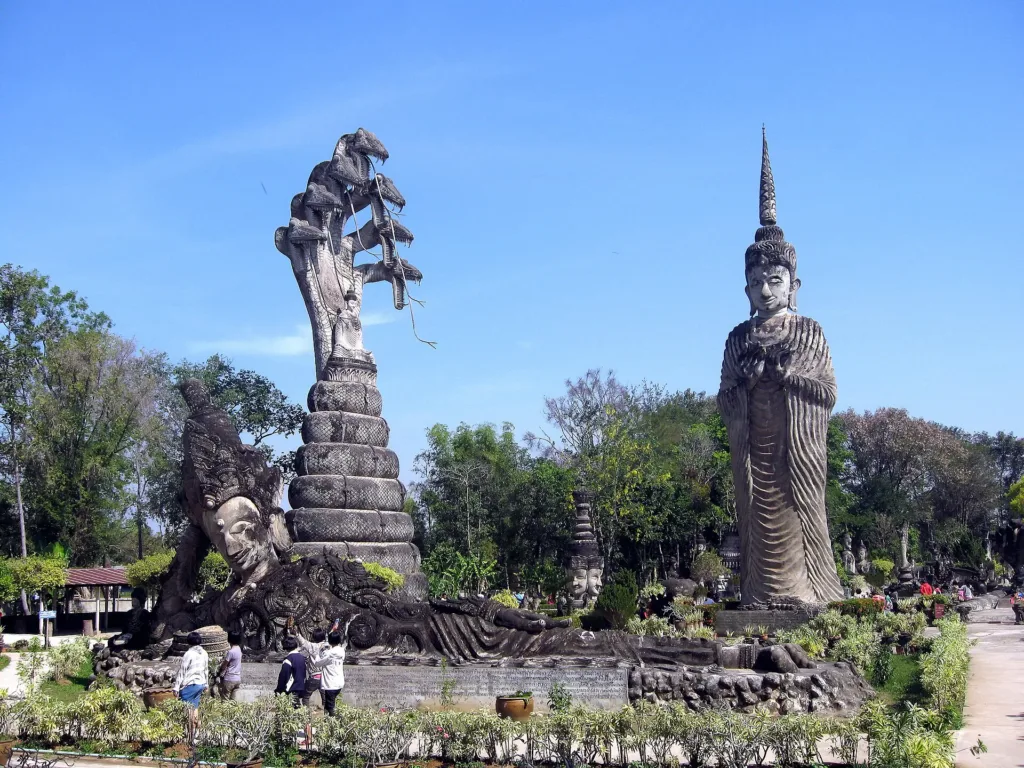
Seven-headed naga BuddhaThe park's signature sculpture, about 25 m tall
NONG KHAI · SCULPTURE PARK
Luang Pu Bunleua Sulilat's park of more than 200 giant Buddhist and Hindu concrete sculptures near Nong Khai town, with a 25 m Buddha sheltered by a seven-headed naga, the Wheel of Life and a three-storey pavilion holding his body.
Holiday / event — crowded · Hot (Afternoon) feels like 39°C
Daily 6:00–18:00 (third floor of the pavilion 7:00–17:00)
20 THB
1–2 hours
Late mornings on holidays, and Oct – Jan
01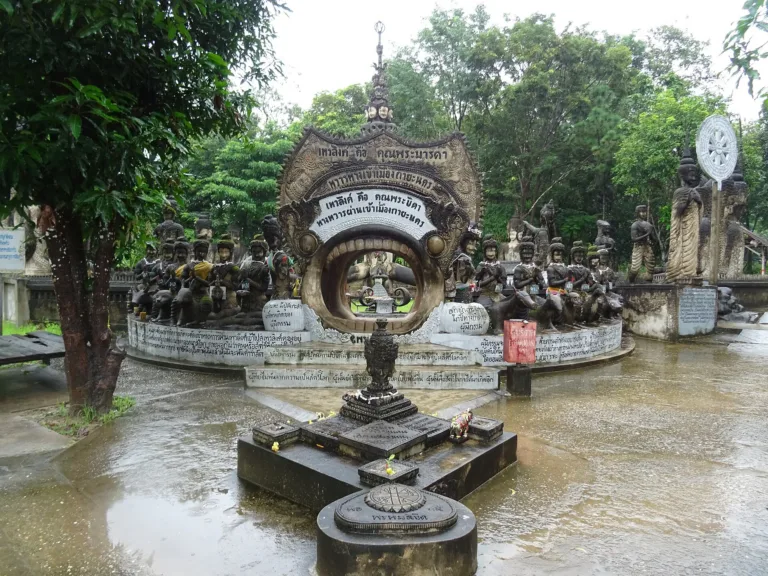 02
 03
 04
 05
Tap a day card to see that day’s weather, rain, haze and hourly forecast
Best time to go Fine all day little rain through the day
Holiday — traffic on the way up and parking fills fast; leave early
Green band = hours used for the score
Best time to go Fine all day little rain through the day
Holiday — traffic on the way up and parking fills fast; leave early
Green band = hours used for the score
Best time to go Fine all day little rain through the day
Holiday — traffic on the way up and parking fills fast; leave early
Green band = hours used for the score
Best time to go Best window 09:00–19:00 Little rain · light drizzle possible at times
No warnings today — normal road and weather conditions
Green band = hours used for the score
Best time to go Best window 06:00–14:00 Little rain
No warnings today — normal road and weather conditions
Green band = hours used for the score
Best time to go Fine all day little rain through the day
No warnings today — normal road and weather conditions
Green band = hours used for the score
Best time to go Fine all day little rain through the day
No warnings today — normal road and weather conditions
Green band = hours used for the score
Sala Kaew Ku (also spelled Sala Keoku), known locally as "Wat Khaek", is a park of giant concrete sculptures on about 42 rai (6.7 ha) in Ban Samakkhi, Hat Kham subdistrict, 4–5 km east of Nong Khai town on Highway 212.
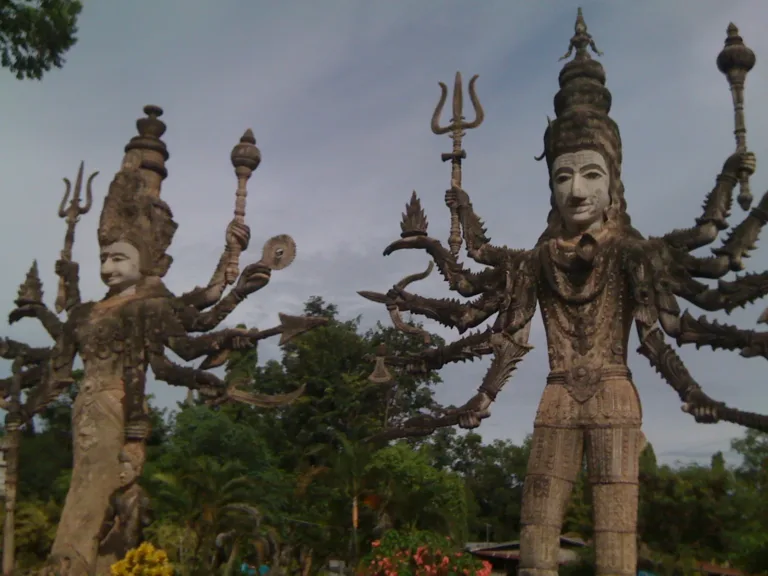
It was built from 1978 by Luang Pu Bunleua Sulilat, who believed all religions could live together. More than 200 Buddhas, Hindu deities and moral parables stand here, the tallest about 25 m, each with an explanation in Thai and Isan at its base.
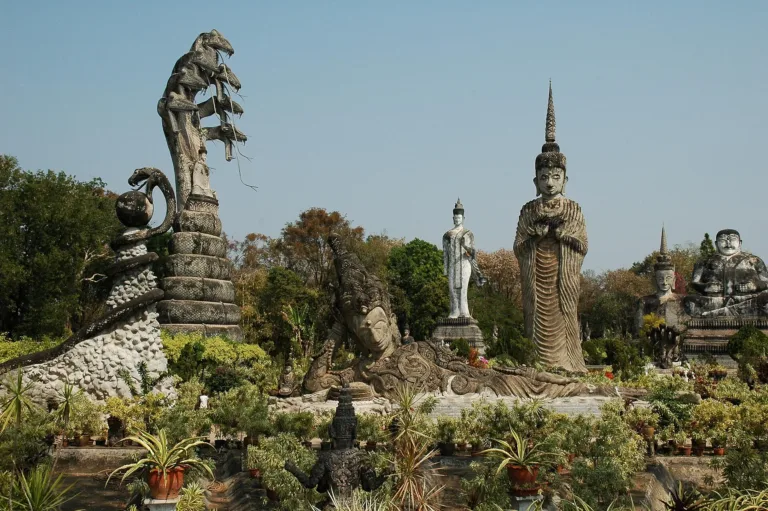
Highlights are the Buddha sheltered by a seven-headed naga, the Wheel of Life showing birth, ageing, sickness and death, and a domed three-storey pavilion where Bunleua's body is kept in a glass urn on the top floor. It is open daily.
Photos from Wikimedia Commons and contributors · full credits inClassic page
The wide concrete grounds have little shade and are very hot 11:00–15:00 — bring a hat, umbrella and water
After rain the concrete and paths are slippery and puddled — walk slowly
Don't climb or sit on the sculptures; some old concrete is fragile
It is a sacred place — dress modestly, especially in the pavilion
Adults 20 THB · Time needed 1–2 hours
Late mornings on holidays, and Oct – Jan
| Tuk-tuk from town, return with waiting time optional | 200 ฿/vehicle |
| Bicycle hire from a guesthouse in town optional | 50 ฿/day |
Mostly cash · Prices may change by season — check with the venue
Tap a month on the wheel to see weather, rain, haze and crowds from 10 years of records
Best time · November–February is cool, dry and clear — comfortable for walking around the sculptures. Come in the morning for good light before the heat builds.
Watch out · August–September is the wettest time, with slippery, puddled concrete. March–April is very hot and the park has little shade, so avoid the middle of the day.
Oct by the records 23–30°C · avg rain 139 mm (14 rainy days) · clear 8 days · avg PM2.5 11
Sala Kaew Ku stands at 10/5 Nong Khai–Phon Phisai Road, Ban Samakkhi, Hat Kham subdistrict, Mueang Nong Khai, not far from the Mekong, on about 42 rai (6.7 ha). Locals call it "Wat Khaek" — roughly "the Indian temple" — for its many Hindu-style deities, although it is not a temple and has no resident monks. It is run by the Nong Khai Buddhist Association (licence no. 60/2519, dated 10 March 1976) together with the Kaew Ku Meditation Centre.
Its creator was Bunleua Sulilat, or "Pu Lua", a layman his followers called "Luang Pu" (venerable grandfather). The association's own book Sala Kaew Ku (1997 edition) gives his birth year as 1933, while Wikipedia and foreign scholars give 7 June 1932, in Nong Khai, as the seventh of eight children. The book tells how his eldest sister, Khamplio Sulilat, dreamed that a white-robed ascetic brought her an emerald naga and told her to collect it in seven months; their ageing mother then conceived and gave birth to her seventh child after a seven-month pregnancy. The family took it as the dream fulfilled, and Khamplio and her husband adopted the baby at birth.
The boy loved going to the temple. When he was six, Khamplio died and he went back to his birth parents, but he kept rebuking adults for wrongdoing and was not well liked by his relatives. At twelve he ran away and wandered until he found the "Kaew Ku hermitage" in Laos, where he studied and practised under a sage until he was twenty, then set out to wander and teach.
Another version, passed down among his followers, says that as a child he fell into a hole or cave and met a hermit named Keoku (Kaew Ku), who could take the form of a naga and became his spiritual teacher. Prof. Justin McDaniel, a Buddhist studies scholar at the University of Pennsylvania who first visited Sala Kaew Ku in 1994, writes in Architects of Buddhist Leisure (2016) that Bunleua trained as a shaman in Vietnam and told followers he was "half-man, half-snake", taught by snake spirits — and that some followers believe part of him lives on as a snake.
Around the age of thirty Bunleua came home to care for his parents. His mother died in 1964 and left him 8 rai of land at Ban Xieng Khuan, Tha Deua, Vientiane, which he turned into a vast "shrine of deities" that drew followers from Asia and Europe. The association's book dates this to 1970, while most foreign sources say work began in 1958. It is today's Buddha Park (Wat Xieng Khuan), now run by the Lao government as a public park and tourist sight.
In 1975 the Pathet Lao took power. McDaniel notes the new government did not support religion for its first two or three years, so Bunleua crossed the Mekong back to Thailand with his followers, leaving the unfinished statues behind, and set up the Nong Khai Buddhist Association, recognised by the Religious Affairs Department in 1976.
In 1978 his followers bought about 41 rai at Ban Samakkhi, Hat Kham, and work began on a new park named after his teacher — Sala Kaew Ku — just a few kilometres from the first park across the river. Hundreds of unpaid volunteers did the building with cement donated by the faithful. Bunleua had no training in art or architecture; the figures came from his imagination and visions, while individual statues were paid for by many donors — Thais from across the country, Chinese, Lao, Vietnamese and Westerners.
There were hard times too. The association's book records that in early 1984 Bunleua was accused of a serious offence — which the association declines to name — and was imprisoned until late 1986. After his release he built many more figures, reaching 209 Buddha and deity forms in all; the tallest is about 25 m (the book says up to 33 m).
Bunleua's central idea was that all religions can live together. The association describes the park as a model of the "immortal city of Kaew Ku Maha Nibbana" — a land of release from defilement. Each sculpture has an explanation in Thai and Isan at its base, many in verse. A 2016 study by Assoc. Prof. Ornnong Rittrachai of Khon Kaen University examined 141 teaching sculptures: 89 on religion, 34 on doctrine, Dhamma riddles and proverbs, and 13 on literature and Isan folk tales. A 2021 study by Sophee Untaya of Mahasarakham University found the inscriptions reflect the multicultural life of the two Mekong banks — in belief, ethnicity, language, tradition and clergy.
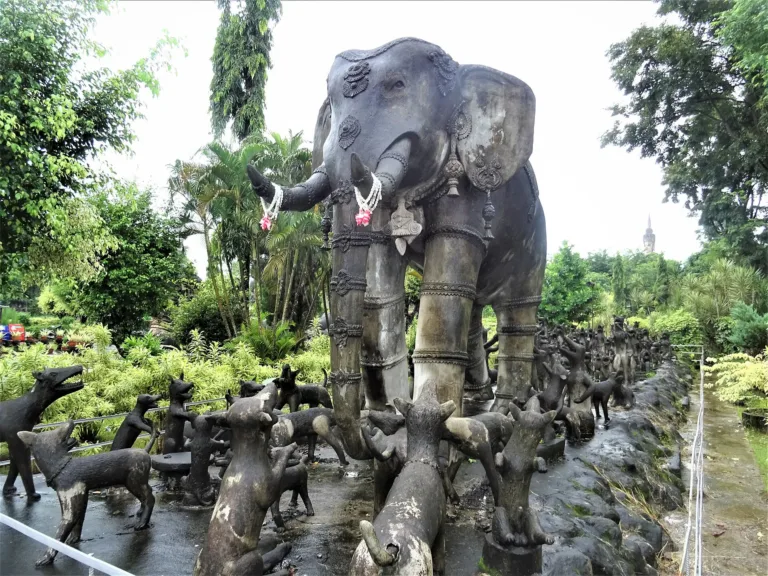
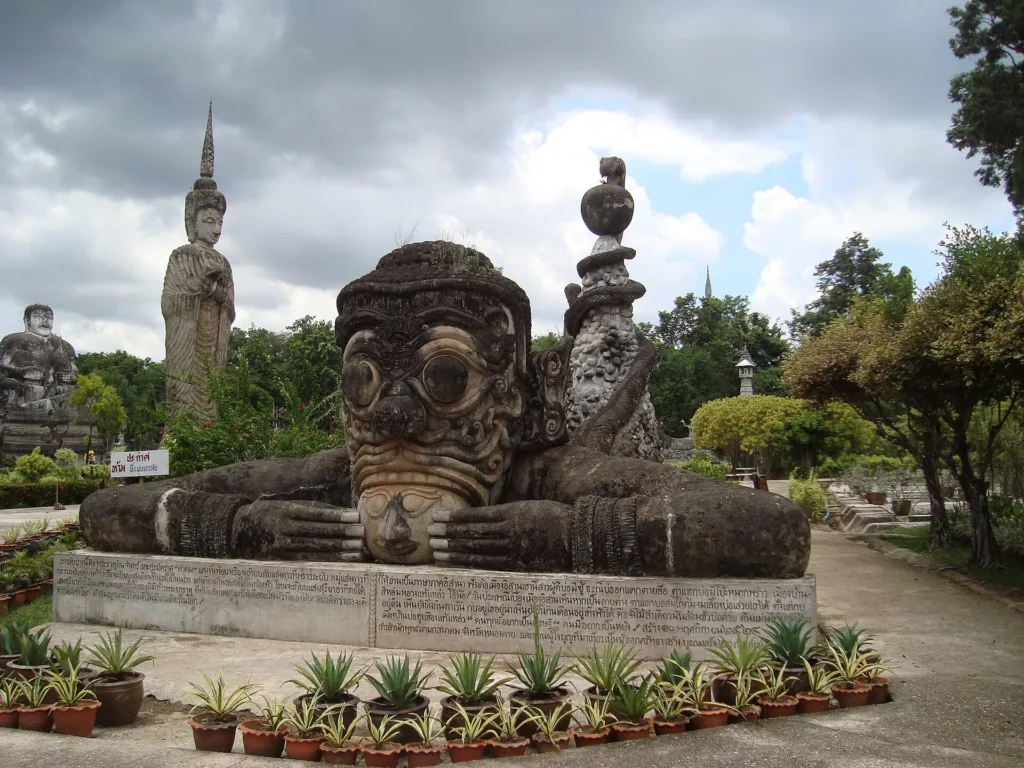
The best-known sculpture is a Buddha seated on the coils of a naga, with seven naga heads spread above. The "Wheel of Life" is entered through a giant mouth, like passing through a womb, then circled clockwise through birth, marriage, old age, illness and death, ending with a young man stepping over the wall to become a Buddha — release from the cycle of rebirth. Elsewhere an elephant wades through a pack of dogs (a lesson not to be troubled by gossip), and there are Rahu swallowing the moon, Shiva and Uma, Hanuman, Ganesh, Guanyin, Angulimala, Prince Siddhartha cutting his hair and Sujata offering milk rice, the Isan legend of Ya Thuat Ae Khai, the naga princess and Khun Thueang — even foreign soldiers and mermaids.
The old pavilion, used from 1980 to 1995, became dilapidated, so Bunleua had it pulled down and a new one begun. During construction he fell ill — reportedly after a fall from one of his sculptures, compounded by a blood disease — and died on 10 August 1996, aged 64. As he had instructed, his followers did not embalm, cremate or bury him but placed his body in a glass urn; it has not decayed and lies on the third floor of the new pavilion, completed to his plans: a three-storey concrete building with a mosque-like dome and the Om symbol on its gable. The lower floors hold Buddha images, deities and photographs of Bunleua through his life.
On 18 January 2006 Sala Kaew Ku made headlines when gunmen shot dead a Lao-American couple, who claimed descent from the Lan Xang royal line, as they were about to pray in the pavilion. Police arrested suspects that May.
Today Sala Kaew Ku is one of Nong Khai's best-known sights. Art books such as the Raw Vision Outsider Art Sourcebook and Taschen's Fantasy Worlds cite it as a classic of "outsider art", and it is often compared with the Gardens of Bomarzo in Italy. Visitors usually pair it with Wat Pho Chai, home of Luang Pho Phra Sai, and cross the Friendship Bridge to Buddha Park in Vientiane to see Bunleua's work on both banks of the Mekong.
Arrived? Check in, collect a stamp and tell others what it is like right now
Check your location first, so you do not fill in the form for nothing
Location must be on and within 0.5 km · One check-in per place per day · come back on other days to check in again
Post photos from anywhere — no need to be here · Up to 20 photos at a time · JPG / PNG / WebP · GPS location data is removed automatically
From Nong Khai town, take Highway 212 towards Phon Phisai, h…
Highway 212 from town towards Phon Phisai · Minimal fuel
Hire from town, return with waiting time · About 200–300 THB
Hire from a guesthouse in town · About 50 THB/day
Get off at the junction and walk about 1 km · Cheap
Paved all the way on Highway 212
Car park at the entrance
Petrol stations on Highway 212 in Nong Khai town
Good mobile signal
Daily 6:00–18:00 (third floor of the pavilion 7:00–17:00)
around 5 km fromNong Khai town
Sala Kaew Ku, Nong Khai
40 THB
Approx. nightly price for 2 adults (next week) · final price depends on your dates
Best day this week: Wednesday 28 Oct · Check in when you arrive to collect a stamp