 01
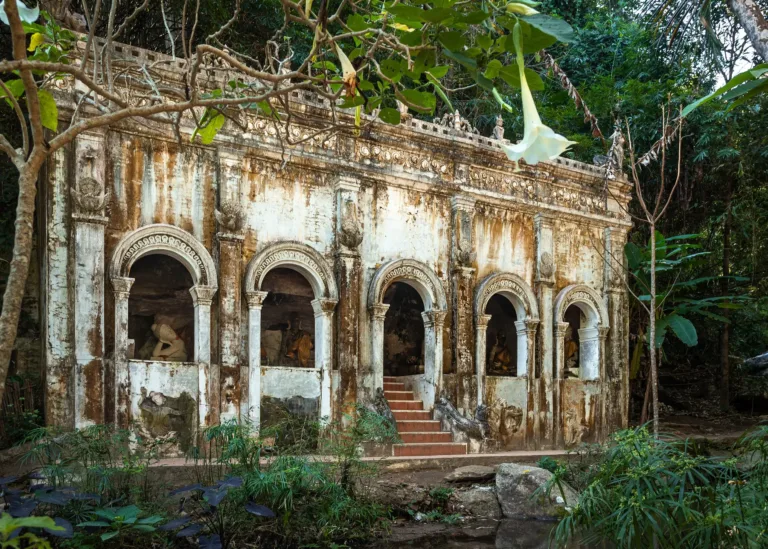
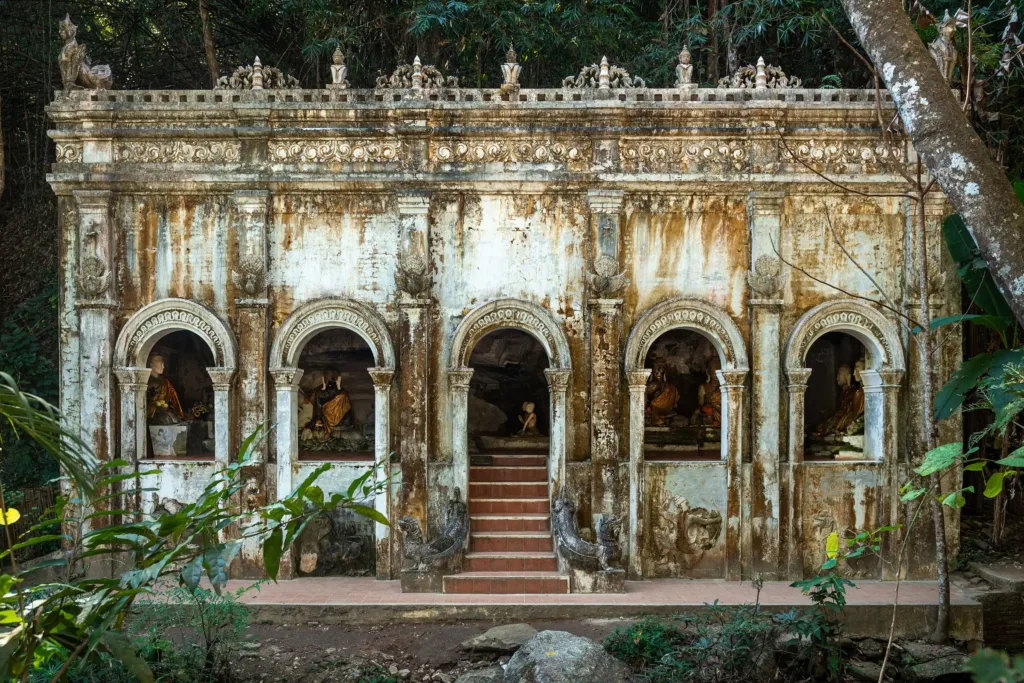
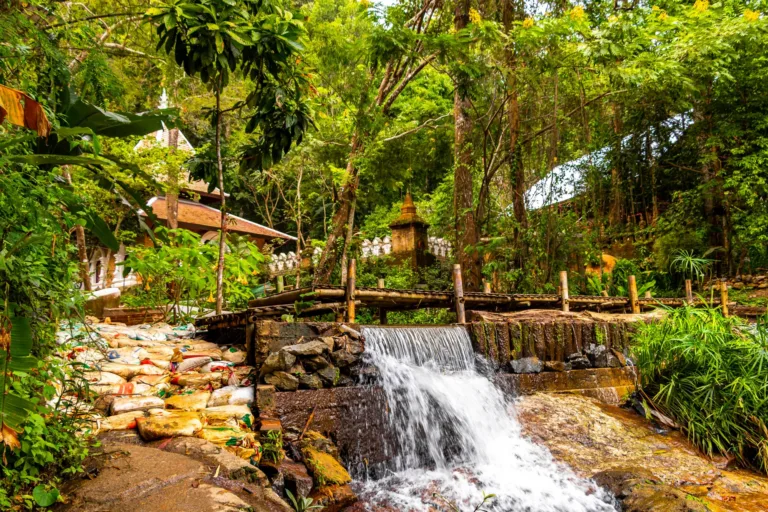
Waterfall shrine hallA brick shrine in Burmese colonial style with five arches, beside the waterfall's rock slabs
Forest temple · Doi Suthep, Chiang Mai
A forest temple on Doi Suthep, once a pilgrims' rest stop, with a Burmese-style waterfall shrine, a moss-covered chedi and the Monk's Trail leading up to it.
Holiday / event — crowded
Dress modestly, covering shoulders and knees · Take off your shoes before entering the halls and shrines · Keep your voice down, as this is a meditation centre · Don't disturb monks or people meditating
Daily, about 06:00–18:00 (a sign at the temple has shown 07:00–17:30)
Before 09:00, while it is cool and quiet
On the night before Visakha Bucha, tens of thousands walk up Srivichai Road past the temple to Doi Suthep
01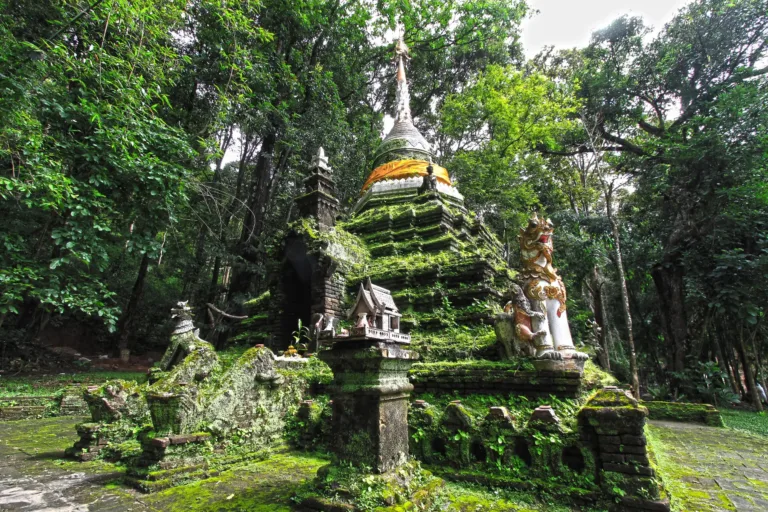 02
 03
 04
Tap a day card to see that day’s weather, rain, haze and hourly forecast
Best time to go Daytime is over · see tomorrow
Holiday — traffic on the way up and parking fills fast; leave early
Green band = hours used for the score
Best time to go Fine all day little rain through the day
Holiday — traffic on the way up and parking fills fast; leave early
Green band = hours used for the score
Best time to go Fine all day little rain through the day
No warnings today — normal road and weather conditions
Green band = hours used for the score
Best time to go Fine all day little rain through the day
No warnings today — normal road and weather conditions
Green band = hours used for the score
Best time to go Fine all day little rain through the day
No warnings today — normal road and weather conditions
Green band = hours used for the score
Best time to go Fine all day little rain through the day
No warnings today — normal road and weather conditions
Green band = hours used for the score
Best time to go Fine all day little rain through the day
No warnings today — normal road and weather conditions
Green band = hours used for the score
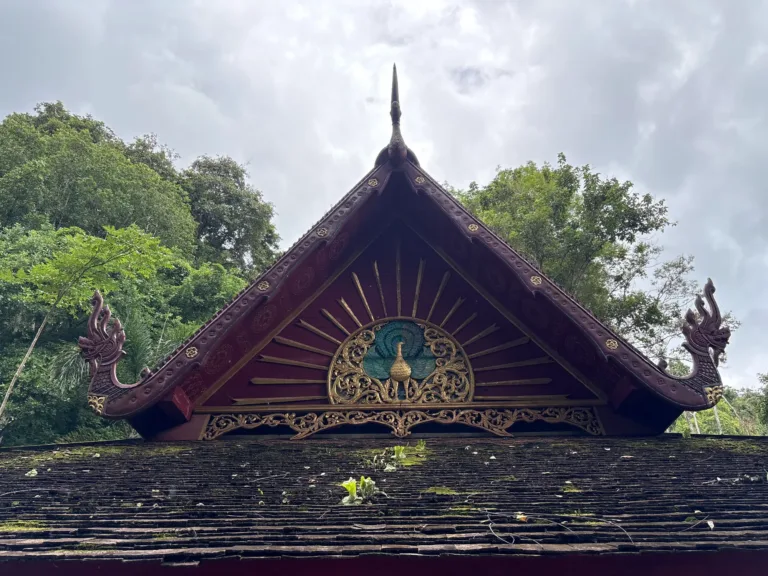
Wat Pha Lat, also called Wat Sakithakami, sits hidden in the forest on the lower slopes of Doi Suthep, inside Doi Suthep–Pui National Park, about 5 km up Srivichai Road from the Kruba Srivichai Monument. Its name refers to the sloping rock face where a stream spills through the grounds as a waterfall. Before the road was built, this was where pilgrims rested on the long walk up to Wat Phra That Doi Suthep.The star attraction is the shrine hall beside the waterfall, a brick building in Burmese colonial style with five arched openings. Nearby stand a Burmese-style chedi coated in moss and ferns, an assembly hall with a peacock carved on its gable and an old well that many consider sacred. From the rock terraces you can glimpse Chiang Mai through the trees.The temple is the popular end point of the Pha Lat nature trail, known to visitors as the Monk's Trail. It starts at the end of Suthep Road behind Chiang Mai University and takes about 30–45 minutes through the forest, and you can carry on up to Doi Suthep. Since 1 October 2025 the national park has charged a fee for using the trail, but driving to the temple on Srivichai Road is free.Wat Pha Lat is a working meditation centre, so dress modestly and keep your voice down. Allow about an hour to look around. The paths and waterfall rocks are slippery, especially in the rainy season, and there is nowhere to buy food or water, so bring your own.
Arrive Before 09:00, while it is cool and quiet
Roots and rocks on the dirt path get very slick after rain, so wear shoes with good grip
The rock slabs are covered in algae; don't walk where the water is running
Steeper, eroded under the power lines, and near the end you have to climb a guard rail and cross Srivichai Road
The orange robe strips tied to trees are fading, so download a map beforehand
Free · Time needed About 1 hour at the temple (2–3 hours if you hike up from the foot of the mountain)
Weekends and holidays, late morning to afternoon
| Pha Lat nature trail fee (adult) (Thai) optional | 20 ฿/person |
| Pha Lat nature trail fee (child) (Thai) optional | 10 ฿/person |
| Pha Lat nature trail fee (adult) (foreigners) optional | 100 ฿/person |
| Pha Lat nature trail fee (child) (foreigners) optional | 50 ฿/person |
| Trailhead parking optional | 30 ฿/car |
| Chartered red songthaew from town to the trailhead optional | 150 ฿/car |
The national park's trail fee is cash only · Prices may change by season — check with the venue
On the night before Visakha Bucha, tens of thousands walk up Srivichai Road past the temple to Doi Suthep
Wat Pha Lat, also known as Wat Sakithakami, stands in the forest on the lower slopes of Doi Suthep, inside Doi Suthep–Pui National Park in Suthep subdistrict, Mueang Chiang Mai. It lies beside Srivichai Road, about 5 km up from the Kruba Srivichai Monument. "Pha Lat" means the sloping rock face over which a stream runs as a waterfall, while "Sakithakami" refers to the second of the four stages of enlightenment. Before the mountain road existed, this was where pilgrims rested on the walk up to Wat Phra That Doi Suthep. Today it is a meditation centre, known for its Burmese-style shrine beside the waterfall, its moss-covered chedi and as the end point of the Monk's Trail.
According to legend, King Kue Na, the sixth ruler of the Mangrai dynasty, received a relic brought from Sukhothai by the monk Phra Sumana Thera. The relic split in two: one part was enshrined at Wat Suan Dok, and the other was placed on the back of an auspicious elephant that was set free to choose its own resting place. On its way up Doi Suthep the elephant stopped to rest, and Pha Lat was one of those stops. Temples were later built at the resting places: Wat Si Soda, Wat Pha Lat (Sakithakami) and Wat Mon Phraya Hong (Anagami), which was later abandoned and rebuilt as the Anagami Buddhist park. Sources disagree on the number of stops: some say three, while the newspaper Naewna says four, with Pha Lat the first.
Local tradition says the place was first called "Phaloet", because people following the elephant slipped on the waterfall rocks. The abbot has said that King Lithai of Sukhothai joined King Kue Na in making merit here and that a relic was enshrined at the site, putting the temple's age at about 640 years (around 1384). A 2025 study by Mahamakut Buddhist University's Lanna campus notes that the temple appears in the Lanna text Phra Chao Liap Lok and that the Lua people have their own stories about the sanctity of the site. All of this belongs to legend and oral tradition.
The physical evidence tells a different story. Several sources admit that no founding date appears in the chronicles. The researcher behind Chiang Mai à la carte found no building older than about 150 years. A 2016 paper by Kreangkrai Kirdsiri and a co-author at Silpakorn University explains that the rock shelter by the waterfall has long been associated in Lanna lore with hermits and monks, but that the brick shrine itself was built around the late 19th century (the early 25th century of the Buddhist era).
The MBU study says that during Burmese rule over Chiang Mai, which began in 1558 and lasted about two centuries, Burmese donors continued to restore the temple, which is why Burmese art shows in its gables, chedi and decoration. The abbot has said that Mong Panyo, also known as Luang Yonakarn Phichit (1845–1927), a Burmese teak trader in Chiang Mai, hired Shan craftsmen to build here. The same researcher estimates that the waterfall shrine, well and sala date from about 1886–1898 and the chedi from about 1898–1916, while other sources say the chedi was built by Burmese craftsmen in Kruba Srivichai's time.
The waterfall shrine is a brick building in Burmese colonial style with five arched openings across its front. According to the Silpakorn paper, it originally held a reclining Buddha and four seated Buddhas in the subduing-Mara pose. The reclining image later disappeared, and the building collapsed and was repaired, with more images added, leaving the archaeological evidence very complicated. Next to it are an old naga staircase once used by pilgrims and a well that many believe dates back to King Kue Na.
Chiang Mai à la carte has collected travel accounts of the old route. British diplomat Ernest Satow walked it in 1886, Prince Damrong Rajanubhab passed by in 1898, and King Prajadhipok and Queen Rambai Barni visited in early 1927. The author also suggests that an earthquake in 1922 may have brought down part of the chedi.
On 9 November 1934 work began on a road up Doi Suthep led by Kruba Srivichai, and it opened on 30 April 1935. The MBU study says Wat Pha Lat was a stop where Kruba Srivichai and the workers stayed, and that he saw it as a forest monastery for monks devoted to meditation. Around this time the assembly hall's leaf-thatched roof was replaced with tiles (Naewna gives the year as 1946–1947, which does not match the road's dates). The hall's front gable is carved with a Burmese-style peacock and the back with a rabbit, the birth year of Kruba Thoem, and an entrance hall housing the Phra Phuttha Metta Pha Lat image was built to mark the road.
Once the road opened, fewer people walked past and the temple grew quiet. During the Second World War looters dug into the chedi and its top collapsed. For a time the temple lay abandoned. Revival as a meditation centre began around 1991, yet in 1993 the Fine Arts Department still found the temple in ruins, with the waterfall shrine collapsed.
MThai says repairs to the chedi began around 2002 and its finial was raised in 2003. The abbot, Phrakhru Thirasutphot (Phra Maha Sanga Thirasamvaro), has said that major restoration began in 2006, when a stone bearing a footprint was found in the waterfall. In 2011 the small Phutthachayanti hall was restored with the national park and the ordination hall was completed. The Fine Arts Department's regional office restored the waterfall shrine to its original form, finishing around 2019. In 2018 Thairath reported the discovery of a cave about 9 m wide and 15 m deep, which the temple sealed until the Fine Arts Department could inspect it.
Today Wat Pha Lat is both a meditation centre and a popular stop on the way up Doi Suthep. Since 1 October 2025 Doi Suthep–Pui National Park has charged users of the Pha Lat nature trail 20 baht for Thais and 100 baht for foreigners, while visitors who drive to the temple by road still enter free.
Arrived? Check in, collect a stamp and tell others what it is like right now
Check your location first, so you do not fill in the form for nothing
Location must be on and within 0.7 km · One check-in per place per day · come back on other days to check in again
Post photos from anywhere — no need to be here · Up to 20 photos at a time · JPG / PNG / WebP · GPS location data is removed automatically
The temple is on Srivichai Road, about 5 km above the Kruba Srivichai Monument at the foot of Doi Suthep, with the entrance on the left going up; you can also walk up on the Pha Lat nature trail.
From the end of Suthep Road behind Chiang Mai University, walk about 1 km on a paved lane, then about 1.5 km on the dirt trail to the temple · Trail fee 20 baht (foreigners 100)
Huay Kaew Road, then about 5 km up Srivichai Road; the entrance is on the left · Free
Charter one from town to the trailhead for around 150 baht, or take a Doi Suthep songthaew and ask to be dropped at the temple; agree the fare first · About 150 baht
Handy for getting to the trailhead, but hard to book for the return from the temple because of the weak signal
Srivichai Road (Highway 1004), paved, steep and winding all the way up the mountain
Roadside parking by the entrance hall and a car park inside, about 100 m on foot · limited parking at the trailhead
Usable at the temple; patchy along the forest trail
Daily, about 06:00–18:00 (a sign at the temple has shown 07:00–17:30)
about 10–12 km from Central Chiang Mai
Wat Pha Lat
Answers travellers want before they go — a one-minute read
On Srivichai Road about 5 km above the Kruba Srivichai Monument, inside Doi Suthep–Pui National Park, Suthep subdistrict, Mueang Chiang Mai
The Pha Lat nature trail, starting at the end of Suthep Road behind Chiang Mai University; it takes about 30–45 minutes through the forest to the temple and continues up to Doi Suthep
The temple charges nothing and driving in on Srivichai Road is free, but since 1 October 2025 the national park has charged trail users 20 baht for Thais and 100 baht for foreigners
Legend links it to King Kue Na about 640 years ago, but no dated record has been found, and the older buildings you see today date from roughly the late 19th and early 20th centuries, heavily restored since
It refers to the second of the four stages of enlightenment, part of a set of names shared with Wat Si Soda at the foot of the mountain and the Anagami Buddhist park higher up
Yes if you come by road and walk about 100 m from the car park, though there are steps and sloping rock inside; the forest trail suits people who are comfortable walking uphill
Best day this week: Monday 30 Nov · Check in when you arrive to collect a stamp
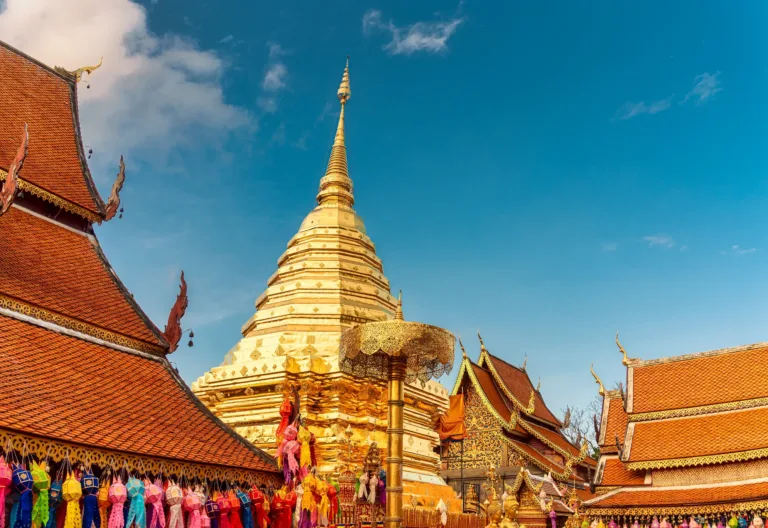 Wat Phra That Doi Suthep
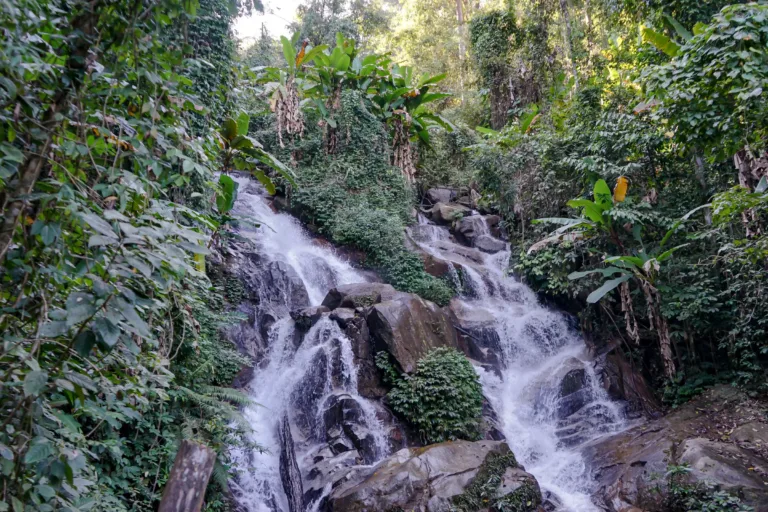 Huai Kaeo Waterfall
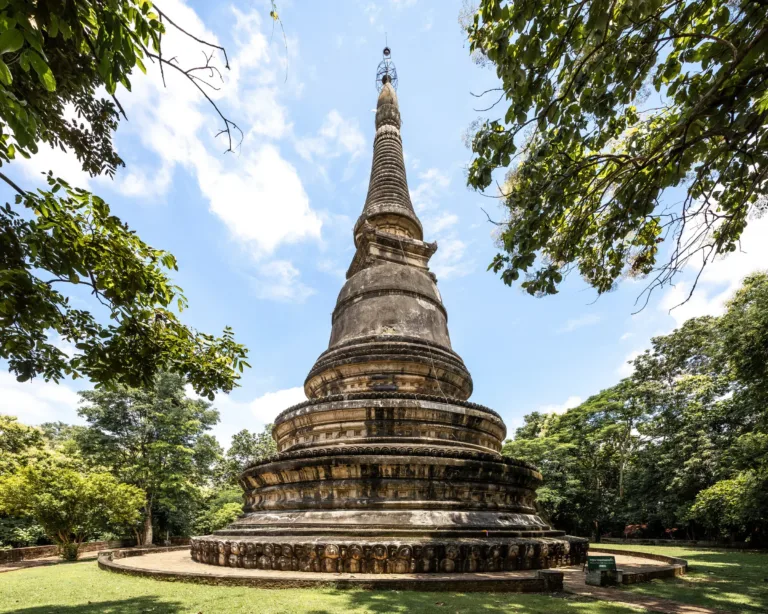 Wat Umong Suan Phutthatham