 01
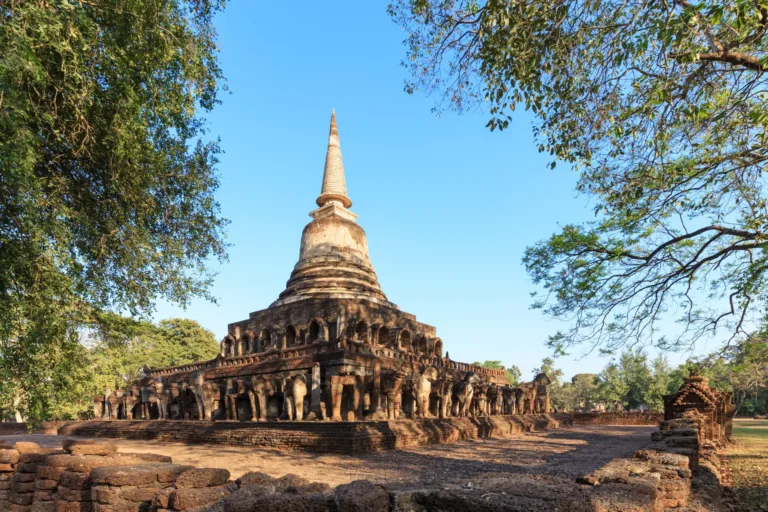
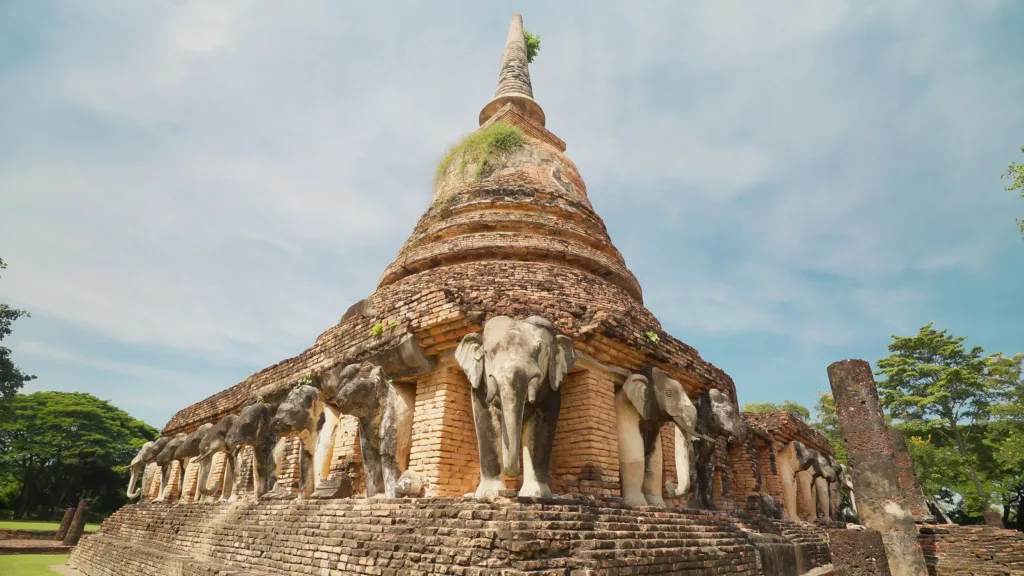
Wat Chang LomA Sri Lankan-style chedi ringed by 39 stucco elephants
World Heritage · Old Si Satchanalai, Sukhothai
Sukhothai's twin city on the Yom River in Si Satchanalai, a World Heritage Site since 1991. Wat Chang Lom with 39 stucco elephants, Wat Chedi Chet Thaeo and Wat Nang Phaya; quiet and great by bike.
Good weather, little rain
Daily 08:00–17:00
Half a day
Wat Chang Lom — The line of stucco elephants around the chedi
Thais 20 THB · Foreigners 200 THB
01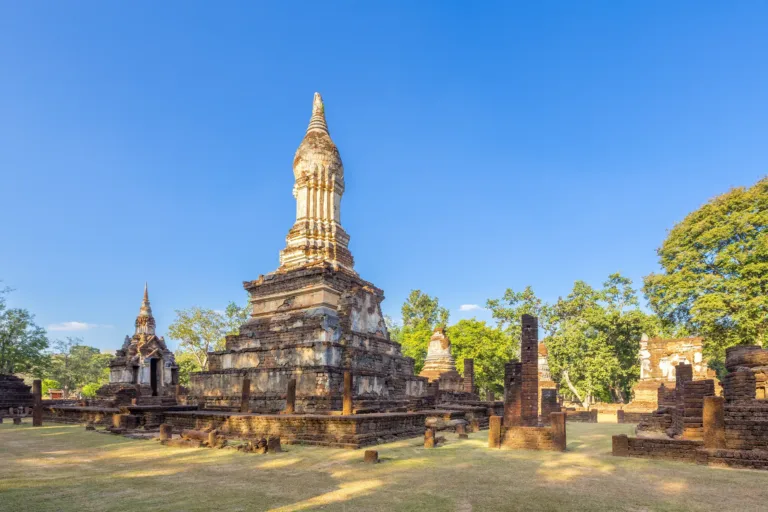 02
Tap a day card to see that day’s weather, rain, haze and hourly forecast
Best time to go Daytime is over · see tomorrow
No warnings today — normal road and weather conditions
Green band = hours used for the score
Best time to go Fine all day little rain through the day
No warnings today — normal road and weather conditions
Green band = hours used for the score
Best time to go Fine all day little rain through the day
No warnings today — normal road and weather conditions
Green band = hours used for the score
Best time to go Fine all day little rain through the day
No warnings today — normal road and weather conditions
Green band = hours used for the score
Best time to go Fine all day little rain through the day
No warnings today — normal road and weather conditions
Green band = hours used for the score
Best time to go Fine all day little rain through the day
No warnings today — normal road and weather conditions
Green band = hours used for the score
Best time to go Fine all day little rain through the day
No warnings today — normal road and weather conditions
Green band = hours used for the score
Si Satchanalai Historical Park lies in Si Satchanalai district, Sukhothai, about 50–68 km from Sukhothai town. It covers the old cities of Si Satchanalai and Chaliang on the Yom River and is part of the Historic Town of Sukhothai and Associated Historic Towns, a World Heritage Site since 1991.Inside the walls are Wat Chang Lom, with 39 stucco elephants around its chedi base, Wat Chedi Chet Thaeo and its chedis in many styles, Wat Nang Phaya with fine stucco reliefs, and hilltop Wat Khao Phanom Phloeng. Sangkhalok kiln sites are nearby.The grounds are flat and wide, so rent a bike at the entrance. It's far quieter than Sukhothai, ideal for unhurried exploring.
Arrive 08:30, before the sun gets strong
Temples are spread out; bring water and a hat
The laterite stairs to Wat Khao Phanom Phloeng are steep
Thais 20 THB · Foreigners 200 THB · Time needed Half a day
Long weekends
| Entry, Thai | 20 ฿/person |
| Entry, foreign | 200 ฿/person |
| Vehicle into the park optional | 50 ฿/car |
| Combined ticket (park, Wat Chom Chuen, Ko Noi kilns), Thai optional | 40 ฿/person |
| Combined ticket (park, Wat Chom Chuen, Ko Noi kilns), foreign optional | 400 ฿/person |
Mostly cash · Prices may change by season — check with the venue
Si Satchanalai Historical Park preserves an ancient city on a bend of the Yom River that was once Sukhothai's twin. It was both a Buddhist centre crowded with temples and the home of the Sangkhalok ceramics traded across the region. The park covers the walled laterite city of Si Satchanalai and the older town of Chaliang beside it. The city lived through the Sukhothai era, the struggle between Ayutthaya and Lanna and the heyday of its kilns, lay abandoned for more than a century, and returned to prominence as a historical park in 1990 and a World Heritage Site, together with Sukhothai and Kamphaeng Phet, in 1991.
People lived in this area some 2,300 to 1,500 years ago. Chaliang later came under Khmer cultural influence from around the 11th century. In the Sukhothai period a new city, Si Satchanalai, was laid out west of Chaliang as a twin to the capital and a link on the route between Lanna and Ayutthaya. Its founding date is uncertain: some sources give around 1250, under King Si Inthrathit, while some research places the walled city somewhat later.
The key written evidence is the Ram Khamhaeng inscription, which records that in 1285 the king had relics dug up for the people to venerate, then enshrined them again in the centre of Si Satchanalai under a chedi that took six years to complete. Thailand's Department of Religious Affairs says the chedi of Wat Chang Lom was built on Ram Khamhaeng's order after relics were found on the spot. The inscription's own date is still debated.
Which chedi the inscription means has been argued over for more than a century. In early 1907 Crown Prince Vajiravudh identified it with Wat Chedi Chet Thaeo. In the 1920s Prince Damrong proposed Wat Chang Lom, and in 1967 A. B. Griswold wrote that it could be attributed to Ram Khamhaeng with virtual certainty, while in 1991 Betty Gosling argued it may be much later, from the 15th century. The link is widely accepted but not settled.
Under King Lithai, by the usual account, the king composed the Traiphum, or Three Worlds, around 1345 while ruling Si Satchanalai before taking the throne of Sukhothai, although the date has been questioned. Griswold and Professor Santi Leksukhum date the group of chedis at Wat Chedi Chet Thaeo to his reign, fitting UNESCO's description of Si Satchanalai as the kingdom's spiritual centre.
The other side of the city was ceramics. North of the walls, along the Yom at Ban Ko Noi and Ban Pa Yang, lie dense clusters of old kilns known locally as Tao Thuriang. Their stoneware, known as Sangkhalok, was made from roughly the 13th to the 16th century, rivalled Chinese wares in quality and reached Ayutthaya and the islands of Southeast Asia. UNESCO calls the city the centre of the kingdom's ceramic export industry.
It was long believed there were only 47 kilns, a figure from a French explorer more than a century ago. But Don Hein, who first came in 1975 and mapped the sites on a UNESCO fellowship in 1977, found hundreds at Ko Noi alone. From 1980–1981 a Thai-Australian archaeology project excavated the area, finding mound 42 with eleven kilns built one on top of another over about 300 years. Kilns 42 and 61 are now displayed at the Sangkhalok Kiln Study and Conservation Centre.
As Ayutthaya pushed north, Chaliang became a frontier town contested with Lanna. In 1460 its lord switched his allegiance to King Tilokarat of Chiang Mai. King Trailokanat asked for the town back while he was a monk in 1465 but was refused, and finally retook it in 1474. The victory inspired the poem Yuan Phai, which calls the town Chiang Chuen; in the Ayutthaya period it was also known as Sawankhalok.
After Ayutthaya's first fall in 1569, ceramic production lost its importance and the town was downgraded to a minor provincial seat. Kiln research shows the last kilns were fired until worn out and then left, a gradual decline rather than a sudden collapse. After the second fall of Ayutthaya in 1767 the old city was abandoned, and its people moved to Ban Wang Mai Khon in today's Sawankhalok district.
Interest returned as scholars searched for the cities of the inscriptions. On his tour of the northern towns in early 1907, Crown Prince Vajiravudh concluded that Si Satchanalai was the old name of Sawankhalok, and soon after the French explorer Lunet de Lajonquière identified the ruins about 12 km upstream as Si Satchanalai. The Fine Arts Department listed 34 monuments here in 1935–36, began sending staff to restore them in 1953 and ran a major restoration programme in 1965–1969, at a time when looting had badly damaged many sites.
In 1982 the Fine Arts Department launched the historical park project. A 28,217-rai monument zone was declared on 12 April 1988, and the park was formally opened on 17 May 1990, though some sources give a different date. In December 1991 the World Heritage Committee inscribed the Historic Town of Sukhothai and Associated Historic Towns, including Si Satchanalai. Communities such as Ban Wang Samrong still live within the area, though a master plan once proposed moving them, and land use inside the protected zone is still discussed from time to time.
Arrived? Check in, collect a stamp and tell others what it is like right now
Check your location first, so you do not fill in the form for nothing
Location must be on and within 1.2 km · One check-in per place per day · come back on other days to check in again
Post photos from anywhere — no need to be here · Up to 20 photos at a time · JPG / PNG / WebP · GPS location data is removed automatically
The park is in Mueang Kao, Si Satchanalai, Sukhothai.
Highway 101 from Sukhothai via Sawankhalok · Fuel
Sukhothai–Uttaradit or Sukhothai–Chiang Rai, get off at the park junction · Standard fare
Highway 101, good road
Parking at the park entrance
Good to fair
Daily 08:00–17:00
about 50–68 km from Sukhothai town
Si Satchanalai Historical Park
200 THB
Answers travellers want before they go — a one-minute read
Daily 08:00–17:00
20 baht for Thais, 200 baht for foreigners; combined ticket with Wat Chom Chuen and Ko Noi 40 / 400 baht
About 50–68 km via Highway 101
Yes, listed in 1991 together with Sukhothai and Kamphaeng Phet
Rent a bike at the entrance; it's flat and spread out
No; the national park is forest and waterfalls, this is the ancient city
Best day this week: Saturday 28 Nov · Check in when you arrive to collect a stamp
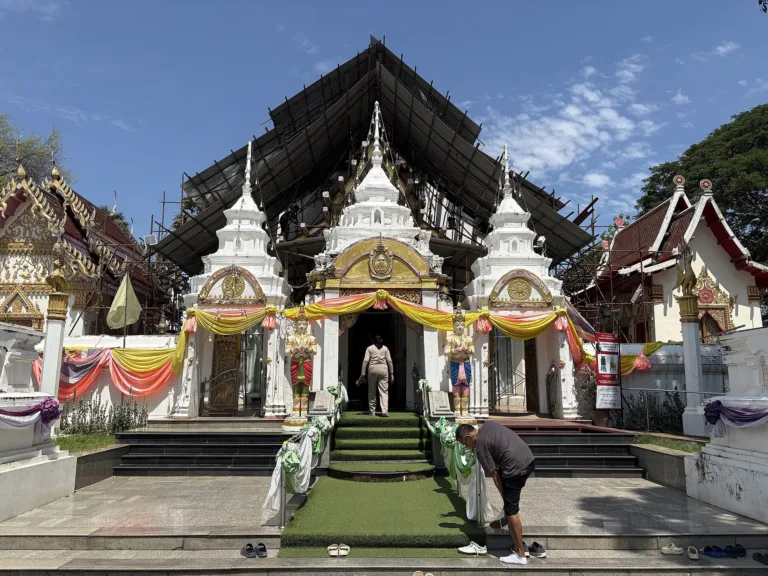
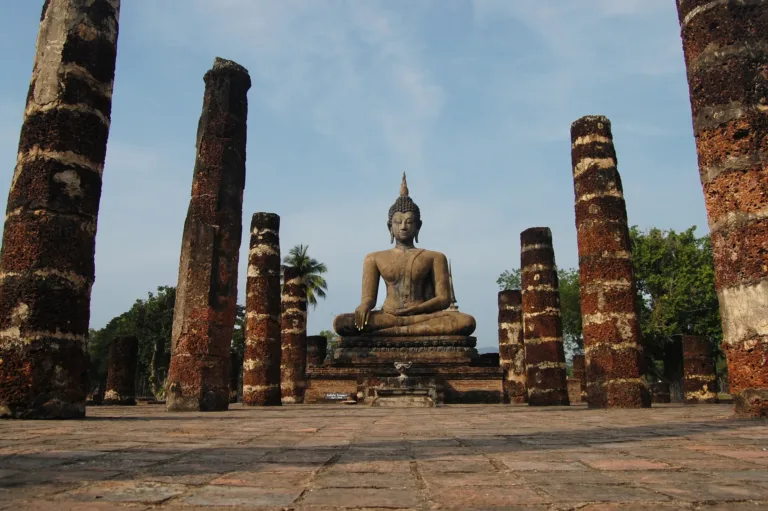 Wat Phra Si Rattana Mahathat Chaliang
 Wat Phra Thaen Sila At
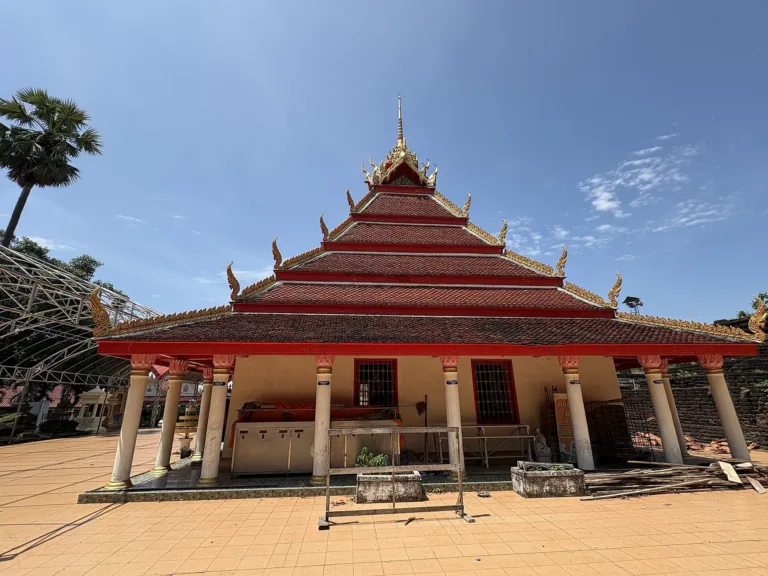 Wat Phra Yuen Phutthabat Yukhon
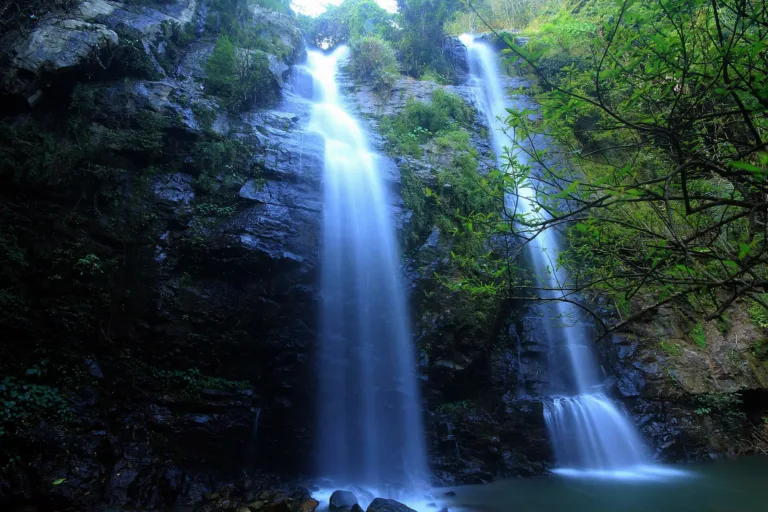 Si Satchanalai National Park