 01
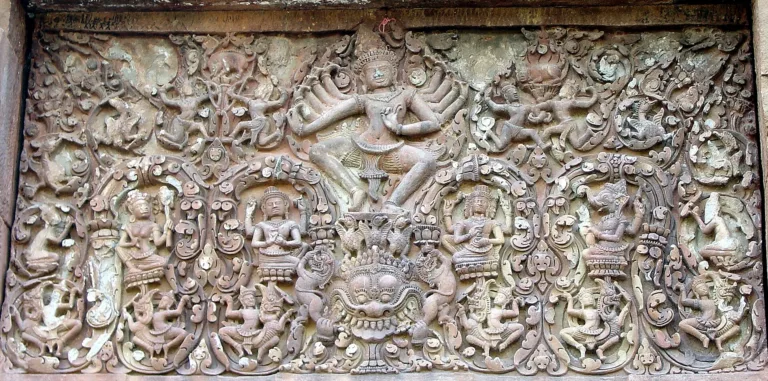
Shiva Nataraja lintelTen-armed Shiva dancing above a kala
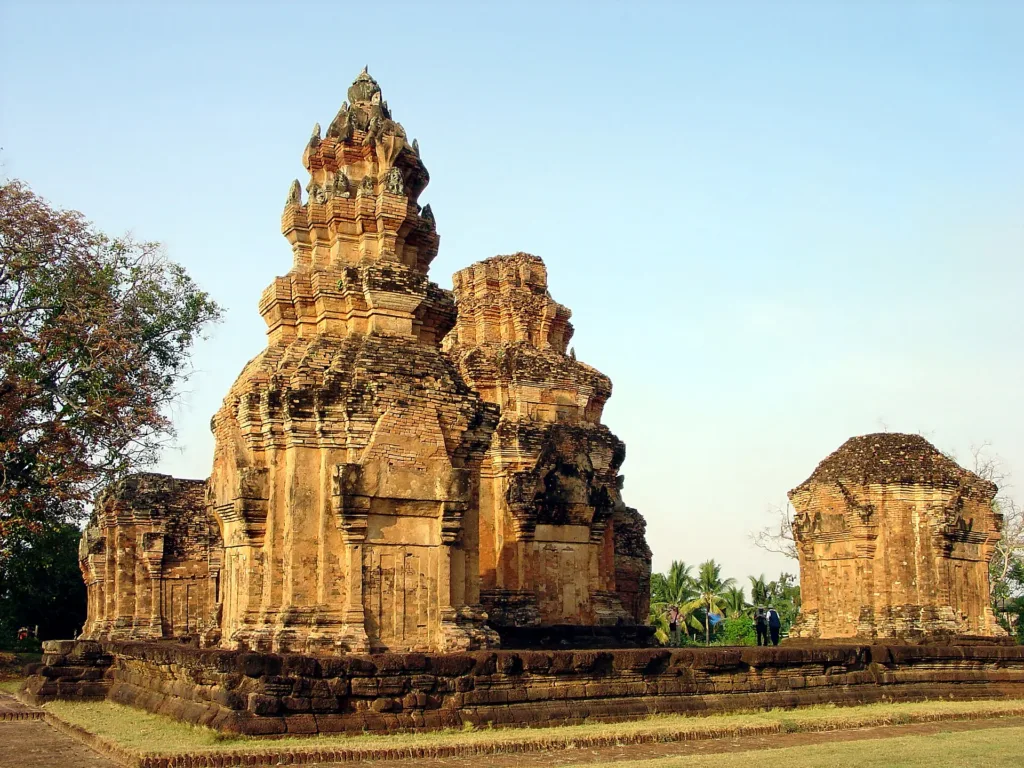
Five brick towers and a dancing Shiva · Surin
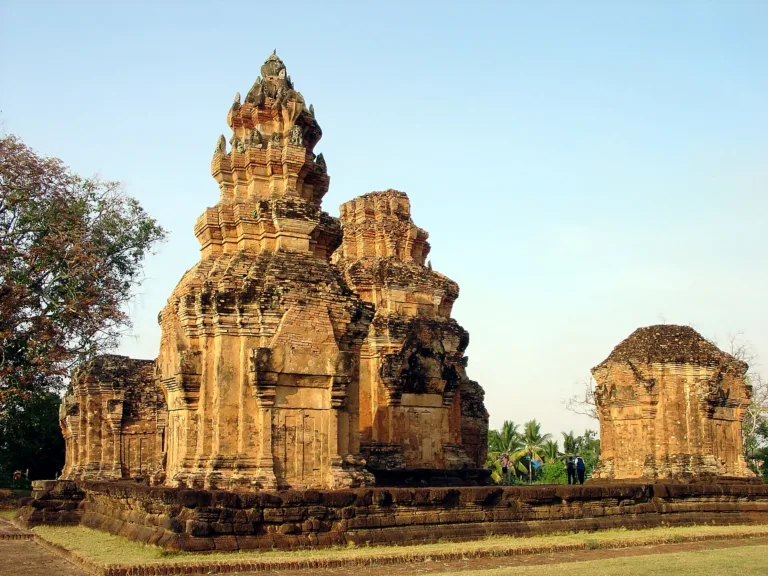
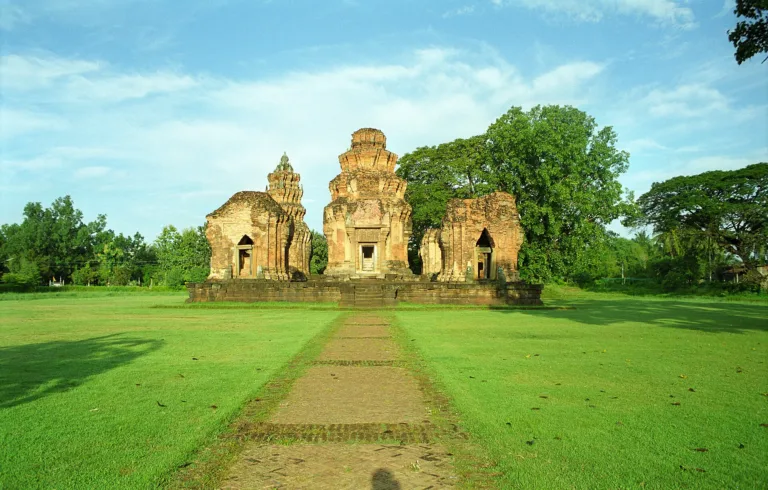
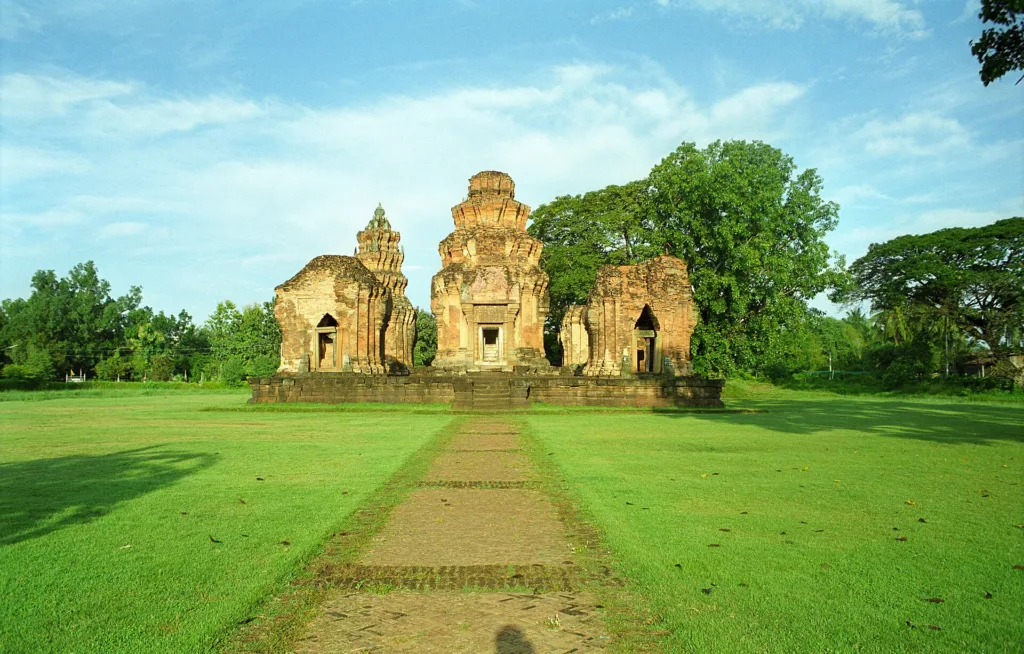
A 12th-century Khmer sanctuary of five brick towers on one laterite base at Ban Prasat, Ra-ngaeng, Surin, famed for its Shiva Nataraja lintel and Angkor Wat-style apsaras found nowhere else in Thailand.
Holiday / event — crowded
07:30–18:00
30–60 minutes
East side — All five towers
Thais 10 THB · Foreigners 80 THB
01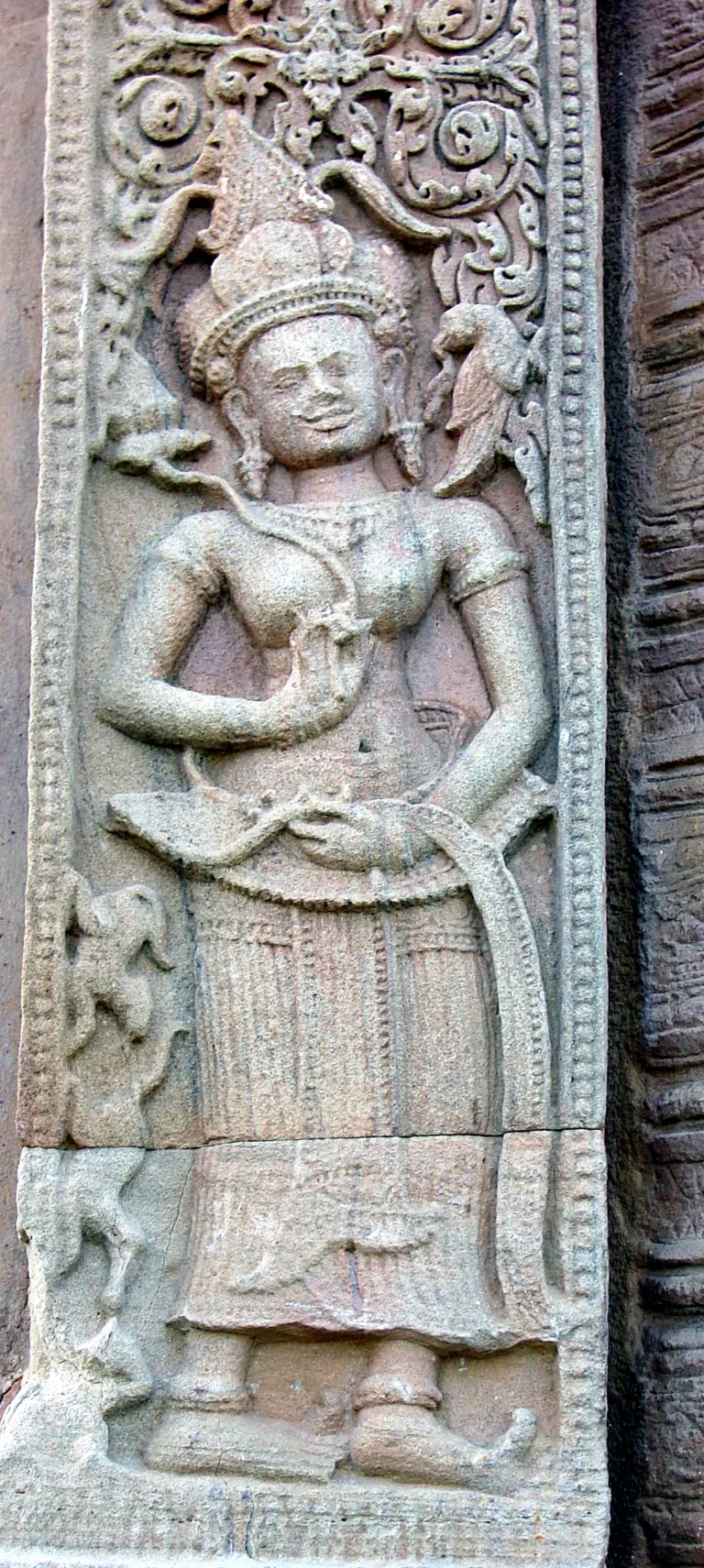 02
 03
Tap a day card to see that day’s weather, rain, haze and hourly forecast
Best time to go Daytime is over · see tomorrow
Holiday — traffic on the way up and parking fills fast; leave early
Green band = hours used for the score
Best time to go Fine all day little rain through the day
Holiday — traffic on the way up and parking fills fast; leave early
Green band = hours used for the score
Best time to go Fine all day little rain through the day
No warnings today — normal road and weather conditions
Green band = hours used for the score
Best time to go Fine all day little rain through the day
No warnings today — normal road and weather conditions
Green band = hours used for the score
Best time to go Fine all day little rain through the day
No warnings today — normal road and weather conditions
Green band = hours used for the score
Best time to go Fine all day little rain through the day
No warnings today — normal road and weather conditions
Green band = hours used for the score
Best time to go Fine all day little rain through the day
No warnings today — normal road and weather conditions
Green band = hours used for the score
Prasat Sikhoraphum, or Prasat Ra-ngaeng, is a Khmer sanctuary of five brick towers in Sikhoraphum district, Surin, with one of Thailand's finest Shiva Nataraja lintels and apsara carvings.
Arrive Morning or evening to avoid the sun
Photos from Wikimedia Commons and contributors · tap a photo to see its credit
Thais 10 THB · Foreigners 80 THB · Time needed 30–60 minutes
Songkran and the Surin Elephant Round-up (Nov)
| Admission, Thai | 10 ฿/person |
| Admission, foreigner | 80 ฿/person |
Cash · Prices may change by season — check with the venue
Annual worship ceremony and Songkran rites at the sanctuary
Tap a month on the wheel to see weather, rain, haze and crowds from 10 years of records
Best time · Nov–Feb: cool weather and warm evening light on the brick towers
Watch out · Mar–May: very hot with no shade on the grounds
Nov by the records 22–30°C · avg rain 47 mm (8 rainy days) · clear 8 days · avg PM2.5 8
Prasat Sikhoraphum, known locally as "Prasat Ra-ngaeng", stands beside Wat Ban Prasat in Ban Prasat, Ra-ngaeng subdistrict, Sikhoraphum district, Surin, about 30 km from Surin town. Thai Wikipedia calls it the most beautiful Khmer sanctuary in Surin. It now belongs to the Ta Muen and Sikhoraphum Historical Park group, as its newest member.
From its art, scholars date the sanctuary to around the 12th century, early in the Angkor Wat period, as a Shaivite Hindu shrine. The Sirindhorn Anthropology Centre (SAC) art database classes it as Lopburi art of the Angkor Wat style, while a 2023 article in the Surindra Rajabhat Academic Journal sees both Baphuon and Angkor Wat features and a plan modelled on Mount Meru. SAC notes there is no direct evidence of its founding; the five towers may have held Shiva lingas.
Dating Sikhoraphum has a long history of debate. The Sirindhorn Anthropology Centre archaeology database summarises: Prince Damrong, visiting in 1930, thought it a Buddhist shrine, a view later disputed; M.C. Subhadradis Diskul saw it as a Shaivite Brahmanical shrine of about 1107; N. na Paknam placed its art in the Angkor Wat generation with the upper spire added in the Ayutthaya period; and Smitthi Siribhadra and Elizabeth Moore dated the lintel to the early 12th century and the spire to later Lao additions. The current conclusion, from the colonnettes and lintels, is construction in the mid-12th century, early in the Angkor Wat period.
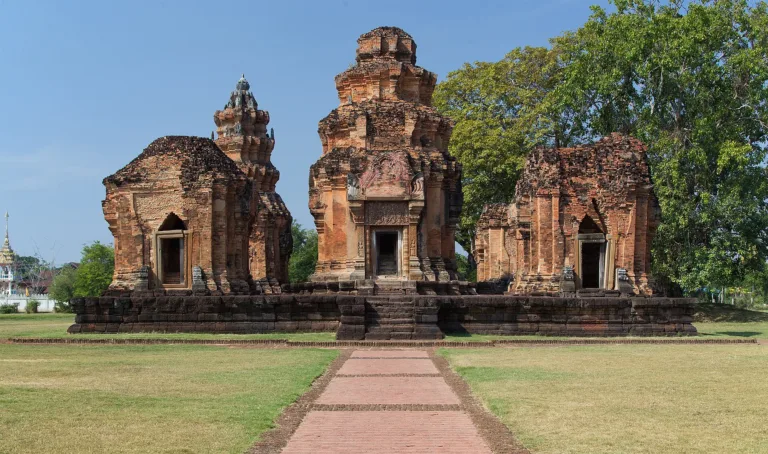
Its plan is unusual in Thailand: five brick towers on a single laterite base, the main tower in the centre and one at each corner, each standing alone without connecting galleries. SAC notes that three towers on one base is more common in Thailand. Thai Wikipedia gives the laterite base as 25 m wide, 26 m long and 1.5 m high, the main tower as about 32 m tall, and a moat on three sides, leaving the east open as the entrance.
The materials point to local work: the towers are of mortarless brick, while the carved parts, such as lintels, doorframes and colonnettes, are sandstone, unlike Angkor Wat-style temples in Cambodia built entirely of sandstone. SAC says this brick-and-sandstone mix appears earlier at Prasat Wat Sa Kamphaeng Yai, a local Khmer style in Thailand. The walls are plain.
The highlight is the main tower's lintel. Thai Wikipedia describes a ten-armed Shiva Nataraja dancing above a kala face, beneath a garland arch with Ganesha, Brahma, Vishnu and Uma. Manager Online (2021) adds that Shiva dances on three hamsa geese, with hermits and lions below, and calls it one of Thailand's most beautiful lintels. The 2023 journal article notes two more lintels depicting Krishna, now in the Phimai National Museum, and the tower's lotus finial displayed under a bodhi tree.
Besides the Shiva Nataraja lintel, whose figures and story SAC says are still debated, there are two Krishnavatara lintels showing Krishna fighting an elephant and a lion, one left unfinished, plus a lintel of Krishna slaying an elephant and a gajasimha from a corner tower. The SAC database says they are kept at the Surin National Museum, while the Surindra Rajabhat Academic Journal places them at the Phimai National Museum, so check with the museum before visiting. These lintels feature in Smitthi Siribhadra and Mayuree Veraprasert's 1990 study of Lopburi-style lintels.
The colonnettes of the main door are carved with apsaras holding lotuses and with club-bearing dvarapala guardians. Thai Wikipedia says the apsaras resemble those of Angkor Wat and are found at no other Khmer sanctuary in Thailand; Manager Online calls them the most beautiful apsara carvings in the country. Yuwadee Ponsiri's 2025 study decoded 11 human-figure carvings on the lintels, colonnettes and spire into dance poses, concluding they are the roots that developed into the 24 basic Thai dance poses.
Around the 16th–18th century the sanctuary was restored and turned into a Buddhist shrine. Thai Wikipedia says the rear southern (southwestern) tower was repaired in Lan Xang style and that a Dharma-script (Tham) inscription is present. SAC says the top of the southwestern tower was rebuilt, imitating a Khmer spire but clearly different from it and close to Lan Xang stupa forms, and that the doorframe inscription is key evidence of Theravada use, probably by settlers from Laos. The 2023 article places this in the late Ayutthaya period.
The key evidence of the Buddhist era is an inscription in Isan Dharma (Tham) script, in Thai and Pali, on the doorframe of the western corner tower. SAC says it records senior monks and local nobles jointly restoring the monument in the late Ayutthaya period; it was read and translated by Phichet Chaiyaphon and Toem Mitem. It thus documents both the Lan Xang-style repairs and the Tai-Lao communities who settled in the Lam Phok and Mun basins and used the sanctuary as their temple.
Fine Arts Department excavations found evidence of habitation before the sanctuary was built, and some finds are displayed at the Surin National Museum (Surindra Rajabhat Academic Journal, 2023). A frequently cited study is Sommart Phalakoet's master's thesis "A Study of Prasat Sikhoraphum, Surin Province" (Silpakorn University, 1986).
On modern conservation, SAC records Fine Arts Department surveys and clearance of northeastern monuments, including this one, in 1960–61. The sanctuary appears in the national monument list in the Royal Gazette, vol. 52, p. 3712, of 8 March 1936, and was registered with a boundary in vol. 98, part 104, of 30 June 1981, covering about 10 rai 2 ngan 27 square wah. Major excavation, restoration and landscaping ran from 1985 to 1991; in 1990 the moat and baray were dredged and a paved road built, and the department worked on the site again in 2017. The same database describes the moat as U-shaped and the main tower as having no porch, with a single east entrance.
The name "Sikhoraphum" comes from a much later town. Thai Wikipedia's district page says the community was founded around 1752, late in the Ayutthaya period, under "Chiang Chai", later titled Khun and then Luang Chai Suriyong, regarded as Sikhoraphum's first governor. Around 1869, early in King Chulalongkorn's reign, the governor of Sangkha asked to raise Ban Kut Phathai (Ban Charaphat) to the town of "Sikhoraphum Phisai", with Luang Chai Suriyong as governor "Phra Sikhoramanurak". The name means a land of highlands or mountains.
The district office moved several times: from Ban Khok Takhian near Ban Prasat to Khok Anan in 1911 because of floods from the Kut Phathai plain, and in 1932 to Ban Ra-ngaeng on the railway, today's district seat. So the nearby sanctuary took the district's name, Prasat Sikhoraphum, while locals still call it Prasat Ra-ngaeng after the subdistrict.
Thai archaeologists knew the sanctuary early on. Thai Wikipedia records that Prince Damrong Rajanubhab visited with three of his daughters, including M.C. Poon Pismai Diskul, in January–February BE 2472 by the old Thai calendar (1930 by the modern count).
In 1988 Princess Maha Chakri Sirindhorn brought instructors from Chulachomklao Royal Military Academy to study the site, and Thai Wikipedia says the sanctuary was afterwards restored to its present dignified state. Today the Fine Arts Department's 12th Regional Office in Nakhon Ratchasima entrusts day-to-day care to the Ra-ngaeng Subdistrict Administrative Organization, but any event on the grounds still needs the department's permission.
The sanctuary is bound up with its community. Ban Prasat Ra-ngaeng is a farming village whose people speak Khmer in daily life and regard the sanctuary as sacred. There is an annual worship ceremony under the "merit traditions at ancient monuments" programme and rites at festivals such as Songkran; the Surindra Rajabhat Academic Journal says the 2022 event was bigger than ever, with dance offerings and an exhibition on the sanctuary's history.
Arrived? Check in, collect a stamp and tell others what it is like right now
Check your location first, so you do not fill in the form for nothing
Location must be on and within 1.5 km · One check-in per place per day · come back on other days to check in again
Post photos from anywhere — no need to be here · Up to 20 photos at a time · JPG / PNG / WebP · GPS location data is removed automatically
From Surin take Highway 226 towards Sisaket about 30 km; the sanctuary is in Ra-ngaeng near Sikhoraphum station
Surin–Sikhoraphum via Highway 226 · Fuel
Bangkok–Ubon Ratchathani line to Sikhoraphum station · Per class
Surin–Sikhoraphum · Per operator
Highway 226 Surin–Sisaket, then into Sikhoraphum town
Car park in front of the sanctuary
Petrol stations in Sikhoraphum town
4G works
07:30–18:00
about 30 km from Surin town
Prasat Sikhoraphum
80 THB
Approx. nightly price for 2 adults (next week) · final price depends on your dates
Answers travellers want before they go — a one-minute read
Ban Prasat, Ra-ngaeng, Sikhoraphum, Surin, about 30 km from town
Around the 12th century, early in the Angkor Wat period
Locals name it after Ra-ngaeng subdistrict where it stands
The ten-armed Shiva Nataraja lintel and Angkor Wat-style apsaras found at no other Khmer sanctuary in Thailand
Thai 10 baht; foreigners 80 baht (2025 ministerial regulation rate)
07:30–18:00
Best day this week: Monday 30 Nov · Check in when you arrive to collect a stamp
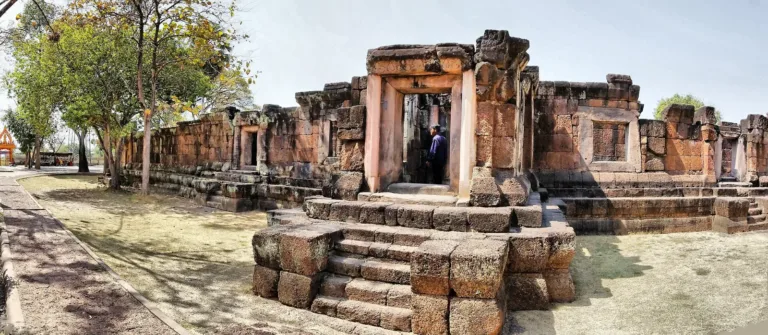 Prasat Sa Kamphaeng Yai
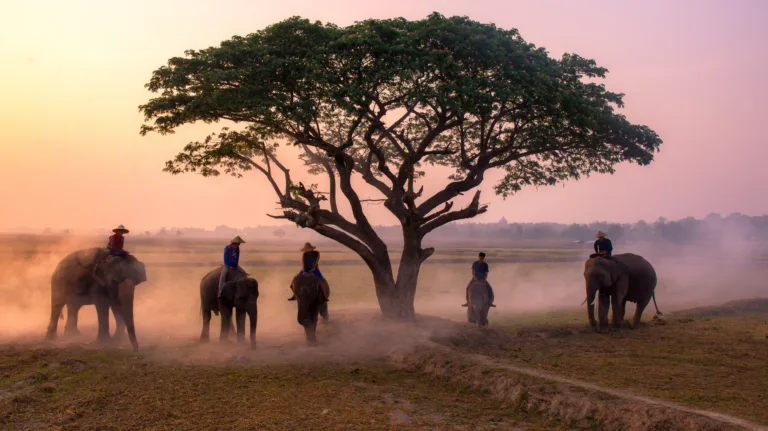 Ban Ta Klang Elephant Village