 01
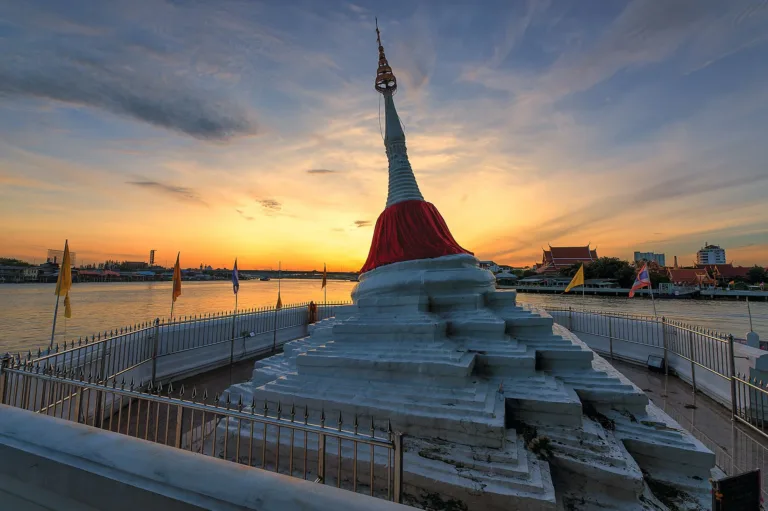
Mutao (leaning) chediThe island’s emblem on the Chao Phraya
NONTHABURI · PAK KRET
An island in the Chao Phraya created by a 1722 canal, home to a Mon community since 1774, with the leaning Mutao chedi, Wat Paramaiyikawat and GI-registered pottery.
Holiday / event — crowded
Daily; most shops about 09:00–17:00
Free
3–4 hours
Weekends and long holidays
01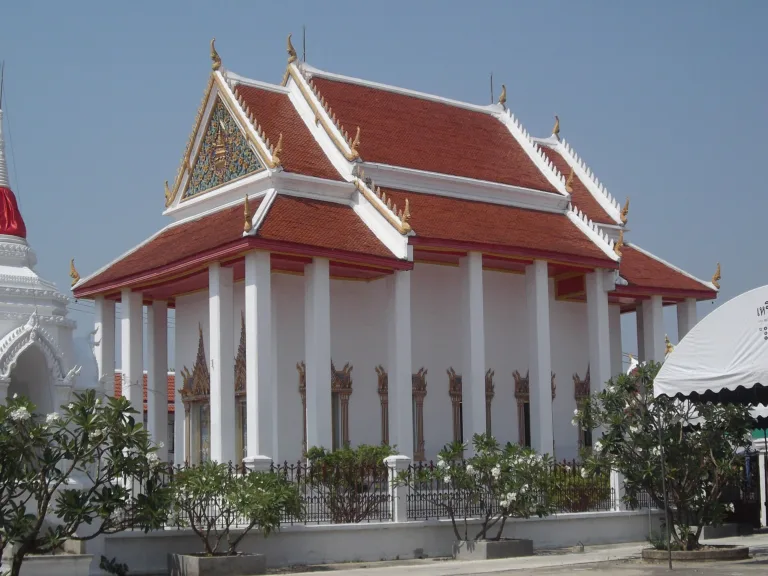 02
 03
 04
Tap a day card to see that day’s weather, rain, haze and hourly forecast
Best time to go Daytime is over · see tomorrow
Holiday — traffic on the way up and parking fills fast; leave early
Green band = hours used for the score
Best time to go Fine all day little rain through the day
Holiday — traffic on the way up and parking fills fast; leave early
Green band = hours used for the score
Best time to go Fine all day little rain through the day
No warnings today — normal road and weather conditions
Green band = hours used for the score
Best time to go Fine all day little rain through the day
No official warnings, but watch for: Hot (Afternoon) feels like 38°C
Green band = hours used for the score
Best time to go Fine all day little rain through the day
No official warnings, but watch for: Hot (Afternoon) feels like 39°C
Green band = hours used for the score
Best time to go Fine all day little rain through the day
No official warnings, but watch for: Hot (Afternoon) feels like 39°C
Green band = hours used for the score
Best time to go Fine all day little rain through the day · light drizzle possible at times
No warnings today — normal road and weather conditions
Green band = hours used for the score
Ko Kret in Pak Kret, Nonthaburi, is a car-free island in the Chao Phraya formed by an 18th-century shortcut canal and home to a Mon community known for its leaning chedi, Mon temples and carved pottery.
Arrive Arrive before 10:00 at weekends for fewer crowds
Photos from Wikimedia Commons and contributors · tap a photo to see its credit
Riverside paths may flood in high-water season
Narrow paths; watch for pedestrians
Dress modestly in temples
Free · Time needed 3–4 hours
Weekends and long holidays
| Cross-river ferry | 2 ฿/trip |
| Parking on the Pak Kret side optional | 30–50 ฿/day |
| Bicycle hire optional | 50 ฿/bike |
Mostly cash; bigger shops take transfers · Prices may change by season — check with the venue
Mon festivals such as Songkran and the honey alms-giving
Tap a month on the wheel to see weather, rain, haze and crowds from 10 years of records
Best time · Nov – Feb is cool and comfortable for walking or cycling around the island.
Watch out · Sep – Oct brings high water that can flood riverside paths; Mar – May is very hot.
Nov by the records 23–31°C · avg rain 85 mm (10 rainy days) · clear 6 days · avg PM2.5 25
Ko Kret is an island in the Chao Phraya River, forming Ko Kret subdistrict in Pak Kret, Nonthaburi. It covers about 4.2 km², roughly 2,625 rai (Thai PBS says over 2,820 rai), in seven villages, and most residents are of Mon descent. It is known for pottery, Mon temples and the leaning chedi at its tip. There are no car roads, so visitors walk or cycle around the island.
Ko Kret was created by a canal. In 1722 King Thai Sa had the Khlong Lat Kret Noi dug across a horseshoe bend of the Chao Phraya to shorten the voyage, using more than 10,000 labourers from the southern provinces for nearly a month; it was 6 sok deep, 6 wa wide and about 29 sen long. Some sources, such as a Chulalongkorn University thesis, credit King Suea instead. The current then switched to the new canal and scoured it into the main river, while the old course silted up into Khlong Om Kret, cutting the land between them off as an island.
“Kret” here means a small shortcut channel between stretches of the same river, and Pak Kret takes its name from the village at the channel’s mouth. The island was once called Ban Laem; title deeds under King Chulalongkorn called it Ko Salakun after Wat Salakun, built by Chao Phraya Rattanathibet in the Thonburi period, and in 1884 the subdistrict took the name Ko Kret.
In the late Ayutthaya period the area was a trading community with a checkpoint for ships bound for Ayutthaya. Wat Pak Ao, later Wat Paramaiyikawat, was built around 1722 after the canal was dug, at the bend where the canal met the river. When the Burmese seized Nonthaburi in 1764 the temple was abandoned.
Mon people migrated to Siam in several waves from the Ayutthaya period on. Most of Ko Kret’s Mon came in the Thonburi era: around 1774 Phraya Cheng, ancestor of the Khotchaseni family, led Mon people to seek King Taksin’s protection and settled at Pak Kret, bringing potter families from Kwan Aman, musicians and dancers. In 1815, under Rama II, came the largest exodus, about 40,000 people, after King Bodawpaya of Burma forced Mon labour to build the Mingun pagoda and crushed a revolt at Martaban; Rama II settled them at Pak Kret, Sam Khok and Phra Pradaeng.
Phraya Cheng had been lord of the Mon town of Tarin. In 1774 the Burmese conscripted about 3,000 Mon troops as the vanguard of an invasion of Siam through the Three Pagodas Pass, holding their families hostage. The Mon revolted at Kanchanaburi, were crushed by the Burmese and fled into Siam via the Three Pagodas Pass and Tak. King Taksin took them in and settled them at Pak Kret and Sam Khok. Rama I later appointed Phraya Cheng Chao Phraya Maha Yotha; his son Thoriya succeeded him, and the family became the most influential Mon lineage at the early Bangkok court. A descendant, Chao Chom Manda Son Klin, consort of Rama IV and mother of Prince Naretworarit (founder of the Kridakorn family), served the king Mon khao chae at Phra Nakhon Khiri in Phetchaburi, turning it into a palace dish that spread as “Phetchaburi khao chae”.
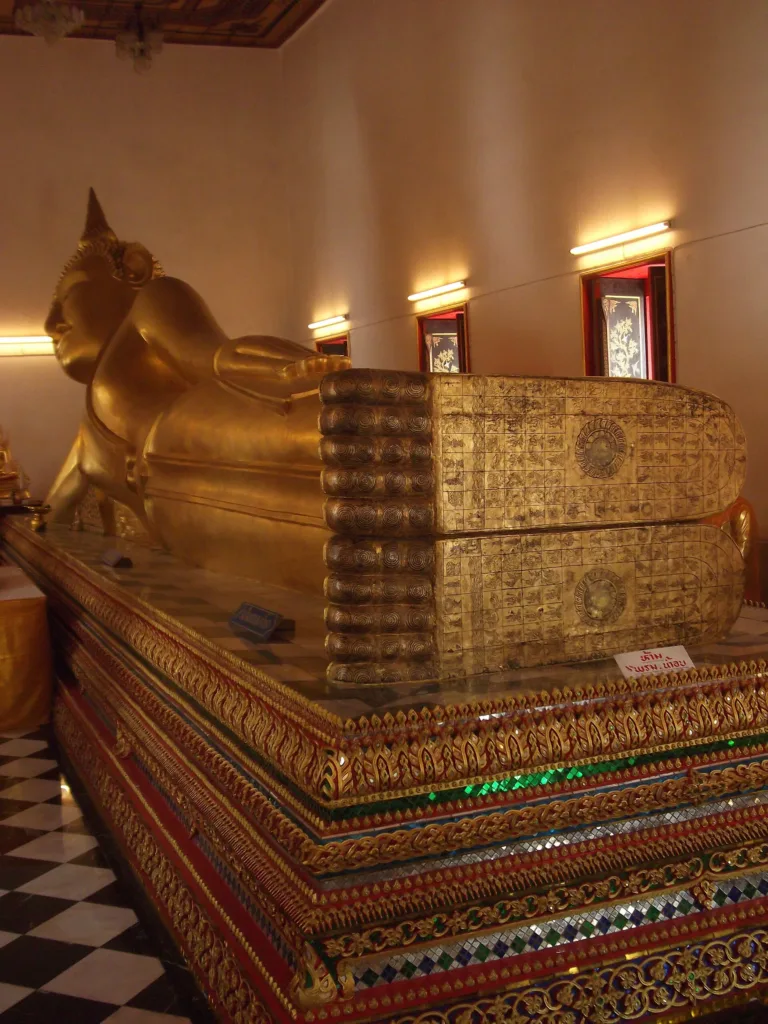
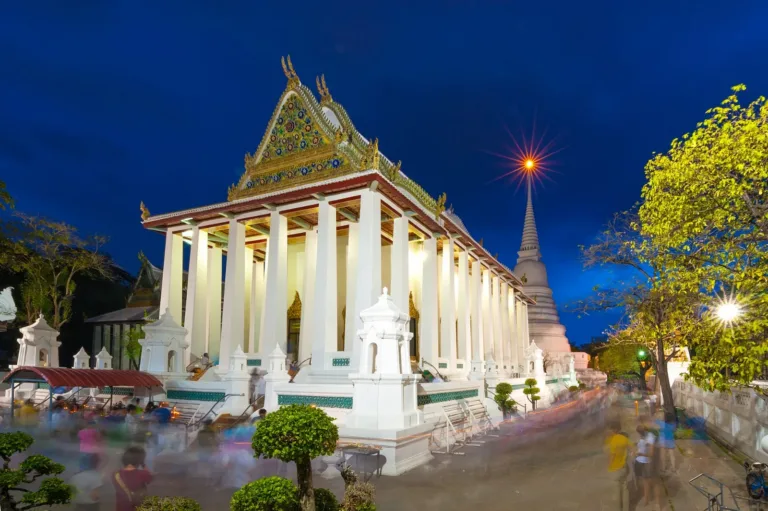
Wat Paramaiyikawat Worawihan is the island’s most important temple. It was restored under King Taksin after the Mon arrived in 1774. In 1874 King Chulalongkorn presented Kathin robes at four Mon temples in Nonthaburi, found Wat Pak Ao badly decayed and had it fully restored in Mon style, renaming it Paramaiyikawat, “temple of the royal grandmother”, in merit for the grandmother who had raised him; he also had chanting done in Mon. A second-class royal temple, it has an ordination hall decorated with Italian materials and traditional Thai murals, a five-spired wooden pavilion once used for Mon-style coffins, and the only Mon-language Tripitaka in Thailand, as well as the Maha Raman chedi and a reclining Buddha.
Wat Paramaiyikawat holds many treasures. By the pier stands a five-spired wooden pavilion once used for the Mon-style coffins of former abbots. The ordination hall is decorated with Italian materials in the European taste of King Chulalongkorn’s reign. The vihara houses a late-Ayutthaya reclining Buddha under a ceiling painted with royal decorations by Prince Prawit Chumsai, and Phra Nonthamunin, Nonthaburi’s provincial Buddha image, in a Mon-style pavilion; a marble Buddha before the vihara was a gift from Burmese people to King Chulalongkorn. The temple museum, open only at weekends, displays votive tablets, glass, ceramics and finely made Mon coffins by Col. Chatiwat Ngamniyom. A Chulalongkorn University thesis says the temple received its royal name in 1884, celebrated with three days of Mon dance, which differs from the 1874 restoration date given elsewhere.
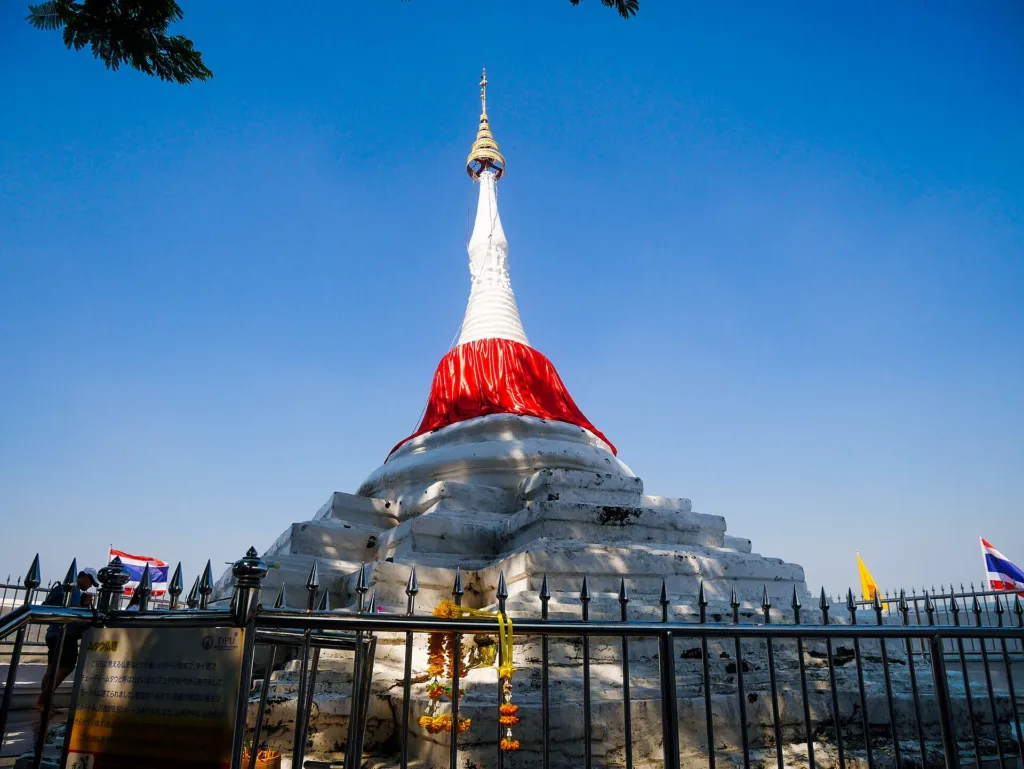
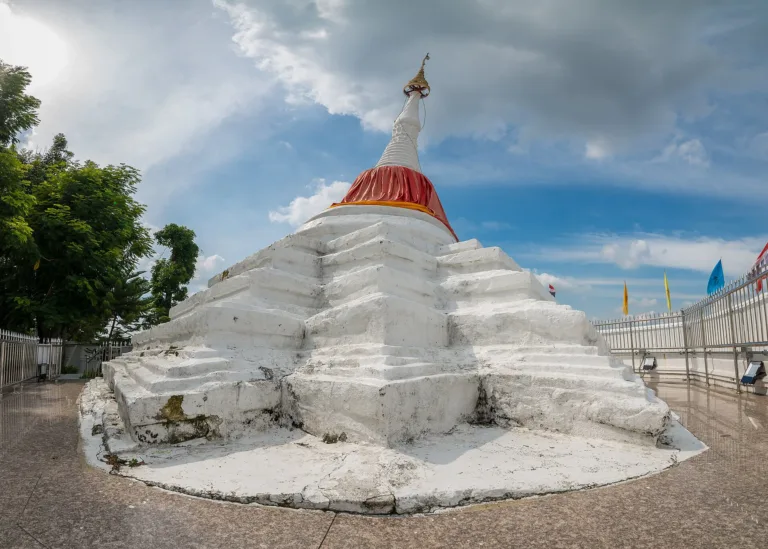
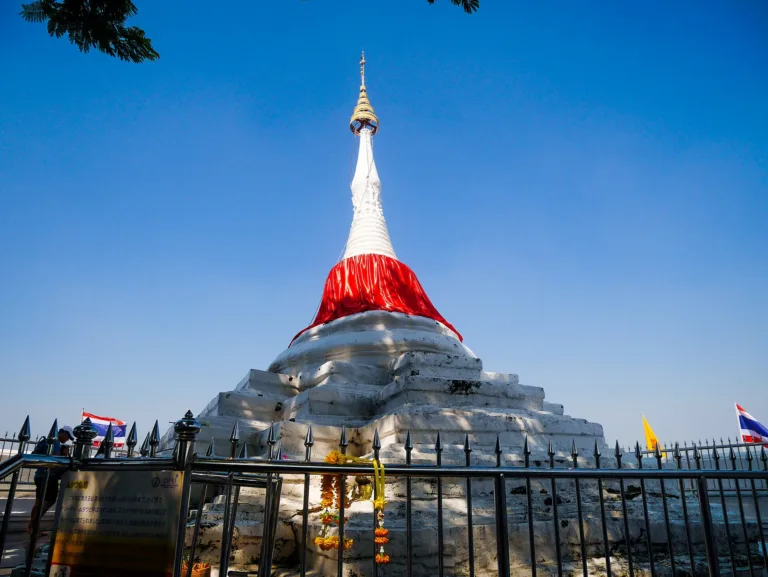
The island’s symbol is the Phra Chedi Mutao, the leaning chedi on its northeastern point: a white Mon-style chedi with red cloth at the tip and an indented octagonal base, modelled on the Shwemawdaw (Mutao) pagoda in Bago. Silpa-Mag puts its age at about 300 years, and Wikipedia says King Chulalongkorn enshrined relics in it in 1884. It once stood upright, but erosion undermined its base. The Ministry of Culture says it began leaning around 1891, but Silpa-Mag notes that a foreign newspaper drawing from 1895 still shows it upright, beside a small riverside lighthouse labelled “BANG PAIN LIGHT-HOUSE”. The Fine Arts Department registered the temple and chedi as ancient monuments in 1935.
In 1992 wooden and cement embankments were built but failed. Later, with funds from the Religious Affairs Department and donations, a permanent concrete embankment was built and the base reinforced. The Fine Arts Department allowed the chedi to be conserved in its leaning state, since it had become the island’s emblem.
The island has several other Mon temples: Wat Chimphli Sutthawat (formerly Wat Pak Fai), with a small ordination hall in original condition; Wat Sao Thong Thong (formerly Wat Suan Mak, “Phia Alat” in Mon), once home to Pak Kret’s first primary school and the district’s tallest chedi; Wat Phai Lom (“Phia To” in Mon), built in the late Ayutthaya period, with a finely carved wooden ordination hall; Wat Salakun; and the now-abandoned Wat Pa Lelai.
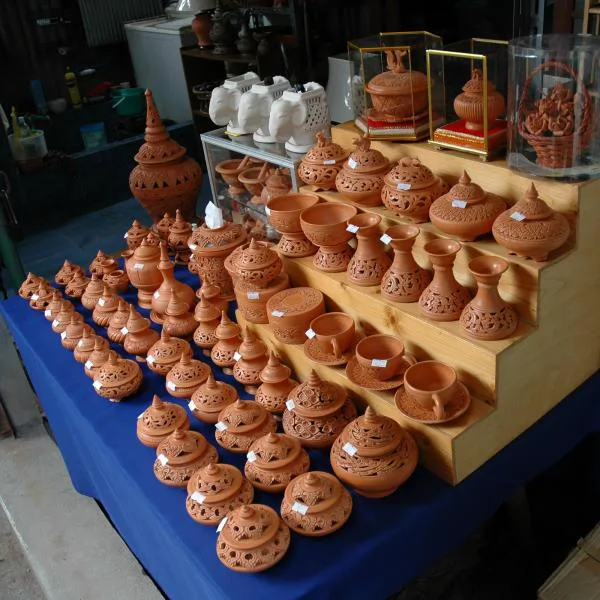
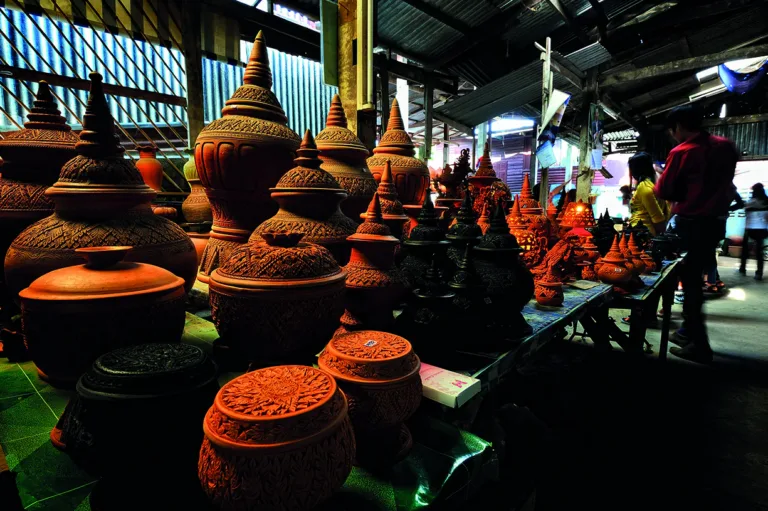
Pottery has been a Mon craft here since the Thonburi period and is Nonthaburi’s oldest folk craft. The potters, descended from Kwan Aman, live in villages 1, 6 and 7 between Wat Paramaiyikawat and Wat Phai Lom. The island’s paddy clay is fine, sticky and grit-free, with a little iron; fired hot, it turns a strong orange-red without glaze, ideal for intricate carving such as the famous carved water jars.
Ko Kret pottery was registered as a geographical indication (GI) in 2010. Thai PBS reports that average prices rose from about 100 baht a piece before GI status to about 500–700 baht, and in January 2026 the Department of Intellectual Property visited to develop packaging, markets and cultural tourism. Yet clay on the island is running out, so potters buy it from Pathum Thani at higher cost, and many young people have turned to other work.
On 29 January 2026 Oramon Sapthaweetham, director-general of the Department of Intellectual Property, visited the Ko Kret pottery centre. Plans include gift packaging, sales with partners such as IconSiam and promoting Ko Kret as a cultural landmark near Bangkok. The department says Thailand now has 250 GI products worth more than 114.6 billion baht.
In 1999–2000 Ko Kret had 5,776 people: 1,041 in village 1, 1,125 in village 2, 905 in village 3, 506 in village 4, 1,009 in village 5, 814 in village 6 and 376 in village 7. The community keeps Mon traditions and spirit beliefs and uses cultural tourism to pass on its identity.
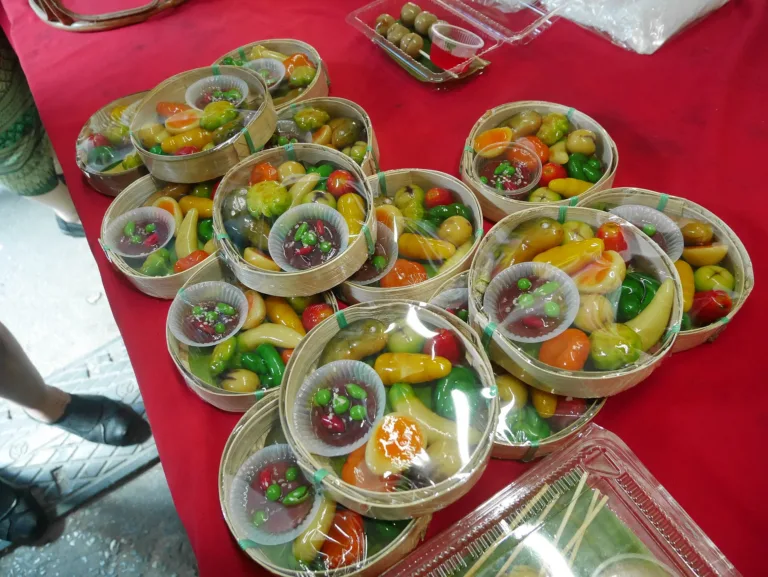
Kwan Aman pottery village serves as a Mon cultural centre, open daily 09:00–17:00. Signature foods include thot man no kala (fried fish cakes with galangal shoots) and Mon-style khao chae, along with Thai desserts, salim, jelly tubes and jar-brewed coffee.
Khao chae, called “poeng dacheik” (water rice) in Mon, is a ritual Songkran dish offered first to the gods, monks and elders before the family shares it. It comes with five to seven side dishes such as pounded dried fish, shredded salted beef, sweet fried radish, salted egg and pickled garlic.
Mon dance is a living tradition on Ko Kret. Dancers from three villages perform before the Wat Paramaiyikawat ordination hall on the first afternoon of Songkran (13–15 April) and at the end of Buddhist Lent, and also at funerals of senior monks and villagers, in front of the funeral pavilion at about 20:30. For auspicious events they wear red sarongs and yellow shoulder cloths, for funerals black, and always dance barefoot to a Mon piphat ensemble. Ko Kret’s Mon dance repertoire has 12 songs, different from other Mon communities. Dancers performed for an abbot’s promotion in 1931, before the king in 1946, and with 30–40 dancers at the Amazing Thailand celebrations at Sanam Luang in 1997. On 13 April 2026 the community still held its procession of the hamsa (swan) and centipede banner to open Mon Songkran.
Wat Paramaiyikawat regularly receives royal Kathin robes; on 12 November 2021, for example, the Royal Thai Army presented them and offered free health checks, dental care and haircuts to residents.
The great flood of 2011 brought life on the island to a halt, and residents worked together to keep water out of the monuments. Manager Online reported in 2016 that durian and pomelo orchards had recovered only about 40% because saltwater intrusion had spoiled the soil, and that flood-damaged kilns and tools had led many potters to quit. About half of local income came from tourism and some 60% of goods sold were local; homestays cost about 600 baht a night, Mon dance shows ran every weekend, and boat trips around the island to pay respects at nine temples were popular. Residents include Thais, Mon and Muslims. Visitor numbers fall in March–April because of the heat.
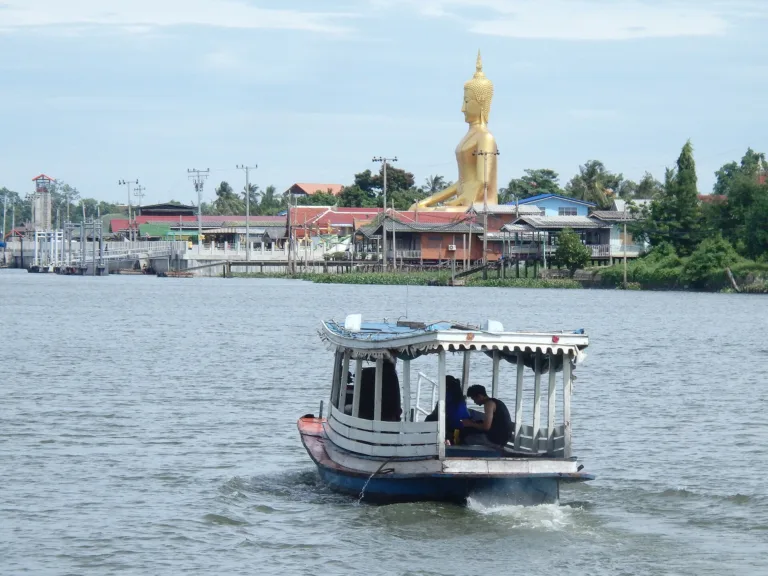
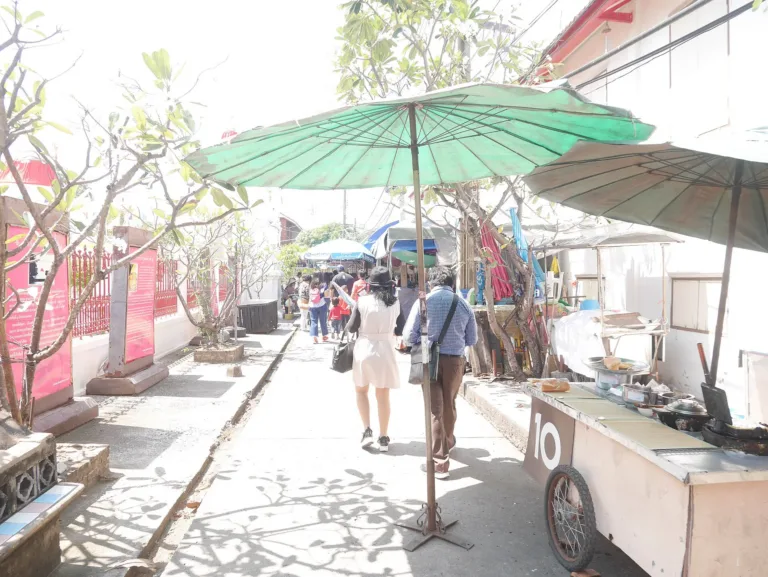
To get there, go to the Pak Kret pier beside Wat Sanam Nuea and take the cross-river ferry. Wongnai reported a fare of 2 baht (2018), with parking on the Pak Kret side about 30–50 baht a day. Shops and stalls are busier at weekends. Walk or rent a bicycle to circle the island; riverside paths can flood in high-water season.
Arrived? Check in, collect a stamp and tell others what it is like right now
Check your location first, so you do not fill in the form for nothing
Location must be on and within 1 km · One check-in per place per day · come back on other days to check in again
Post photos from anywhere — no need to be here · Up to 20 photos at a time · JPG / PNG / WebP · GPS location data is removed automatically
Traffic builds on the Pak Kret side on weekday evenings; there are no car roads on the island.
To Pak Kret pier, then the ferry · Parking 30–50 baht + fare
To Wat Sanam Nuea, then the ferry · Fare + ferry
Weekend Chao Phraya boats (if running) · Per package
Drive to the Pak Kret pier beside Wat Sanam Nuea, park on the Pak Kret side and take the ferry across.
Private car parks on the Pak Kret side, about 30–50 baht a day
Petrol stations in Pak Kret town
Good mobile signal
Daily; most shops about 09:00–17:00
about 25 km from Bangkok
Ko Kret (Pak Kret pier by Wat Sanam Nuea)
Approx. nightly price for 2 adults (next week) · final price depends on your dates
Answers travellers want before they go — a one-minute read
By the Khlong Lat Kret Noi shortcut canal, dug in 1722, which became the main river
Erosion undermined its base, and the Fine Arts Department conserved it in its leaning state
Take the ferry from Pak Kret pier beside Wat Sanam Nuea
Mostly Thais of Mon descent whose ancestors came in the Thonburi period
Best day this week: Monday 30 Nov · Check in when you arrive to collect a stamp
 Wat Chaloem Phra Kiat Worawihan
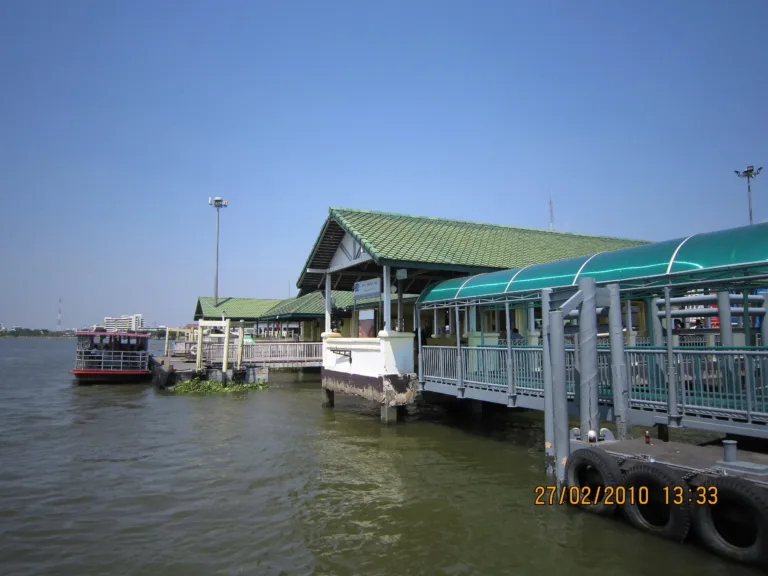 Tha Nam Non (Nonthaburi Pier)
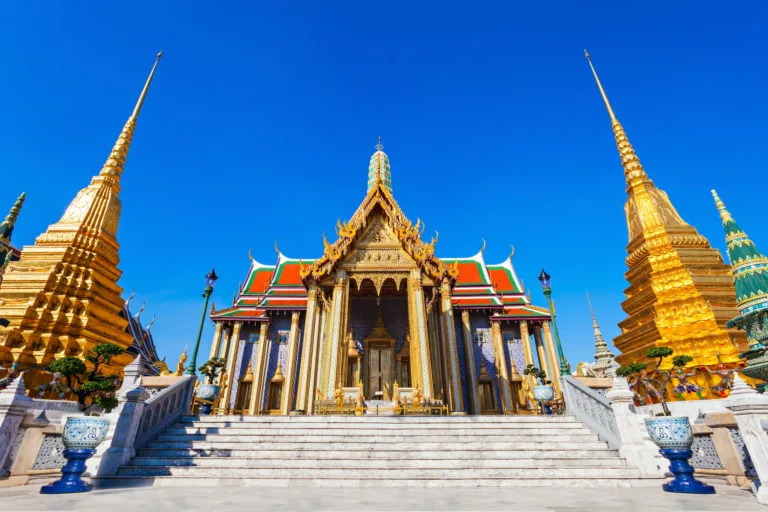 Wat Phra Kaew (Temple of the Emerald Buddha)