Wat Phra Kaew (Temple of the Emerald Buddha)
The royal temple inside the Grand Palace, founded with Bangkok itself to house the Emerald Buddha, Thailand's most sacred Buddha image — with the golden Phra Si Rattana Chedi, giant yaksha guardians and 178 Ramakien mural panels around its cloister.
Before you goWhich of the next 7 days is best Best dayMonday 19- Severe weatherNone · light showers
- EarthquakesNone in 48 h
- Major disastersNone
- Site noticesNone
About
Overview · highlights · who it suits
Wat Phra Si Rattana Satsadaram, better known as Wat Phra Kaew, stands within the Grand Palace in Phra Nakhon, Bangkok. It was built when King Rama I founded Rattanakosin as the capital, to house the Emerald Buddha (Phra Phuttha Maha Mani Rattana Patimakon), the palladium of the kingdom.
Like Wat Phra Si Sanphet in the old Ayutthaya palace, it is a royal chapel with no resident monks. Inside are the ordination hall, the Phra Si Rattana Chedi, the Phra Mondop library, the Prasat Phra Thep Bidon, a model of Angkor Wat, giant yaksha guardians and 178 panels of the Ramakien painted along the cloister walls.
It is open daily 8:30–16:30 (tickets until 15:30). Thais enter free with an ID card; foreigners pay 500 baht, which also covers the Grand Palace and the Textile Museum. Modest dress is required.
Don't-miss highlights
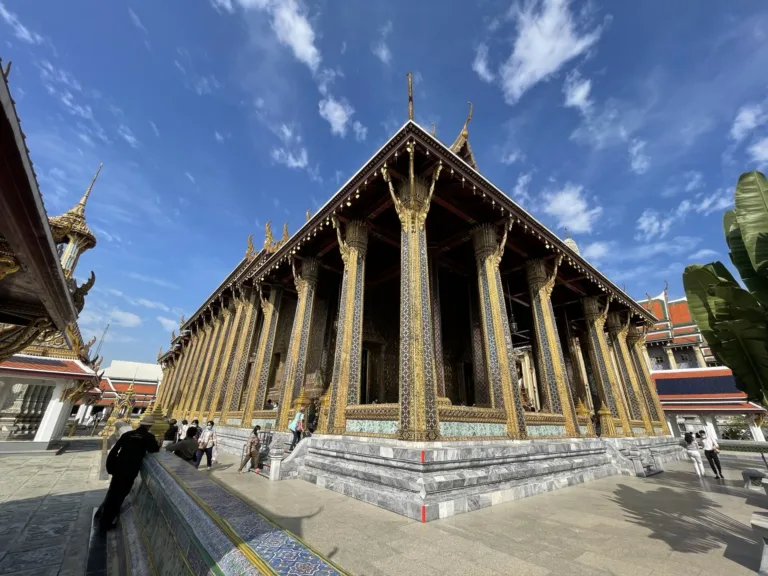
The Emerald Buddha
A green jade-like Buddha about 66 cm tall, dressed in seasonal attire
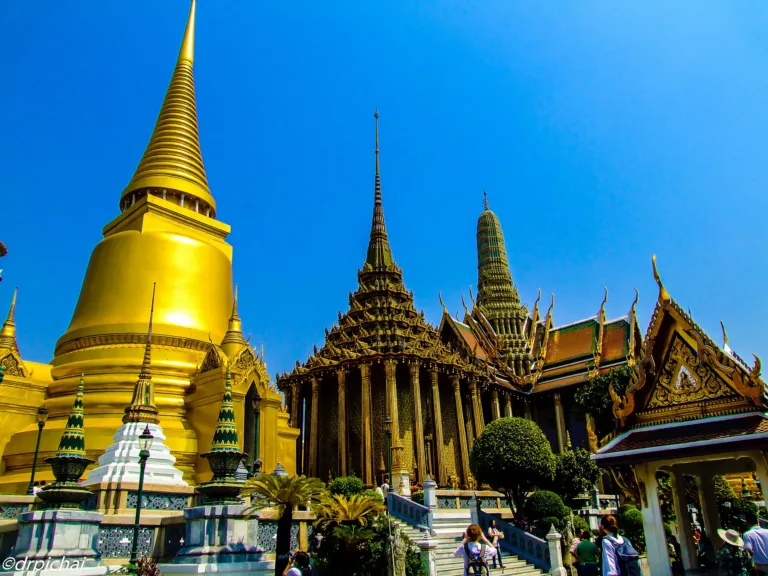
Phra Si Rattana Chedi
The golden Sri Lankan-style chedi built by King Rama IV
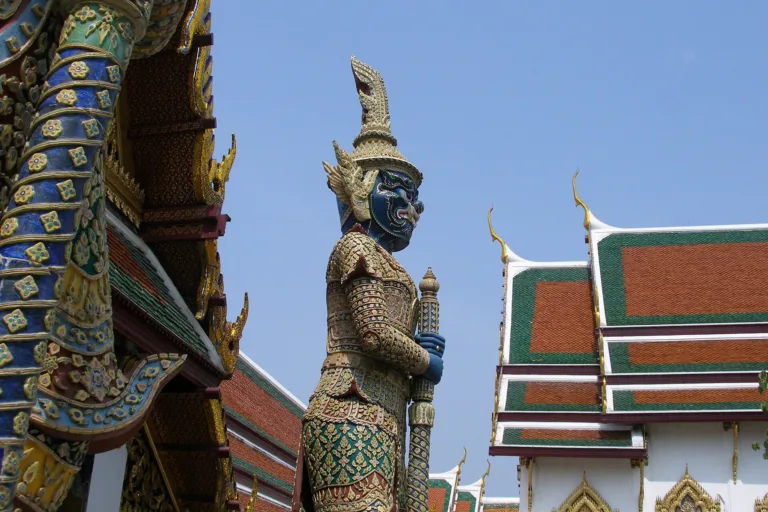
Yaksha guardians
Twelve 5 m giants guarding the six gates
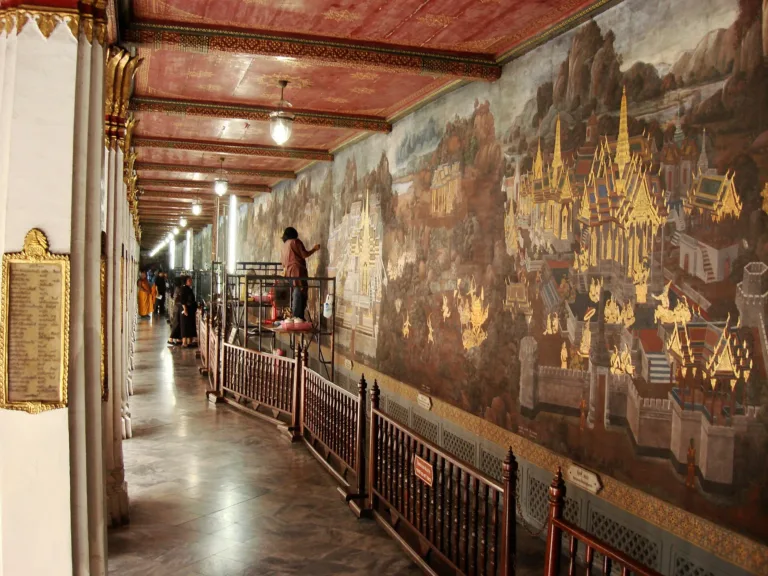
Ramakien murals
178 panels of the Ramakien around the cloister
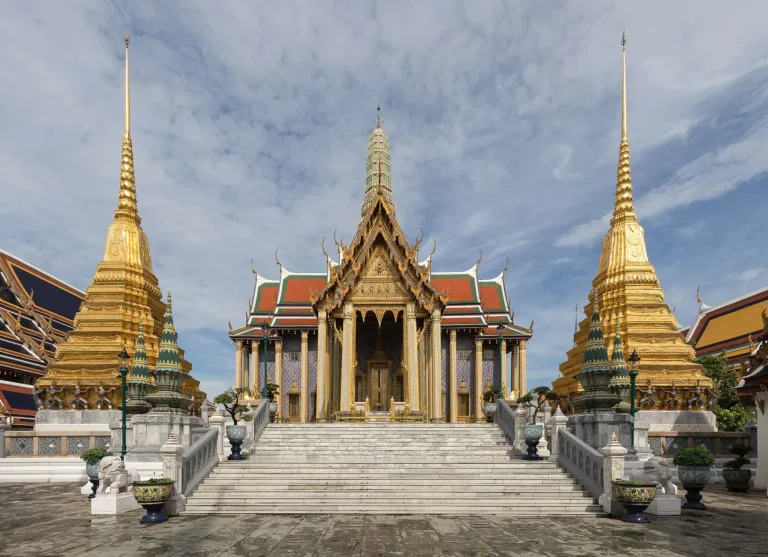
Prasat Phra Thep Bidon
Royal Pantheon with statues of the Chakri kings, open only on 6 April
Before you go
Gallery
Get a feel for the place · tap a photo to enlarge
 Wat Phra Kaew reflected in waterTemple buildings and the Phra Si Rattana Chedi seen from the Grand Palace lawn · Photo: Ninara (CC BY 4.0)
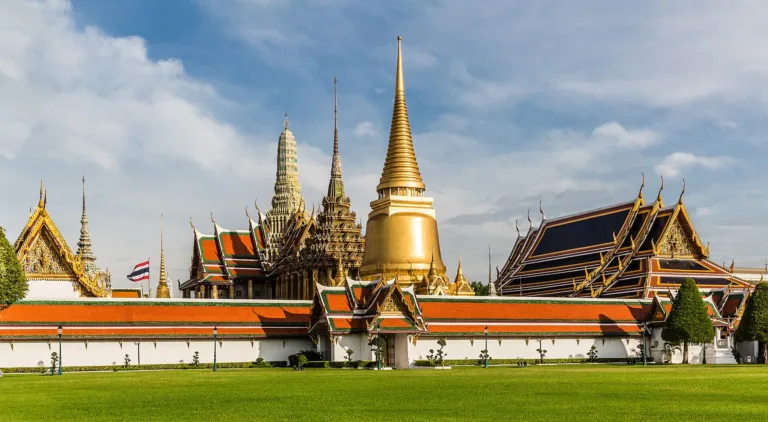 Buildings and the golden chediPrasat Phra Thep Bidon with the twin golden chedis · Photo: Basile Morin (CC BY-SA 4.0)Prasat Phra Thep BidonThe golden Phra Si Rattana Chedi among the temple buildings · Photo: Drpichai1234 (CC BY-SA 4.0)Phra Si Rattana ChediGlass-mosaic buildings at Wat Phra Kaew · Photo: Slyronit (CC BY-SA 4.0)Glass-mosaic buildingsYaksha and monkey figures supporting a golden chedi · Photo: Basile Morin (CC BY-SA 4.0)
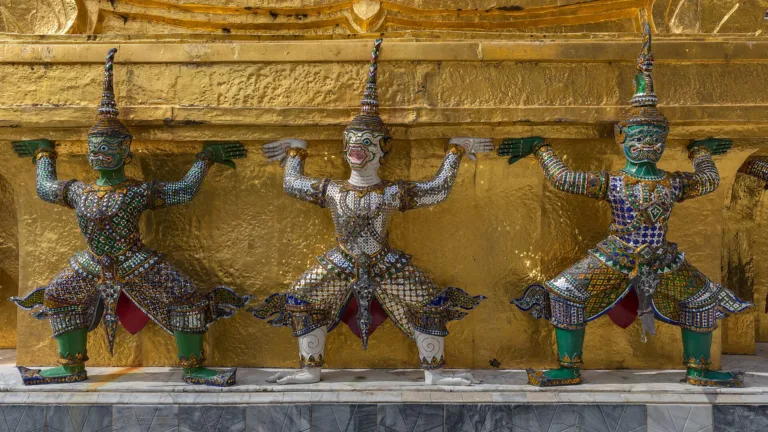 Yaksha and monkeys supporting a chediA yaksha guardian at a gate of Wat Phra Kaew · Photo: Vyacheslav Argenberg (CC BY 4.0)Yaksha guardianRamakien murals on the cloister walls · Photo: Jorge Láscar (CC BY 2.0)Cloister muralsA palace scene in the Ramakien murals · Photo: Photo Dharma (CC BY 2.0)
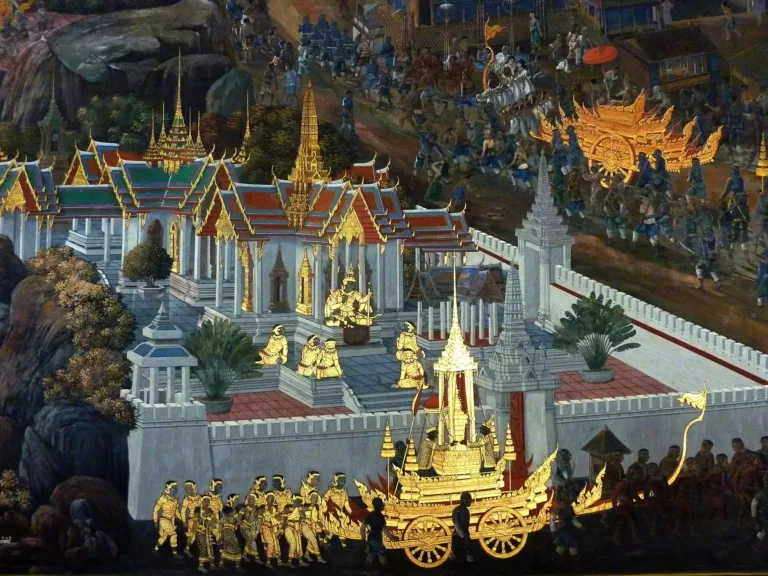 Palace scene in the Ramakien
Photo credits9 photos from Wikimedia Commons
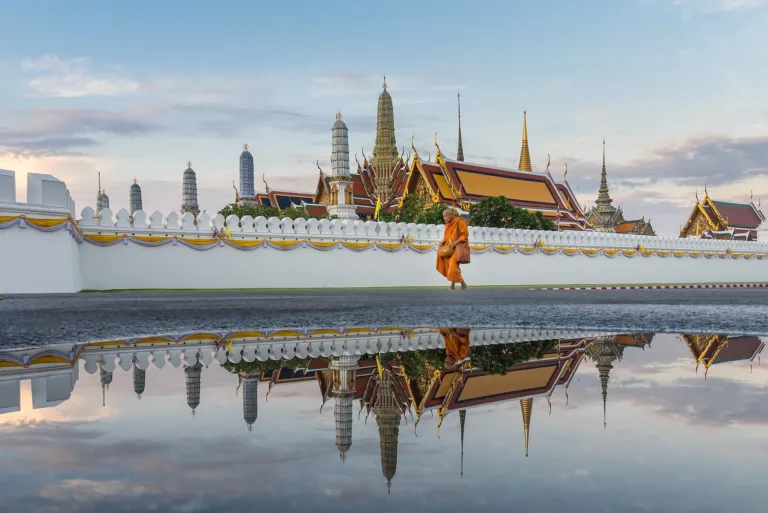
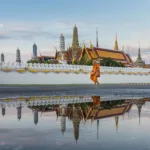 Wat Phra Kaew and the Grand Palace reflected in water in the morningPhoto: Nawit science CC BY-SA 4.0
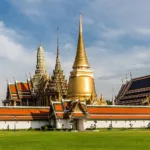 Temple buildings and the Phra Si Rattana Chedi seen from the Grand Palace lawnPhoto: Ninara CC BY 4.0
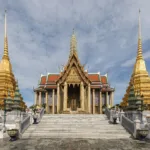 Prasat Phra Thep Bidon with the twin golden chedisPhoto: Basile Morin CC BY-SA 4.0
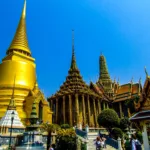 The golden Phra Si Rattana Chedi among the temple buildingsPhoto: Drpichai1234 CC BY-SA 4.0
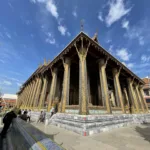 Glass-mosaic buildings at Wat Phra KaewPhoto: Slyronit CC BY-SA 4.0
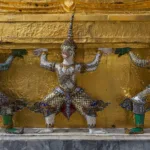 Yaksha and monkey figures supporting a golden chediPhoto: Basile Morin CC BY-SA 4.0
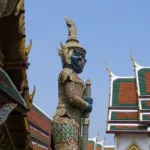 A yaksha guardian at a gate of Wat Phra KaewPhoto: Vyacheslav Argenberg CC BY 4.0
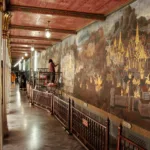 Ramakien murals on the cloister wallsPhoto: Jorge Láscar CC BY 2.0
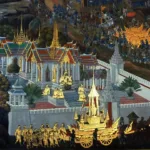 A palace scene in the Ramakien muralsPhoto: Photo Dharma CC BY 2.0
Before you go
Weather, haze and crowds before you set off
Best time of day — hourly
Today in detail
Open-MeteoWhat to bring
Local cautions
- Dress code Strictly enforced: no sleeveless tops, shorts, short skirts, or sheer or ripped clothes — you will be turned away
- Scams Ignore strangers who say 'the palace is closed today' and offer a tuk-tuk elsewhere — check at the entrance yourself
- Inside the chapel Remove shoes and hats; no photos inside the ordination hall
Moreค่าใช้จ่าย · คนเยอะไหม · Travel warnings · อากาศละเอียด
What to bring —
Estimated costs
Crowds — estimate
Travel warnings
Best months
Tap a month to see weather, rain, haze and crowds
November–February is Bangkok's coolest season and the most comfortable for walking in the open. Arrive at the 8:30 opening, before tour groups and the midday sun.
April–May is fiercely hot, with little shade on the marble courtyards; September–October brings frequent heavy rain. On long holidays or during royal ceremonies, parts or all of the site may close.
- Weather
- Rain
- Haze
- Crowds
See 10 years of real weather dataMonthly temperature, rainy days, clear days and haze
Past weather records
Check-ins & visitor photos
Location must be on and within 2 km · you can check in on every visit
History & stories
Legend · history · architecture
The legend of the Emerald Buddha, told in the Ratanabimbavamsa chronicle written around the 15th century, says the sage Nagasena made the image in Pataliputra, India, around 43 BCE, with the gods Vishnu and Indra helping to find the magic gem, before it travelled through many lands. The oldest surviving manuscript of the chronicle dates from 1788.
Historically, the Emerald Buddha first appears in Chiang Rai, in the Lan Na kingdom, around 1434, when lightning struck a chedi and revealed a Buddha image covered in stucco and gilt. Later the stucco on the nose flaked off, exposing green stone underneath. The image is about 66 cm tall and 48 cm wide at the lap, carved from a green jade-like stone or jasper — "emerald" refers to its colour, not the material.
When the king of Lan Na tried to bring it to Chiang Mai, the elephant carrying it kept heading for Lampang instead, so it stayed at Wat Phra Kaeo Don Tao in Lampang for about 32 years. In 1468 King Tilokaraj moved it to Chedi Luang in Chiang Mai, where it stayed about 84 years.
Read more history 19 more paragraphs
In 1552 King Setthathirath, who had briefly ruled Chiang Mai, took the Emerald Buddha to Luang Prabang, capital of Lan Xang, and when he moved his capital to Vientiane in 1564 he enshrined it in the Haw Phra Kaew. It remained in Vientiane for about 214 years.
In 1779, in the Thonburi period, General Chao Phraya Chakri captured Vientiane and brought the Emerald Buddha back, placing it in a pavilion near Wat Chaeng (Wat Arun) on the west bank of the Chao Phraya.
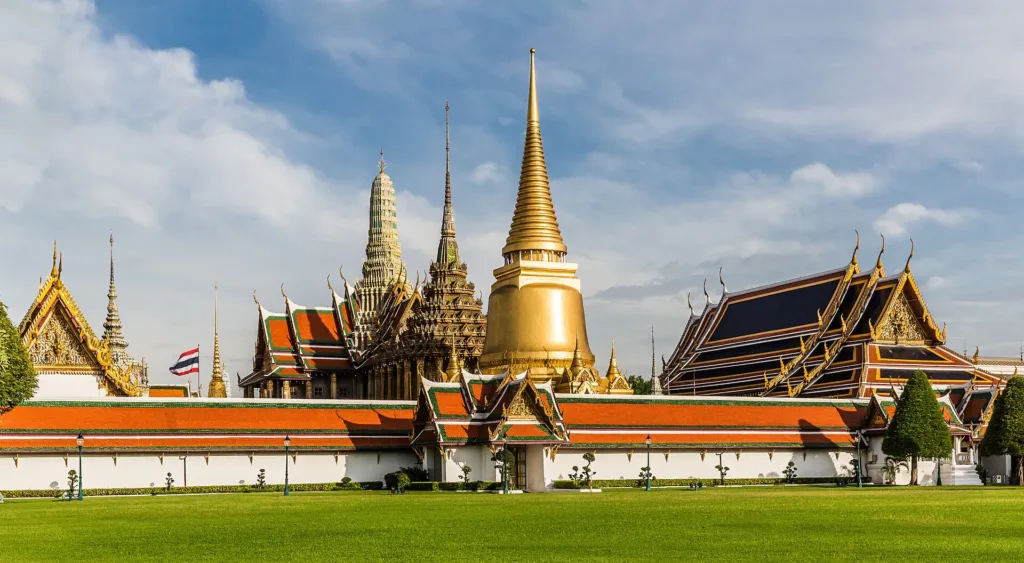 Wat Phra Kaew was built together with the Grand Palace when Rattanakosin was founded · Photo: Ninara
On 6 April 1782 Chao Phraya Chakri became King Rama I, first of the Chakri dynasty, and moved the capital to the east bank. He built the Grand Palace with Wat Phra Si Rattana Satsadaram inside its walls, modelled on Wat Phra Si Sanphet in the Ayutthaya royal palace — so the temple has no resident monks. The city's name, "Rattanakosin" — the jewel of Indra — refers to the Emerald Buddha itself.
The ordination hall was begun around 1782–1783, and the Emerald Buddha was carried across the river to be enshrined there. Many sources give 22 March 1784 (some say 7 March), but the Fine Arts Department has established the date as 28 February 1785 (still counted as 2327 in the old Thai calendar). The hall has 48 columns, 112 garuda figures holding naga, 12 bronze lions and eight boundary-stone pavilions.
Rama I commissioned the Emerald Buddha's attire for the hot and rainy seasons; the cool-season attire was made under Rama III. The king, or a royal representative, still changes the attire three times a year. After the Tripitaka was revised in 1788, Rama I also built the Phra Mondop to house its cabinet.
When the original Tripitaka hall in the middle of a pond burned down, Rama I built the Phra Mondop in its place in 1789, modelled on Mount Meru with a seven-tiered spire. Inside, a mother-of-pearl cabinet holds the gilded Tripitaka of 84,000 sections, while the nearby Ho Phra Monthien Tham served as a scripture hall and meeting hall for monks.
Rama III restored the whole temple between 1831 and 1848: he had the ordination hall repainted, repaired the cloister and spired buildings, enlarged the eight Phra Atsada Maha Chedi on the east side and enshrined relics in them, enlarged the Ho Phra Nak, and created the new set of yaksha guardians still standing at the gates. The ordination hall murals show the life of the Buddha, the Victory over Mara, the Three Worlds cosmology and the Ten Jatakas.
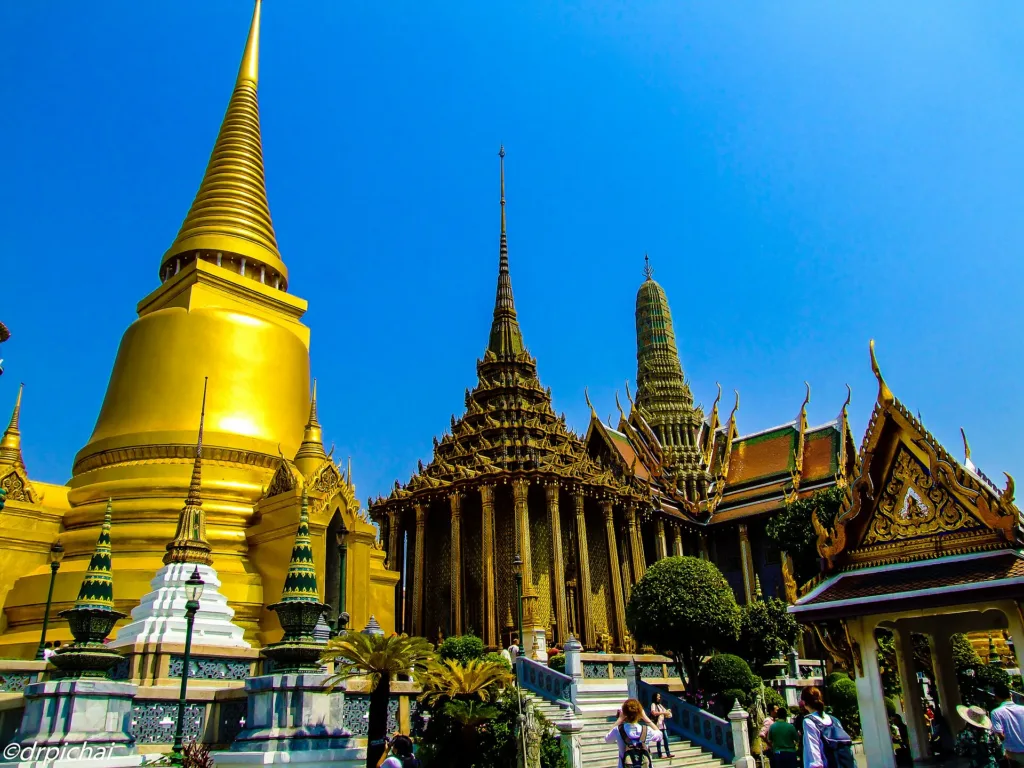 The Phra Si Rattana Chedi, built by King Rama IV in 1855 · Photo: Drpichai1234
The temple has been restored for every major anniversary of the capital. Rama III began restoring it in 1831 for Bangkok's 50th anniversary in 1832. In 1855 Rama IV built the Sri Lankan-style Phra Si Rattana Chedi to enshrine relics from Sri Lanka, built the Prasat Phra Thep Bidon (first called Phutthaprang Prasat), and ordered a scale model of Angkor Wat after the Cambodian temple complex was rediscovered around 1860.
Rama IV also enlarged the Mondop terrace, built the Ho Phra Khanthararat, and built the Ho Phra Ratcha Karamanusorn and Ho Phra Ratcha Phongsanusorn beside the Phra Bodhi Dhat Phiman, painted with royal chronicles by Khrua In Khong — the painter who introduced Western shading and perspective to Thai mural art. The Ho Phra Ratcha Phongsanusorn also holds the offerings for the oath-of-allegiance ceremony.
The greatest restoration came under Rama V. In 1879 he vowed to complete the temple for Bangkok's centenary, assigning his brothers individual tasks such as the marble floor of the ordination hall, the stone inscriptions, the brass floor plating and repairs to the mother-of-pearl doors. Prince Adisorn Udomdet ordered glazed tiles from Germany for the Phra Si Rattana Chedi. It was paid for from the privy purse Rama III had left as a legacy, plus the king's own money, without drawing on the national treasury. Work finished on 13 April 1882, after 2 years, 3 months and 20 days, and the temple was celebrated on 21 April 1882 together with the city's centenary.
During the same restoration, Prince Prawit Chumsai completed the model of Angkor Wat begun under Rama IV, and marble statues were ordered from Europe to decorate the grounds — among them, according to contemporary Western accounts, a figure of Emperor Napoleon III. These Western statues were moved to the National Museum in 1927.
In 1903 fire destroyed the Prasat Phra Thep Bidon; it was rebuilt under Rama VI. Today it houses statues of the Chakri kings and opens to the public only on 6 April, Chakri Day.
Rama VI renamed the Phutthaprang Prasat as the Prasat Phra Thep Bidon, and on 6 April 1918 statues of the first five Chakri kings were installed there; today it holds statues of nine kings of the dynasty.
The anniversary restorations continued: Rama VII restored the temple for Bangkok's 150th anniversary in 1932, and Rama IX for the bicentennial in 1982. The temple also hosts major royal ceremonies, such as the oath of allegiance, once held twice a year.
Rama VII's restoration for the 150th anniversary cost about 600,000 baht. Under Rama VIII a concrete dado was added to stop damp damaging the cloister murals, and under Rama IX all four sides of the cloister murals were restored in time for the bicentennial — painters who had worked on the 150th-anniversary restoration were invited back alongside a new generation who had to pass a test, such as Sanga Mayura, who painted panel 161, and Chakrabhand Posayakrit, who painted panels 159–160. In the present reign parts of the temple were restored for the 2019 coronation.
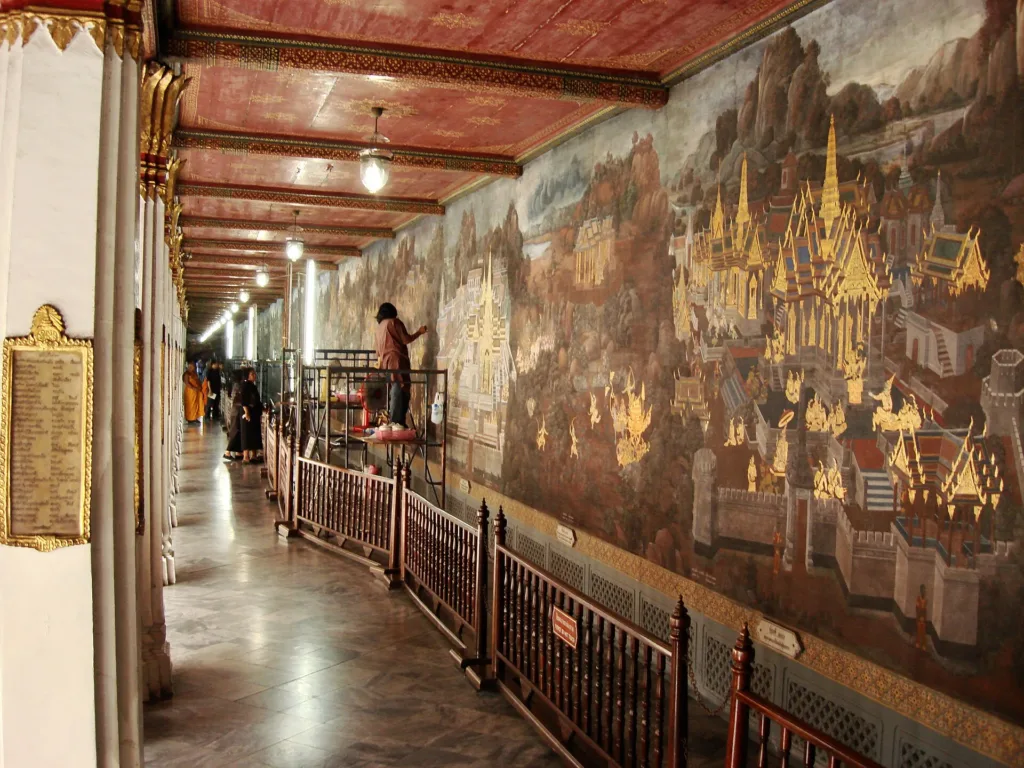 The Ramakien murals on the cloister walls, repainted over many reigns · Photo: Jorge Láscar
The cloister around the ordination hall is painted with 178 panels of the Ramakien, begun under Rama I and repainted over many reigns, telling the story from Rama's birth to the end of the war, with lively scenes of everyday life slipped in. The six gates are guarded by twelve yaksha about 5 m tall, including Thotsakan, Sahatsadecha and Inthrachit.
The twelve yaksha guardians are characters from the Ramakien: Suriyaphop, Inthrachit, Mangkornkan, Wirunhok, Thotsakhiritorn, Thotsakhiriwan, Chakrawat, Atsakanmara, Thotsakan, Sahatsadecha, Maiyarap and Wirunchambang. They stand in pairs at the six gates, marking the step from the outer palace courtyards into the sacred precinct.
The temple also has the eight Phra Atsada Maha Chedi on the east side, the Ho Phra Monthien Tham library, a bell tower, twelve open pavilions around the ordination hall, and twin golden chedis supported by yaksha and monkey figures. Today Wat Phra Kaew is open daily 8:30–16:30; Thais enter free, while foreigners pay 500 baht including the Grand Palace and Textile Museum — one of Bangkok's most visited sights.
Though no monks live here, the temple has regular religious activity: sermons every Sunday and Buddhist holy day, schoolchildren chanting the traditional "O-e" verses in the pavilions around the ordination hall during Buddhist Lent, and, every 6 April, the public paying homage to the royal statues in the Prasat Phra Thep Bidon. Groups of ten or more must request permission at least a week in advance.
Location & getting there
Map · how to get there · costs
Directions use live traffic to estimate travel time
- Travel timeAbout 20–40 min from central Bangkok, depending on traffic
- RoadCity streets; heavy traffic at rush hours
- ParkingVery limited parking — use the MRT, river boat or a taxi
- FuelPetrol stations throughout the city
Suggested route
Wat Phra Kaew is inside the Grand Palace; the main entrance is the Wiset Chaisri Gate on Na Phra Lan Road, opposite Sanam Luang.
The easiest way is the MRT Blue Line to Sanam Chai station, then a 10–15 minute walk, or the Chao Phraya Express boat to Tha Chang pier, about 5 minutes' walk to Na Phra Lan Road.
Tell taxis or ride-hailing drivers to drop you on Na Phra Lan Road. Ignore strangers who say "the temple is closed today" and offer to take you elsewhere — a common scam around here.
4 ways to get there
Get off at Sanam Chai, walk about 10–15 min
Get off at Tha Chang, walk about 5 min
Ask to be dropped on Na Phra Lan Road
Many routes pass Sanam Luang and Na Phra Lan Road
Prices and times are estimates and vary with season and traffic