Rainy season, safety and preparation
May – Sep
Strong water in the rains — Wear your life jacket and helmet at all times and follow the guide
Half a day
Patchy
7 days ahead
When to go
this week
Tap a day card to see that day’s weather, rain, haze and hourly forecast
Best time to go Daytime is over · see tomorrow
Strong gusts, about 51 km/h
Holiday — traffic on the way up and parking fills fast; leave early
Hour by hour
Green band = hours used for the score
Best time to go Fine all day little rain through the day
Strong gusts, about 56 km/h
Holiday — traffic on the way up and parking fills fast; leave early
Hour by hour
Green band = hours used for the score
Best time to go Fine all day little rain through the day
No warnings today — normal road and weather conditions
Hour by hour
Green band = hours used for the score
Best time to go Fine all day little rain through the day
No official warnings, but watch for: Outside this place's best season
Hour by hour
Green band = hours used for the score
Best time to go Fine all day little rain through the day · light drizzle possible at times
No official warnings, but watch for: Outside this place's best season
Hour by hour
Green band = hours used for the score
Starry sky
How likely
Scored from cloud cover at every level and tonight’s moonlight — the darker the sky, the clearer the Milky Way · tap another night below for the next 7 nights
Kaeng Hin Phoeng
Kaeng Hin Phoeng is at Ban Nong Nae in Saphan Hin, Na Di District, Prachin Buri. It's a series of rock rapids on the Sai Yai river within the Prachin Buri side of Khao Yai National Park, and one of eastern Thailand's best-known rafting spots.The rafting route is about 4.5 km and takes around two hours, running through Kaeng Hin Phoeng, Wang Bon, Luk Suea and Wang Sai before ending at Ngu Hao. Difficulty ranges from class 3 to 5 depending on water levels.The water is best in the rainy season, roughly July to October. In the dry months it's usually too low to raft, but you can still come to see the rocks and paddle at the edge.
- Morning rafting, pleasant weather
- Possible, but afternoon rain is common in the wet season
Arrive Morning, to leave time for rafting and relaxing afterwards
- Rock shelf at Kaeng Hin PhoengWater pouring over the rocksmorning
Good to know here
Wear your life jacket and helmet at all times and follow the guide
Rafting usually isn't possible from November to May
Rocks are slippery and the current is fast; stay out of deep water
- Book an operator ahead on rainy-season weekends
- Ask about water levels before you set off
- Wear shoes with heel straps and quick-dry clothes
- Bring a change of clothes and a dry bag for your phone
Adults 40 THB · Time needed Half a day
Weekends in the rainy season
| Park entry, Thai adult | 40 ฿/person |
| Park entry, Thai child optional | 20 ฿/person |
Cash · Prices may change by season — check with the venue
- Kids Young children shouldn't raft at this level, but can watch from the bank
- Seniors Rafting isn't suitable, but the riverside views are
- Wheelchair The way down to the rapids is rock and dirt; not suitable
- Pets It's inside a national park; pets aren't allowed
- Resort and operator restaurantsMade-to-order Thai food
- Listen to the guide's safety briefing before boarding
- Take your rubbish with you
- Don't drink alcohol before rafting
- Wear a life jacket and helmet for the whole trip
- The river rises fast after heavy rain; heed the staff
- Riverside rocks are very slippery
Annual rafting festival in August
The story of this place
Kaeng Hin Phoeng is the rocky lower stretch of the Sai Yai river, which flows down from the forests of Khao Yai to the Na Di side of Prachin Buri. Sandstone layers more than a hundred million years old lie across the river and create a chain of rapids. For a long time it was simply a forest stream that the surrounding villages relied on, until 1997, when the province surveyed it and trialled rafting in rubber rafts. Since then Kaeng Hin Phoeng has become one of Thailand's best-known rafting spots, with a festival opening the season every year.
Read more 10 more paragraphs
The story of the rapids begins with the rock. The sandstone here is thick, coarse and poorly sorted, running east–west and dipping gently to the south. The Department of Mineral Resources explains that Khao Yai has river-laid sediments of the Khorat Group sitting on older volcanic rocks; in the park the Phu Kradueng Formation is roughly 140–150 million years old and the Phra Wihan Formation roughly 120–130 million years old.
The rapids formed as water cut along fractures and bedding planes, leaving large sandstone blocks across the channel. Where the channel narrows, rainy-season floods run fast and hard and keep breaking the rock, while in the dry season the water slows and winds around the rocky islets.
The rock shelves still show the river's work: potholes ground into the bedrock by swirling gravel during floods, cross-bedding that records the direction of ancient currents, small waterfalls and natural rock bridges. In the dry season, when the water drops, Kaeng Hin Phoeng is better for looking at geology than for rafting. The Department of Mineral Resources also records footprints of a meat-eating dinosaur on a fallen block of Cretaceous sandstone beside the Sai Yai river.
The Sai Yai rises on Khao Yai. Park information and local media say the river runs about 80 km from Wang Wae waterfall to Kaeng Hin Phoeng, though only about 2.5 km can be rafted safely. Downstream it joins the Prachin Buri river, which meets the Nakhon Nayok river to form the Bang Pakong.
These headwater forests have long been protected. After Prime Minister Field Marshal Sarit Thanarat set Thailand's national park system in motion in 1959, Khao Yai was proclaimed the country's first national park on 18 September 1962, spanning four provinces including Prachin Buri. It became an ASEAN Heritage Park in 1984, and on 14 July 2005 it was inscribed as a natural World Heritage Site as part of the Dong Phayayen–Khao Yai Forest Complex. Today the rafting base is Khao Yai's Ranger Unit 9 (Kaeng Hin Phoeng).
The rapids are surrounded by the communities of Saphan Hin and Samphan Ta. "Saphan Hin" (stone bridge) comes from a large rock slab that spanned the stream like a bridge, which villagers used to cross between the two subdistricts; it was first called "Hin Saphan" and became a subdistrict in 1928. "Samphan Ta" is named after the sam phan ta tree that once grew widely here. Most residents farm rice and fruit and have always depended on the Sai Yai's water.
The turning point came in 1997, when the then provincial governor surveyed the river and trialled rafting in rubber rafts. It proved fun, exciting and safe, so the first rafting festival was held, and it has been held every year since. Rafting became a second income for villagers: after the rice season many work as porters and raft paddlers, organised around the Kaeng Hin Phoeng rafting operators' club.
A trip starts with a walk of about 2.5 km from Unit 9 up to the launch point, then runs through Kaeng Hin Phoeng, Phak Nam Lom, Wang Bon, Luk Suea, Wang Sai and Ngu Hao rapids. Kaeng Hin Phoeng, the first, is about 150 m long, and the rapids are rated class 3 to 5. Each raft seats 8 to 10 people. Reports from 2007 note that rescue-trained staff were stationed at every rapid. Some sources give a longer total route, depending on the starting point and water level.
The festival gradually grew into a provincial event. In 2011 it was held at Unit 9 with stage shows and OTOP products; 2019 saw the 23rd festival on 12–17 July, and 2025 the 26th on 9–12 August, organised by the province, the provincial administrative organisation, local authorities and the operators' club. In recent years the festival has moved from July to August.
The fun at Kaeng Hin Phoeng always depends on the rain. In 2010 late rains left the Sai Yai low, hurting both farming and tourism, and in August 2021 the park temporarily closed the rapids under Covid-19 controls, when Prachin Buri was in the highest-control zone. Today Kaeng Hin Phoeng remains both a rainy-season adventure playground and an open-air geology classroom in the dry season.
- 1928Saphan Hin subdistrict is established, named after a rock slab that bridged the stream
- 1959Prime Minister Field Marshal Sarit Thanarat initiates Thailand's national park system, starting with Khao Yai
- 196218 Sep: Khao Yai is proclaimed Thailand's first national park, protecting the Sai Yai headwaters
- 1984Khao Yai is declared an ASEAN Heritage Park
- 1997The provincial governor surveys the river and trials rubber-raft rafting; the first Kaeng Hin Phoeng rafting festival follows
- 200514 Jul: the Dong Phayayen–Khao Yai Forest Complex is inscribed as a natural World Heritage Site
- 2007Staff trained in water rescue are stationed at all six rapids during the rafting season
See 7 events
- 2010Late rains leave the Sai Yai river low, hurting farming and tourism
- 2010The Department of Mineral Resources publishes a Khao Yai geology guide explaining the rapids and potholes
- 2011The rafting festival is held at Ranger Unit 9 with shows and OTOP products
- 201923rd Kaeng Hin Phoeng rafting festival, 12–17 July
- 2021August: the park temporarily closes Kaeng Hin Phoeng under Covid-19 control measures
- 2023Rafting festival held 10–14 August at Ranger Unit 9
- 202526th Kaeng Hin Phoeng rafting festival, 9–12 August
Check-ins & visitor photos
Arrived? Check in, collect a stamp and tell others what it is like right now
Check your location first, so you do not fill in the form for nothing
Location must be on and within 3 km · One check-in per place per day · come back on other days to check in again
Post photos from anywhere — no need to be here · Up to 20 photos at a time · JPG / PNG / WebP · GPS location data is removed automatically
How to get there
Kaeng Hin Phoeng is at Ban Nong Nae, Saphan Hin, Na Di District, Prachin Buri, on the Prachin Buri side of Khao Yai National Park.
Via Na Di district to Ban Nong Nae, Saphan Hin · Fuel
Paved road to the rapids area
Patchy
Daily from 08:00, closing around 16:00–17:00
Kaeng Hin Phoeng
FAQ
Before you go: Kaeng Hin Phoeng
Answers travellers want before they go — a one-minute read
When is the best time to raft Kaeng Hin Phoeng?
The rainy season, roughly July to October
How long is the trip?
About 4.5 km, taking around 2 hours
Is it difficult?
Class 3–5 depending on the water; no experience needed, but follow your guide
Can I raft in the dry season?
Usually the water is too low, but you can still visit the rapids
How much does rafting cost?
Roughly 2,500–3,000 THB per raft depending on the operator; ask first
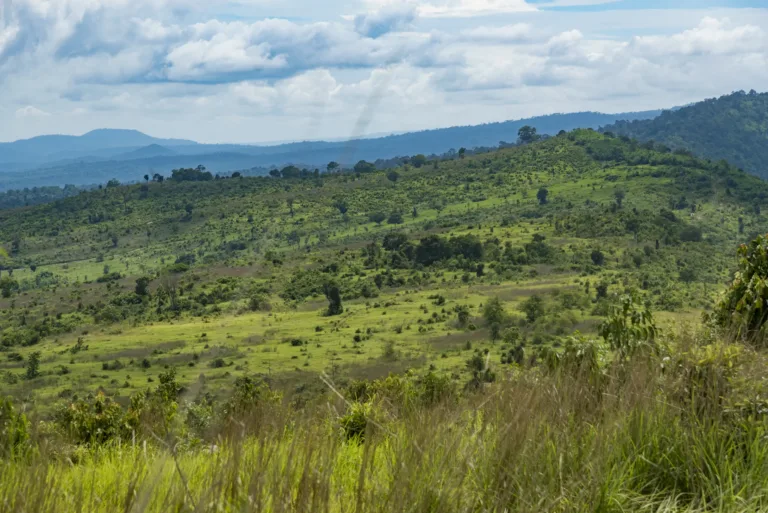 Thap Lan National Park
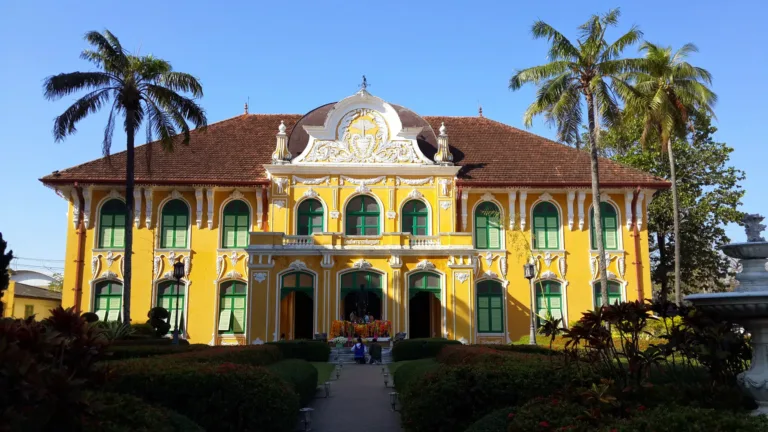 Chao Phraya Abhaibhubejhr Building
Ready to go to Kaeng Hin Phoeng?
Best day this week: Monday 30 Nov · Check in when you arrive to collect a stamp