7 days ahead
When to go
this week
Tap a day card to see that day’s weather, rain, haze and hourly forecast
Best time to go Daytime is over · see tomorrow
Holiday — traffic on the way up and parking fills fast; leave early
Hour by hour
Green band = hours used for the score
Best time to go Fine all day little rain through the day
Holiday — traffic on the way up and parking fills fast; leave early
Hour by hour
Green band = hours used for the score
Best time to go Fine all day little rain through the day
No warnings today — normal road and weather conditions
Hour by hour
Green band = hours used for the score
Best time to go Fine all day little rain through the day
No warnings today — normal road and weather conditions
Hour by hour
Green band = hours used for the score
Best time to go Fine all day little rain through the day
No warnings today — normal road and weather conditions
Hour by hour
Green band = hours used for the score
Best time to go Fine all day little rain through the day
No warnings today — normal road and weather conditions
Hour by hour
Green band = hours used for the score
Best time to go Fine all day little rain through the day
No warnings today — normal road and weather conditions
Hour by hour
Green band = hours used for the score
Starry sky
How likely
Scored from cloud cover at every level and tonight’s moonlight — the darker the sky, the clearer the Milky Way · tap another night below for the next 7 nights
Hin Sam Wan (Three Whale Rock)
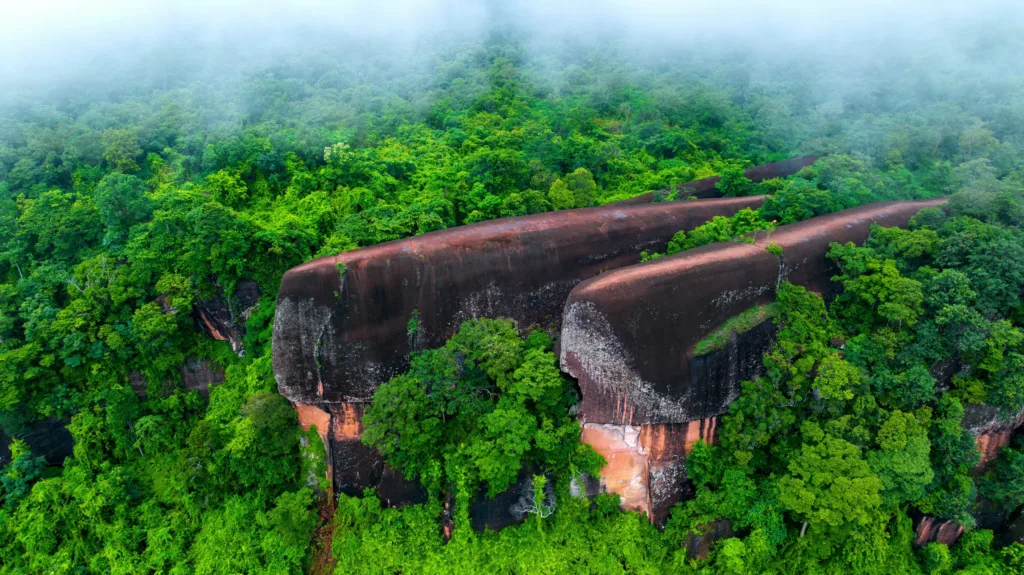
Hin Sam Wan is a group of three huge sandstone boulders on Phu Sing, inside the Dong Dip Kala, Phu Sing and Dong Si Chomphu forest reserves in Khok Kong, Mueang Bueng Kan. The rock is around 75 million years old, and from above it looks like a father, mother and baby whale swimming towards the cliff edge.From the rock you look out over forest and rubber plantations to the Mekong and Phu Khao Khwai in Laos. It is Bueng Kan's favourite sunrise spot.The final climb is by forest-volunteer pickup up a steep track. There are no railings on the rock, so take real care near the edge.
- Sunrise and light mist
- Clear views of the Mekong
- Hot rock, strong sun
Arrive Before sunrise
On the rock at dawn in the cool season, with light mist over the forest below.
- On the mother whaleFigures on the rock with forest belowmorning
- High ground behindThe whole whale family in one framemorning
Good to know here
The rock sits on a cliff of about 200 m; keep back from the edge and hold on to children
Muddy in the rains; use the volunteers' vehicles for safety
- Arrive before first light for sunrise
- Wear grippy rubber-soled shoes; the rock slopes
- Bring a windbreaker in the cool season and water, as there is no shade
- Check the cost and hours of the ride up at the service point
No data yet check before you go · Time needed 2–3 hours
Pre-dawn on cool-season weekends
- Kids Fine, but hold children's hands; there are no railings
- Seniors A steep ride up and walking on sloping rock
- Wheelchair Rough, sloping rock; not suitable
- Pets Forest reserve; best to leave pets at home
- Take your rubbish back down
- Follow the volunteers' instructions
- Don't scratch or damage the rock
- No railings and a high cliff edge
- Steep track, slippery after rain
- Strong sun and no shade at midday
The story of this place
Hin Sam Wan is a group of three huge sandstone boulders jutting from a cliff edge on Phu Sing, at Ban Non Sai Thong in Khok Kong subdistrict, Mueang Bueng Kan, within the Dong Dip Kala, Phu Sing and Dong Si Chomphu national forest reserves. Seen from above, they look like a family of whales swimming through a sea of forest. The mountain was once a hideout during a period of political conflict, before the Royal Forest Department turned it into a "natural classroom", and in 2021 it was chosen as one of Thailand's first recreation forests. Today Hin Sam Wan is one of the best-known places in the Northeast to watch the sun rise over the Mekong.
Read more 10 more paragraphs
The story begins in deep geological time. The Department of Mineral Resources has surveyed Phu Tok, Phu Wua, Phu Sing and Hin Sam Wan, and dates the sandstone here to about 75–80 million years, laid down in what was once an ancient desert. The rock sequence is about 200 metres thick and belongs to the Phu Tok Formation, with arkose sandstone alternating with calcareous silty sandstone. The 75-million-year figure is the one repeated by travel guides, while some geology articles place these rocks in the much older Phu Phan Formation, so the age is best taken as an estimate.
Once the land was pushed up into mountains, rainwater slowly dissolved and wore away the softer calcareous layers, leaving the harder sandstone standing proud. Over a very long time this produced the cliffs, rock platforms, overhangs, caves and oddly shaped boulders found all over Phu Sing. There is no water source on the summit, so the vegetation is dry dipterocarp, mixed deciduous and dry evergreen forest with scrub on the rock. The Phu Sing forest covers more than 12,000 rai, while some sources give the Hin Sam Wan recreation forest itself as about 5,735 rai.
The name Phu Sing, "lion mountain", comes from a large red sandstone overhang shaped like a crouching lion, where a Buddha image called Luang Pho Phra Sing is enshrined. Forest officers say a temple stood on the mountain before it became a forest reserve, and its monks later moved to a temple at the foot of the hill. Tham Ruesi, another viewpoint, takes its name, according to legend, from a hermit who once meditated in the cave.
The name Hin Sam Wan, "three whale rocks", comes from three sandstone blocks that have split apart and step down in size, so they are called the father, mother and baby whale. Some sources describe the large father in the middle with the mother and baby on either side; others describe the three swimming in line towards the cliff. Only the father and mother can be walked on; the baby is out of reach.
Phu Sing also has a more recent history that many visitors never hear about. During the conflict between the state and the Communist Party of Thailand, the area served as a stronghold and refuge. The big cave on the eastern side could hold several hundred people; some sources say 300–500. A local account published in 2015 says that about 40 years earlier the cave was attacked from the air and many people died, before the conflict ended through negotiation. Traces of a first-aid room, shelters and carved inscriptions can still be seen in the cave.
After the area became a forest reserve, the Royal Forest Department gradually developed Phu Sing as a place to learn about nature. A 2015 report said officials meant it to be a "natural classroom" rather than a commercial attraction, free to enter, with improved trails and interpretive signs. Visitors had to notify staff in advance, and Phu Sing forest volunteers guided them and drove them up to the viewpoints.
From 2016 travel media began presenting Hin Sam Wan as Bueng Kan's newest "Unseen" sight, including a feature made with support from the Tourism Authority of Thailand, which described it as one of about ten viewpoints on Phu Sing, reachable only by pickup because the road is steep and winding. Aerial shots of the stone whales in the forest were shared widely and became an image of the province.
In 2020 Hin Sam Wan closed from March to limit the spread of COVID-19. In June, officials from the Ministry of Interior and the provincial governor inspected the site, pushing to develop it to world-class standards and to improve the road up the mountain. It reopened on 1 July 2020 with screening and distancing measures. In October, the Minister of Natural Resources and Environment visited to follow an ecotourism development project and warned that the site could be closed if its resources were damaged.
In 2021 the Royal Forest Department selected Hin Sam Wan as one of the country's first ten recreation forests, chosen from 109 proposed sites. A recreation forest is not a national park but a forest reserve opened for people to learn about nature under the department's care. In late 2022 the department named Hin Sam Wan one of the pilot sites for service fees, with the income going back into the area, and collection began on 1 January 2023.
Today Hin Sam Wan is a favourite place to greet the first sunrise of the year: on New Year's morning 2024 crowds of Thai and foreign visitors camped out to wait for dawn, and the department waived fees for Thai visitors over the holiday. In mid-2025 the department clarified that a skywalk image shared on social media was made with AI and that no such project exists. In 2026 the site hosted a hill run and Valentine's Day marriage registrations on the rock, and during the July holiday it was among the three most visited recreation forests in the country.
- 2015The Royal Forest Department sets out Phu Sing as a free "natural classroom", upgrading trails and signs
- 2016Travel media begin presenting Hin Sam Wan as Bueng Kan's new "Unseen" sight
- 2018Media describe about ten viewpoints on Phu Sing and the big cave used as a refuge in the communist era
- 2020Closed from March to limit the spread of COVID-19
- 2020June: the Ministry of Interior and the province push to make it a world-class destination
- 20201 July: reopens under new-normal measures
- 2020October: the Minister of Natural Resources and Environment visits the ecotourism development project
See 8 events
- 2021Chosen as one of the Royal Forest Department's first ten recreation forests
- 20228 June: reopens to visitors while the road up the mountain is repaired
- 2022November: named a pilot site for recreation-forest service fees
- 20231 January: service fees begin
- 2024New Year's Day: crowds camp out to watch the first sunrise of the year
- 2025May: the department clarifies that a Hin Sam Wan skywalk image is AI-made and no project exists
- 202614 February: hill run and marriage registrations at the viewpoint
- 2026July: among the three most popular recreation forests over the long holiday
Check-ins & visitor photos
Arrived? Check in, collect a stamp and tell others what it is like right now
Check your location first, so you do not fill in the form for nothing
Location must be on and within 1 km · One check-in per place per day · come back on other days to check in again
Post photos from anywhere — no need to be here · Up to 20 photos at a time · JPG / PNG / WebP · GPS location data is removed automatically
How to get there
Hin Sam Wan is on Phu Sing in Khok Kong, Mueang Bueng Kan, about 25 km south-east of town.
Highway 212 then Highway 3007 to the Phu Sing entrance · Fuel
From the service point up to the viewpoint · Ask at the service point
Paved to the entrance; the steep, rough climb is done in volunteers' vehicles
Park private cars at the service point below
Daily, around 05:30–17:00 (popular at sunrise)
about 25 km from Bueng Kan town
Hin Sam Wan
FAQ
Before you go: Hin Sam Wan (Three Whale Rock)
Answers travellers want before they go — a one-minute read
Where is Hin Sam Wan?
On Phu Sing, Khok Kong, Mueang Bueng Kan, about 25 km from town
How old is the rock?
The sandstone is about 75 million years old
Can I drive up myself?
The final climb uses forest-volunteer vehicles
Which whales can I walk on?
The father and mother; the baby can't be reached
When should I go?
Before dawn for sunrise; clearest in the cool season
Is it OK for kids?
Yes, but there are no railings, so keep them close
Nearby places
 Wat Chetiyakhiri Wihan (Wat Phu Tok)
 Naga Cave
 Kham Chanot
Ready to go to Hin Sam Wan (Three Whale Rock)?
Best day this week: Monday 30 Nov · Check in when you arrive to collect a stamp