 01
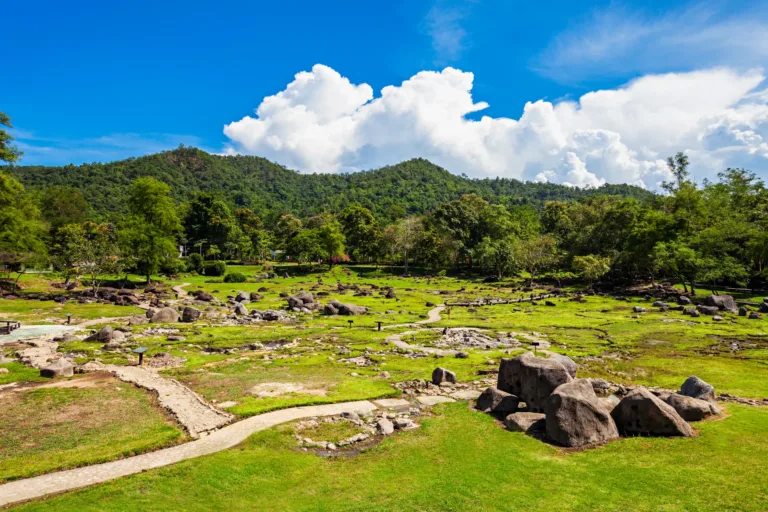
Hot spring fieldMore than 50 pools spread over about 10 rai, with steam drifting everywhere
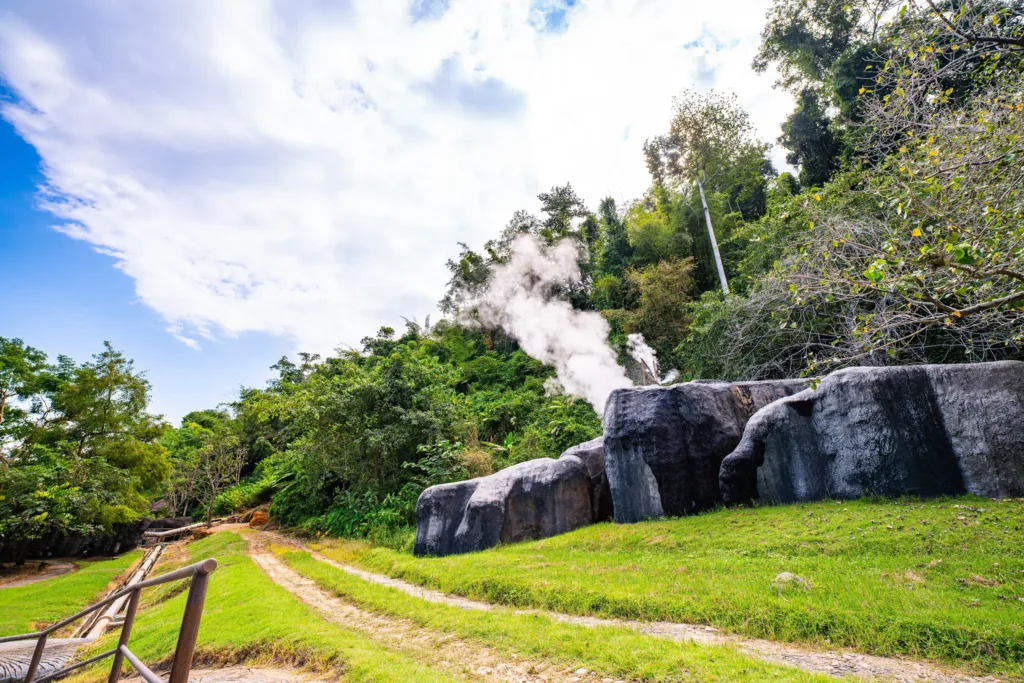
Hot springs · Doi Pha Hom Pok National Park
Over 50 hot springs at the Doi Pha Hom Pok National Park HQ in Fang, Chiang Mai: boil eggs, take a mineral bath, watch steam shoot skyward and see Thailand's first geothermal plant.
Holiday / event — crowded
Jun – Sep
Scalding pools — Some pools are close to boiling. Never dip hands or feet in, and do not lean on or pull at the railings.
2–3 hours
01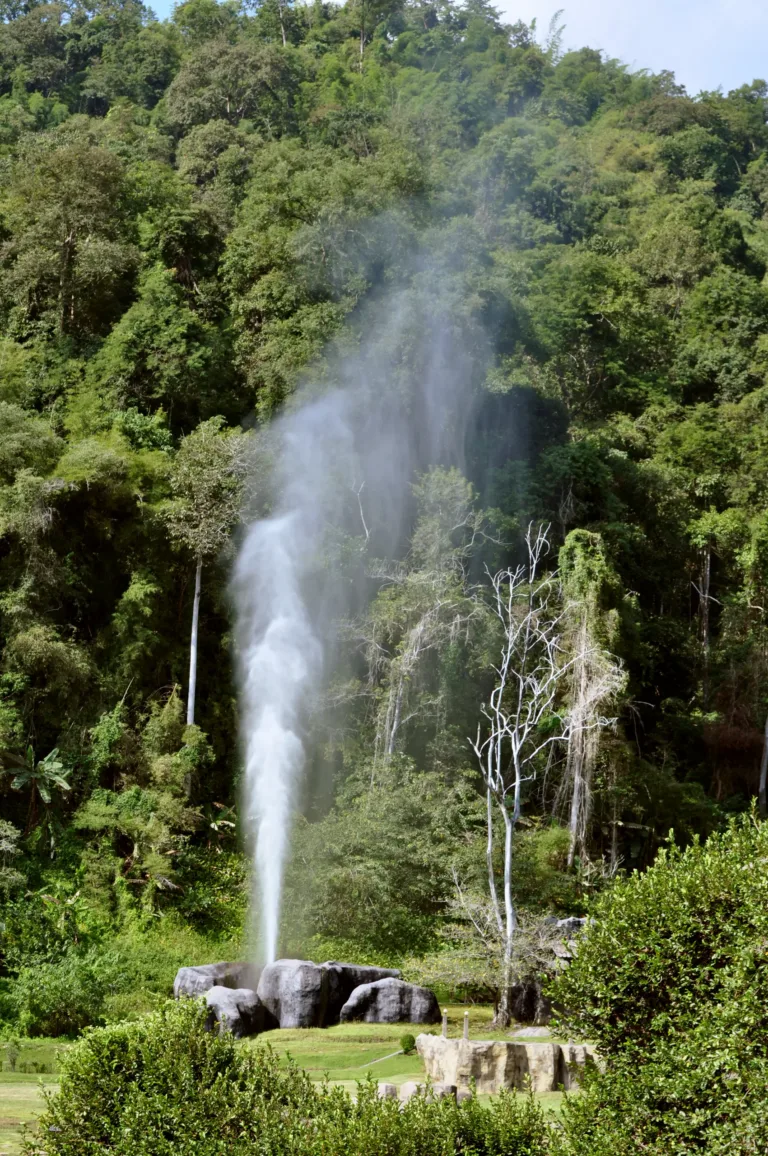 02
Tap a day card to see that day’s weather, rain, haze and hourly forecast
Best time to go Daytime is over · see tomorrow
Holiday — traffic on the way up and parking fills fast; leave early
Green band = hours used for the score
Best time to go Fine all day little rain through the day
Holiday — traffic on the way up and parking fills fast; leave early
Green band = hours used for the score
Best time to go Fine all day little rain through the day
No warnings today — normal road and weather conditions
Green band = hours used for the score
Best time to go Fine all day little rain through the day
No warnings today — normal road and weather conditions
Green band = hours used for the score
Best time to go Fine all day little rain through the day
No warnings today — normal road and weather conditions
Green band = hours used for the score
Best time to go Fine all day little rain through the day
No warnings today — normal road and weather conditions
Green band = hours used for the score
Best time to go Fine all day little rain through the day
No warnings today — normal road and weather conditions
Green band = hours used for the score
Scored from cloud cover at every level and tonight’s moonlight — the darker the sky, the clearer the Milky Way · tap another night below for the next 7 nights
Fang Hot Springs sit at Ban Pong Nam Ron in Fang District, northern Chiang Mai, and double as the headquarters of Doi Pha Hom Pok National Park. More than 50 springs bubble across roughly 10 rai (about 1.6 ha). The pools visitors see run from about 50 to 87°C, a few close to boiling, and on cool-season mornings the whole field is wrapped in steam.Most people come to boil eggs in the designated pool, soak their feet, and book a shared or private mineral bath or the steam room. The crowd-pleaser is a jet of steam that shoots about 30 m into the air at intervals; geologists note it comes from an old exploration well engineered to erupt on a cycle for visitors.The same hot water feeds EGAT's 300 kW binary-cycle power plant, connected to the grid on 5 December 1989 and widely described as Thailand's first geothermal power plant. November to February is the best time: cool air, comfortable soaking, and a handy stop before heading up to Kiew Lom camp and the summit of Doi Pha Hom Pok.
Arrive 08:00 for the best steam and fewer people
Some pools are close to boiling. Never dip hands or feet in, and do not lean on or pull at the railings.
The park says there is a dedicated egg-boiling spot with hooks for baskets; other pools are for viewing only.
Paths around the pools are wet and mossy. Wear shoes with grip and keep hold of children.
Thais 60 THB · Foreigners 300 THB · Car 30 THB · Time needed 2–3 hours
Cool-season weekends and holidays, late morning to afternoon
| Entry, Thai child optional | 30 ฿/person |
| Entry, foreign child optional | 150 ฿/person |
| Motorcycle | 20 ฿/vehicle |
| Shared mineral bath room optional | 20 ฿/person |
| Private mineral bath room optional | 50 ฿/person |
| Steam room optional | 30 ฿/person |
| Camping (own tent) optional | 30 ฿/person |
Prices may change by season — check with the venue
Fang Hot Springs lie at Ban Pong Nam Ron in Fang District, Chiang Mai, at about 600 m above sea level and roughly 0.7–1 km north of the Mae Chan fault. The site is at once the headquarters of Doi Pha Hom Pok National Park, a popular place to boil eggs and bathe, and the home of Thailand's first geothermal power plant, so its story is one of geological and energy research rather than legend or chronicle.
Geologically, the water is groundwater that seeps deep underground, is heated by hot rock and rises back up through fractures. A 2018 study by Wood and colleagues in the journal Geothermal Energy measured the hottest seeps at about 95.7–98.6°C, close to the boiling point of 99.3°C at this altitude, with other seeps at roughly 55–89°C. Chemical geothermometers suggest the reservoir below may reach about 146–150°C.
Systematic measurements began in the 1970s. The same study cites monitoring by Ramingwong and colleagues between 1974 and 1979 that put natural discharge at about 20 litres per second, and in 1980 a soil temperature survey and resistivity soundings were carried out. That same year, according to the Department of Mineral Resources, Fang was chosen, together with San Kamphaeng, as a first-priority area for detailed study.
Between 1981 and 1984 the Electricity Generating Authority of Thailand (EGAT) worked with France's BRGM and Geowatt on a project to model the reservoir for power generation. An EGAT report says a feasibility study for a 100–300 kW binary demonstration plant began in 1982, followed by many shallow wells; in 1984 EGAT drilled eight slim holes that confirmed a productive shallow fractured reservoir.
The breakthrough came with wells FGTE-14 and FGTE-15, drilled from late 1985 to early 1986, which together produced about 22 litres per second of water at 125°C (some papers spell the well names FTGE). EGAT and Department of Mineral Resources papers say a 300 kW pilot power project with BRGM got under way in 1987.
The 300 kW binary-cycle plant was connected to the local grid on 5 December 1989. Hot water at roughly 115–120°C heats a low-boiling working fluid that drives the turbine, producing about 1.2 million kWh a year for the Provincial Electricity Authority grid. It is widely described as Thailand's first geothermal power plant; the 2018 study identifies the unit as an ORMAT plant.
Water leaves the plant still at about 70–80°C, so it was put to further use. A 2002 EGAT report describes a crop dryer, absorption air-conditioning and cold storage, and a larger dryer built by the Royal Project's food processing section; a 2015 Department of Mineral Resources paper adds that trials dried chilli, tea, garlic, onion, lychee, tobacco and potato. Around half a million cubic metres of cooled water a year went to nearby farms, and the same report notes that Mae Fang National Park built a public bathing pond and a steam sauna.
The famous steam jet that visitors call a geyser is, according to the 2018 study, well FTGE-7, engineered as a tourist geyser: it is shut in for about 30 minutes to build pressure, then opened for about 3 minutes, reaching some 30 m, while Wikipedia and some travel media give 40–50 m. Deeper exploration with France's ADEME began in 1990 with the FX wells targeting 500 m; FX-2 and FX-4 produced hot water and were tied into the plant in 1996, but EGAT judged deep vertical drilling too risky because the faults are so steep.
As for the park, Wikipedia says Mae Fang National Park was declared Thailand's 97th national park on 4 September 2000 and renamed Doi Pha Hom Pok National Park on 14 March 2006 after its best-known peak. Today the park headquarters stands at the hot springs, with bungalows, camping and the check-in point for trips up to Kiew Lom camp.
After 2010 the field attracted fresh research, funded by the Department of Alternative Energy Development and Efficiency in 2010 and by the Department of Groundwater Resources, which supported studies by Chiang Mai University, Mahidol University and consultants in 2013. A February 2015 survey found four wells still feeding the plant, which produced about 115–250 kW depending on the season, and the researchers estimated that pumping 120°C water at 55 litres per second could generate about 2 MW. A 2026 news report still cites the plant in the push to add geothermal power to Thailand's power development plan, without stating whether it is currently running.
On the visitor side, in early September 2023 a teenage visitor fell into a hot pool while reaching for eggs. The park said a concrete railing had been weakened from inside by hot steam and that the spot was for viewing only, with the real egg-boiling area about 200 m away, and said it would consult engineers on heat-resistant material for the railings, while the Fang district chief called for more warning signs. A January 2026 Chiang Mai News report said the springs had been certified at the "excellent" level under the Department of Tourism's tourist-site quality standards for fiscal year B.E. 2568.
Arrived? Check in, collect a stamp and tell others what it is like right now
Check your location first, so you do not fill in the form for nothing
Location must be on and within 3 km · One check-in per place per day · come back on other days to check in again
Post photos from anywhere — no need to be here · Up to 20 photos at a time · JPG / PNG / WebP · GPS location data is removed automatically
Paved road right up to the park HQ car park, fine for any ordinary car.
Highway 107 from Chiang Mai to Fang, then follow the hot spring signs for about 10 km · Fuel + park entry + 30 THB car fee
Take a Chiang Mai–Tha Ton bus from Chang Phueak bus station, get off in Fang and switch to local transport · Current fares
Hire a taxi or motorcycle taxi at Fang bus station · Negotiable
Paved all the way: Highway 107 to Fang, then follow the Fang Hot Springs signs for about 10 km.
National park car park on site
Stations in Fang town
Daily; sources differ on hours (roughly 07:30–19:00 or 09:00–17:30), so call ahead
about 150–160 km from Chiang Mai city
Fang Hot Springs
300 THB
Answers travellers want before they go — a one-minute read
At the designated egg-boiling spot with basket hooks; the other pools are for viewing only.
About 10–20 minutes for soft-boiled, depending on the pool.
Geological research says it comes from an exploration well that is shut to build pressure, then opened so it erupts on a cycle.
A 2026 news report lists shared rooms at 20 THB, private rooms at 50 THB per person and the steam room at 30 THB, on top of park entry.
Yes, there are national park bungalows and camping on site, or hotels in Fang town.
Within the hot spring area itself; it runs on hot water from wells drilled in the field.
Best day this week: Monday 30 Nov · Check in when you arrive to collect a stamp
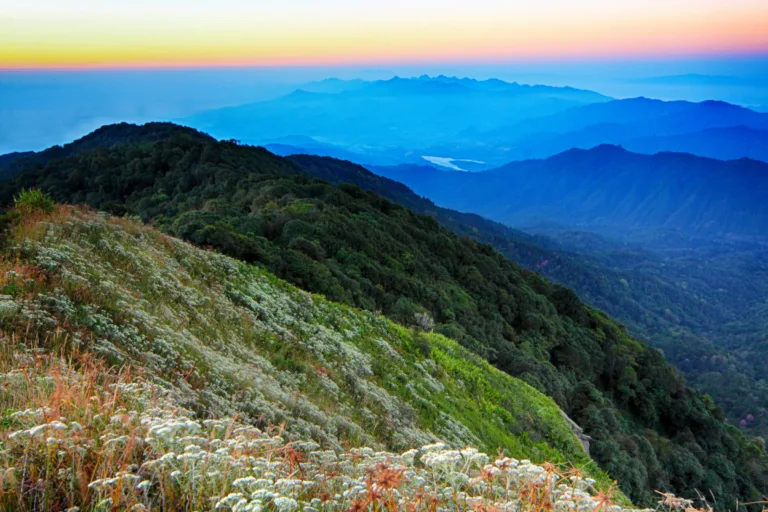 Doi Pha Hom Pok (Doi Pha Hom Pok National Park)
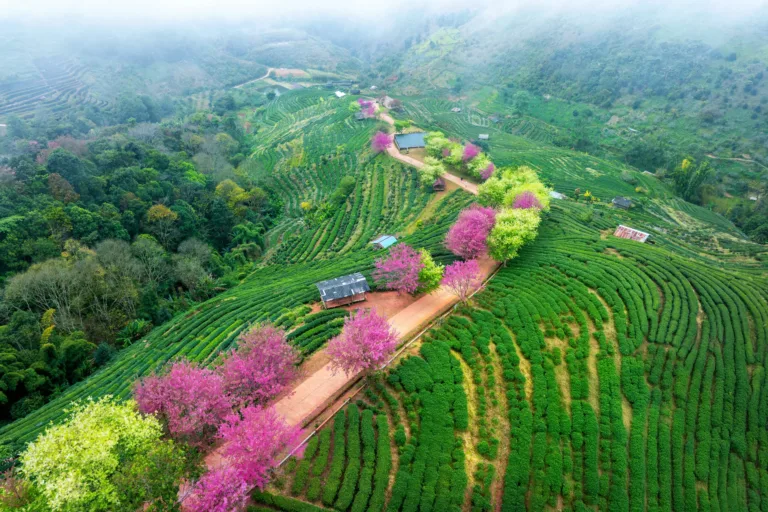 Doi Ang Khang (Royal Agricultural Station Angkhang)
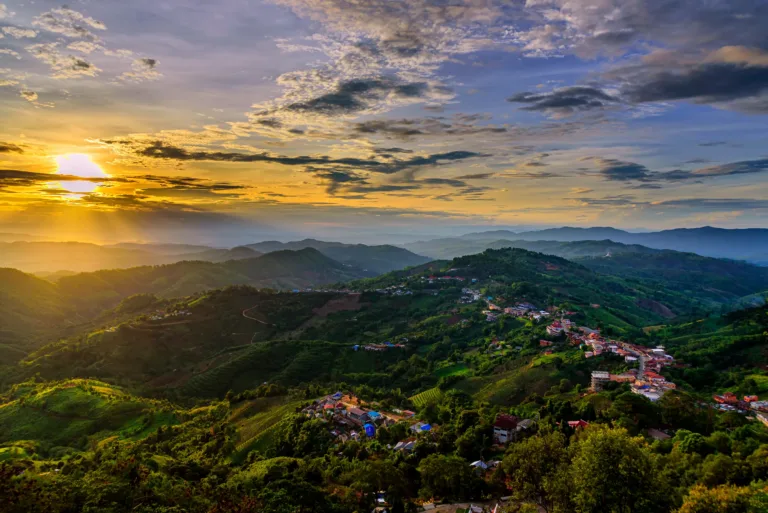 Doi Mae Salong
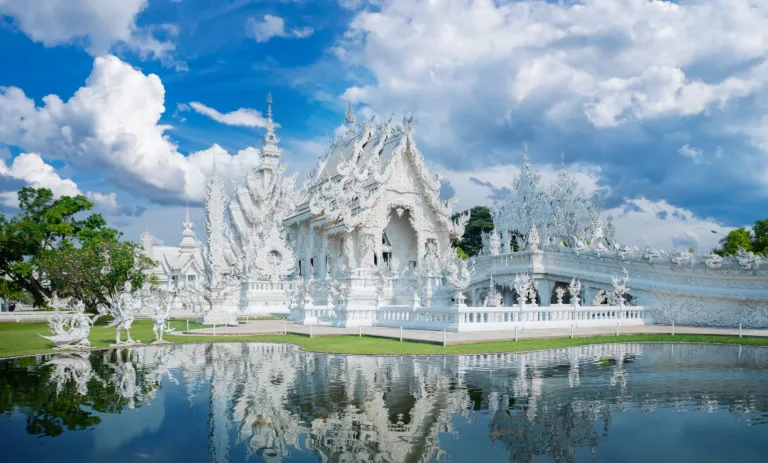 Wat Rong Khun (White Temple)