 01
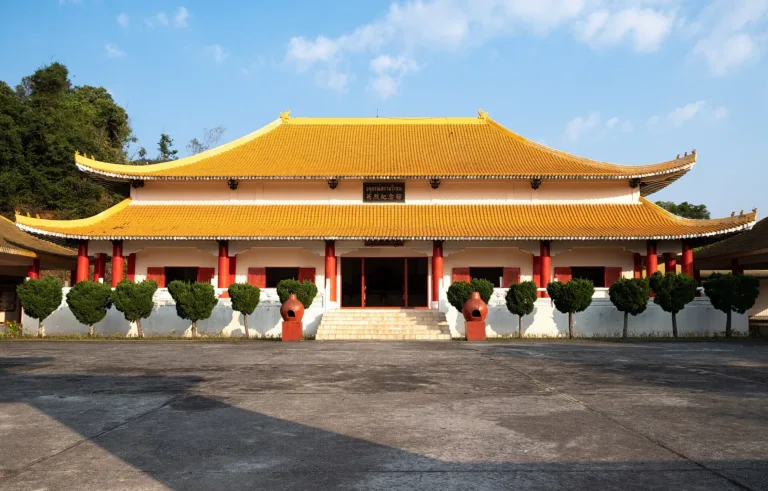
Chinese Martyrs' Memorial MuseumThe 93rd Division story and hall of spirit tablets
Yunnanese hill village · Chiang Rai
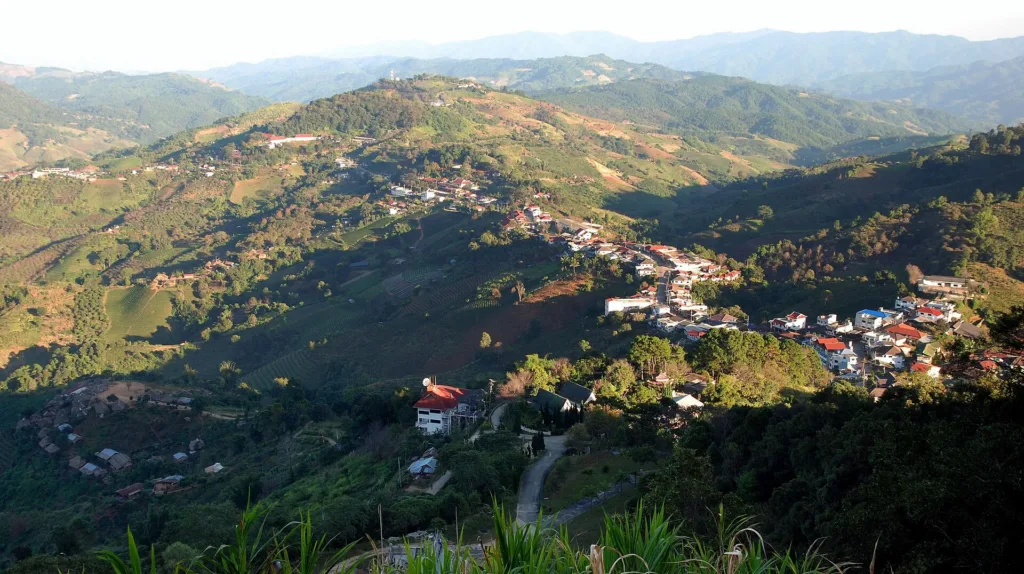
A former Chinese Nationalist (93rd Division) village high in Mae Fa Luang, Chiang Rai, renamed Santikhiri in 1978 — oolong tea gardens, Yunnanese food, a hilltop chedi and pink cherry blossom around New Year.
Holiday / event — crowded · Chance of a sea of mist 5/10
sea-of-mist places: morning matters most
Nov–Feb brings morning mist and sea-of-cloud views from the chedi terrace and tea gardens
Before 07:00 for the mist and the morning market
From Chiang Rai take Highway 1 north to Ban Pasang in Mae Chan, then turn left onto Route 1130, a steep winding climb to Santikhiri village
4G works in the village; weak on some bends of the mountain road
01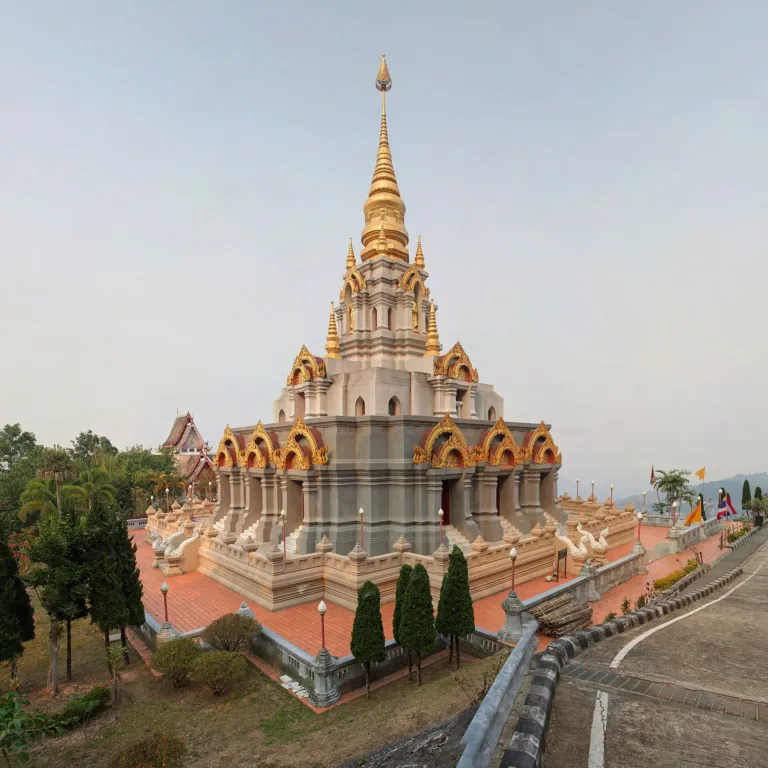 02
 03
 04
Tap a day card to see that day’s weather, rain, haze and hourly forecast
Best time to go Best window 06:00–16:00 Little rain
Holiday — traffic on the way up and parking fills fast; leave early
Green band = hours used for the score
Best time to go Fine all day little rain through the day
Holiday — traffic on the way up and parking fills fast; leave early
Green band = hours used for the score
Best time to go Fine all day little rain through the day
Holiday — traffic on the way up and parking fills fast; leave early
Green band = hours used for the score
Best time to go Fine all day little rain through the day
No warnings today — normal road and weather conditions
Green band = hours used for the score
Best time to go Best window 08:00–14:00 Little rain · light drizzle possible at times
Thick morning fog with visibility under 1 km — use headlights and drive slowly
Green band = hours used for the score
Best time to go Fine all day little rain through the day · light drizzle possible at times
No warnings today — normal road and weather conditions
Green band = hours used for the score
Best time to go Fine all day little rain through the day
No warnings today — normal road and weather conditions
Green band = hours used for the score
Scored from cloud cover at every level and tonight’s moonlight — the darker the sky, the clearer the Milky Way · tap another night below for the next 7 nights
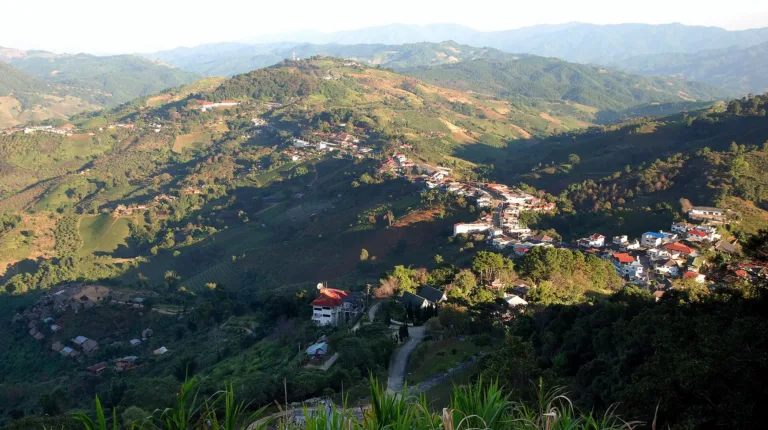
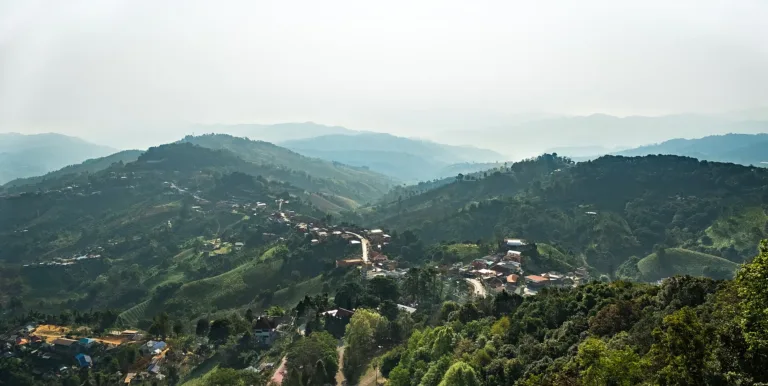
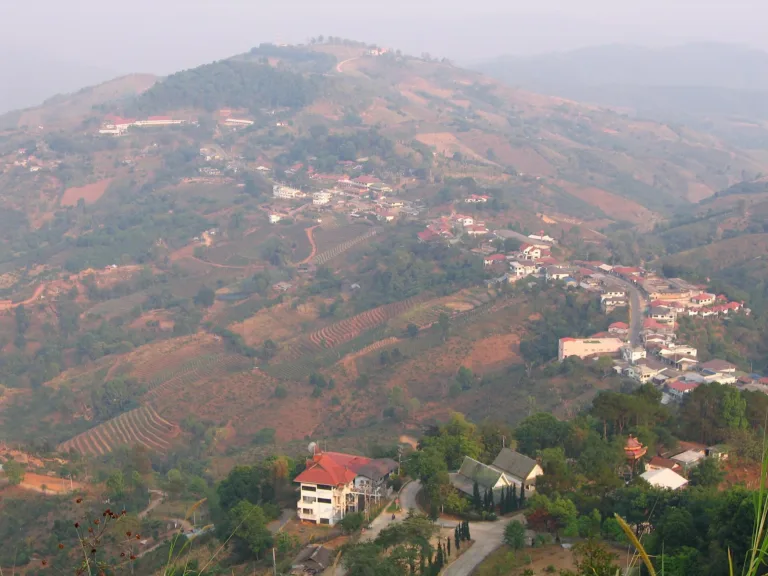
Doi Mae Salong (Ban Santikhiri), Mae Fa Luang district, Chiang Rai: home of the descendants of the Kuomintang 93rd Division, with oolong tea gardens on the high ridges.
Arrive Before 07:00 for the mist and the morning market
Nov–Feb brings morning mist and sea-of-cloud views from the chedi terrace and tea gardens
Photos from Wikimedia Commons and contributors · full credits inClassic page
The climb is steep with many bends; use a low gear downhill and don't ride the brakes
Thick mist in the mornings and rainy season; use dipped lights and drive slowly
The mountain runs along the Myanmar border; stay on roads and marked paths
Adults 0 THB · Time needed A day to one night
Late Dec–Jan during the blossom and New Year holidays
| Chinese Martyrs' Memorial Museum, Thai visitors optional | 20 ฿/person |
| Chinese Martyrs' Memorial Museum, foreign visitors optional | 50 ฿/person |
| Songthaew Ban Pasang–Mae Salong optional | 60 ฿/person |
Cash / bank transfer at most shops · Prices may change by season — check with the venue
Cherry blossom (wild Himalayan cherry) festival around 28 Dec–2 Jan each year
Tap a month on the wheel to see weather, rain, haze and crowds from 10 years of records
Best time · Nov–Feb is cool to cold with clear skies and morning mist; late Dec–Jan brings the wild cherry blossom and festival
Watch out · Mar–Apr thick forest-fire haze, short views · Aug–Sep heavy rain, slippery roads and dense mist
Oct by the records 18–24°C · avg rain 178 mm (22 rainy days) · clear 7 days · avg PM2.5 8
Doi Mae Salong, officially Ban Santikhiri, lies in Mae Salong Nok subdistrict, Mae Fa Luang district, Chiang Rai. The village runs along a ridge at about 1,100–1,300 metres, some 70–80 km from Chiang Rai city. Unlike other hill villages in the north, it is home to the descendants of Chinese Nationalist (Kuomintang) soldiers known as the 93rd Division, living alongside Akha, Yao, Lisu, Lahu, Shan and lowland Thai neighbours. Houses, shop signs and food all have a clear Yunnanese character.
Geologically, Doi Mae Salong is a tangled range of red Mesozoic sedimentary rock with small grey limestone hills and red soils. Most ridges stand at 950–1,200 metres, surrounded by peaks such as Doi Hok, Doi Sam Sao Yai, Doi Sam Sao Noi and Doi Mae Salong Noi. It is cool most of the year: the Highland Research and Development Institute gives an average winter temperature of about 15°C and about 1,556 mm of rain a year over 135 days, with September the wettest month and February the driest.
The people's story begins in China. In October 1949 the Communists won the civil war and Chiang Kai-shek's Nationalist government withdrew to Taiwan, but some units in Yunnan refused to surrender. When Kunming fell in January 1950, about 1,700 men of the 93rd Division under General Li Mi retreated into Shan State, Burma, setting up headquarters at Tachileik, and their numbers grew from there. Some sources put the 3rd and 5th Armies that crossed into Burma at about 12,000 men under Generals Li Wenhuan and Duan Xiwen (Tuan Shi-wen).
In July 1950 Burma ordered the soldiers to disarm or leave. When they refused, the Burmese army took Tachileik and the Chinese moved about 60 km west to Mong Hsat, supplied by regular airdrops from unmarked aircraft. In 1951 they invaded Yunnan three times — in April, July and August — the last pushing about 100 km in before being driven back. After an airstrip was built at Mong Hsat and reinforcements arrived from Taiwan, the force grew to about 12,000.
Burma took its complaint to the United Nations on 25 March 1953, and on 23 April 1953 the General Assembly condemned the force and called for it to be disarmed or removed. A four-party committee of the United States, Thailand, Nationalist China and Burma was set up in Bangkok, and between 7 November 1953 and May 1954 four airlifts through Thailand took 7,784 people to Taiwan — mostly children, the elderly and the sick — while several thousand soldiers stayed hidden in Burma. In March 1954 Burma bombed and captured Mong Hsat.
In late November 1960 about 25,000 Burmese and Chinese Communist troops launched a major offensive. The Nationalists' headquarters in Kengtung State fell in December and about 10,000 men fled across the Mekong into Laos. Another airlift from Chiang Rai to Taiwan followed in early 1961, its last flight leaving on 30 April 1961, yet about 4,000 people stayed behind in Thailand — some 2,600 soldiers and 1,350 family members.
Those who stayed split into three groups. General Duan settled his 5th Army on Doi Mae Salong, General Li took his 3rd Army to Tham Ngop in Chai Prakan district, Chiang Mai, and a small column of 400–500 men remained hidden in Shan State. Most sources say about 4,000 people came up Doi Mae Salong with General Duan in 1961 (some give far higher figures). Thailand let them stay as a frontier force against communist infiltration, and on 5 November 1963 General Duan formally set up the 5th Army headquarters on the mountain. Both generals later took Thai names: Chawan Khamlue (Duan) and Chai Chaisiri (Li).
For years Mae Salong was closed to outsiders, and as late as the mid-1970s entry was strictly forbidden. It lay inside the Golden Triangle, and the mountain army's economy was tied to the opium trade: caravans of hundreds of mules brought opium down from Shan State, with the Nationalists charging for protection along the way. In 1967 General Duan told a British newspaper that opium was the only source of money in those mountains, and a 1971 CIA report described Mae Salong as one of the largest heroin refineries in Southeast Asia.
In 1969 a Thai delegation led by Air Chief Marshal Thawee Chullasap negotiated with Taiwan, which agreed to hand the remaining soldiers in Thailand over to Thai control, with Lt. Gen. Kriangsak Chomanan put in charge. On 6 October 1970 the cabinet allowed the men to stay as refugees under the Supreme Command. Official papers called the force the "Chinese Irregular Forces", placed under a special task force code-named 04.
The Chinese soldiers repaid their hosts by fighting alongside Thai forces. A major operation began in early December 1970 (sources give 8 or 10 December) with the Border Patrol Police, to clear Communist Party of Thailand strongholds along Doi Yao–Doi Pha Mon and Doi Luang, across Wiang Kaen, Khun Tan and Thoeng districts. The main base on Doi Pha Mon fell on 3 January 1971, at a cost of 15 Chinese soldiers killed and 45 wounded in that first phase, but fighting along this front dragged on for about five more years and killed more than 1,000 people, many of them by landmines.
In 1972 the former soldiers were recognised as civilians and organised into 13 villages in Chiang Rai, Chiang Mai and Mae Hong Son, on condition that they gave up opium, laid down their arms and took up farming. The two generals reportedly handed over about 40 tonnes of raw opium for the Thai authorities to destroy — about 32 tonnes from General Li's side and 8 tonnes from General Duan's.
Development followed. In 1973 Kriangsak started a tea project at Doi Mae Salong and Tham Ngop, with about 6 million tea bushes in the first phase. About 18,000 three-needle pines were planted as a trial in 1974 and about 20,000 more in 1975. That same year a Chinese-language boarding school opened on Doi Mae Salong, children were allowed into state and private schools, and some boys from Mae Salong and Tham Ngop were sent to a hill-tribe school in Chiang Dao.
On 30 May 1978 the government set up a committee to consider the group's citizenship, and that year the village of Mae Salong Nok was renamed Ban Santikhiri, "hill of peace", to leave its opium-and-war image behind; villagers began receiving ID cards. On 22 August 1979 General Kriangsak, by then Prime Minister, came up to accept a house the villagers had built for him and planted another 18,000 pines.
General Duan died in 1980 and was buried in a marble, pagoda-like tomb on a hill above the village. A climb of about 300 metres leads to it, with a view over all of Santikhiri, and it is still visited with respect by Thai-Chinese travellers. General Lei Yutian then led the veterans' community.
In the early 1980s about 400 former Nationalist soldiers were also sent to fight alongside government forces at Khao Kho in Phetchabun, and in 1982 troops from Doi Mae Salong guarded the building of the Thung Samo–Khao Kho road amid repeated clashes. Twenty-two of the former soldiers who had not yet received Thai nationality died on the Khao Kho front.
Close by, on 21 January 1982, several thousand Thai soldiers, police and rangers with aircraft and tanks attacked Khun Sa's Shan United Army base at Ban Hin Taek, about 28 km from Doi Mae Salong. After about two weeks of fighting Khun Sa withdrew into Burma, and Ban Hin Taek was renamed Ban Thoet Thai. Real security came to the area from 1982, and most of the former soldiers and their families were granted Thai citizenship in return for their service (sources date this between 1982 and 1984).
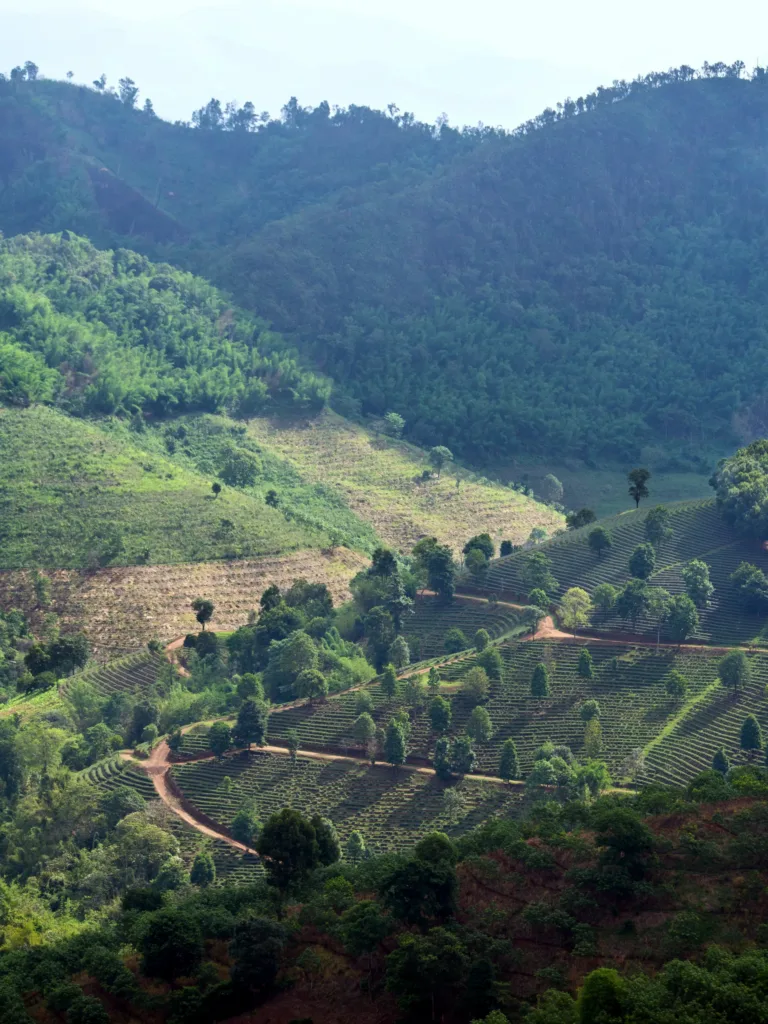
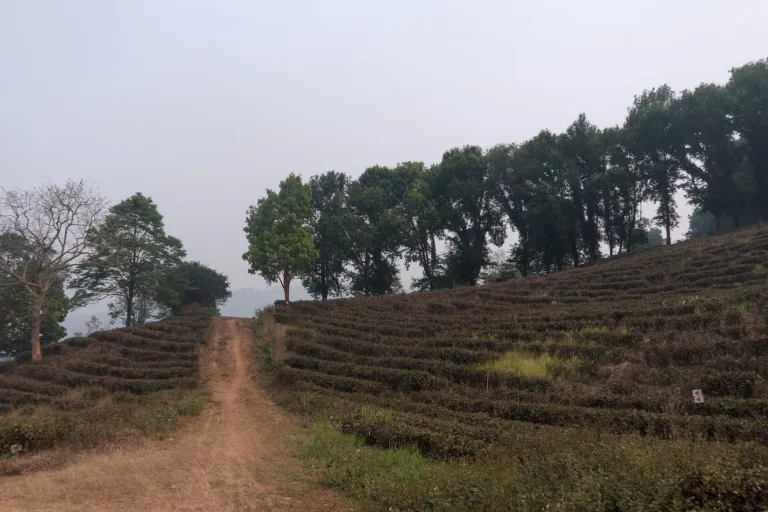
Tea became the heart of the local economy. Mae Salong's oolong grows at about 1,200–1,400 metres, with Taiwanese experts helping with cultivation and processing and Taiwanese varieties such as Jin Xuan (known locally as "No. 12") and Si Ji Chun. The area produces about 80% of Chiang Rai's tea; a 2013 survey by the Highland Research and Development Institute counted about 5,050 rai of tea yielding about 1,142 tonnes a year, and about 1,430 rai of arabica coffee. In 2005 the Ministry of Tourism and Sports named Mae Salong an OTOP tourism village for its oolong.
Once the area was peaceful, Mae Salong opened up to visitors, and from 1994 it was developed seriously for tourism, earning the nickname "Little Switzerland". The village's first hotel, the Chinshae, had just eight rooms at 30 baht a night. Later came the Mae Salong Resort, which put part of its income towards veterans disabled in the fighting, and a resort run by General Duan's son.
On the highest summit, at about 1,500 metres and some 4 km from the village, stands Phra Borommathat Chedi Srinagarindra Sathit Maha Santikhiri, built in honour of Princess Mother Srinagarindra for her 90th birthday in 1990. The 30-metre chedi is in an adapted Lanna style inspired by Wat Pa Sak in Chiang Saen, on a base about 15 metres a side, with standing Buddha images in niches on all four sides. Work began around 1989 and finished around 1994 (some sources say 1996). The terrace looks out over layered ridges to the Myanmar border.
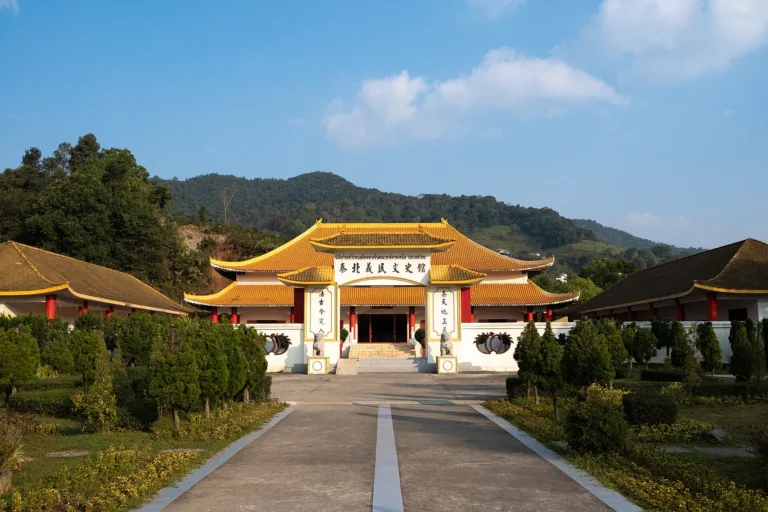
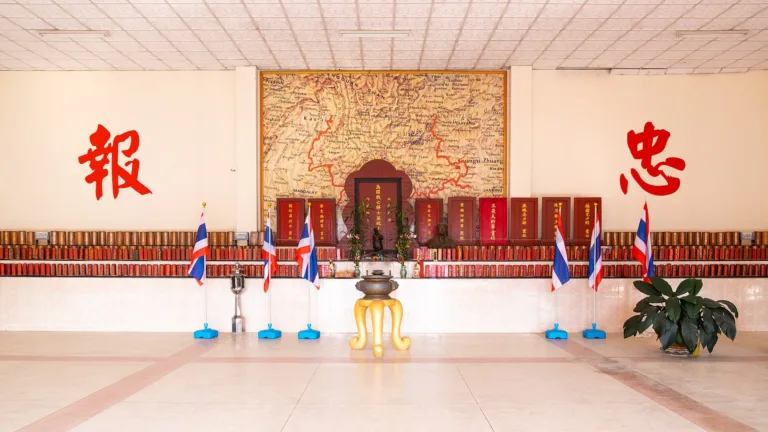
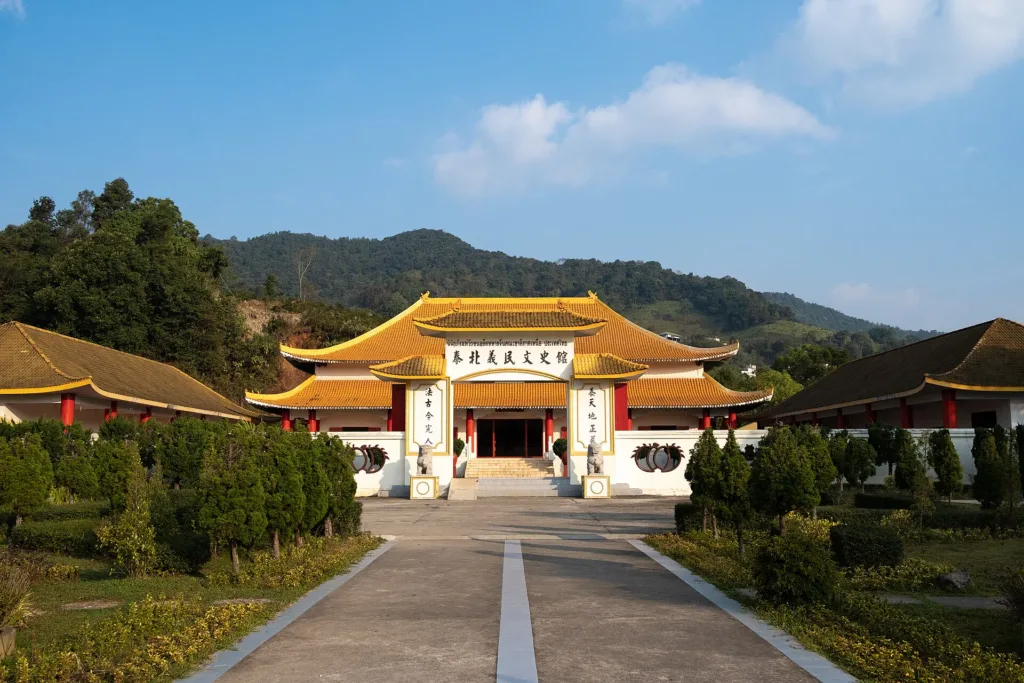
The best place to understand Mae Salong is the Chinese Martyrs' Memorial Museum (the Northern Chinese Nationalist Veterans Memorial in Thailand), completed in 2003 and officially opened on 20 February 2004. Its three Chinese-style buildings cover the war years in date order with photographs and battlefield models, a central hall of spirit tablets for the dead, and the support the community received from Chinese associations and Taiwan, from scholarships to public works. A memorial ceremony is held every year — the 16th, on 10 April 2022, brought together district officials, the military, the Taipei Economic and Cultural Office in Thailand and the families of the fallen.
On 1 August 2010 the Royal Project Foundation began the Mae Salong Highland Development Project at the request of the army's development office, covering 20 villages and about 102,230 rai in Mae Salong Nok. The project lists eight ethnic groups in the area — lowland Thai, Yunnanese Chinese, Shan, Akha, Yao, Lisu, Lua and Lahu — growing tea, coffee, plums and temperate vegetables.
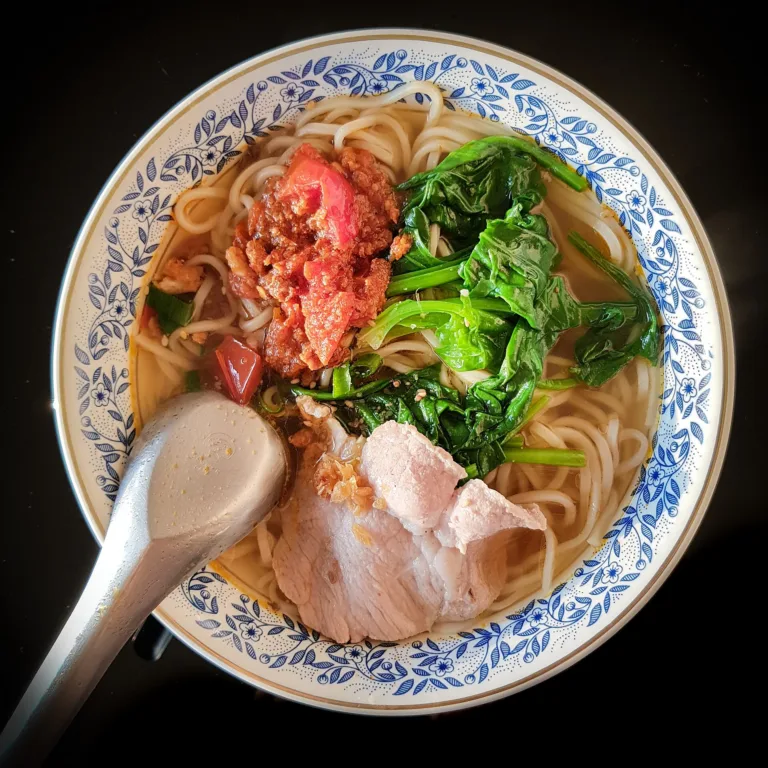
Today Mae Salong still speaks Yunnanese and serves Yunnan noodles, braised pork leg with steamed buns and black-chicken herbal soup, with tea shops lining the road and a morning market where hill-tribe families sell produce. From late December to January the wild Himalayan cherry trees along the mountain roads turn pink, and the subdistrict and district hold a cherry blossom festival around 28 December–2 January each year. Parts of the film 3 Needles (2005) were shot here in place of Yunnan.
Arrived? Check in, collect a stamp and tell others what it is like right now
Check your location first, so you do not fill in the form for nothing
Location must be on and within 3 km · One check-in per place per day · come back on other days to check in again
Post photos from anywhere — no need to be here · Up to 20 photos at a time · JPG / PNG / WebP · GPS location data is removed automatically
From Chiang Rai take Highway 1 north to Ban Pasang in Mae Ch…
Chiang Rai–Mae Chan–Ban Pasang–Route 1130 · Fuel
Bus to Mae Chan/Ban Pasang, then songthaew up the mountain · Varies
Yellow songthaew Tha Ton (Chiang Mai)–Kiew Satai–Mae Salong · About 60 baht
Bangkok–Mae Fah Luang Chiang Rai Airport, then a rental car · Varies
Highway 1 towards Mae Chan to Ban Pasang, then left onto Route 1130 up the mountain (or Route 1234 via Ban Kiew Satai)
Roadside in the village, and car parks at the museum, the chedi and tea gardens
Fill up in Mae Chan or Ban Pasang before the climb
4G works in the village; weak on some bends of the mountain road
Village always open · museum and chedi about 08:00–17:00
around 75 km fromChiang Rai city
Santikhiri Mae Salong
0 THB
Approx. nightly price for 2 adults (next week) · final price depends on your dates
Answers travellers want before they go — a one-minute read
They are descendants of the Kuomintang 93rd Division, who retreated from Yunnan through Burma and settled here in 1961
'Hill of peace', the name used instead of Ban Mae Salong Nok since 1978
The wild Himalayan cherry blooms about late Dec–Jan, with a festival around 28 Dec–2 Jan
About 4 km on a steep, winding paved road; you can drive to the terrace
Take a bus from Chiang Rai to Ban Pasang and a songthaew up, or the yellow songthaew from Tha Ton in Chiang Mai
Oolong grown at 1,200–1,400 m, about 80% of Chiang Rai's tea
Best day this week: Thursday 29 Oct · Check in when you arrive to collect a stamp