What to know before visiting the temple
Dress modestly · Remove shoes before entering viharns · Don't climb or sit on the chedi base · Keep noise down in the sacred area
About 06:00–21:00
Buddhist holy days, holidays, the bathing and lantern festivals
Phra That Hariphunchai bathing festival, northern eighth month (2026: 25 Apr–1 May) · Khom Saen Duang lanterns, Oct–Nov
7 days ahead
When to go
this week
Tap a day card to see that day’s weather, rain, haze and hourly forecast
Best time to go Fine all day little rain through the day
Holiday — traffic on the way up and parking fills fast; leave early
Hour by hour
Green band = hours used for the score
Best time to go Fine all day little rain through the day
Holiday — traffic on the way up and parking fills fast; leave early
Hour by hour
Green band = hours used for the score
Best time to go Fine all day little rain through the day
Holiday — traffic on the way up and parking fills fast; leave early
Hour by hour
Green band = hours used for the score
Best time to go Best window 06:00–15:00 Little rain · light drizzle possible at times
No warnings today — normal road and weather conditions
Hour by hour
Green band = hours used for the score
Best time to go Best window 08:00–17:00 Little rain · light drizzle possible at times
No warnings today — normal road and weather conditions
Hour by hour
Green band = hours used for the score
Best time to go Fine all day little rain through the day · light drizzle possible at times
No warnings today — normal road and weather conditions
Hour by hour
Green band = hours used for the score
Best time to go Fine all day little rain through the day
Thick morning fog with visibility under 1 km — use headlights and drive slowly
Hour by hour
Green band = hours used for the score
Wat Phra That Hariphunchai Woramahawihan
Wat Phra That Hariphunchai Woramahawihan, Inthayongyot Road, Mueang Lamphun.
- Quiet, cool morning
- Getting hot
- Hot
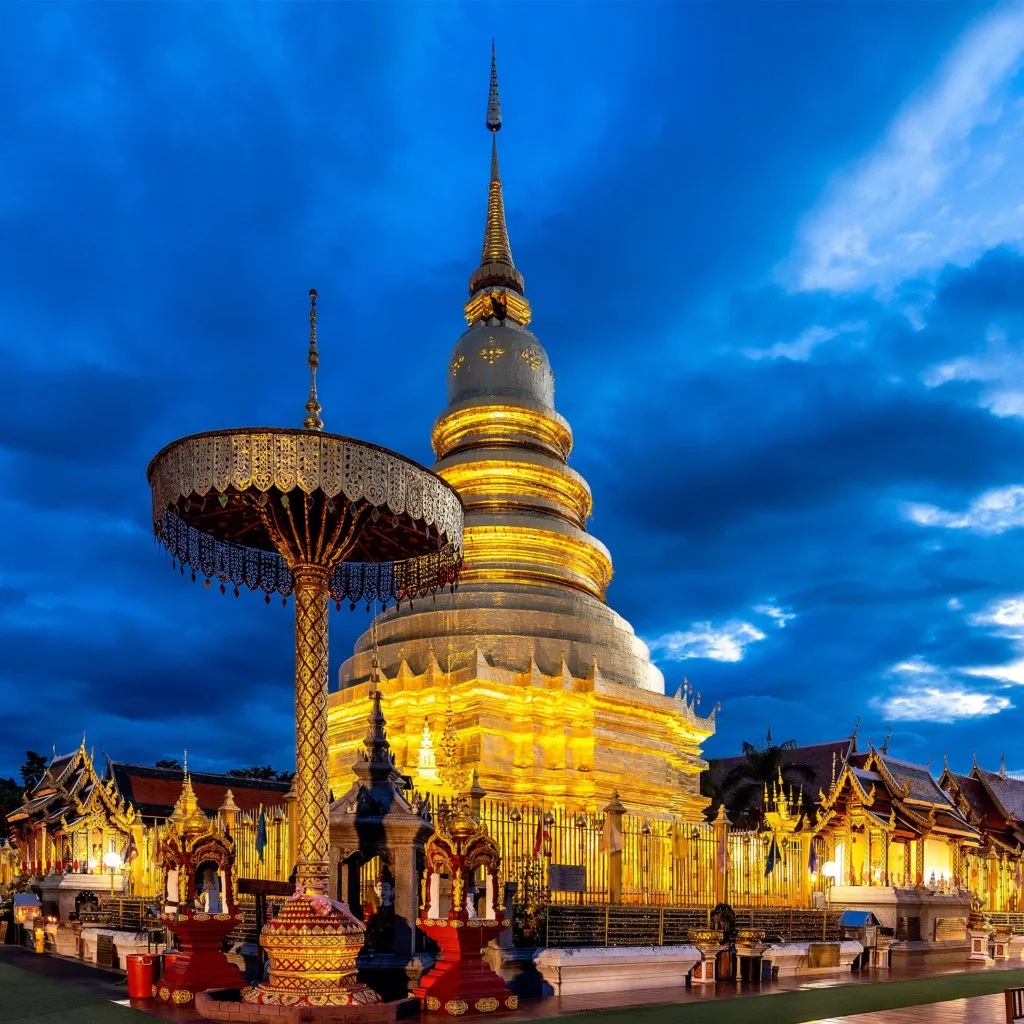
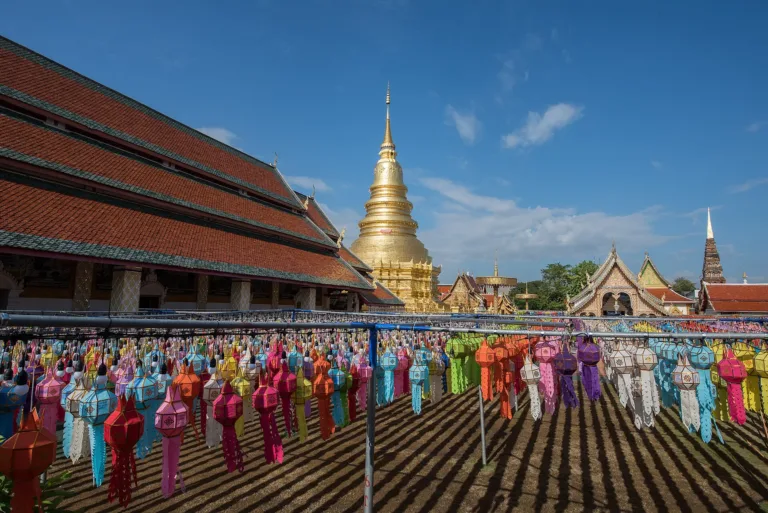
- Evening light on the gold chedi
- Chedi floodlit
- Chedi and golden umbrellasFrom the eastern courtyardEvening
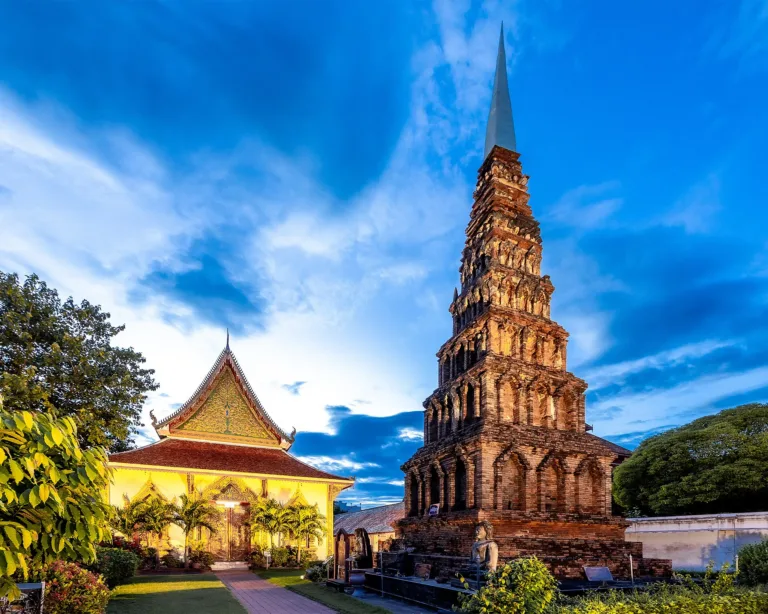
- Suwanna ChediFive-tier stepped chediMorning
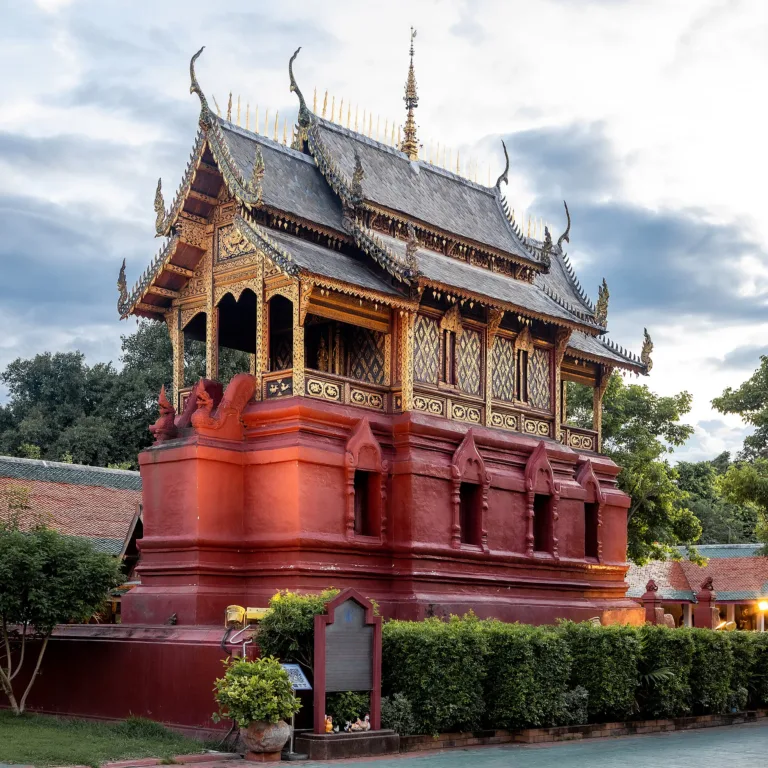
- Scripture hallTimber hallMorning
- Lantern festivalStreet in front of the templeNight
Gallery
Photos from Wikimedia Commons and contributors · full credits inClassic page
Good to know here
No shorts, short skirts or sleeveless tops
Many Lanna relic temples bar women from the inner enclosure; follow the signs
Very crowded; allow time to park
- Dress modestly
- Walk three times clockwise around the chedi
- Go early or late to avoid the heat
- Take the town tram on to Wat Chamadevi
- Visit the Hariphunchai National Museum next door
Adults 0 THB · Time needed 1–2 hours
Buddhist holy days, holidays, the bathing and lantern festivals
| Foreigner admission | 20 ฿/person |
| Town tram, adult optional | 50 ฿/person |
| Lantern offering optional | 99 ฿/lantern |
Cash · Prices may change by season — check with the venue
- Kids Yes, flat town-centre site
- Seniors Yes, flat ground
- Wheelchair Thresholds and steps at the viharns
- Pets Not appropriate in the temple
- Longan noodle shop, Wiang Yong sideNoodles
- Shops and markets around townNorthern food
- Dress modestly
- Remove shoes before entering viharns
- Don't climb or sit on the chedi base
- Keep noise down in the sacred area
- Very crowded during festivals
- April is very hot; carry water
Best months
Tap a month on the wheel to see weather, rain, haze and crowds from 10 years of records
Best time · Nov–Feb is cool, and the lantern festival runs Oct–Nov
Watch out · April is very hot · festival days are crowded with scarce parking
17°Jan
17°Feb
21°Mar
24°Apr
25°May
25°Jun
24°Jul
24°Aug
24°Sep
23°Oct
20°Nov
18°Dec
Oct by the records 23–30°C · avg rain 192 mm (20 rainy days) · clear 7 days · avg PM2.5 12
The story of this place
Wat Phra That Hariphunchai Woramahawihan stands on Inthayongyot Road in the heart of old Lamphun, beside the Kuang River, on about 28 rai. It is a first-class royal temple of the Woramahawihan grade and one of the most important relic temples in the north. Lamphun people regard its relic as the city's pillar, and the chedi appears on the provincial seal.
Read more 19 more paragraphs
Legend says Hariphunchai was founded by Queen Chamadevi. King Athitayarat of her dynasty later found Buddha relics within his palace, gave the palace to become a temple, removed its outer wall and built a square laterite chedi of about 12 sok (6 m) with four gateways, enshrining relics of the Buddha's head, breastbone and finger and a bowlful of smaller relics.
Sources disagree on the date. The Jinakalamali chronicle says Athitayarat came to the throne in CS 409 (1047) and built the chedi 16 years later, around 1063, close to MGR Online's 1064; the Yonok chronicle gives 1043, matching Wikipedia's 1044. Khaosod gives 897, and Kapook and the provincial Buddhism office 1108. Lamphun province says broadly the 11th–12th centuries CE.
Queen Pathumwadi, Athitayarat's consort, built a chedi at the same time, now called the Suwanna Chedi, northwest of the main chedi: a square, five-tier stepped pyramid of laterite and brick with Buddha niches, akin to the Ku Kut chedi at Wat Chamadevi. Wikipedia dates the present structure to about 1418. It is linked to the famous Phra Poem amulet of Lamphun.
After King Mangrai took Hariphunchai in the late 13th century, he rebuilt the chedi from a prasat form into a round Lankan-style chedi, though MGR Online describes a five-spired prasat, so the form at this stage is uncertain. Around 1408 King Saen Mueang Ma gilded the chedi for the first time.
King Tilokarat, with the monk Phra Maha Medhangkarayan, enlarged the chedi into the Lanna bell shape seen today, 92 sok tall on a 52-sok base, and built the enclosing wall. Most sources date this to 1447, but Wikipedia gives 1443. The 3 m lion pair at the main gate is also attributed to this period and was restored in 1956.
Under King Mueang Kaeo, inscription LP.15 of about 1500 records the founding of the scripture hall. In 1511 the chedi was sheathed in copper and re-gilded, with a railing around it, and in 1514 the main viharn was built. Nirat Hariphunchai, a poem of about 720 lines on a pilgrimage from Chiang Mai to the relic, probably dates from around 1517–18.
The scripture hall has a brick lower storey and a carved, gilded timber upper storey, and once held the Tripitaka and about 420 palm-leaf bundles. Its founding inscription is now in the Hariphunchai National Museum. Wikipedia dates the present building to the 19th century.
In 1786 King Kawila placed gold-tipped umbrellas at the chedi's four corners. In 1860 the ruler of Chiang Mai cast and donated a giant gong, which Wikipedia calls the world's largest, though other sources rank it second to Mandalay's Mahamuni, so "one of the largest" is safer. Under Chao Luang Daradirekrattanaphairot, Lamphun's 7th ruler (r. 1871–90), a large bronze bell was cast.
The storm that wrecked the main viharn is dated three ways: 1915 by Watportal, 1923 by the provincial Buddhism office, and the TAT office dates the present hall to 1925. A Silpakorn journal says Khruba Siwichai's first restoration project was rebuilding the main viharn around 1920. Its principal image is Phra Maha Muni Si Hariphunchai, while some sources mention Phra Kaeo Khao on a gilded throne.
Khruba Siwichai, the revered Lanna monk, was held at this temple by the local sangha around 1910–11; a gilded image of him now marks the spot. He later returned to lead restorations in the 1920s–30s. In 1926 King Prajadhipok bathed the chedi during his tour of the northern provinces, as shown in photographs cited by an academic journal. In 1938 Khruba Kham Fu built the bell and gong towers.
The Fine Arts Department registered the temple as an ancient monument in the Royal Gazette on 8 March 1935, with a further notice on 30 October 1979, according to Watportal. The date it was raised to Woramahawihan has not been found, and provincial PR in 2026 still says Worawihan. It counts among Thailand's eight great relic chedis and is the birth-year chedi for those born in the Year of the Rooster.
On 19 February 2013 the temple was listed as Lamphun provincial heritage. A chedi here also appears on the 1-satang coin, minted 1987–2007 according to Numista, though sources disagree whether it is the main chedi or the Suwanna Chedi.
The present chedi is a Lanna bell shape sheathed in gilded copper, about 46 m (92 sok) tall, though a Payap University document gives about 51 m. It stands within a double sattabanchon railing with four small Buddha pavilions and golden boats on the north and south. Around it are many viharns, including Phra Lawo, Phra Phut, Phra Thanjai, the Four Footprints, the Reclining Buddha and Phra Chao Daeng, plus the Phra Mueang Kaeo museum with its candelabra, scripture chest and great drum.
The biggest annual event is the Phra That Hariphunchai bathing festival, beginning on the 9th waxing day of the northern eighth month and peaking on Paet Peng, the full moon. Rites include inviting Phra Upakut from the Kuang River, raising the water pole, a procession of royal bathing water and holy water from Doi Khamo, and hoisting the water up to bathe the chedi. In 2026 it ran from 25 April to 1 May, with Paet Peng on Friday 1 May — not the same as central Thailand's Visakha Bucha (31 May 2026) — so check dates each year.
In 2025 the bathing festival ran from 5 to 11 May, with Paet Peng on 11 May coinciding with Visakha Bucha. Earlier, the 2012 festival ran from 29 April to 5 May, and in 2009 the main day fell on 8 May.
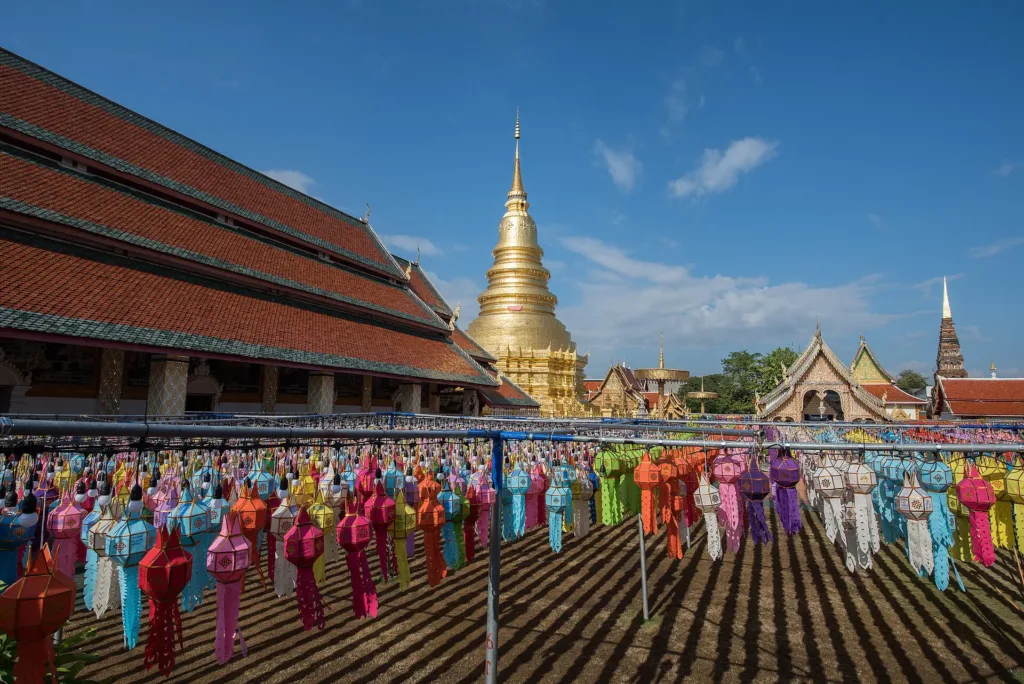
Since 2012 the temple has held the Khom Saen Duang lantern festival, begun for the 2,600th anniversary of the Enlightenment with about 3,000 lanterns. In 2023 it ran from 4 October to 27 November with over 100,000 lanterns, and the Ministry of Culture named it one of 16 festivals to promote internationally. The 13th edition in 2025 ran from October to 10 November. Visitors can buy a lantern, write a wish and hang it as an offering.
The 2026 lantern festival, probably the 14th, runs from 1 October to 30 November 2026; by 15 October more than 30,000 lanterns had been hung.
Other events include New Year prayers and wrapping the chedi in cloth, a robe procession on Makha Bucha (3 March in 2026) and the Tan Kuay Salak merit festival around September. On 30 April 2025 the temple held chanting at the main viharn for Princess Dipangkorn's birthday.
The temple opens about 06:00–21:00; Thais enter free and foreigners pay 20 baht. Next door is the Hariphunchai National Museum, and the Lamphun town tram starts at the temple, running Tuesday–Sunday at 09:30 and 13:30 with 10 stops including Wat Chamadevi and the Chamadevi monument; adults pay 50 baht.
- 11th–12th c. CEKing Athitayarat builds the relic chedi (dates given range from 897 to 1108)
- Same eraQueen Pathumwadi builds the Pathumwadi (Suwanna) Chedi
- Late 13th c.King Mangrai rebuilds the chedi
- c. 1408King Saen Mueang Ma first gilds the chedi
- 1443 or 1447King Tilokarat enlarges it into a 92-sok bell chedi
- c. 1500Inscription LP.15 records the scripture hall
- 1511Chedi sheathed in copper and re-gilded
See 18 events
- 1514Main viharn built
- 1786King Kawila presents umbrellas for the four corners
- 1860Giant gong cast
- c. 1910–11Khruba Siwichai held at the temple by the local sangha
- 1915 or 1923Storm wrecks the main viharn (sources conflict)
- c. 1920Khruba Siwichai begins rebuilding the main viharn
- 1925Present main viharn
- 1926King Prajadhipok bathes the chedi on his northern tour
- 8 Mar 1935Registered as an ancient monument
- 1938Khruba Kham Fu builds the bell and gong towers
- 1956Gate lions restored
- 30 Oct 1979Further Royal Gazette notice
- 2012Khom Saen Duang lantern festival begins
- 19 Feb 2013Listed as Lamphun provincial heritage
- 4 Oct–27 Nov 2023Lantern festival with over 100,000 lanterns
- 5–11 May 2025Bathing festival; Paet Peng fell on Visakha Bucha
- 25 Apr–1 May 2026Phra That Hariphunchai bathing festival
- 1 Oct–30 Nov 2026Khom Saen Duang lantern festival (14th year)
Check-ins & visitor photos
Arrived? Check in, collect a stamp and tell others what it is like right now
Check your location first, so you do not fill in the form for nothing
Location must be on and within 0.6 km · One check-in per place per day · come back on other days to check in again
Post photos from anywhere — no need to be here · Up to 20 photos at a time · JPG / PNG / WebP · GPS location data is removed automatically
How to get there
Flat town streets
Highway 106 from Chiang Mai · Fuel
Stops near the temple · Ask for fares
Lamphun station, then local transport · By class
Highway 106 (the yang-tree road), 26 km, or Highway 11, about 33 km from Chiang Mai
Around the temple and nearby streets; hard during festivals
Good
About 06:00–21:00
around 26 km fromChiang Mai
Wat Phra That Hariphunchai
20 THB
Stays near Wat Phra That Hariphunchai Woramahawihan
Approx. nightly price for 2 adults (next week) · final price depends on your dates
FAQ
Before you goWat Phra That Hariphunchai Woramahawihan
Answers travellers want before they go — a one-minute read
How much is admission?
Free for Thais, 20 baht for foreigners
What are the hours?
About 06:00–21:00 (some sources say 07:00–18:00)
Which birth year is it for?
The Year of the Rooster
When is the bathing festival?
Northern eighth month, around Apr–May; 25 Apr–1 May in 2026
When is the lantern festival?
Around Oct–Nov, at Yi Peng
How far is it from Chiang Mai?
26 km on Highway 106 or 33 km on Highway 11
How old is it?
About the 11th–12th centuries CE; sources give several dates
Ready to go to Wat Phra That Hariphunchai Woramahawihan?
Best day this week: Thursday 29 Oct · Check in when you arrive to collect a stamp