 01
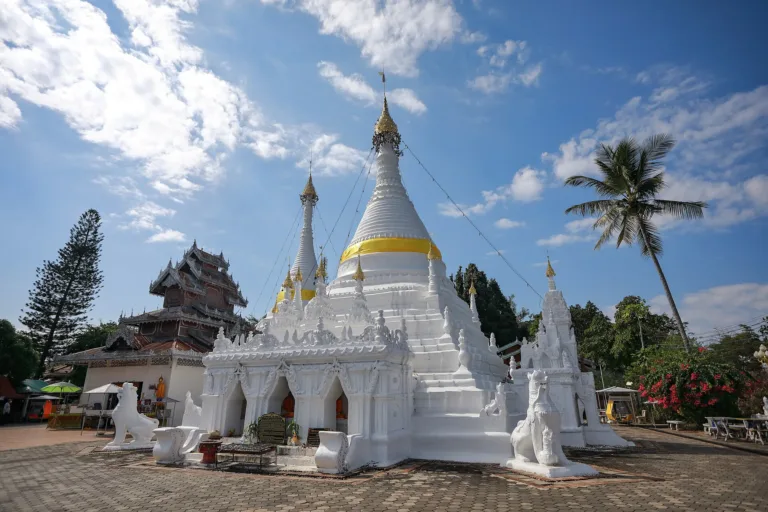
Twin white chedisShan-Burmese stupas of 1860 and 1874
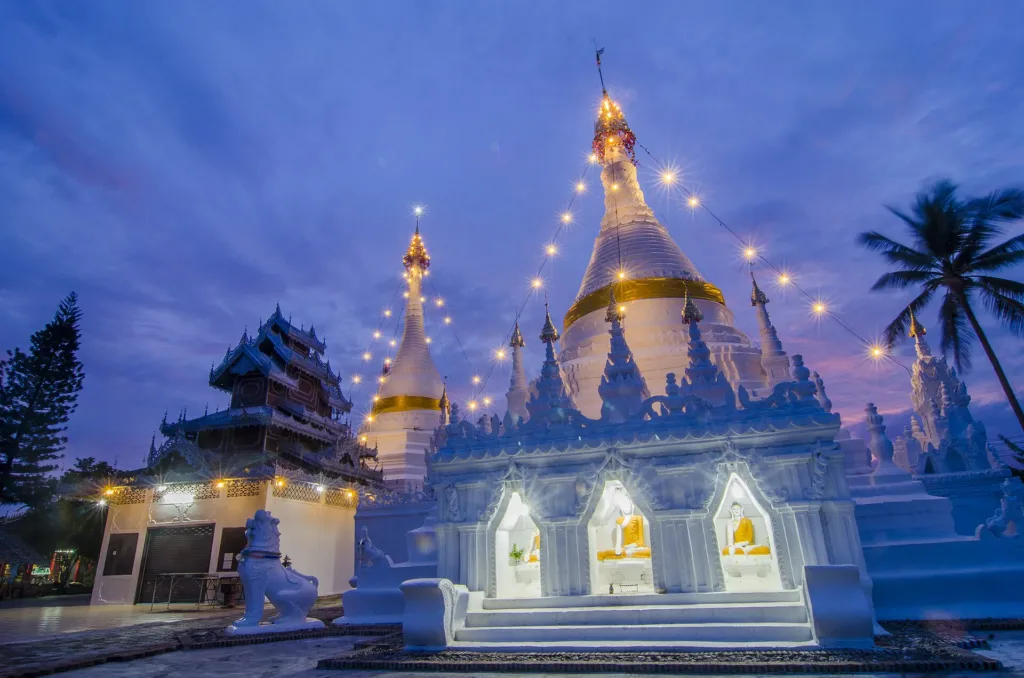
Twin Shan chedis · Mae Hong Son
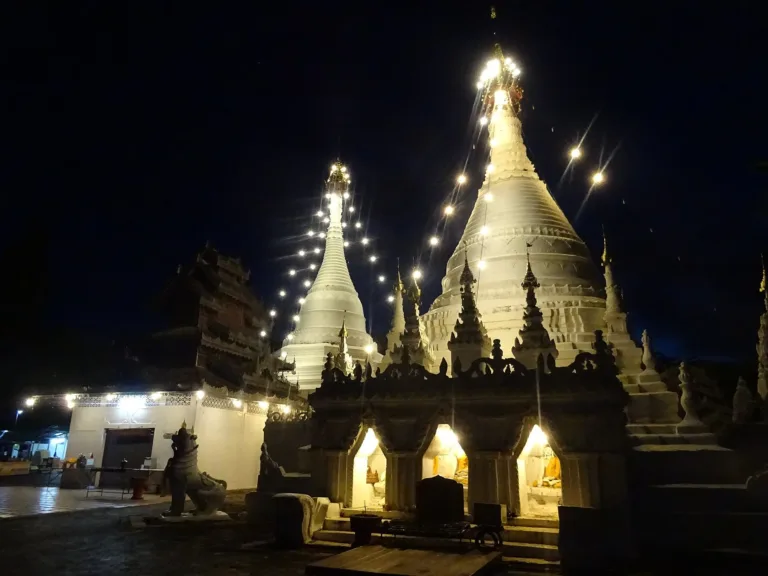
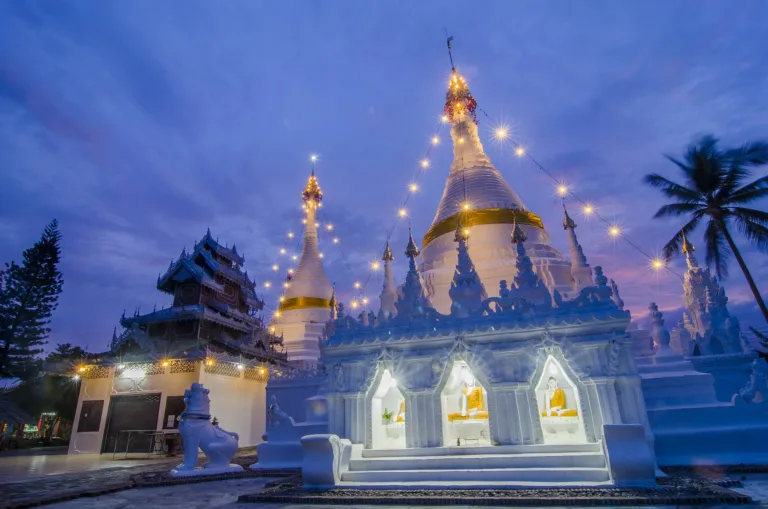
Twin Shan-Burmese chedis on the summit of Doi Kong Mu above Mae Hong Son town, formerly Wat Plai Doi. The first was built in 1860 by Chong Tong Su, the second in 1874 by Phaya Singhanat Racha, the first ruler. A free viewpoint over town and the airport.
Holiday / event — crowded · Hot (Late morning) feels like 37°C · Chance of a sea of mist 5/10
sea-of-mist places: morning matters most
Dress modestly · Shoes off on the chedi terrace · Don't climb the chedi base · Keep quiet in the temple grounds
About 06:00–18:00 (terrace lit at night)
06:00 for the mist, or 17:00 for sunset
Tak Bat Thewo (end of Lent, Oct) · Phra That Doi Kong Mu worship (12th lunar month, about Nov)
01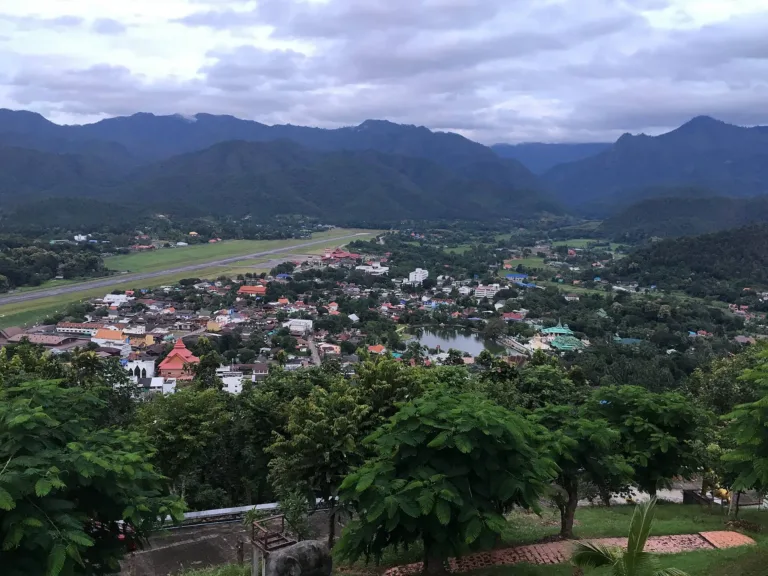 02
 03
 04
Tap a day card to see that day’s weather, rain, haze and hourly forecast
Best time to go Fine all day little rain through the day
Holiday — traffic on the way up and parking fills fast; leave early
Green band = hours used for the score
Best time to go Fine all day little rain through the day
Holiday — traffic on the way up and parking fills fast; leave early
Green band = hours used for the score
Best time to go Fine all day little rain through the day · light drizzle possible at times
Holiday — traffic on the way up and parking fills fast; leave early
Green band = hours used for the score
Best time to go Best window 06:00–15:00 Little rain · light drizzle possible at times
No warnings today — normal road and weather conditions
Green band = hours used for the score
Best time to go Best window 06:00–14:00 Little rain · light drizzle possible at times
Thick morning fog with visibility under 1 km — use headlights and drive slowly
Green band = hours used for the score
Best time to go Fine all day little rain through the day · light drizzle possible at times
Thick morning fog with visibility under 1 km — use headlights and drive slowly
Green band = hours used for the score
Best time to go Fine all day little rain through the day
Thick morning fog with visibility under 1 km — use headlights and drive slowly
Green band = hours used for the score
Scored from cloud cover at every level and tonight’s moonlight — the darker the sky, the clearer the Milky Way · tap another night below for the next 7 nights
Wat Phra That Doi Kong Mu, Chong Kham, Mueang Mae Hong Son.
Arrive 06:00 for the mist, or 17:00 for sunset
Sea of mist over town at dawn, Nov–Jan
Photos from Wikimedia Commons and contributors · full credits inClassic page
Cover shoulders and knees; shoes off on the chedi terrace
Use low gear going down
Adults 0 THB · Time needed 30–60 minutes
Every sunset, and festivals Oct–Nov
| Motorbike taxi return from the market optional | 100 ฿/person |
| Merit offering / flowers and incense optional | 20 ฿/person |
Cash · Prices may change by season — check with the venue
Tak Bat Thewo (end of Lent, Oct) · Phra That Doi Kong Mu worship (12th lunar month, about Nov)
Tap a month on the wheel to see weather, rain, haze and crowds from 10 years of records
Best time · Nov–Jan dawns bring a sea of mist over town · Oct Tak Bat Thewo · Nov chedi worship festival
Watch out · Feb–Apr forest-fire haze hides the view
Oct by the records 21–30°C · avg rain 148 mm (19 rainy days) · clear 3 days · avg PM2.5 6
Wat Phra That Doi Kong Mu stands on top of Doi Kong Mu on the western side of Mae Hong Son town, Chong Kham subdistrict. The summit is about 400 m above sea level, some 150 m above town (some sources say 1,300 m, which is wrong). It was formerly Wat Plai Doi, and "kong mu" is Shan for a stupa. Locals revere it as the town's guardian relic, and say that if you haven't been up Doi Kong Mu you haven't really reached Mae Hong Son.
Before the town existed, Lawa people lived in the valley. In 1831 the ruler of Chiang Mai sent Chao Kaew Mueang Ma with men over the western ranges to catch wild elephants, with Pa Ka Mong in charge. They camped by a stream and a plain suited to training elephants and called it "Mae Rong Son", which later became Mae Hong Son. Sources disagree on the Chiang Mai ruler's name.
Around 1856 war west of the Salween drove many Shan to settle here under Chao Fa Ko Lan and Chan Kale. Chan Kale won Pa Ka Mong's trust, married his daughter Nang Sai and moved south to found Khun Yuam, later marrying Nang Mia, granddaughter of Chao Fa Ko Lan. Khun Yuam prospered and sent teak as tribute.
In 1860 a Shan merchant named Chong Tong Su ("chong" is a title for a temple patron) and his wife Nang Loek built monks' quarters and a chedi on the hill to enshrine relics of Maha Moggallana, brought from Mawlamyine by U Pun Tek Ta, a monk from Taunggyi, who became the first abbot. After Chong Tong Su died the monk returned to Taunggyi.
In 1874 Chao Inthawichayanon of Chiang Mai raised Mae Hong Son to a town and appointed Chan Kale as Phaya Singhanat Racha, its first ruler. To mark the occasion he built a second chedi for relics of Sariputta brought from Mandalay by U Eng Ta Ka, who became the next abbot. A statue of Phaya Singhanat Racha stands at the foot of the hill at the turn-off to the temple.
Sources still disagree on which chedi is the larger, though most agree. The version told by the Tourism Authority of Thailand and Wikipedia says the large chedi is Chong Tong Su's of 1860 and the small one Phaya Singhanat Racha's of 1874. But the Sirindhorn Anthropology Centre's Southeast Asian Arts database, citing a 1982 Fine Arts Department survey, says the reverse: the large chedi is Singhanat Racha's with Sariputta's relics, and the small octagonal one is Chong Tong Su's. That database gives the year as 1864, probably a typo for 1874.
Architecturally, the SAC describes the large chedi as a masonry bell-shaped stupa on two plain plinths and a three-tier lotus base adorned with lions, norasingha, vases and miniature stupas, with a short round bell, spire and tiered hti. Because the norasingha base overlaps the lotus base it was probably added in a later restoration. The SAC calls it the only Burmese chedi in Thailand organised systematically like authentic Amarapura–Mandalay stupas, comparable to Wat Chong Sung in Mae Sariang and King Mindon's Kuthodaw in Mandalay.
The small chedi has an octagonal plan with Mon features such as an inverted lotus and a long spire, comparable to Yangon's Sule Pagoda. Thai PBS in 2023, however, described the large chedi as an octagonal Mon-style stupa with Buddha niches on eight sides and the small one as a square three-tier base with corner lions — so the shapes too are told differently by different sources.
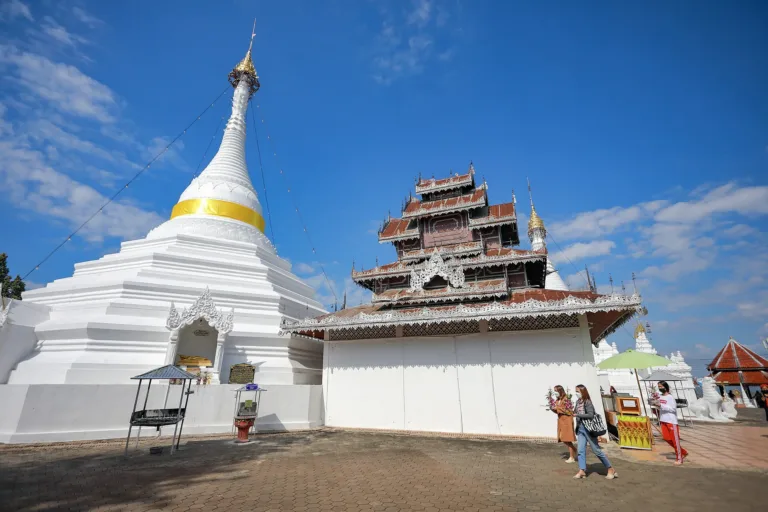
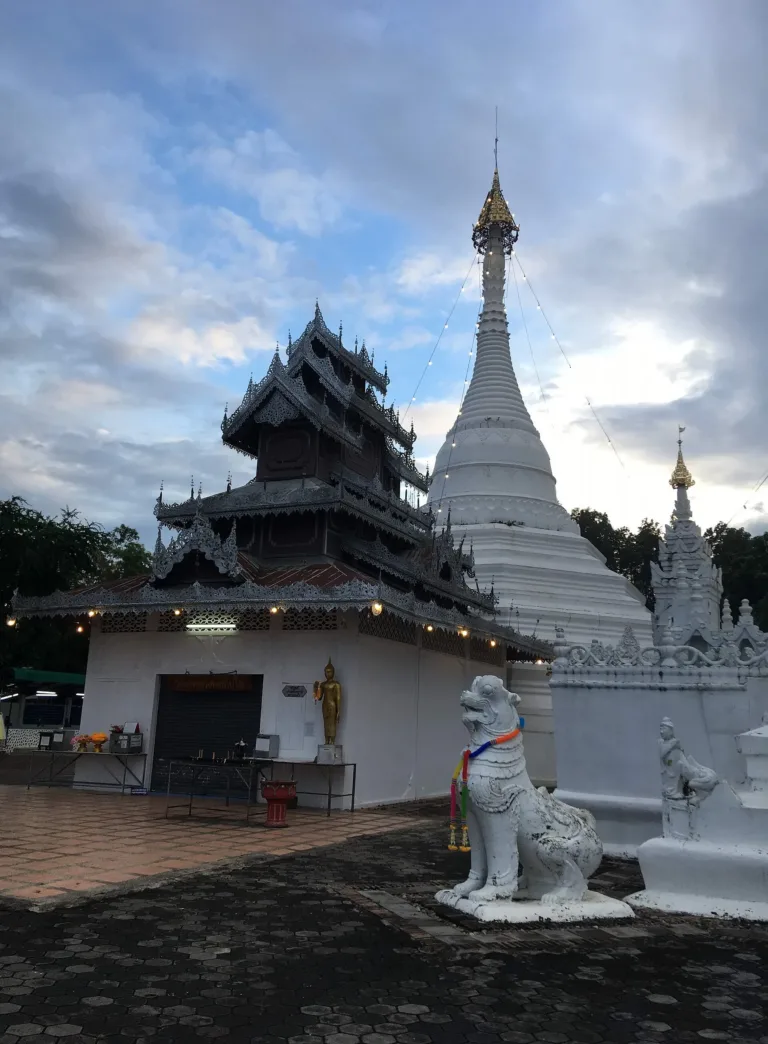
The viharn in front of the chedis blends Shan and Burmese styles, decorated with three-dimensional pierced tin fretwork called "pan soi", a craft now rarely seen. Inside is a Shan-Burmese Buddha in the subduing-Mara posture, which at least two sources call Luang Pho Than Jai. The ordination hall higher up has a standing Buddha and a crowned Buddha, and around the chedis are day-of-the-week Buddhas, naga and lion statues and Burmese-style tiered wooden pavilions.
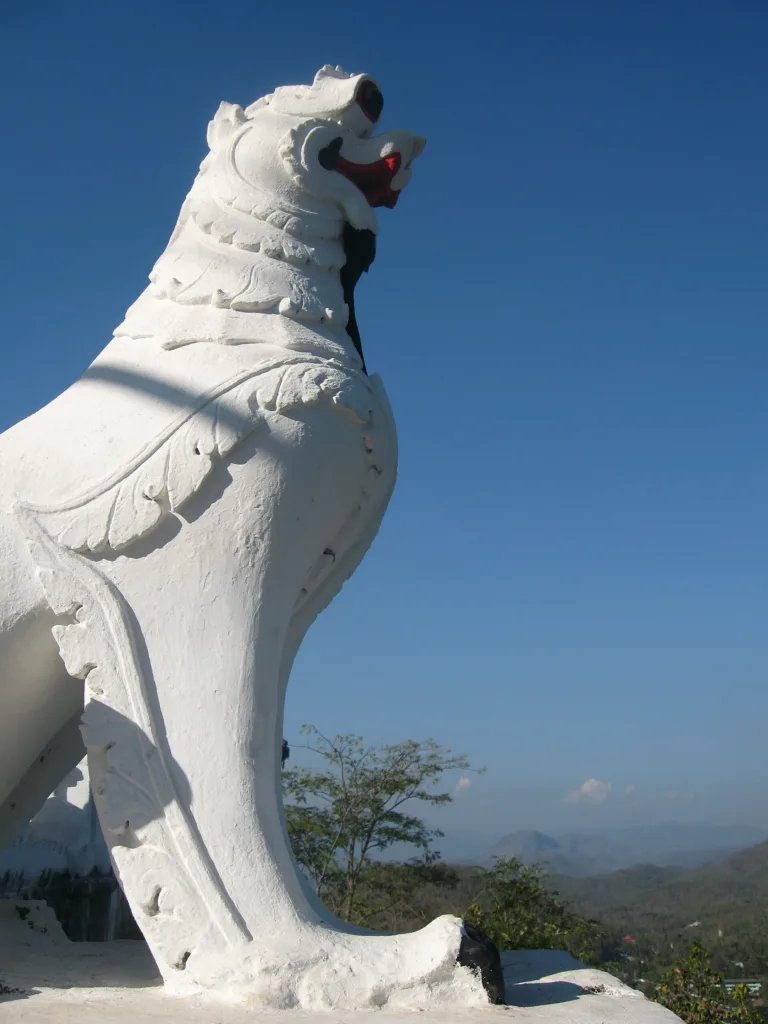
The lion statues follow Burmese belief: the one facing the town guards the town. Shan devotees also offer the four elements ("si pa") to the chedi, and ringing the bell is said to tell the god Indra and to make sure you come back.
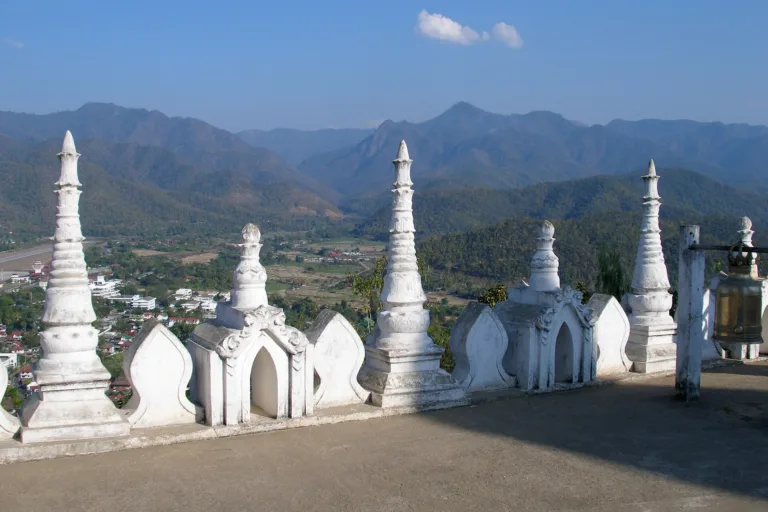
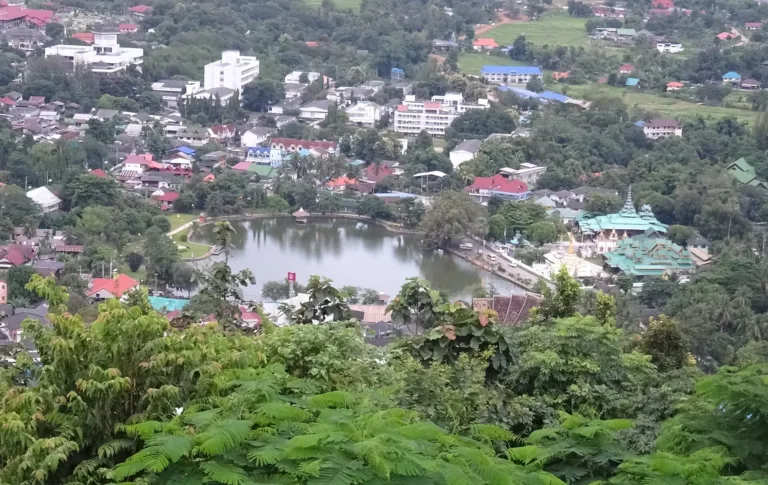
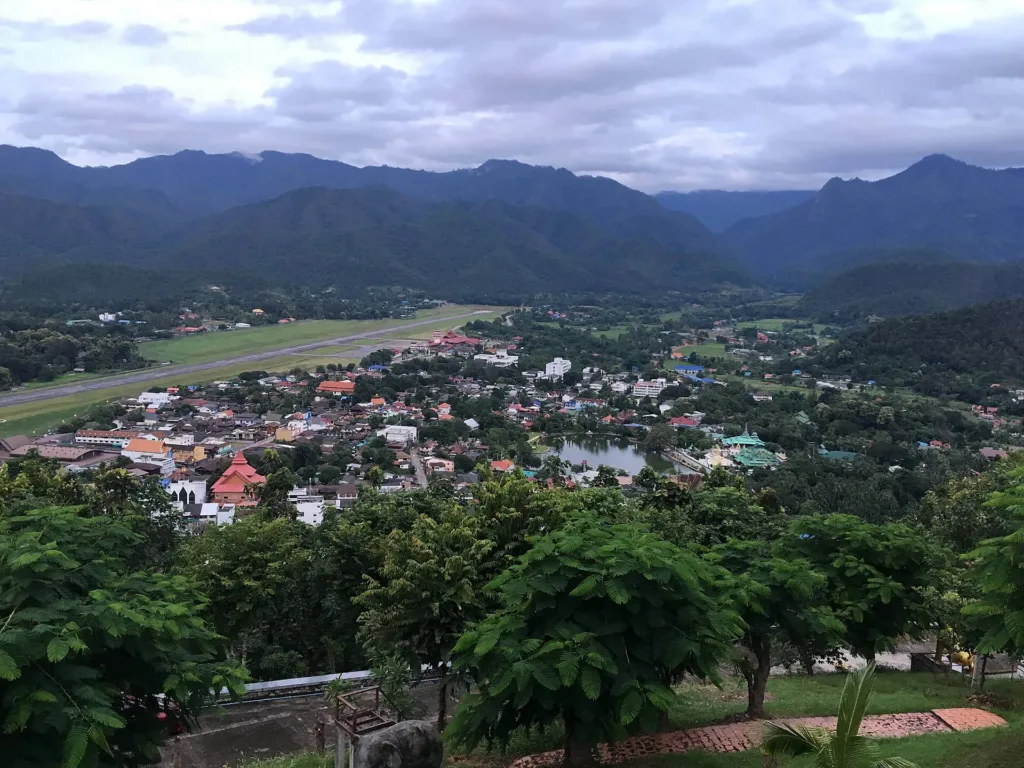
The two white chedis are also a landmark for pilots landing at Mae Hong Son airport; a local cultural council chairman once said their colour must never change for that reason. The summit terrace gives a 360° view over town, Nong Chong Kham lake, the runway and the Daen Lao range on the Myanmar side. At night hundreds of bulbs light the chedis, visible from town.
Over the same period Mae Hong Son was drawn into Siam's administration. Mae Hong Son, Khun Yuam, Mae Sariang and Pai were merged into the Western Chiang Mai circle (Thailex says 1890, TrueID 1900); Wikipedia says the Anglo-Siamese boundary commission of 1892–93 confirmed the area as Siamese (still to be checked). The circle was renamed Phayap Nuea in 1903, and in 1910 Mae Hong Son became a fourth-class town (mueang chattawa) in Monthon Phayap, with Phra Si Surarat (Plueang) as its first governor. Wat Chong Kham beside Nong Chong Kham at the foot of the hill is counted among the town's first temples; its name comes from its gold-leafed pillars, and its Luang Pho To image is 4.85 m wide at the lap.
In January–March 1968 anthropologists Charles and Jane Keyes photographed the temple, its bell and the summit; the photos are in the SAC Anthropological Archives. On 27 October 1981 the Royal Gazette (vol. 98, part 177) registered both chedis as ancient monuments.
The main annual festival is the Phra That Doi Kong Mu worship in the twelfth lunar month around Loi Krathong, held since about 1969. Because the temple is far from any river, a former abbot, Phra Khru Anusan Sasanakon, began floating "heavenly krathong" lanterns into the sky instead, on the 11th to 15th waxing nights of the twelfth month, with a procession carrying the "sang kan" robe up the naga staircase to wrap the chedi. The 2022 festival ran 4–8 November, the 2023 edition 23–27 November with a no-foam campaign, and in 2021 TAT handed out lucky ta-laeo charms.
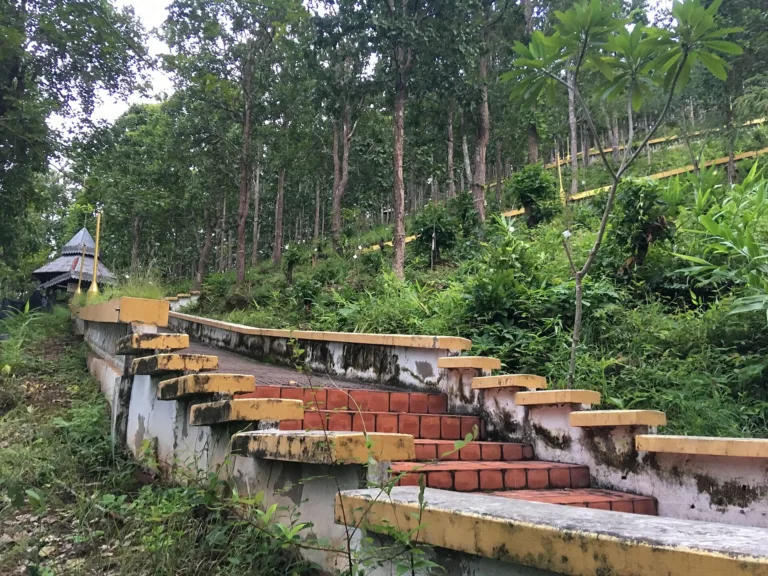
At the end of Buddhist Lent comes the Tak Bat Thewo alms round, when monks and novices walk down the naga staircase of more than 600 m. On 7 October 2025, 99 monks and novices from 11 temples took part, watched by crowds in Shan dress. The current abbot, Phra Sumon Sasanakit (Dr.), is also the provincial head of the Sangha.
The list of abbots is incomplete: U Pun Tek Ta was the first from 1860, followed by U Eng Ta Ka after 1874; the middle of the list is not recorded, through to Phra Khru Anusan Sasanakon and Phra Sumon Sasanakit (Dr.), abbot since at least 2022. The temple uses the second half of the provincial slogan, "mist in three seasons, Kong Mu touching the sky", making the hilltop chedis the emblem of Mae Hong Son.
On 15 December 2025 the governor led the release of 1,000 lanterns at Nong Chong Kham, at the foot of Doi Kong Mu, in tribute to Queen Sirikit — lanterns rising over the lake with the twin chedis on the hill behind became one of Mae Hong Son's images of that year.
Today you can drive up a winding 1.5 km paved road or climb the naga staircase. Entry is free and there is no cable car. In February–April forest-fire haze can hide the view — on 4 March 2022 the town was invisible — while from November to February mornings often bring a sea of mist over the town.
Arrived? Check in, collect a stamp and tell others what it is like right now
Check your location first, so you do not fill in the form for nothing
Location must be on and within 1 km · One check-in per place per day · come back on other days to check in again
Post photos from anywhere — no need to be here · Up to 20 photos at a time · JPG / PNG / WebP · GPS location data is removed automatically
Steep, winding paved road of about 1.5 km
From town via Highway 108, then up the hill · Fuel
From the town market · About 100 baht return
From the foot of the hill · Free
From the Phaya Singhanat Racha monument on Highway 108 go about 150 m, turn left at the sign and climb about 1.5 km of winding road to the summit car park
Summit car park; busy on holidays
Good
About 06:00–18:00 (terrace lit at night)
around 2 km fromMae Hong Son town
Wat Phra That Doi Kong Mu
0 THB
Approx. nightly price for 2 adults (next week) · final price depends on your dates
Answers travellers want before they go — a one-minute read
No
Yes, on a 1.5 km paved road
No
Those of Moggallana (from Mawlamyine) and Sariputta (from Mandalay)
Chong Tong Su (1860) and Phaya Singhanat Racha (1874)
Shan for a stupa
Wat Plai Doi
Best day this week: Wednesday 28 Oct · Check in when you arrive to collect a stamp