 01
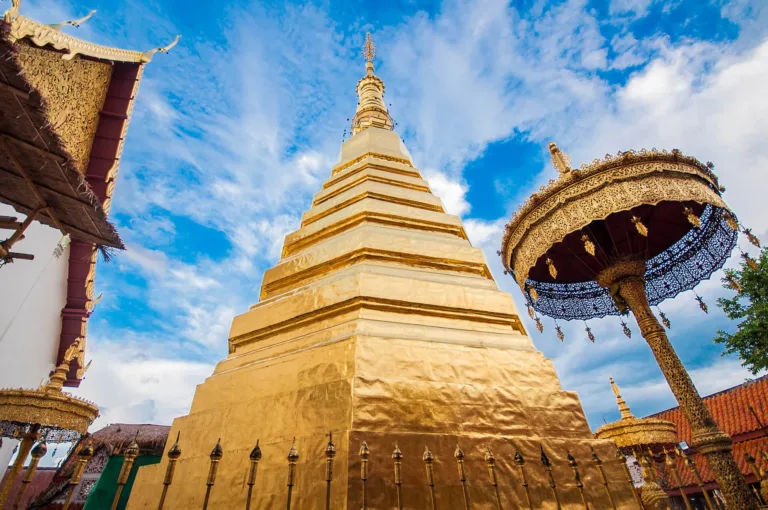
Phra That Cho HaeOctagonal chedi in gilded copper, 33 m tall
PHRAE · YEAR OF THE TIGER
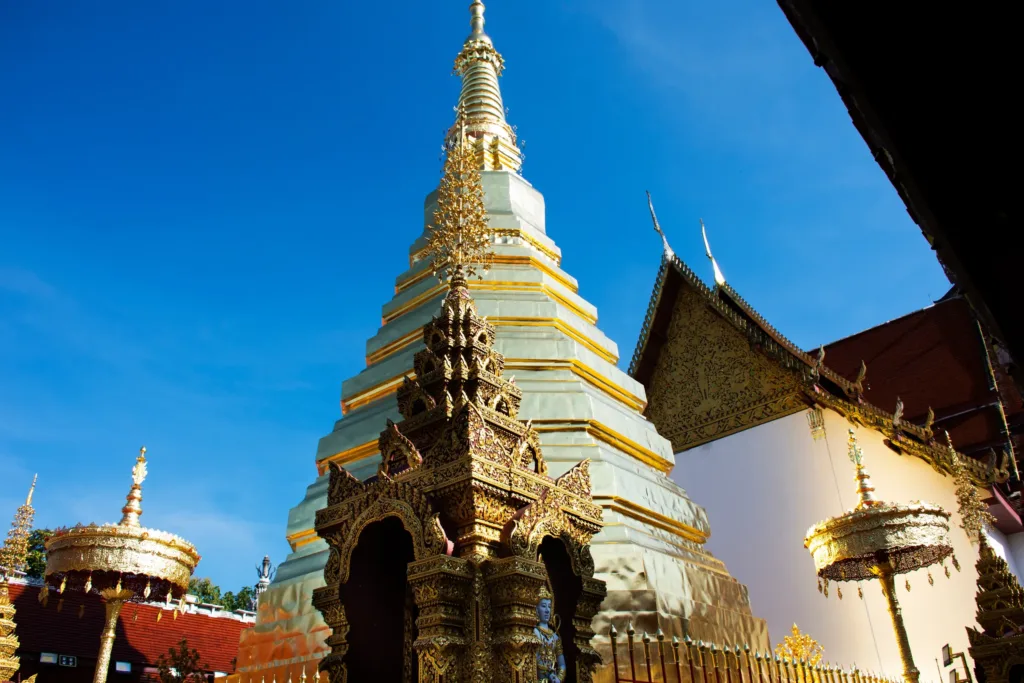
Phrae's most sacred temple and the relic chedi of the Year of the Tiger, a 33 m gilded octagonal chedi on a hill
Holiday / event — crowded
Open daily during daytime
Before 10:00 or after 15:30 for good light and cooler air
Phra That Cho Hae festival with the giant tung procession, 9th–15th waxing days of the 6th northern month (around March)
01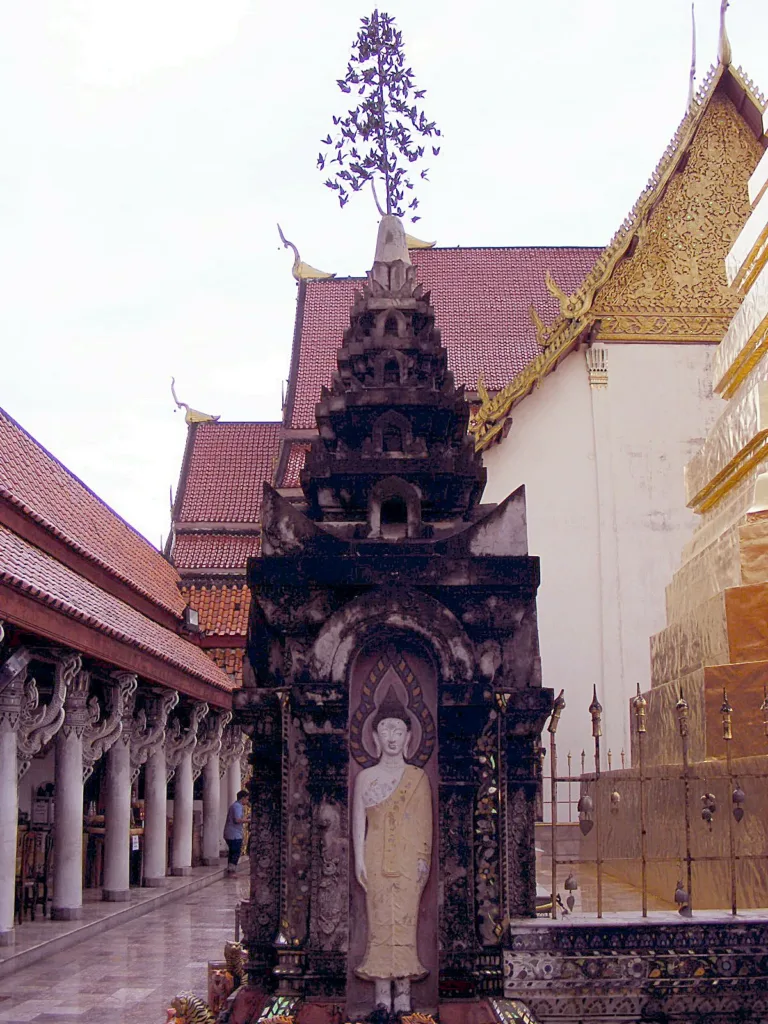 02
 03
 04
 05
Tap a day card to see that day’s weather, rain, haze and hourly forecast
Best time to go Daytime is over · see tomorrow
Holiday — traffic on the way up and parking fills fast; leave early
Green band = hours used for the score
Best time to go Fine all day little rain through the day
Holiday — traffic on the way up and parking fills fast; leave early
Green band = hours used for the score
Best time to go Fine all day little rain through the day
No warnings today — normal road and weather conditions
Green band = hours used for the score
Best time to go Fine all day little rain through the day · light drizzle possible at times
No warnings today — normal road and weather conditions
Green band = hours used for the score
Best time to go Fine all day little rain through the day · light drizzle possible at times
No warnings today — normal road and weather conditions
Green band = hours used for the score
Best time to go Fine all day little rain through the day · light drizzle possible at times
No warnings today — normal road and weather conditions
Green band = hours used for the score
Best time to go Fine all day little rain through the day · light drizzle possible at times
No warnings today — normal road and weather conditions
Green band = hours used for the score
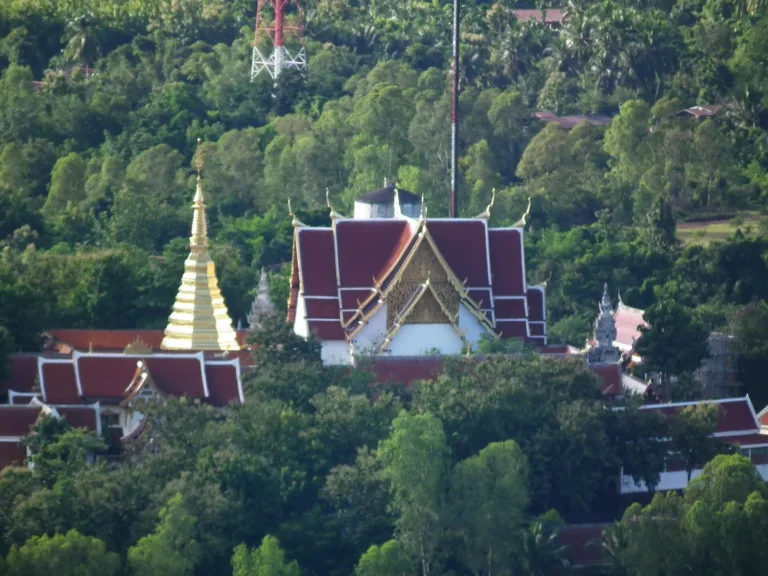
Wat Phra That Cho Hae is a royal temple on a low hill about 9 km from Phrae town. Its 33 m octagonal chedi, clad in gilded copper, is the most sacred monument of Phrae and the relic chedi for people born in the Year of the Tiger.
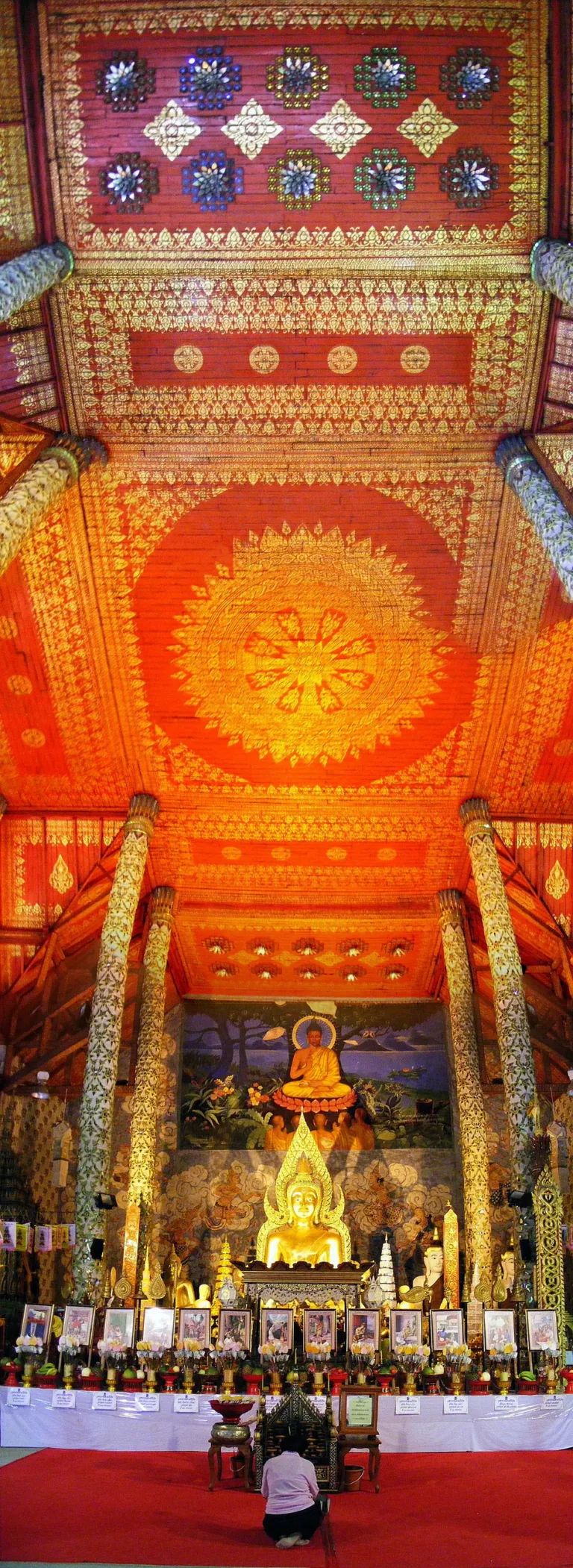
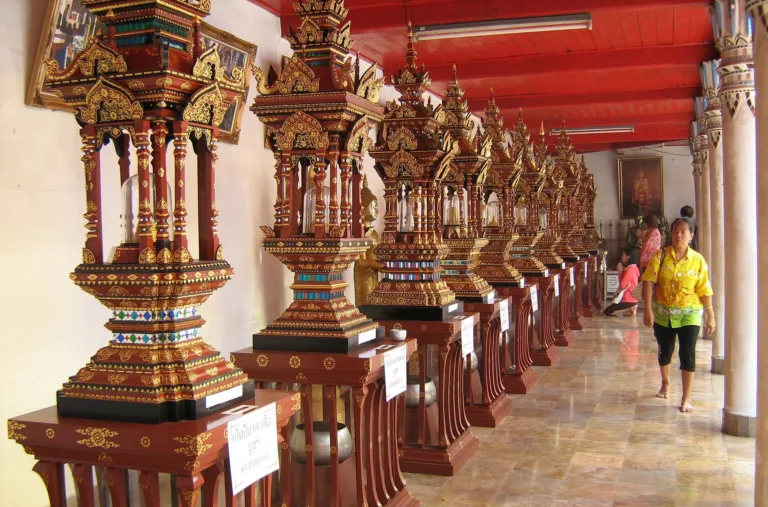
Visitors climb the naga stairs to the chedi, see the Burmese-style shrines left by the teak-era Shan and Burmese communities, and pray to the Phra Chao Than Jai image. The big festival, with its giant tung banner procession, is held around March.
Photos from Wikimedia Commons and contributors · tap a photo to see its credit
About 120 naga steps from the car park
Cover shoulders and knees
Remove shoes before the chedi courtyard and viharns
Traffic jams and full car parks during the festival
Free · Time needed 45 minutes – 1.5 hours
Festival days around March, weekends and Buddhist holy days
| Flowers, incense and silk pennants for offering (optional) optional | 20–100 ฿/set |
| Songthaew from Talat Preeda in town optional | 30 ฿/person/trip |
Mostly cash · Prices may change by season — check with the venue
Phra That Cho Hae festival with the giant tung procession, 9th–15th waxing days of the 6th northern month (around March)
Tap a month on the wheel to see weather, rain, haze and crowds from 10 years of records
Best time · November to February is cool and clear; the golden chedi glows against the sky and the naga stairs are an easy climb. The temple is liveliest during its festival around March.
Watch out · April in Phrae is extremely hot and hazy and the chedi courtyard bakes; in the rainy season the stairs can be slippery.
Nov by the records 21–30°C · avg rain 51 mm (7 rainy days) · clear 15 days · avg PM2.5 9
Wat Phra That Cho Hae stands at No. 1, Moo 11, Cho Hae subdistrict, Mueang Phrae district (some older documents say Pa Daeng subdistrict), on a low hill called "Doi Kosiya Thachakka Banphot", about 8–9 km from Phrae town in the Yom River basin. Its chedi is the most important monument in Phrae province and the town's guardian, and in Lanna belief it is the relic chedi for people born in the Year of the Tiger. In the northern dialect it is pronounced "Pha That Cho Hae".
The name "Cho Hae" comes from "cho phrae", a triangular pennant made of silk (phrae). Tradition says Khun Lua Ai Kom offered silk cloth to the Buddha, and later villagers tied fine silk woven in Sipsongpanna to the chedi as an offering. Inscriptions in Tai Tham script spell the name both "Cho Hae" and "Cho Rae", both pronounced "Cho Hae".
The "Buddha Travels the World" chronicle says that 25 years after his enlightenment the Buddha journeyed with his disciples and rested under a betel-nut tree on this hill. A Lua man named Ai Kom (also written Ai Khom) brought him food, and the Buddha foretold that a great city named "Mueang Phrae" would rise here. Some versions say eating the betel nut made people mad, giving the town its name. The Buddha gave Ai Kom a hair relic to enshrine in a cave on the east side of the hill, whose mouth Indra sealed with stones, and instructed that a relic of his left elbow be brought here after his passing.
The legend continues that 218 years after the Buddha's passing, King Ashoka and the arahants distributed relics across many places, including this hill. Seven arahants and the rulers of the towns of La Hueng, Khon, Wiang, Non and Wa built the reliquary together.
The chronicles point to the Sukhothai period. The Sukhothai chronicle held by the National Library says that between CS 698–700 (1336–1338), Phraya Lithai, then viceroy at Si Satchanalai, chose this hill for a chedi and gave Buddha relics to Khun Lua Ai Kom, who enshrined them in a golden lion inside the chedi, followed by a seven-day celebration. Legend says one of his baggage elephants collapsed at Ban Kwang, now in Sung Men district, giving rise to the name "Ban Kwan Chang Mup". A government heritage record adds a major restoration in 1359, when the hill was named "Kosiya Thachakka Pabbate".
People in Phrae believe that the seven-day celebration of Lithai's time is the origin of today's Phra That Cho Hae festival, which is still held from the 9th to the 15th waxing day of the 6th northern (4th southern) month, as the chronicle describes.
Scholars still debate its age. Bordin Kinawong suggests Lithai may have built Phra That Cho Hae during his roughly seven months in Phrae, citing the Wat Pa Daeng and Khao Kop inscriptions, though neither names the chedi directly. Based on its art style, the Sirindhorn Anthropology Centre dates the present chedi to around the 15th–17th century, in the Lanna period.
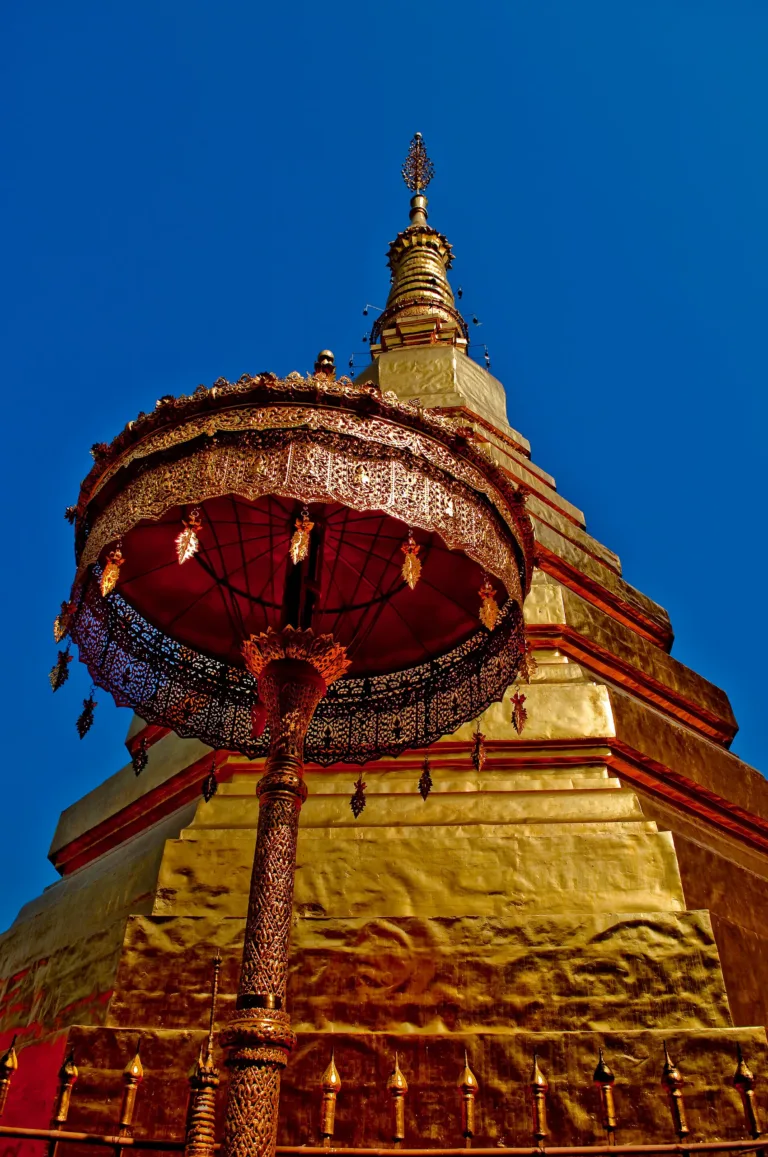
The chedi is an octagonal, bell-shaped Lanna stupa with indented corners, clad in gilded copper sheets known as thong dok buap or thong chang ko. It stands 33 m tall on a square base about 10–11 m per side. From bottom to top it has a square plinth, octagonal fascias, seven tiers of octagonal lotus mouldings, a lotus bell base, a small octagonal bell, a twelve-sided pedestal, ringed spire and a Lanna-style umbrella. An iron railing with four gates surrounds it.
Scholars read its form in different ways. Sommai Premchit (1981) called it a "Pagan-style octagonal chedi" unique to Phrae. Sai Klang Jindasu (2004) and Worawat Setthanasin (2004) linked octagonal lotus-base chedis to Lanna influence in the 15th–17th centuries, and Sakchai Saising (2011) placed it among late Lanna bell-shaped chedis. Some see it as developing from the Phra That Lampang Luang type, with a many-sided bell, and more slender than Doi Suthep. Phonlawat Aromma (2012) described the octagonal bell chedi as a local form that became a symbol of Phrae and was widely copied.
After Phrae joined the Lanna kingdom, Lanna kings maintained the chedi, but it decayed once the Mangrai dynasty lost power. In 1769, when King Taksin attacked the Burmese in Lanna, the lord of Phrae, Chao Mangchaiya, joined his army, was made Phraya Si Suriyawong, and restored the chedi. Later rulers of Phrae continued the work: Chao Luang Thepwong ("Golden Tongue") in 1818, Chao Luang Inthawichai in 1830 and Chao Luang Phimphisan around 1872. The last ruler, Chao Phiriya Thepwong, fled to Luang Prabang after the Shan rebellion and looting of Phrae in 1902.
Locally, the "Kathatu" family has looked after the chedi for generations. The surname was registered after the Surname Act of 1913, showing that the family of caretakers was known in the community well before then.
In the late 19th century Phrae became a teak centre. Siam opened forest concessions to foreign firms from 1883, and the British Bombay Burmah company brought in many Burmese and Shan workers. These communities left Burmese art at the temple: a gilded stucco reclining Buddha in the Mandalay style, built in 1916 by Pho Chong Pan Jitakhae and Mae On Prangsuwan, which pilgrims once bowed to before climbing to the chedi; prasat-style gateways on all four sides of the chedi courtyard, built in 1917; and the round "Heckman" chedi holding the ashes of a Burmese timber merchant.
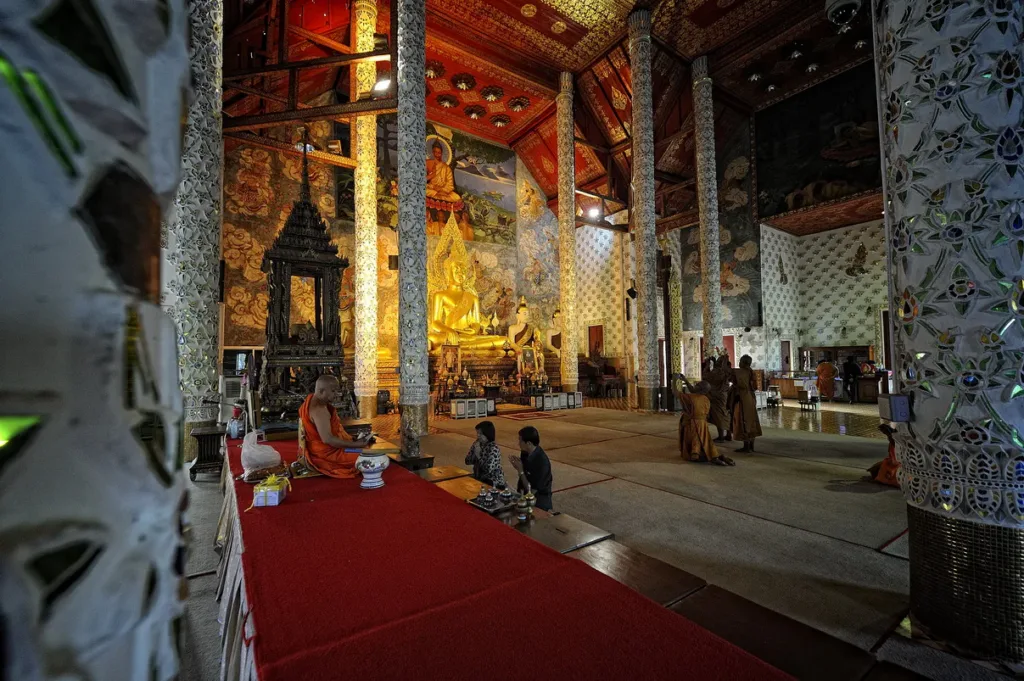
"Phra Chao Than Jai" is a gilded Buddha in meditation built in 1921 by Sang Kham Pan, a Shan man, in a Chiang Saen style blended with Burmese features. It sits in a Burmese prasat-style mondop behind the chedi, open on three sides, with mirrored stucco pillars, floral pediments and vases of plenty at the upper corners. People come to ask for wishes granted "than jai" (in time), and in 2024 the province promoted the image as about 100 years old.
In 1924 Kruba Sriwichai, the revered monk of Lanna from Lamphun, led a major restoration with the monks of Phrae, with Phra Maha Methangkon (Phrom Phromthewo), a former provincial abbot, presiding for the sangha. He enlarged the base, raised the spire, removed the old copper sheets, built up the plaster slightly before re-cladding, added a railing and carved gateways on four sides (some sources say the Burmese gates already existed from 1917). The work is recorded in the Pang Doem chronicle verse, and today's festival includes a "Retracing Kruba Sriwichai" procession. The temple's small museum keeps the urn of Kruba Sriwichai's relics. Kruba Sriwichai was himself born in a Year of the Tiger (1878), the zodiac year of this chedi, and the temple museum displays rupee coins used to pay for the restoration.
In 1940 Ban San Klang in Pa Daeng subdistrict, not far from the temple, served as the battle set for "The King of the White Elephant", a film produced and written by Pridi Banomyong and directed by San Vasuthan. It staged the Hanthawaddy army storming Ayutthaya and battles with elephants and horses, with Doi Chang Pha Dan as a backdrop, and Chao Wong Saensiriphan supplied the elephants and mahouts. The film was inscribed on UNESCO's Memory of the World register on 17 April 2025, and the temple museum shows photographs of its filming.
The Fine Arts Department registered the chedi as an ancient monument in the Royal Gazette (vol. 52, part 75) on 8 March 1936 and later defined its boundaries. Records of the National Office of Buddhism say the temple was founded in 1357 and received its consecrated ground in 1367.
The spire top has been replaced several times. In 1990 a new top designed by Witthaya Suriya was made as a nine-petalled lotus of pure silver set with the nine auspicious gems. Later its gold leaf peeled and the umbrella stem rusted, so the abbot Phra Khru Wimonkittisunthon made a new gold lotus top in Lanna and Sri Lankan style, shaped like a mak beng flower offering, with nine tiers of gold and silver flowers and 129 gems. Princess Maha Chakri Sirindhorn raised it onto the chedi on 21 February 2011. When the copper and gold cladding later blistered, split along its seams and let rain seep in, a roughly seven-month restoration began on 19 December 2021 at a cost of about 36 million baht. The old cladding was replaced, 8.88 kg of pure gold was added at the base of the umbrella, the upturned lotus was set with diamonds, gems, zircons and rubies, the lower part was pierced with tiger motifs, and eight gold Buddhas seated on tigers were added to mark the Tiger-year chedi. The new top was raised on 16 July 2022.
The temple was raised to a third-class royal monastery (ordinary grade) effective 23 June 2006, announced in the Royal Gazette on 19 September 2006, and Phrae declared it a provincial heritage site on 4 October 2012. Inside are a viharn with "Phra Chao Cho Hae", a gilded stucco Buddha resembling Phra Buddha Chinnarat, a teak Buddha carved from a single log, and a cloister of Buddha images and small chedi shrines around the courtyard.
Besides Phra Chao Cho Hae and Phra Chao Than Jai, the temple has the Viharn Phra Phutthalokanatbophit with a naga-sheltered Buddha, a teak Buddha, an old pulpit, a stupa for Kruba Sriwichai's relics, an inscribed stone slab, the Cho Hae botanical garden and old naga staircases on all four sides of the hill. The workers brought in by the timber firms included Karen as well as Burmese and Shan people, and Phrae has several other Burmese-style temples, such as Wat Sa Bo Kaeo, Wat Ton Thong and Wat Chom Sawan. In 2019 the temple received an outstanding environmental management award from the Department of Environmental Quality Promotion.
In 2023 the temple opened a free history museum at the top of the grounds, open daily. It covers the legend of Khun Lua Ai Kom, the story of Lithai and the life of Kruba Sriwichai, with old photographs, replica monk's requisites, a relic stupa, costumes of five ethnic groups of Phrae, the twelve zodiac animals, a model viharn, a model procession of the old rulers of Phrae, old wooden Buddhas and Tai Lue woven banners.
The main annual event is the "Phra That Cho Hae Worship Festival – Phrae's Giant Tung Procession", from the 9th to the 15th waxing day of the 6th northern month (around March). It takes its name from a tung banner given by the Princess Mother to be offered to the chedi. Highlights include a procession of ruler's elephants, offerings from all eight districts, a procession of cloths to wrap the chedi, a twelve-zodiac tung parade, a long-drum dance by more than 300 women, and Maha Chat sermons day and night, while devotees walk candlelit circles around the chedi. In 2024 it ran from 18 to 24 March, and in 2025 it was extended to nine days and nights.
The year 2024 marked a century since Kruba Sriwichai's restoration. On 17 March 2024 a procession carried a likeness of Kruba Sriwichai from Lamphun to Phrae, with seven monks riding an elephant, and on 10–11 June 2024 the temple held a consecration of Kruba Sriwichai medals, a merit-making ceremony for his 146th birth anniversary and the consecration of a bronze statue of him. The abbot, Phra Kosai Chetiyarak (Wichan Kittipanyo), deputy provincial sangha chief, has also campaigned for UNESCO to honour Kruba Sriwichai as a person of world significance.
The surrounding community blends old Lua and Tai Yuan (khon mueang) cultures and still keeps salak merit-making traditions. Visitors can see taleo charms, woven salak baskets and flower offerings being made, and try local dishes such as kaeng khae, larb khua, kaeng hang le and herbal rice rolls. The Wat Phra That Cho Hae community was chosen as one of ten model community-tourism villages for fiscal 2023, and a 2026 academic study examined the beliefs of Tiger-year people who come to worship here.
Visitors should dress modestly, remove shoes before the chedi courtyard, walk clockwise around the chedi quietly and never climb the railing. People born in the Year of the Tiger often bring silk pennants or flowers as offerings for good fortune.
Arrived? Check in, collect a stamp and tell others what it is like right now
Check your location first, so you do not fill in the form for nothing
Location must be on and within 1 km · One check-in per place per day · come back on other days to check in again
Post photos from anywhere — no need to be here · Up to 20 photos at a time · JPG / PNG / WebP · GPS location data is removed automatically
From Phrae town go via the Ban Thung intersection and follow Cho Hae Road past Phrae Hospital, Phrae Airport and several villages, about 8–9 km and 15 minutes.
Cho Hae Road, about 9 km · Fuel
From Talat Preeda, Cho Hae Road · About 30 baht
From the Ban Thung intersection in Phrae take Cho Hae Road past Phrae Hospital and Phrae Airport, about 8–9 km on paved road
Car park at the foot of the hill, with souvenir and food stalls
Petrol stations in Phrae town
Good mobile signal
Open daily during daytime
about 9 km from Phrae town
Wat Phra That Cho Hae, Phrae
Approx. nightly price for 2 adults (next week) · final price depends on your dates
Best day this week: Monday 30 Nov · Check in when you arrive to collect a stamp
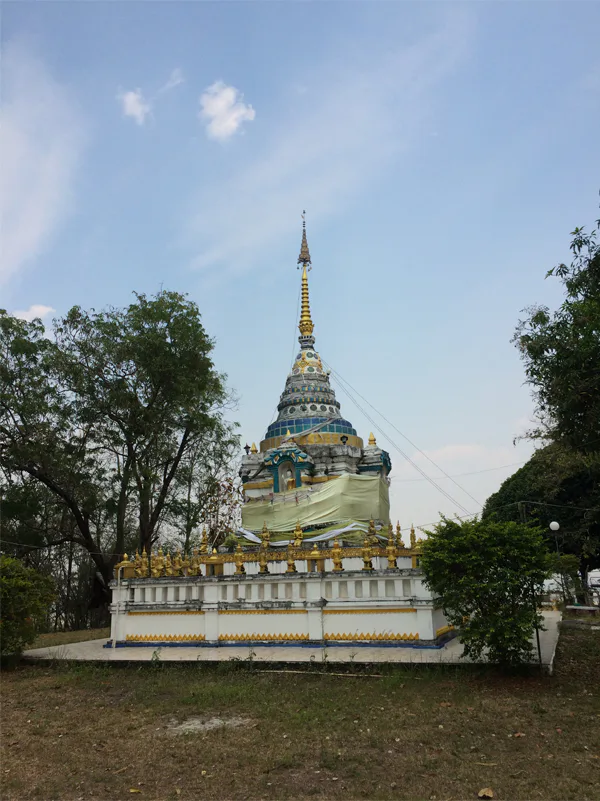 Wat Phra That Chom Chaeng
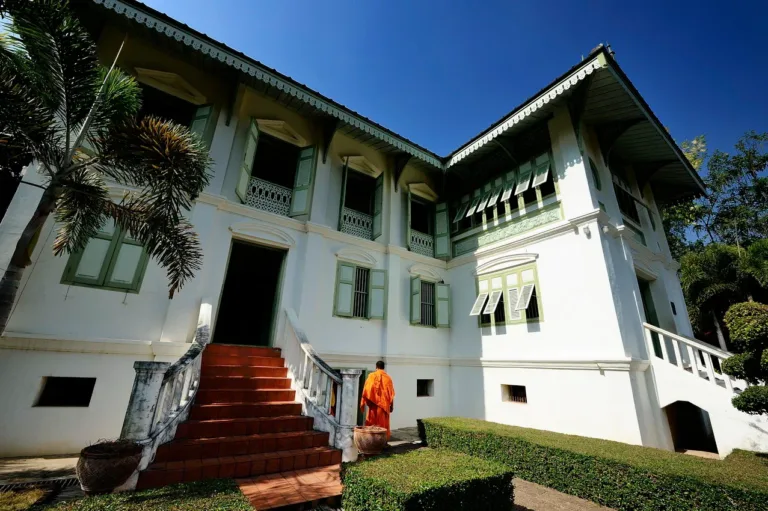 Khum Chao Luang Mueang Phrae
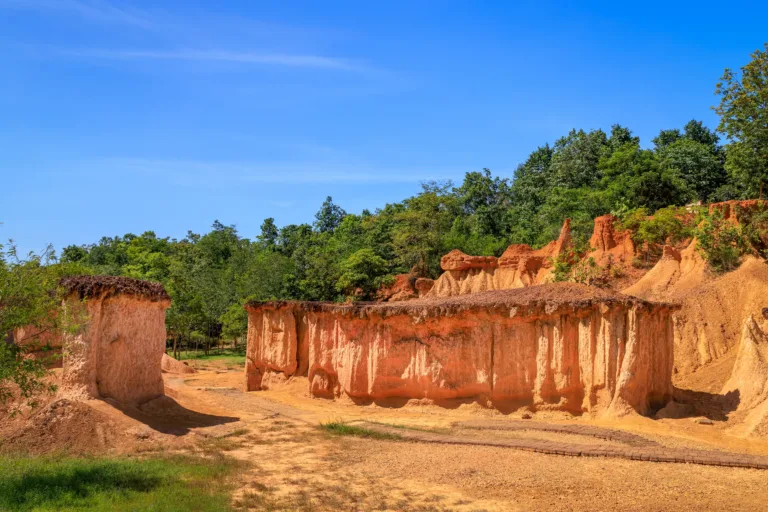 Phae Mueang Phi Forest Park