 01
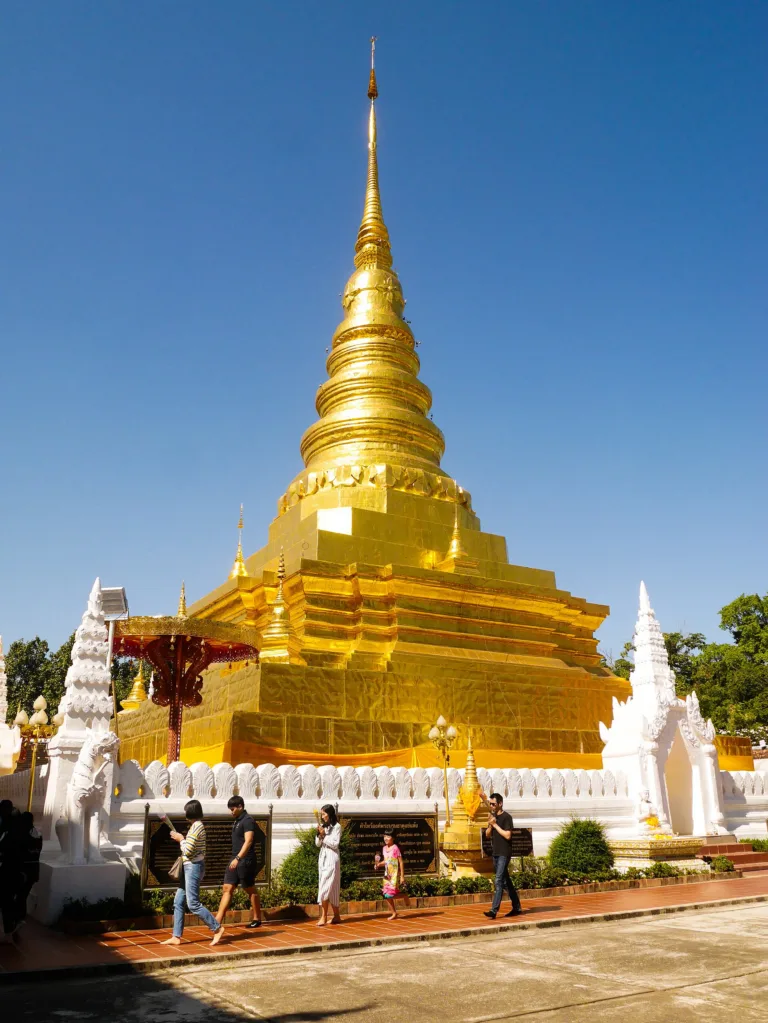
Golden chediAbout 55 m, clad in brass-copper
Year of the Rabbit chedi · Phu Phiang
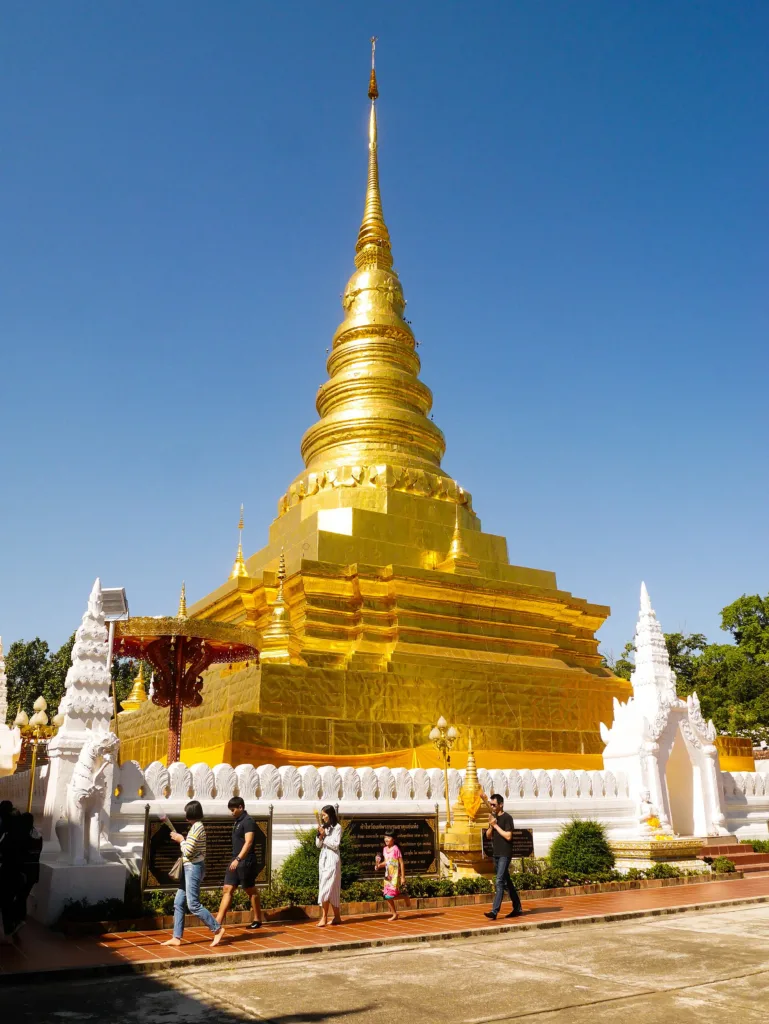
A golden chedi on Doi Phu Phiang Chae Haeng on the east bank of the Nan River, 2–3 km from Nan town, built under Phaya Kan Mueang for relics given by King Lithai of Sukhothai. Centre of Nan's capital from about 1359 to 1368, and the Year of the Rabbit's chedi.
Holiday / event — crowded · Hot (Afternoon) feels like 38°C
Dress modestly · Shoes off on the chedi terrace · Don't climb the nagas · Keep quiet in the viharn
About 06:00/07:00–18:00
Hok Peng festival and long weekends
Hok Peng chedi festival (11th–15th waxing days of the northern sixth month, around Feb–Mar)
01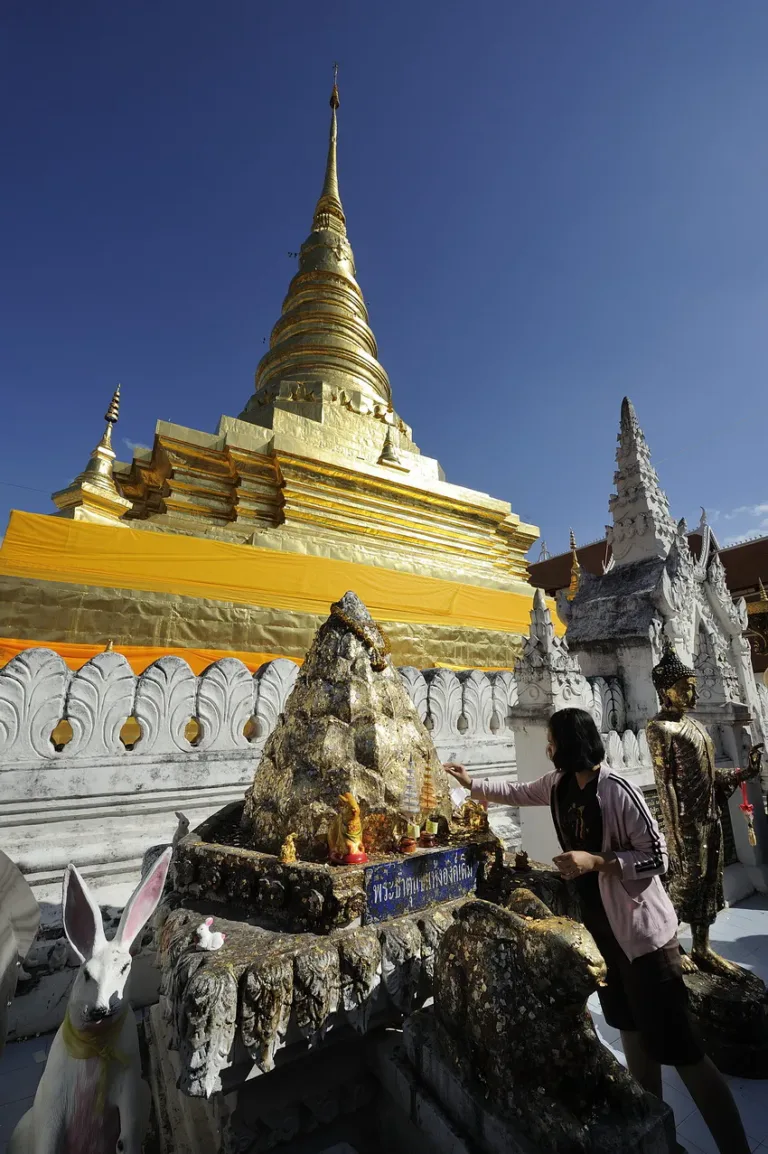 02
 03
 04
Tap a day card to see that day’s weather, rain, haze and hourly forecast
Best time to go Fine all day little rain through the day
Thick morning fog with visibility under 1 km — use headlights and drive slowly
Holiday — traffic on the way up and parking fills fast; leave early
Green band = hours used for the score
Best time to go Fine all day little rain through the day
Holiday — traffic on the way up and parking fills fast; leave early
Green band = hours used for the score
Best time to go Fine all day little rain through the day
Holiday — traffic on the way up and parking fills fast; leave early
Green band = hours used for the score
Best time to go Best window 08:00–15:00 Little rain · light drizzle possible at times
No warnings today — normal road and weather conditions
Green band = hours used for the score
Best time to go Fine all day little rain through the day · light drizzle possible at times
No warnings today — normal road and weather conditions
Green band = hours used for the score
Best time to go Fine all day little rain through the day
No warnings today — normal road and weather conditions
Green band = hours used for the score
Best time to go Fine all day little rain through the day
No warnings today — normal road and weather conditions
Green band = hours used for the score
Wat Phra That Chae Haeng, royal temple, Ban Nong Tao, Muang Tuet, Phu Phiang, Nan.
Photos from Wikimedia Commons and contributors · full credits inClassic page
Cover shoulders and knees; shoes off on the chedi terrace
Don't climb the nagas
Adults 0 THB · Time needed 1 hour
Hok Peng festival and long weekends
| Merit offering / flowers and incense optional | 20 ฿/person |
| Samlor / hired car from town optional | 80 ฿/vehicle |
Cash · Prices may change by season — check with the venue
Hok Peng chedi festival (11th–15th waxing days of the northern sixth month, around Feb–Mar)
Tap a month on the wheel to see weather, rain, haze and crowds from 10 years of records
Best time · Nov–Feb is cool · late Feb–Mar for the Hok Peng festival
Watch out · April is hot and hazy
Oct by the records 22–30°C · avg rain 121 mm (17 rainy days) · clear 6 days · avg PM2.5 9
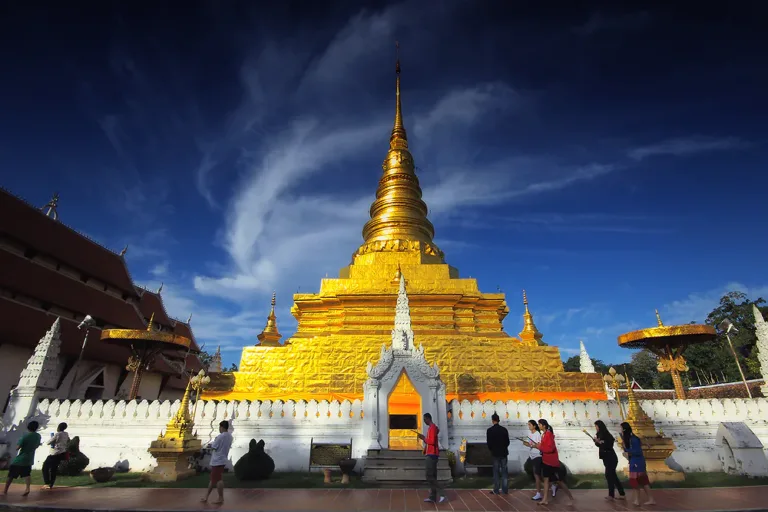
Wat Phra That Chae Haeng, a royal temple, stands on Doi Phu Phiang Chae Haeng at Ban Nong Tao, Moo 3, Muang Tuet subdistrict, Phu Phiang district, on the east bank of the Nan River 2–3 km from Nan town — across the river bridge and along Highway 1168 toward Mae Charim. In rituals the chedi is called Phra Maha That Chao Phu Phiang Chae Haeng, and in Lanna belief it is the relic shrine for those born in the Year of the Rabbit.
Legend says the Buddha came to the bank of the Nan River, where Phraya Monlarat offered him a dried myrobalan; he soaked it (chae) before eating and prophesied that relics would one day rest here — hence "Chae Haeng". A chronicle variant ties the name to logs soaked in a stream until it ran dry; both are folk tales.
Phaya Kan Mueang, a Phukha-dynasty ruler of Mueang Pua (Wora Nakhon), went to help King Lithai of Sukhothai build Wat Luang Aphai (Wat Pa Mamuang). In return Lithai gave him seven Buddha relics with 20 gold and 20 silver votive tablets, a sign of friendship between Sukhothai and Nan.
After consulting the senior monk Thammaban, Phaya Kan Mueang chose Doi Phu Phiang Chae Haeng for the relics. Khaosod's Technology Chaoban says he cast a large bronze reliquary, sealed it in lime mortar, buried it a wa deep and built a brick chedi one wa high over it.
Founding dates vary. Tourism copy often gives 1348 (BE 1891), but Nan province counts the chedi as 673 years old in 2026, matching construction in 1353 (BE 1896), which TopNews (25 Feb 2026) also states. The scholarly date of about 1359 (BE 1902) refers to the relic enshrinement and the move of the city, not the start of construction.
Around 1359 Phaya Kan Mueang moved his people from Wiang Pua to found Wiang Phu Phiang Chae Haeng, with the chedi at its centre on the highest point of the walled town. Earth dug for the walls and chedi became Nong Tao pond, which gave Ban Nong Tao its name, and in 2023 the town's 670th anniversary was celebrated.
In 1368, after a drought, his son Phaya Phakong moved the city across to the west bank of the Nan River at Ban Huai Khrai, the site of today's Nan. Phra That Chae Haeng thus marks Nan's early capital, which lasted only about a decade.
Later, Thao Kha Kan, who ruled Nan for about five years around 1474–80, rediscovered the relics and built a chedi six wa high over them, according to Kannika Wimonkasem's 2024 study of the chronicles.
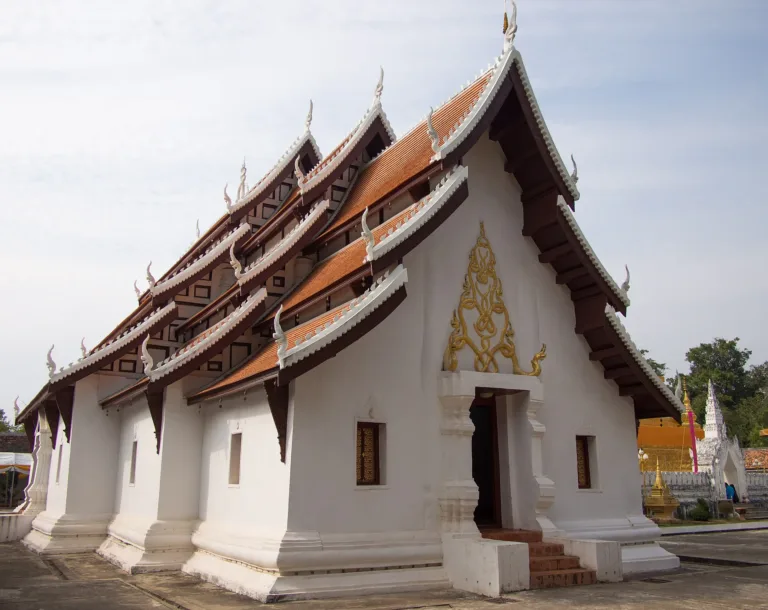
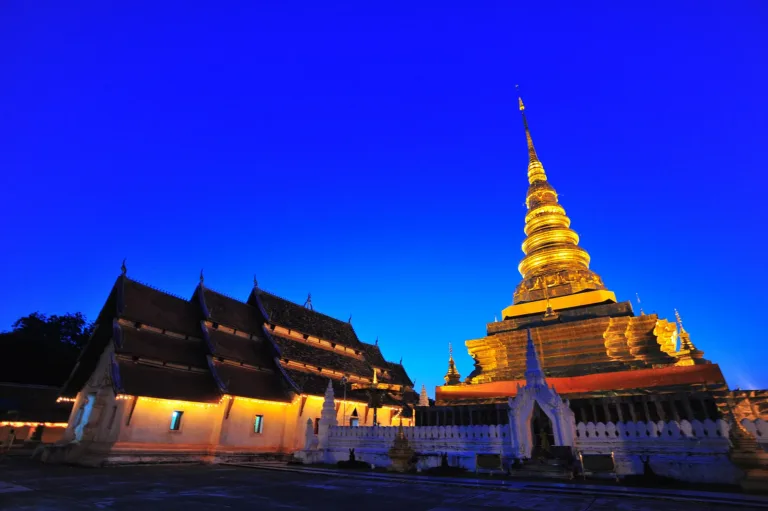
The great viharn was rebuilt on the orders of Chao Fa Sawatthi, ruler of Chiang Mai under Burmese rule, with Nan's ruler Phaya No Kham Chai Sathian Songkhram overseeing the work. The chronicles say timber was gathered in 1581, the old viharn taken down by 1584, the new one built in 1585 according to an inscription, and completed around 1588; the inscription was found behind the viharn and moved to Chiang Mai in 1988.
Khaosod says a major restoration around 1610 encased the old chedi in a larger one clad in brass-copper and added inner and outer walls, which fits Thai Post's note that the present form is Lanna style from later restorations.
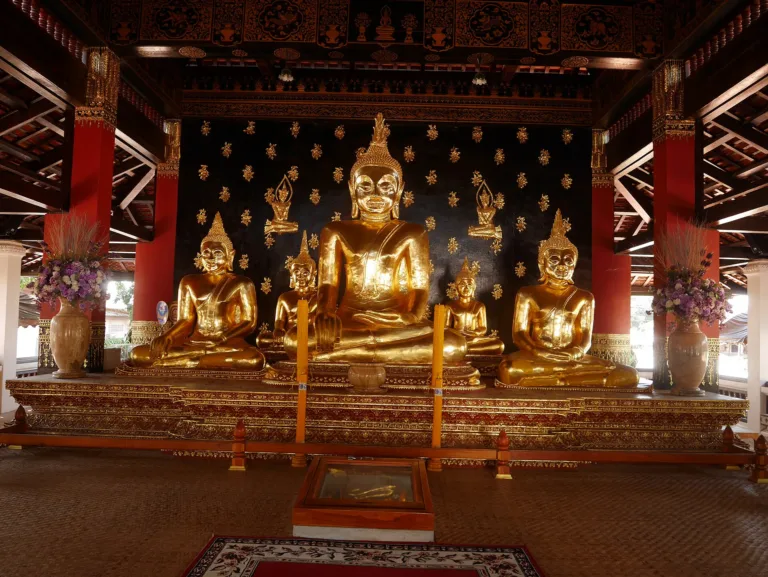
In 1790 Chao Atthawarapanyo, Nan's first ruler under the Rattanakosin kingdom, and his family commissioned a life-size wooden Buddha subduing Mara from craftsman Mun Si Sapphachang, with an inscription in Lanna Dhamma script on its base. The viharn's principal image is Phra Chao Lan Thong, and the temple also has Phra Chao Un Mueang, Phra Chao Than Jai and a reclining-Buddha hall.
The Bo Kaeo well, whose water is used in the temple's ceremonies, was dug in 1830 (BE 2373), according to two sources.
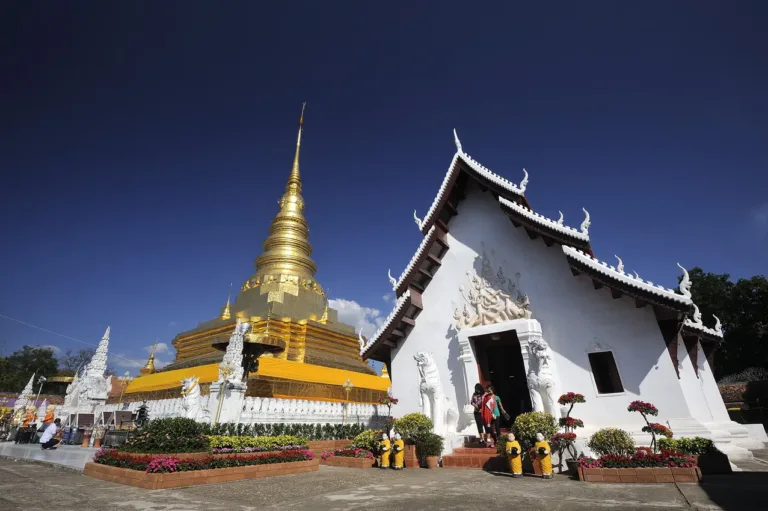
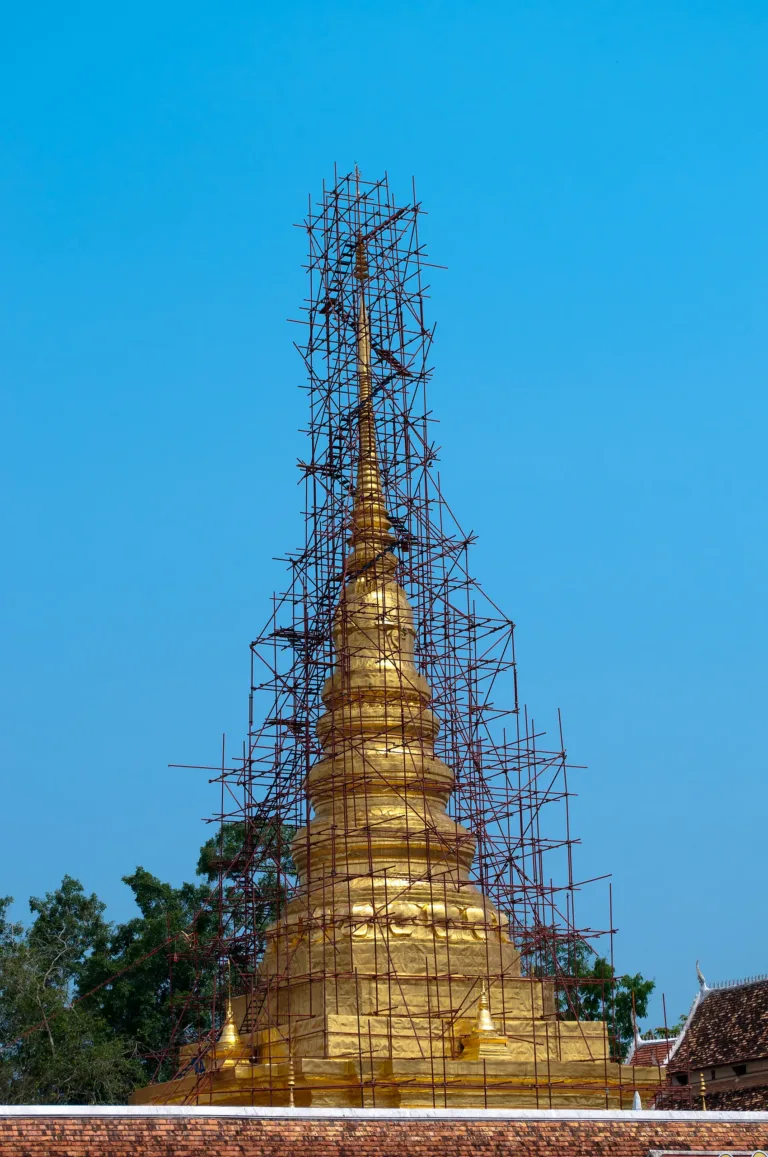
The chedi is a Lanna bell-shaped stupa modelled on Phra That Hariphunchai in Lamphun, clad in thong changko (a brass-copper alloy), not solid gold. Most sources give its height as 55.5 m on a 22.5 m square base, though Khaosod gives 43.49 m on a 19.25 m base.
The chedi's height is unsettled: sources give 55.5 m, 43.49 m, and one temple database "2 sen" (about 80 m). The Fine Arts Department gives no figure.
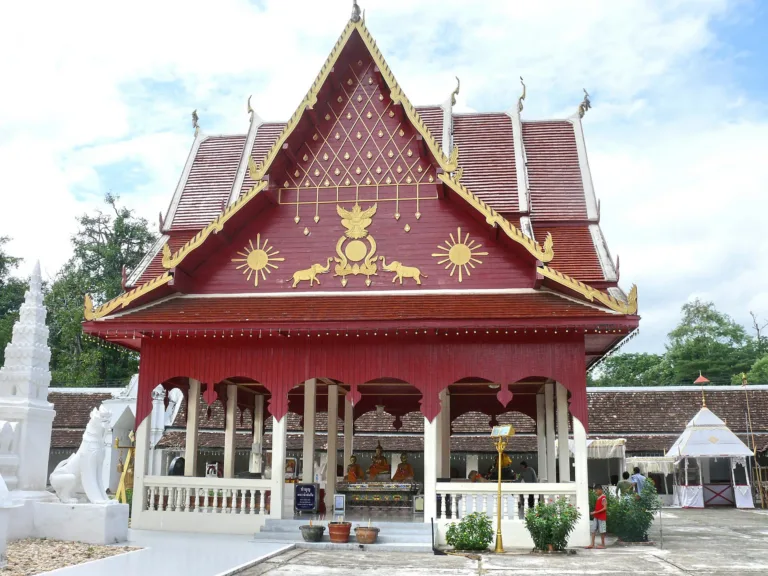
Twin naga balustrades climb the hill to the chedi, and the viharn's gable bears stucco intertwined nagas, a hallmark of Nan craftsmen. There are also satellite chedis at the base and corners, a white Burmese-style replica chedi and a Buddha-footprint hall.
The 24 March 2011 Tachileik earthquake cracked the chedi, and a later quake centred in Laos tilted the core of the spire and snapped the wire holding the umbrella. On 8 May 2023 a restoration billed as the biggest in 100 years was announced with Fine Arts Department approval, using 12 kg of gold for a new finial in the original design, which was raised on Sunday 3 September 2023.
An earthquake on 21 November 2019 damaged the top of the chedi. In December 2020 the Fine Arts Department set a restoration budget of 35,793,000 baht, paid by the temple, for structural repair, re-gilding, the walls and terrace, lightning protection and a new finial, leading on to the 2023 gold-finial project.
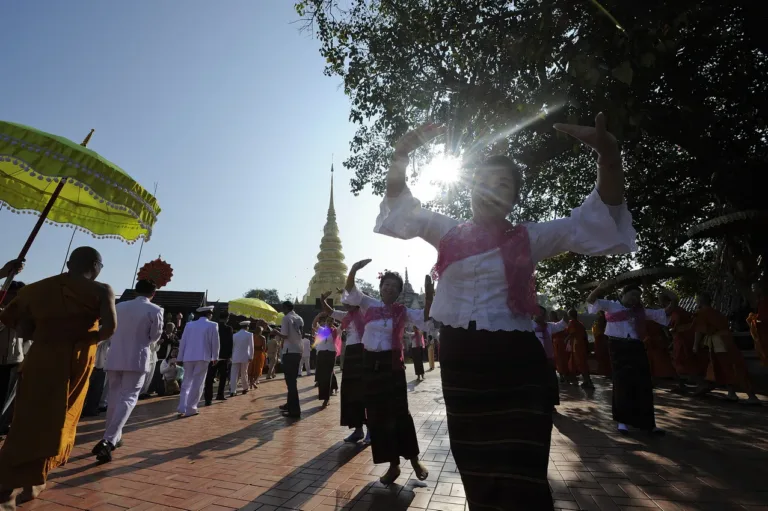
The main annual festival is Hok Peng, the worship of Phra That Chae Haeng on the 11th–15th waxing days of the northern sixth month, around late February to early March, with offerings processions from 15 districts, long-life rites, robing of the chedi, candlelit processions, drum contests and rockets. In 2025 it ran 7–13 March and launched Ban Nong Tao as a model community-tourism village.
The 2026 Hok Peng festival ran from 25 February to 3 March, opening on 25 February at 10:09. On 2 March came a procession of royal offerings, and on Makha Bucha day, 3 March, royally granted robes and sermon offerings from Princess Sirindhorn were presented.
On 14 March 2025 the abbot, Phra Ratchanantawatcharabandit (Thammawat Charanathammo), deputy head of the Nan Sangha, led a ceremony to begin a new pair of swan pillars and great banners (tung luang) to replace lost originals that old photographs show at the foot of the naga stairway.
People born in the Year of the Rabbit believe that paying respect at their birth-year chedi brings a smooth life, good health and career success. In 2023, a Rabbit year, TAT ran a "Rabbits down the Nan" campaign offering discounts on hotels and restaurants to Rabbit-year visitors.
Arrived? Check in, collect a stamp and tell others what it is like right now
Check your location first, so you do not fill in the form for nothing
Location must be on and within 1 km · One check-in per place per day · come back on other days to check in again
Post photos from anywhere — no need to be here · Up to 20 photos at a time · JPG / PNG / WebP · GPS location data is removed automatically
Good paved road
From town across the Nan River bridge · Fuel
From town · 80–150 baht
Cross the Nan River bridge and take Highway 1168 toward Mae Charim for 2–3 km
Parking at the foot of the hill and on the temple terrace
Good
About 06:00/07:00–18:00
around 3 km fromNan town
Wat Phra That Chae Haeng
0 THB
Approx. nightly price for 2 adults (next week) · final price depends on your dates
Answers travellers want before they go — a one-minute read
Legend says the Buddha soaked a dried myrobalan before eating it
The Year of the Rabbit
Around the mid-14th century under Phaya Kan Mueang; tourism sources often say 1348
It is clad in brass-copper; the 2023 finial used 12 kg of gold
About 55.5 m (one source says 43.49 m)
Hok Peng, 11th–15th waxing days of the northern sixth month, around Feb–Mar
About 06:00–18:00; free
Best day this week: Thursday 29 Oct · Check in when you arrive to collect a stamp