 01
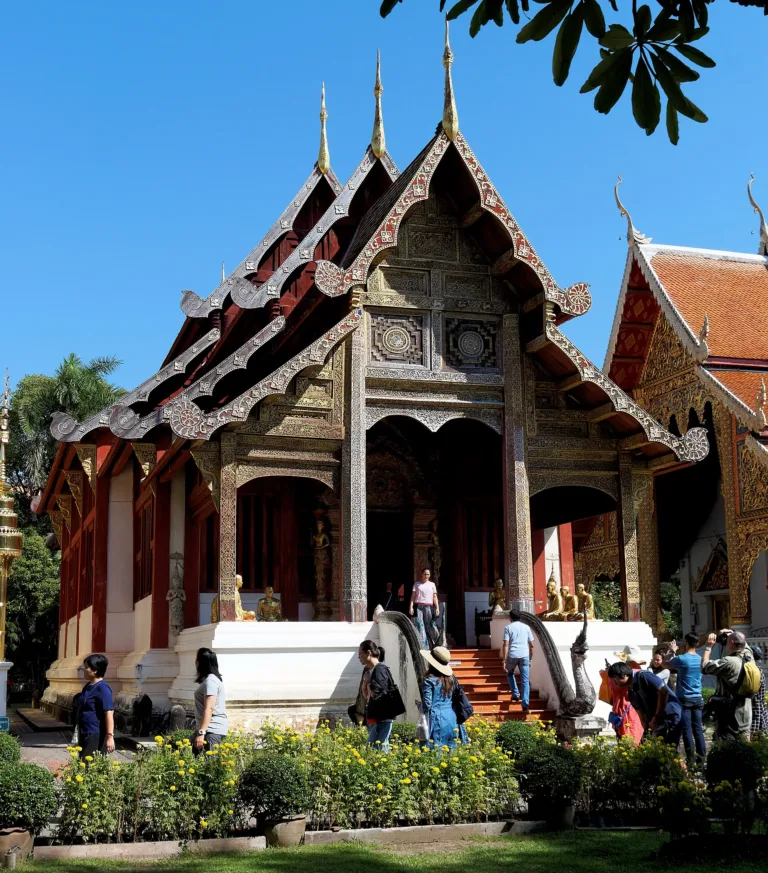
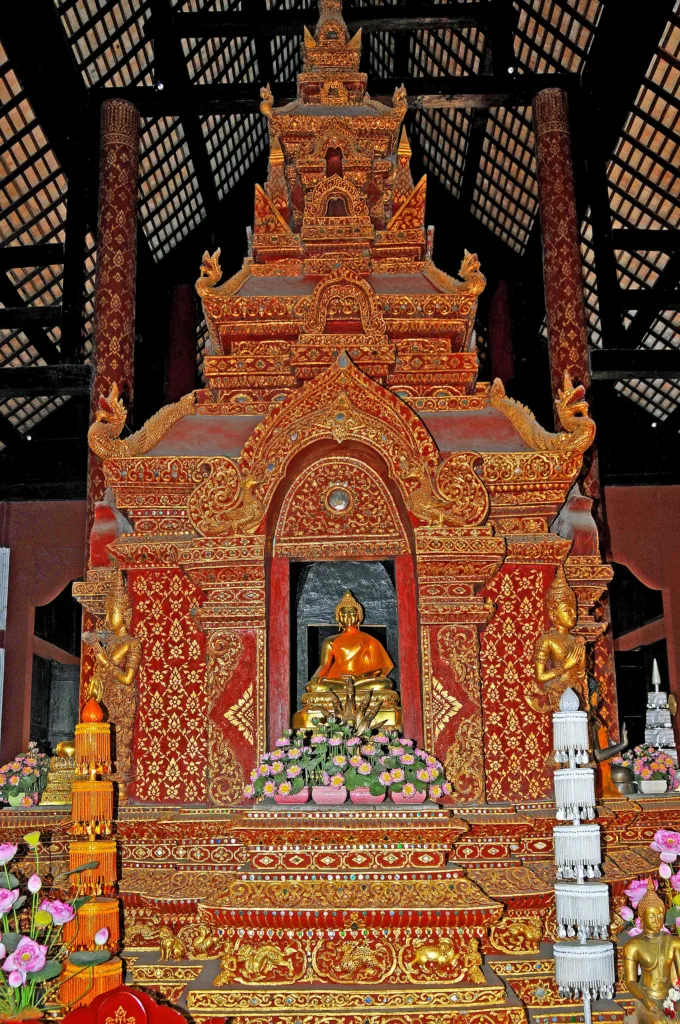
Viharn Lai KhamLanna hall of gold-on-red patterns housing the Phra Sihing
Royal temple in the old city · Chiang Mai
Chiang Mai’s royal temple of the Phra Sihing image, founded in 1345 — with the gilded Viharn Lai Kham, its 1860s murals of Lanna life, a library ringed by stucco deities and the Dragon-year chedi.
Holiday / event — crowded · Hot (Afternoon) feels like 38°C
Dress modestly, covering shoulders and knees · Remove shoes and hats before entering · No flash on the murals · Don’t point your feet at Buddha images
06:00–17:00
Before 09:00 for fewer people and soft light
Songkran, around 13 Apr: the Phra Sihing is paraded round the city and bathed at the temple
01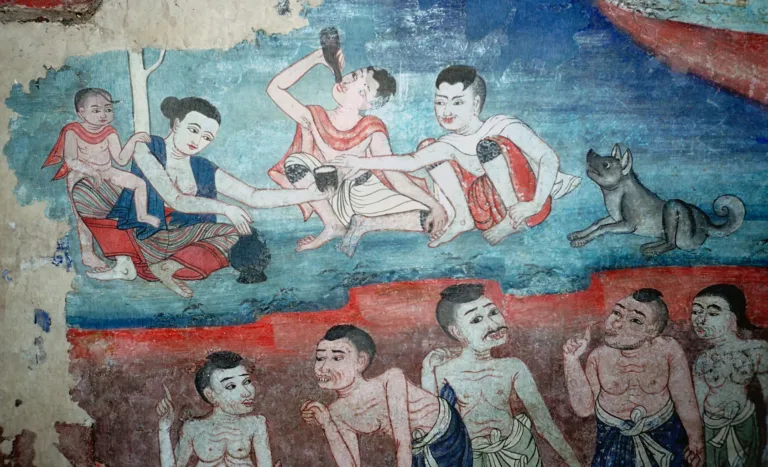 02
 03
 04
Tap a day card to see that day’s weather, rain, haze and hourly forecast
Best time to go Fine all day little rain through the day
Holiday — traffic on the way up and parking fills fast; leave early
Green band = hours used for the score
Best time to go Fine all day little rain through the day
Holiday — traffic on the way up and parking fills fast; leave early
Green band = hours used for the score
Best time to go Fine all day little rain through the day
Holiday — traffic on the way up and parking fills fast; leave early
Green band = hours used for the score
Best time to go Best window 06:00–15:00 Little rain · light drizzle possible at times
No warnings today — normal road and weather conditions
Green band = hours used for the score
Best time to go Best window 06:00–15:00 Little rain · light drizzle possible at times
No warnings today — normal road and weather conditions
Green band = hours used for the score
Best time to go Fine all day little rain through the day
No warnings today — normal road and weather conditions
Green band = hours used for the score
Best time to go Fine all day little rain through the day
No warnings today — normal road and weather conditions
Green band = hours used for the score
Wat Phra Singh Woramahawihan, inside Chiang Mai’s old city: home of the Phra Phuttha Sihing and some of Lanna’s finest art.
Arrive Before 09:00 for fewer people and soft light
Photos from Wikimedia Commons and contributors · full credits inClassic page
Cover shoulders and knees; remove shoes before entering halls
No flash photography of the Lai Kham murals
Parts of the ubosot are traditionally restricted; check the signs
Adults 0 THB · Time needed 1–1.5 hours
10:30–14:00, Nov–Feb and Songkran
| Viharn Lai Kham donation, foreign visitors optional | 20 ฿/person |
Cash / donation boxes · Prices may change by season — check with the venue
Songkran, around 13 Apr: the Phra Sihing is paraded round the city and bathed at the temple
Tap a month on the wheel to see weather, rain, haze and crowds from 10 years of records
Best time · Nov–Feb is cool and pleasant for walking the old city; Songkran brings the Phra Sihing procession
Watch out · Mar–Apr thick haze and heat · 10:30–14:00 on holidays is crowded and hot
Oct by the records 22–29°C · avg rain 179 mm (18 rainy days) · clear 8 days · avg PM2.5 15
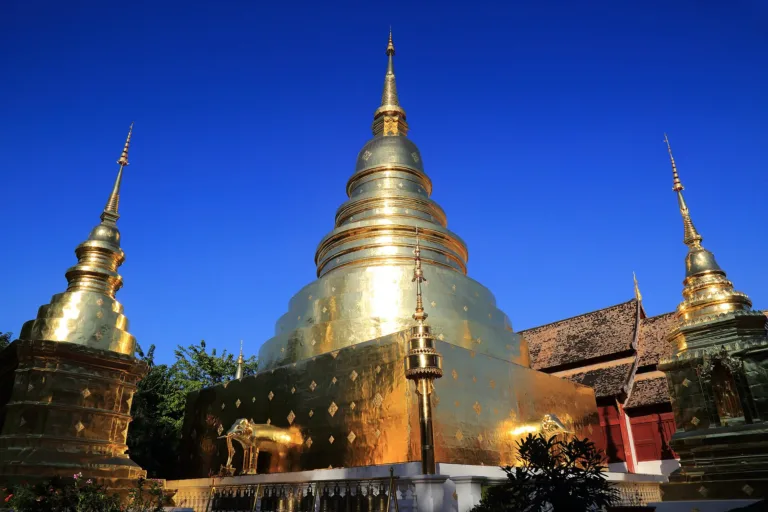
Wat Phra Singh Woramahawihan stands at the western end of Ratchadamnoen Road inside Chiang Mai's moat, in Phra Sing subdistrict. It is a first-class royal temple of the Woramahawihan grade in the Maha Nikaya order, and one of the most important temples in Lanna because it houses the Phra Phuttha Sihing, or "Phra Singh", the city's guardian Buddha image. The compound holds the Viharn Lai Kham, counted among the most beautiful Lanna viharns, murals showing Lanna life about 160 years ago, and a scripture library ringed with stucco deities.
The temple was founded in 1345 by King Phayu, fifth king of the Mangrai dynasty. The first structure was a 23-wa chedi for the ashes of his father, King Khamfu, brought from Chiang Saen. Two years later came a viharn, sermon hall, scripture library and monks' quarters, and the monk Phra Aphai Chula Mahathera was invited from Hariphunchai as the first abbot — a move scholars see as shifting the centre of northern Buddhism to Chiang Mai. The temple was first called Wat Li Chiang Phra, because it stood by the central market; "li" means market in Lanna. As for King Khamfu, the Chiang Mai Chronicle says he died when attacked by a "ngueak" — an old Lanna word for a crocodile — while bathing in a river.
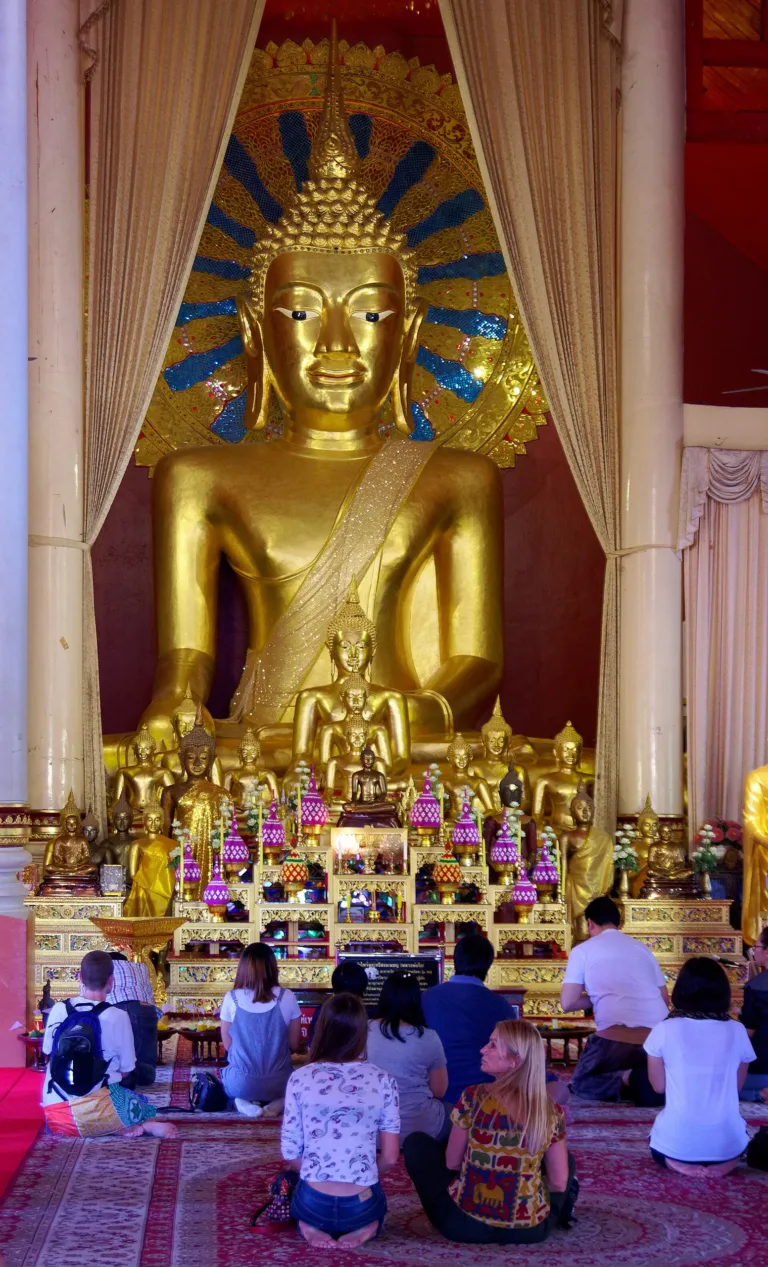
According to the Sihinga Nidana legend, the Phra Phuttha Sihing was made in Sri Lanka around 157 CE by three Sri Lankan kings and arahants, with a naga who had seen the Buddha taking his form as the model. From Sri Lanka it travelled to Sukhothai under King Ramkhamhaeng, then on to Phitsanulok, Ayutthaya, Kamphaeng Phet and Chiang Rai, until in 1400 Maha Phrom, ruler of Chiang Rai, presented it to King Saen Mueang Ma, the seventh Mangrai king, who enshrined it at Wat Li Chiang Phra. From then on people called the temple Wat Phra Singh. The legend was set down in Pali as the Sihinga Nidana by the Lanna monk Bodhiransi before 1442, and also appears in the Jinakalamali and the Yonok Chronicle, which give differing dates; some sources place the image's arrival in Chiang Mai in 1407.
Despite the legend, the Chiang Mai image is a bronze, lacquered and gilded Buddha seated in the "diamond" cross-legged posture subduing Mara, about 79 cm high with a lap about 63 cm wide, in the Lanna "Singh Nueng" or Chiang Saen Singh Nueng style — full-bodied and broad-chested, with a short robe flap above the chest. Art historians therefore believe it was cast in Lanna around the 14th century. Asst. Prof. Dr. Sakchai Saisingh argues that diamond-posture images of this kind originated in Lanna and that the name "Phra Singh" probably came from this Lanna group; key evidence is a diamond-posture Buddha at Wat Phra Chao Mengrai in Chiang Mai, inscribed in 1470 and calling itself "Phra Phuttha Sihing". Prince Subhadradis Diskul suggested the Sri Lankan original may have been lost and replaced, or the legend invented to add prestige. Two explanations are offered for the name: the lion-like bearing of the figure, or a Mon word meaning "delightful". Three Phra Sihing images are especially revered today: at the Phutthaisawan Throne Hall in Bangkok (seated in the ordinary cross-legged posture), at the Ho Phra Phuttha Sihing in Nakhon Si Thammarat, and here at Wat Phra Singh.
According to the chronicles, the Phra Sihing was taken out of Chiang Mai more than once. Most notably, King Narai of Ayutthaya captured Chiang Mai around 1662 and enshrined the image in his palace at Ayutthaya (some accounts say at Wat Phra Si Sanphet), where it stayed about 105 years; a copied inscription dated 1758 at Wat Phra Thaen Sila At in Uttaradit records that the Ayutthayan army "fought Chiang Mai and obtained the Phra Phuttha Sihing". After Ayutthaya fell in 1767 the image is recorded as returning to Chiang Mai, and in 1795 the Front Palace Viceroy Maha Sura Singhanat took a Phra Sihing image from Chiang Mai to Bangkok — the one now in the Phutthaisawan Throne Hall. Some scholars, however, say there is no firm evidence that the Bangkok image came from Chiang Mai, so which image is the "original" remains unsettled.
From 1558 until about 1774 Chiang Mai was under Burmese rule for nearly two centuries. After the Burmese were driven out the city lay abandoned until Phra Chao Kawila resettled it in 1796. Most temples were in ruins, so Kawila, founder of the Thipchak dynasty, began restoring Wat Phra Singh and built the front scripture library in 1811.
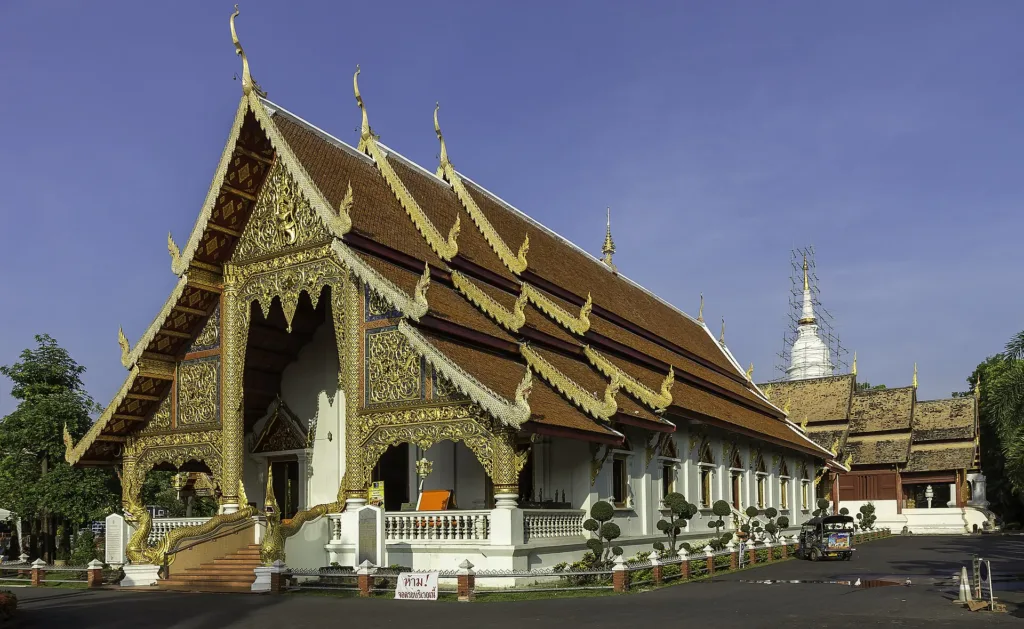
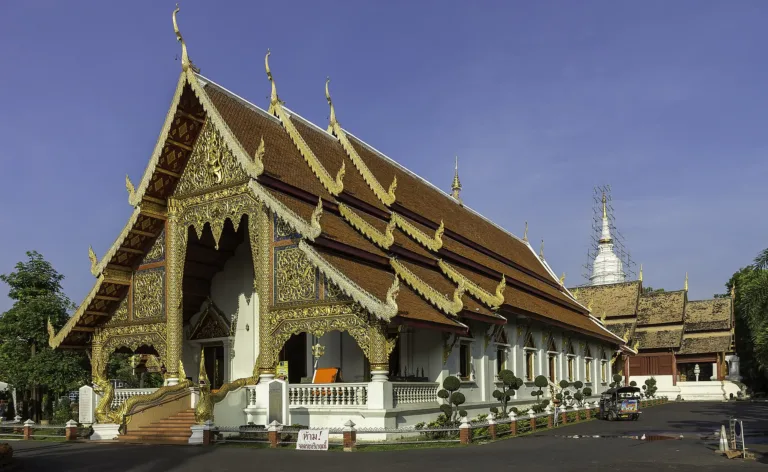
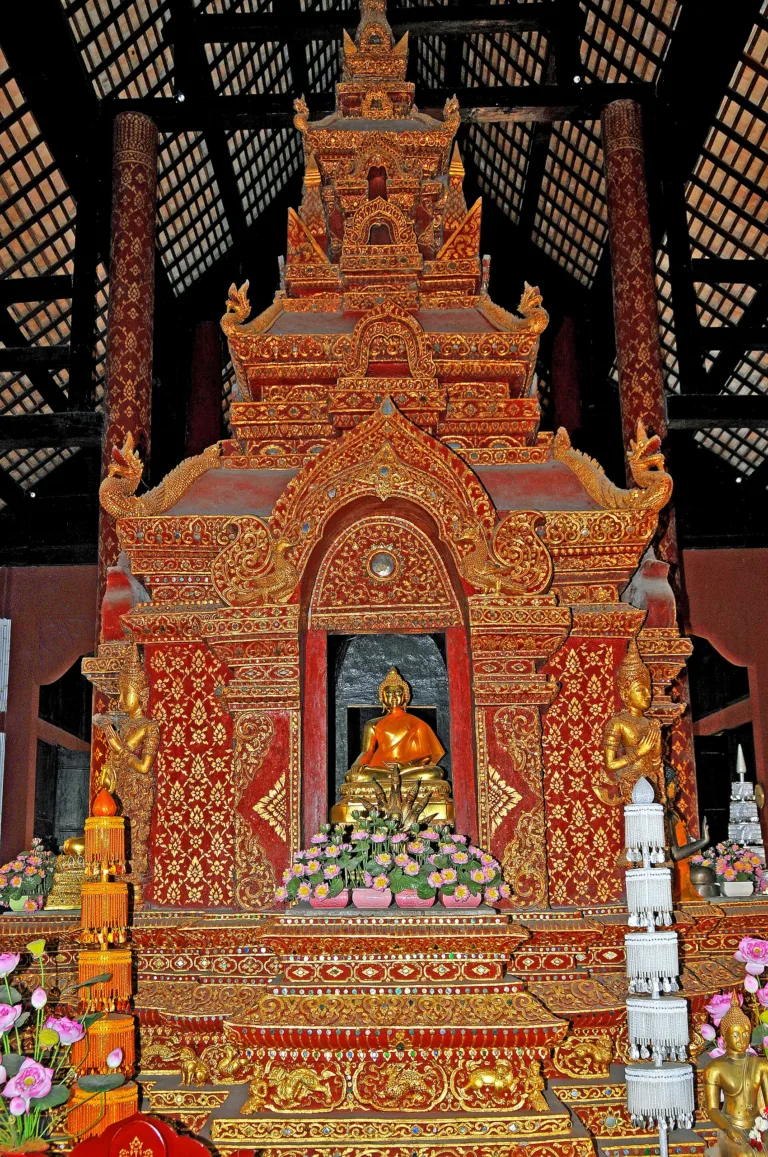
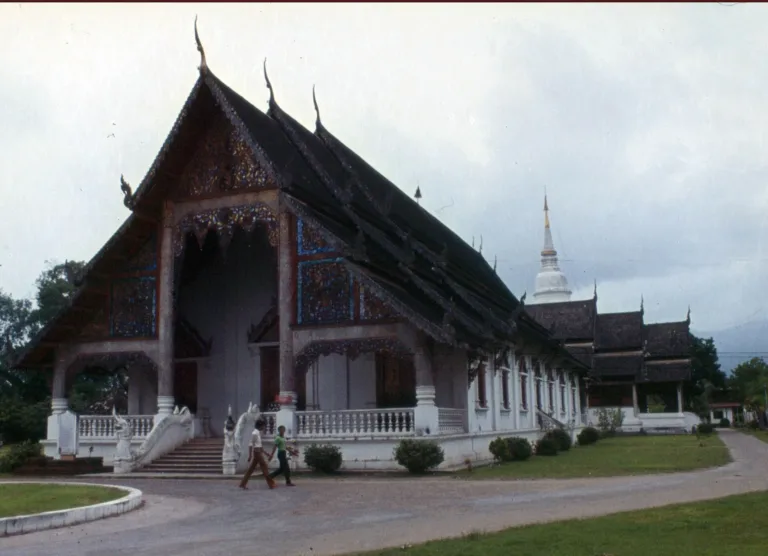
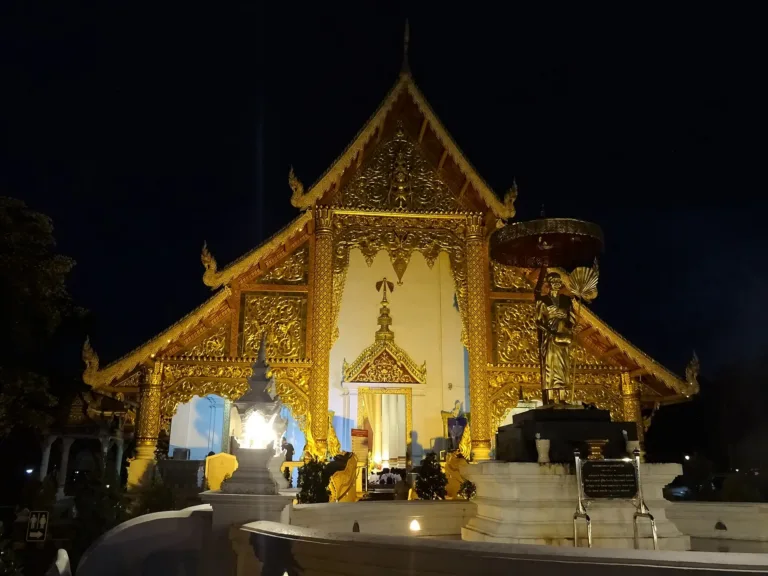
The Viharn Lai Kham is the building most visitors come to see. Tradition says a viharn stood here from 1518, in Lanna's golden age, but the present building dates from the 19th century; some sources date its rebuilding to 1815–1821 under Phraya Thammalangka, the second ruler of Chiang Mai. "Lai kham" means gold-leaf patterns on red lacquer, here covering the wall behind the main image, the pillars and the rear wall with shrine-pavilions, dragons, phoenixes and Chinese-style clouds; when sunlight enters, the whole hall glows gold. The viharn faces east, with a naga stair and a pair of stucco lions; old photographs show its roof was once more steeply tiered than today.
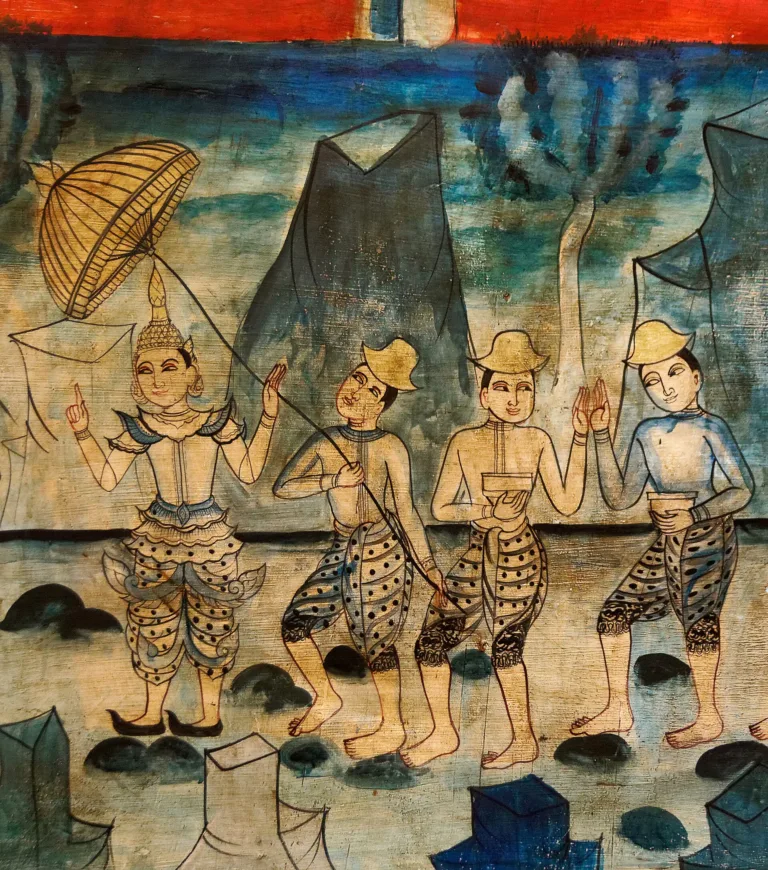
The murals in the Viharn Lai Kham were probably painted during its restoration under Chao Kawilorot Suriyawong, around 1863, in powder pigments by two painters whom the ruler had sent to study painting in Siam and Burma. Jek Seng, a local painter of Chinese descent, painted the Sang Thong story, while Nan Photha painted Suwannahong in the Bangkok Rattanakosin manner. Both tales come from the Pannasa Jataka rather than Lanna literature, so scholars think Chao Kawilorot, who had lived in Bangkok, was inspired by literary murals at temples such as Wat Suthat. The innermost wall shows the Buddhas of the past, with rows of deities above the narrative scenes.
What makes these murals precious is the everyday life woven into the stories: a Lanna woman carrying water, courting couples, a bare-chested woman smoking, a man showing off his tattooed legs, a drinking circle. Clothing ranges from Lanna, Burmese and Shan to Central Thai, alongside modern objects such as blue-and-white porcelain and lamps. Jek Seng is believed to have painted himself on the frame of the central north window — a young man in a hat with a long thin beard, sitting with knees raised. His Sang Thong is the only surviving work of the Chiang Mai school, and Silpa Bhirasri said the paintings make viewers feel they are living in the real world of a century earlier.
Today the Phra Phuttha Sihing sits in the Viharn Lai Kham; it once stood in a shrine-pavilion at the back of the viharn. In 1921 (some sources say 1922) thieves cut off the original head, so the head seen today is a replacement, and the image closest to the original's appearance is in the Chiang Mai National Museum.
In 1924–1925 Khruba Siwichai, the revered monk of Lanna who was acting abbot in 1924, dismantled the old cruciform viharn, too decayed to repair, and built the present Viharn Luang with an all-teak roof frame, blending Rattanakosin and Lanna styles. Its gable shows Vishnu on Garuda and a tiger, the zodiac animal of Khruba Siwichai's birth year, and inside sits the Phra Si Sanphet, a large stucco Buddha believed to be the old viharn's principal image. During the 1926 renovation an urn holding King Khamfu's ashes was found; it was taken to the old provincial hall and later disappeared.
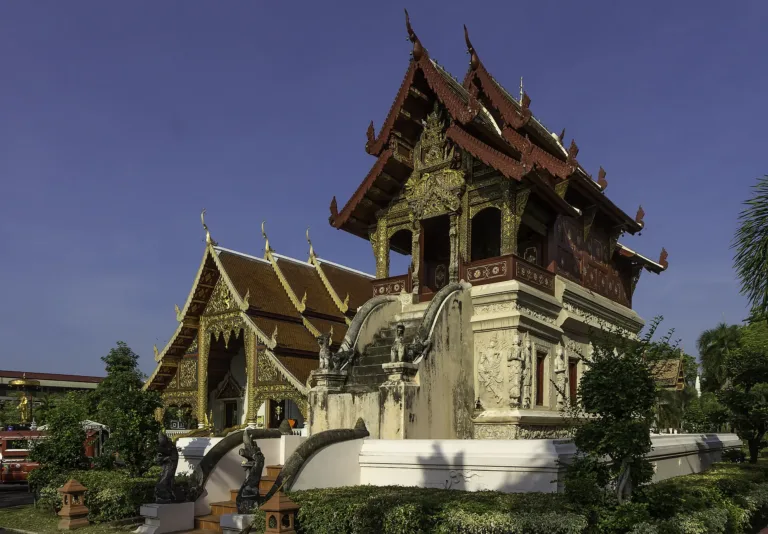
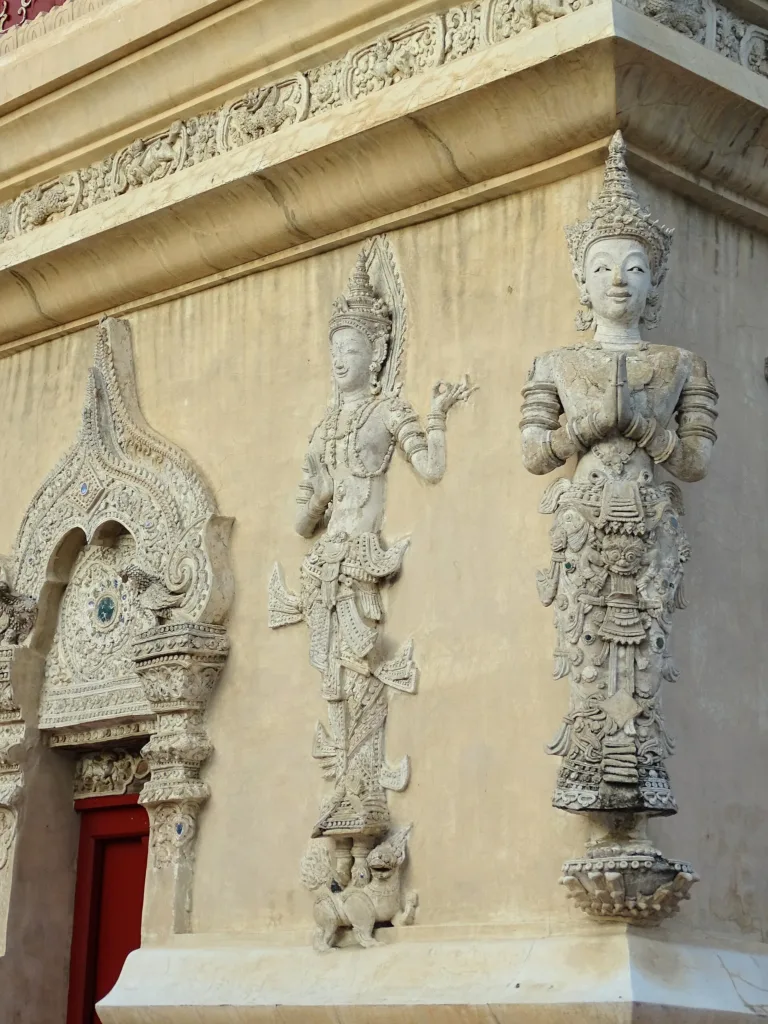
Wat Phra Singh has two scripture libraries — the first temple in Chiang Mai to have two. The front library, built by Kawila in 1811, has a high masonry base and an upper storey of wood decorated with gilt lacquer and glass; around the base stand stucco deities with palms joined, alternating with animals, as guardians of the Dhamma, making it one of the finest libraries in the north. The second, the "new Dhamma hall" north-west of the chedi, is a two-storey concrete building built by Luang Anusarn Sunthon and his wife as a gift to Khruba Siwichai together with a monk's residence; the residence has since collapsed, leaving only the library. Another account, from Thailand's environmental policy office, attributes the stucco deities around the library to craftsmen of King Mueang Kaeo's reign in the early 16th century, Lanna's artistic golden age, and records that Chao Kaeo Nawarat repaired the library base around 1933.
The main gilded bell-shaped chedi on its square base is one of the oldest bell-shaped chedis in central Chiang Mai, and in Lanna belief it is the relic chedi for those born in the Year of the Dragon, who come to pay respects. Nearby are a mondop-style chedi and the ruins of a chedi where bones believed to be King Khamfu's were found. The ubosot behind the Viharn Luang marks its boundary with stone posts instead of sema leaves, and its principal Buddha sits in a central shrine so it can be worshipped from both sides — a layout whose reason is still debated.
Wat Phra Singh was registered as an ancient monument in the Royal Gazette on 8 March 1935 and raised to a first-class royal temple of the Woramahawihan grade on 23 November 1940 (some sources say it became a royal temple in 1935 under King Rama VIII). It has had 14 abbots since its founding; the current abbot, Phra Thep Singhawarachan (Sophon Sophano), has served since 2009. The temple is also among the Chiang Mai heritage sites being put forward for World Heritage listing.
The temple is an important store of Lanna palm-leaf manuscripts in its two libraries. Together with Chiang Mai University's Faculty of Social Sciences and private partners it has surveyed and conserved the manuscripts, among them the Lokavinai written by Khruba Siwichai, and held seminars on 19 March 2025 and 24 March 2026, the latter marking 100 years since Khruba Siwichai's great restoration.
Every Songkran, around 13 April, the Phra Phuttha Sihing is carried on a bussabok through the streets of Chiang Mai so people can pour water and make wishes for the Lanna New Year, before returning to the temple where devotees continue to bathe it — one of the city's most important merit-making festivals.
Arrived? Check in, collect a stamp and tell others what it is like right now
Check your location first, so you do not fill in the form for nothing
Location must be on and within 0.2 km · One check-in per place per day · come back on other days to check in again
Post photos from anywhere — no need to be here · Up to 20 photos at a time · JPG / PNG / WebP · GPS location data is removed automatically
Inside Chiang Mai’s moat at the western end of Ratchadamnoen…
From Tha Phae Gate along Ratchadamnoen, about 1.2 km · Free
City red truck, ask for Wat Phra Singh · By distance
From your hotel in town · By distance
Into the moat, park in private lots on Samlan Road · Parking fee
At the western end of Ratchadamnoen Road inside the moat, by Singharat and Samlan roads
Little parking inside; private paid lots on Samlan Road fill by late morning in the cool season
City centre; fuel stations around the moat
4G/5G on all networks
06:00–17:00
around 1.2 km fromTha Phae Gate
Wat Phra Singh Woramahawihan
Approx. nightly price for 2 adults (next week) · final price depends on your dates
Answers travellers want before they go — a one-minute read
In 1345 by King Phayu, first called Wat Li Chiang Phra
In 1400, under King Saen Mueang Ma
Jek Seng painted Sang Thong and Nan Photha painted Suwannahong, around 1863
The Year of the Dragon
Kawila built the first in 1811; the second was built as a gift to Khruba Siwichai
Cover shoulders and knees, and remove shoes before entering halls
Best day this week: Thursday 29 Oct · Check in when you arrive to collect a stamp