 01
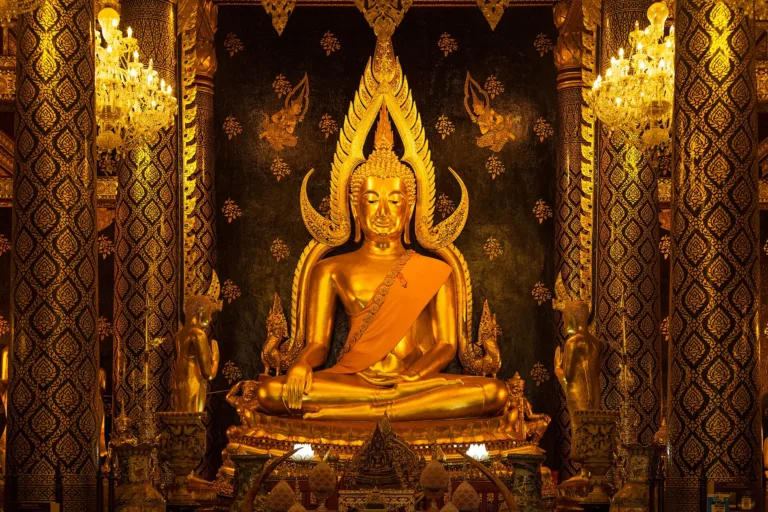
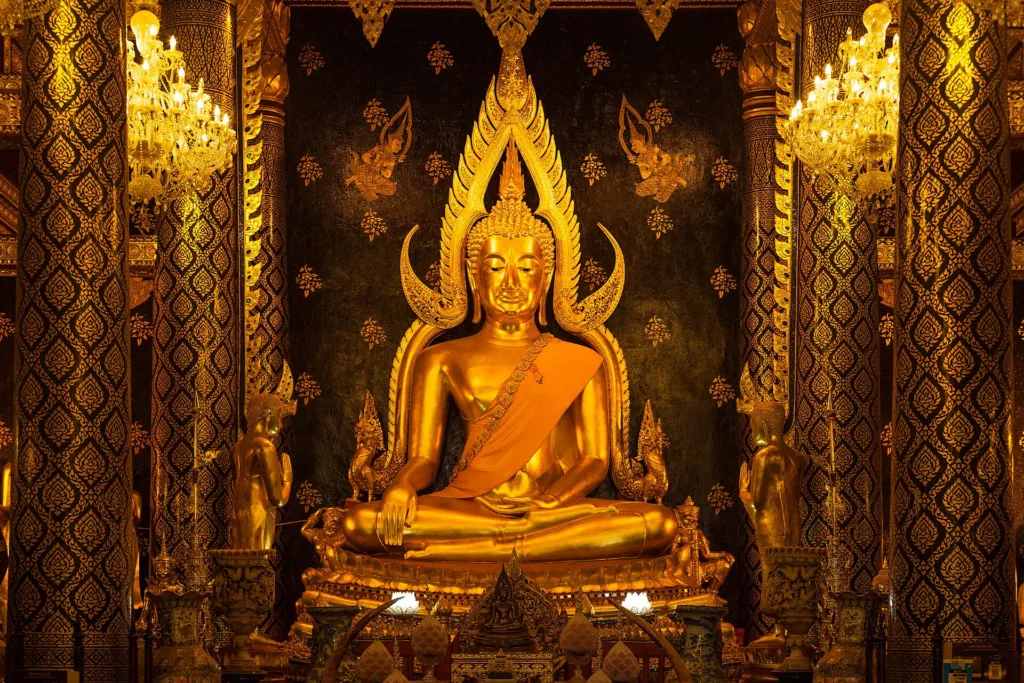
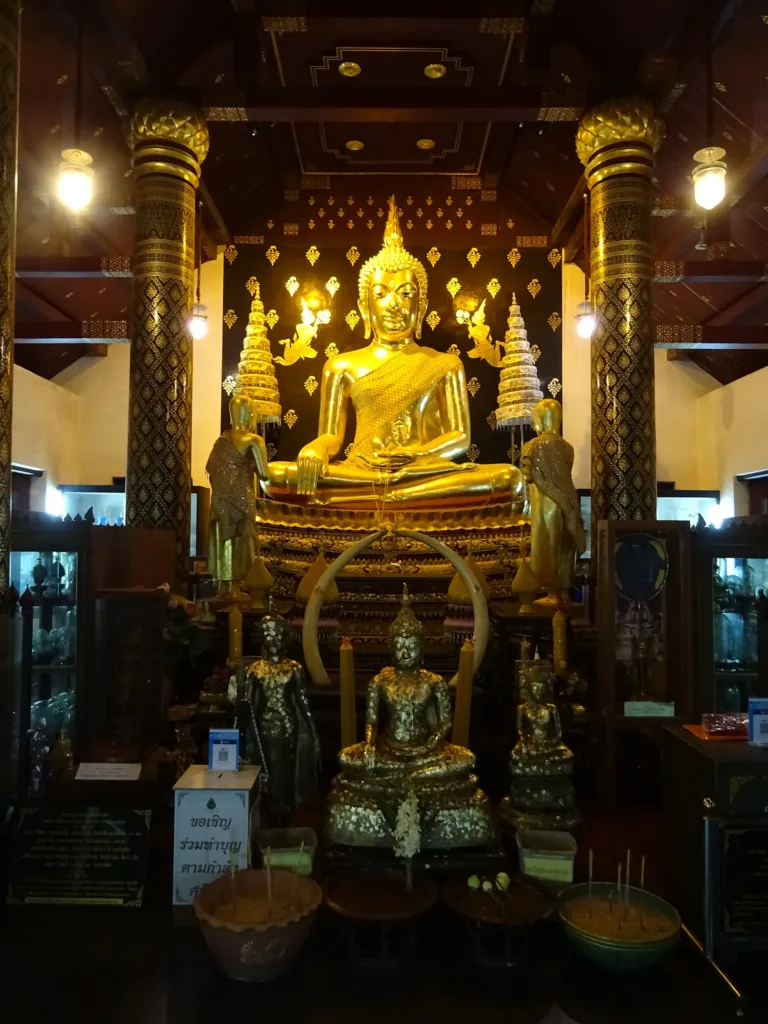
Phra Phuttha ChinnaratBronze subduing-Mara image, c. 1357
PHITSANULOK · MUEANG
Phitsanulok’s great riverside temple, founded around 1357 and home to Phra Phuttha Chinnarat, one of Thailand’s most beautiful Buddha images
Holiday / event — crowded · Hot (Afternoon) feels like 40°C
Temple daily 06:30–18:00 · Museum Wed–Sun 08:30–16:00 (closed Mon–Tue and public holidays)
Arrive before 08:00 for fewer crowds and calm worship
Phra Phuttha Chinnarat festival (6th–12th waxing days of the 3rd lunar month, early Feb) · Nan River long-boat races (early Oct)
01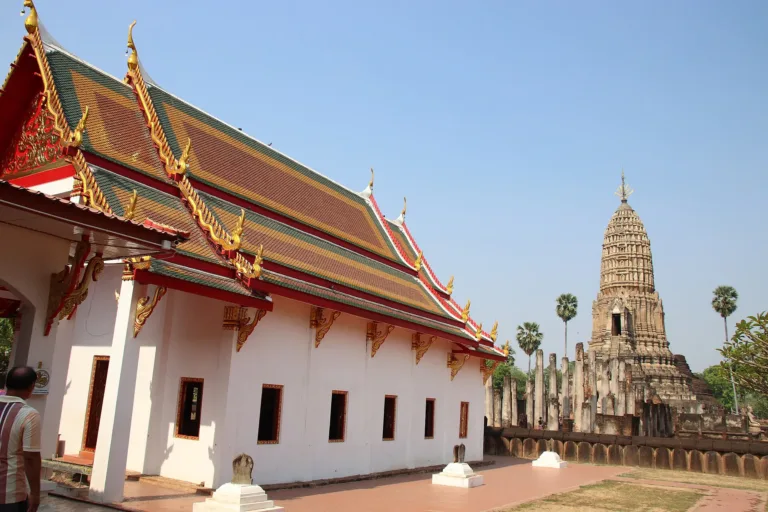 02
 03
 04
 05
Tap a day card to see that day’s weather, rain, haze and hourly forecast
Best time to go Fine all day little rain through the day
Holiday — traffic on the way up and parking fills fast; leave early
Green band = hours used for the score
Best time to go Fine all day little rain through the day
Holiday — traffic on the way up and parking fills fast; leave early
Green band = hours used for the score
Best time to go Fine all day little rain through the day
Holiday — traffic on the way up and parking fills fast; leave early
Green band = hours used for the score
Best time to go Best window 06:00–14:00 Little rain · light drizzle possible at times
No warnings today — normal road and weather conditions
Green band = hours used for the score
Best time to go Best window 06:00–14:00 Little rain · light drizzle possible at times
No warnings today — normal road and weather conditions
Green band = hours used for the score
Best time to go Fine all day little rain through the day
No warnings today — normal road and weather conditions
Green band = hours used for the score
Best time to go Fine all day little rain through the day
No warnings today — normal road and weather conditions
Green band = hours used for the score
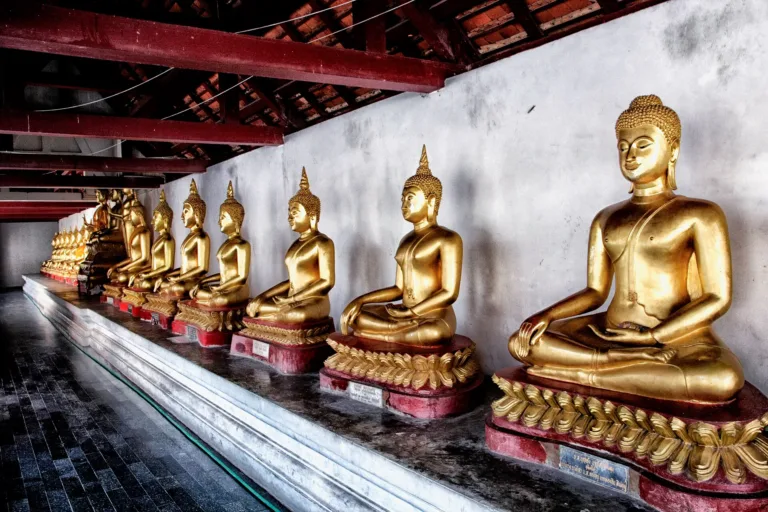
Wat Phra Si Rattana Mahathat, or Wat Yai, stands on the Nan River in Phitsanulok. Founded around 1357, it houses Phra Phuttha Chinnarat in a Sukhothai-style vihara with mother-of-pearl doors dated 1756.
Kings from Ayutthaya to Bangkok revered the image; Rama V had a replica cast for Wat Benchamabophit rather than take the original from Phitsanulok.
Photos from Wikimedia Commons and contributors · full credits inClassic page
Wear sleeved tops and clothing covering the knees
The vihara is packed late morning and on holidays; watch your belongings
Remove shoes before entering the vihara
Temple parking fills fast during the annual festival
Adults 0 THB · Car 0 THB · Time needed 1–2 hours
Long weekends, major Buddhist holy days and the festival in early February
| Temple entry | Free |
| Offerings / flowers and incense optional | Pay as you like |
Mainly cash; some shops take transfers · Prices may change by season — check with the venue
Phra Phuttha Chinnarat festival (6th–12th waxing days of the 3rd lunar month, early Feb) · Nan River long-boat races (early Oct)
Tap a month on the wheel to see weather, rain, haze and crowds from 10 years of records
Best time · Nov – Feb: cool and pleasant; the annual festival in early February is lively; come early morning for quiet worship
Watch out · Long weekends and late morning to afternoon are very crowded; Mar – May is very hot
Oct by the records 24–31°C · avg rain 190 mm (21 rainy days) · clear 7 days · avg PM2.5 11
Wat Phra Si Rattana Mahathat Woramahawihan, known locally as “Wat Yai” (the Big Temple), stands on the east bank of the Nan River on Phutthabucha Road, opposite Phitsanulok’s provincial hall. It is a first-class royal temple of the Woramahawihan grade covering about 36 rai, and it houses Phra Phuttha Chinnarat, widely regarded as one of the most beautiful Buddha images in Thailand.
By the generally accepted account, the temple was built around 1357 (B.E. 1900) under King Maha Thammaracha I (Lithai) of Sukhothai. The Northern Chronicle tells it differently, crediting King Si Thammatraipidok of Chiang Saen with founding Phitsanulok and casting its three great images; Prince Damrong Rajanubhab concluded that this legendary king was in fact Lithai.
The oldest account of Phra Phuttha Chinnarat is in the Northern Chronicle, compiled late in Rama I’s reign (around 1807) by Phra Wichian Pricha (Noi) from older northern texts. It tells how King Si Thammatraipidok of Chiang Saen marched on Sajjanalai, ruled by King Phasuchararat, until the monk Phutthakhosachan made peace; Phasuchararat gave his daughter Pathumthewi as queen. The king then founded a new city where the Buddha was believed to have eaten beneath a samo tree — Phitsanulok — built a stupa and viharas, and had craftsmen from Sajjanalai and Haripunchai cast the three images, the legend dating the casting to B.E. 1500. In 1866 King Mongkut wrote a new account of the three images, stressing that they were made by Siamese craftsmen from Sawankhalok.
Legend says the king ordered three images cast as principal Buddhas for three viharas. Phra Phuttha Chinnasi and Phra Si Satsada came out well, but Phra Phuttha Chinnarat failed repeatedly until a mysterious white-clad old man, believed to be Indra in disguise, helped with the final casting; versions differ on whether it took three or four attempts. On style, Prince Damrong dated the image to around 1357 because it blends Sukhothai and Chiang Saen traits, while some scholars such as Pichaya Sumchinda have proposed a late Ayutthaya date; the prevailing view still follows Damrong.
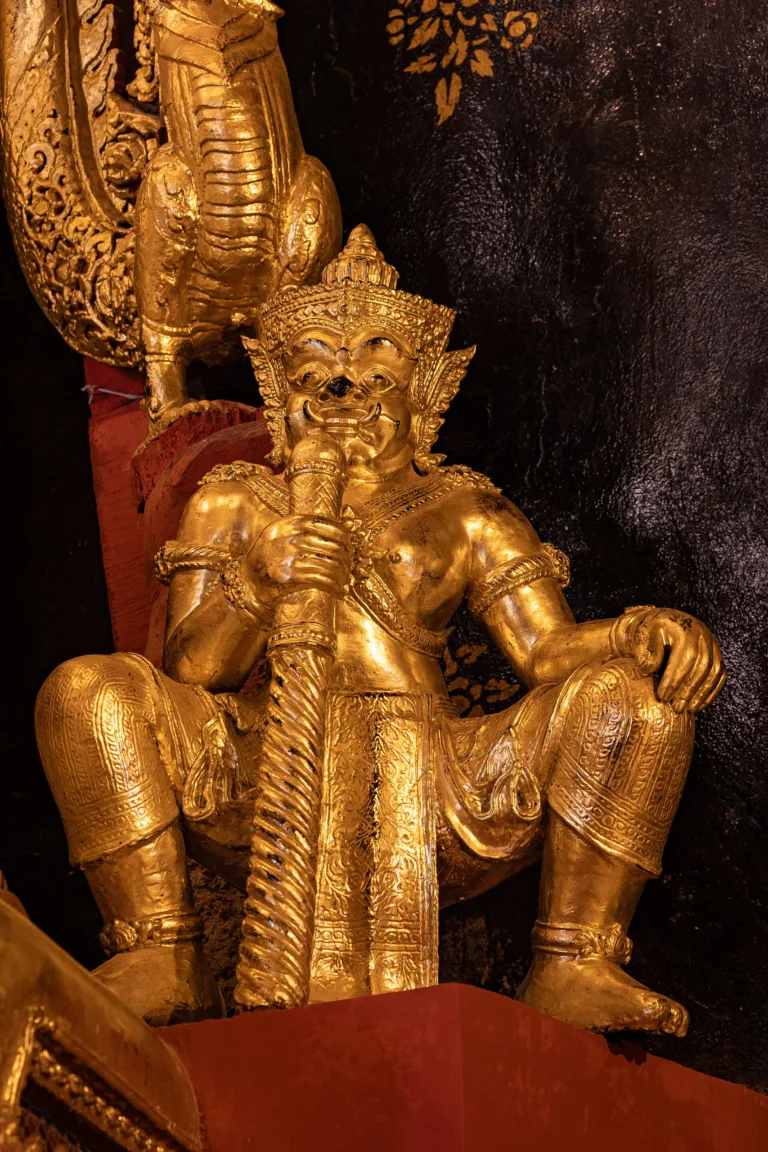
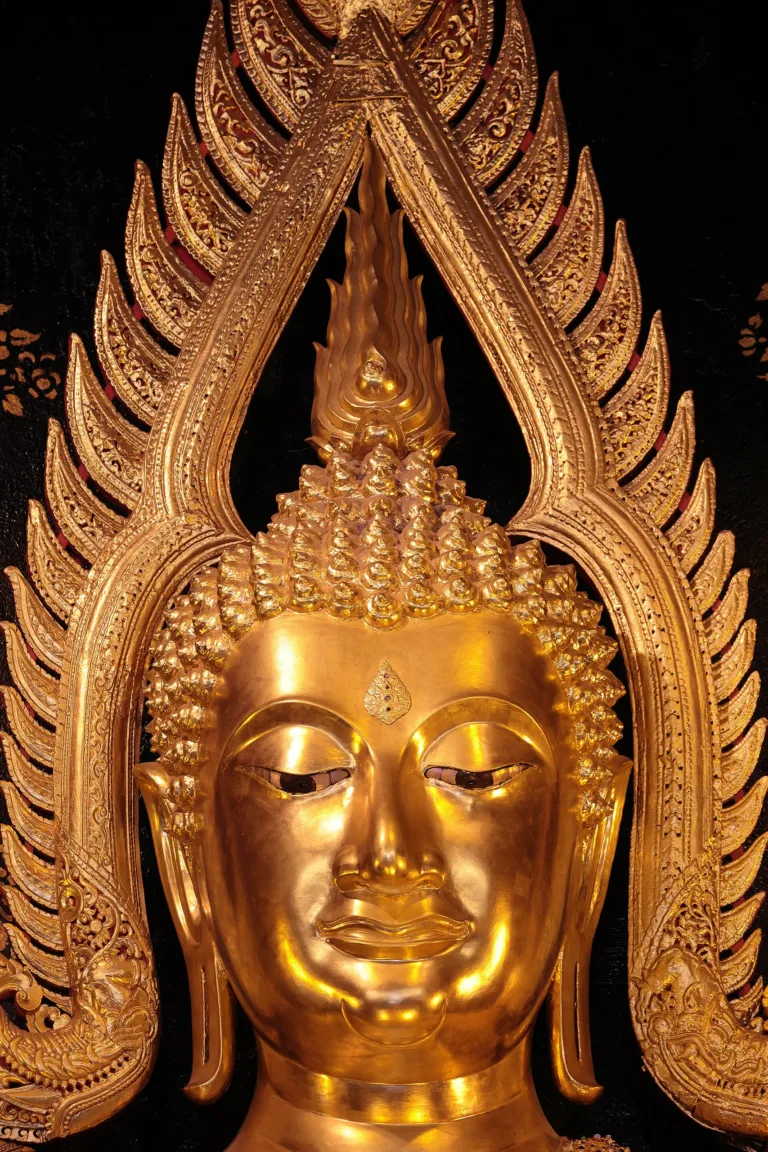
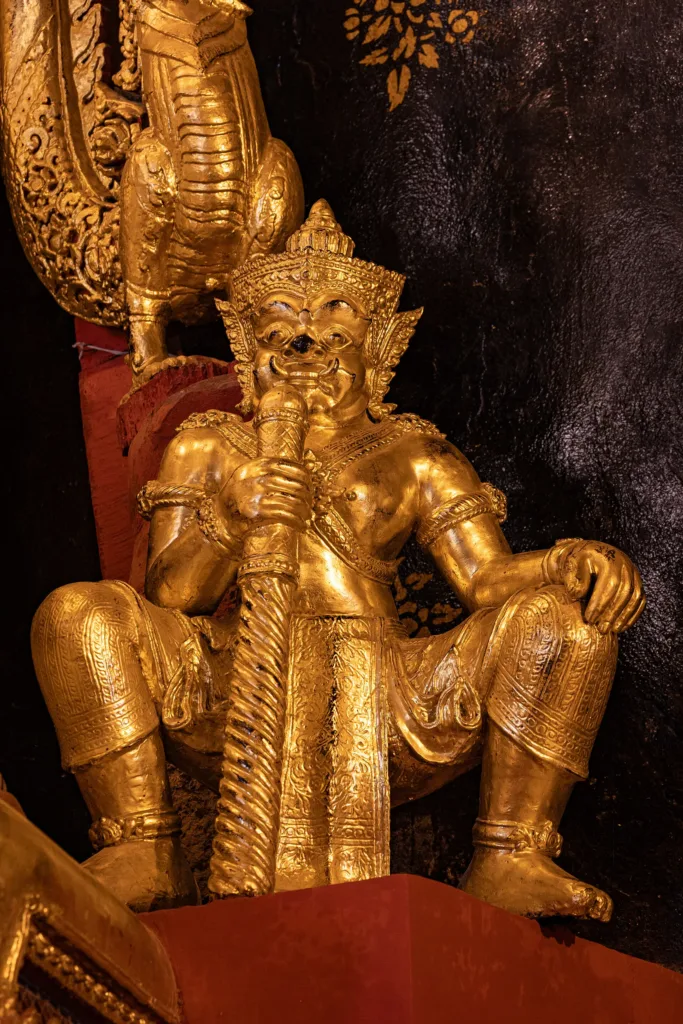
Phra Phuttha Chinnarat is a bronze image in the subduing-Mara posture, with a lap width of 5 sok 1 khuep 5 niu and a height of 7 sok. Its face is rather round, the brows arched and the halo shaped as a flame; locals reverently call it “Luang Pho Yai”. The gilded carved-wood arch (sum ruean kaeo) framing it, and the guardian figures of Vessavana and the ogre Alavaka at either side, are thought to be Ayutthaya-period additions.
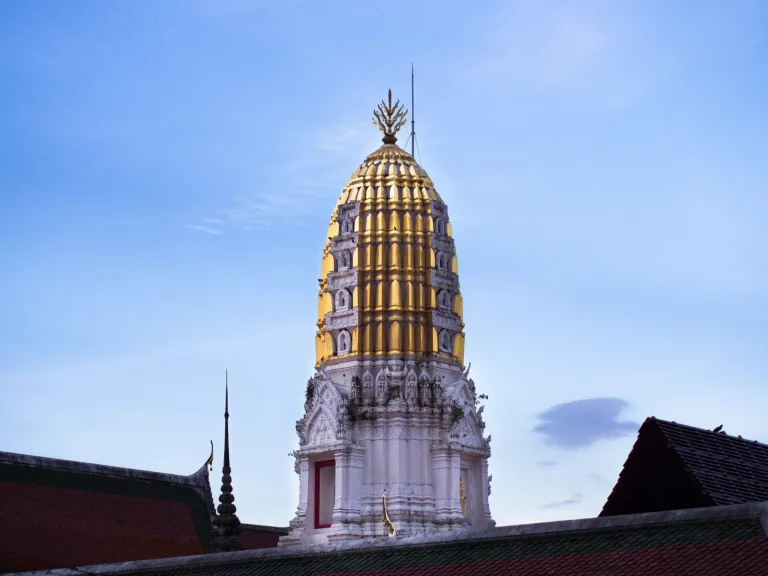
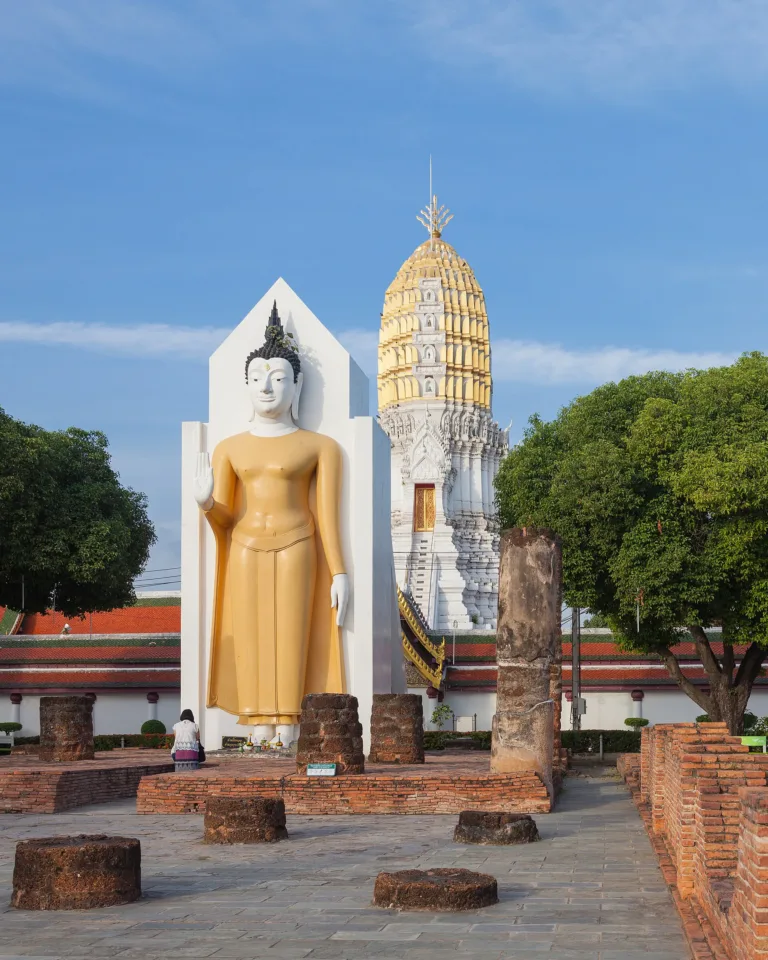
The temple is laid out around a central prang enshrining relics of the Buddha. Four viharas face the cardinal points: the main western vihara houses Phra Phuttha Chinnarat, the eastern one Phra Attharot, the northern one originally Phra Phuttha Chinnasi and the southern one originally Phra Si Satsada, all within a two-tier cloister. The prang stands about 15 wa high; tourism sources say it began as a Sukhothai chedi and was converted into an early Ayutthaya-style prang on a twenty-sided base. Under Rama V it was clad in gold-glazed tiles from Italy; as they fell, locals kept them as amulets because their backs bear five auspicious bumps.
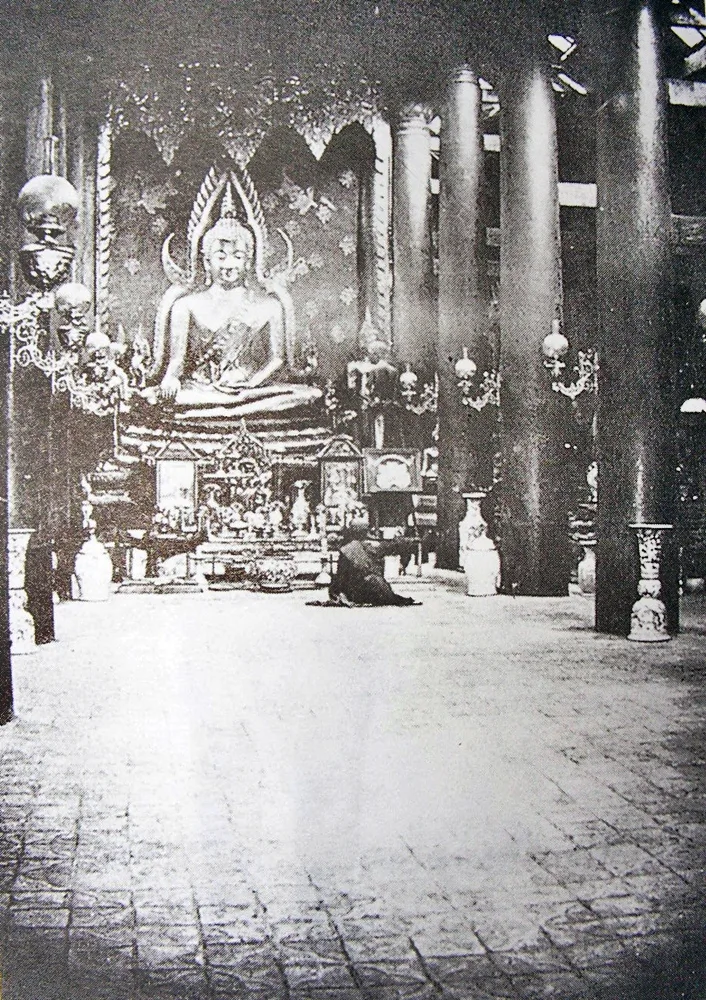
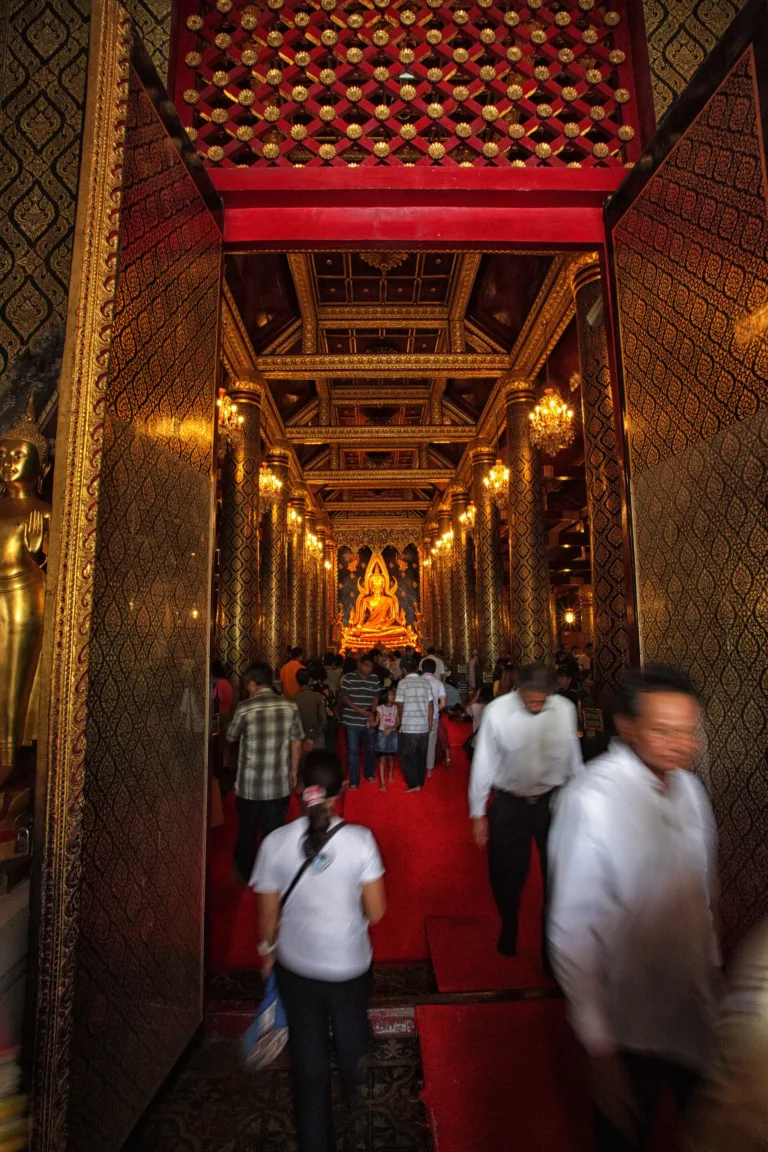
The main vihara housing Phra Phuttha Chinnarat is regarded as one of the finest and most complete Sukhothai-style buildings in Thailand, its tiered roofs and dim interior making the golden image glow. English Wikipedia notes that it survived the Burmese siege of Phitsanulok in 1775.
The main vihara has been restored several times, most recently in a major way in 1986. In early 2016 the temple asked the Fine Arts Department and the Crown Property Bureau to restore it again, as the wooden roof structure had rotted in places, roof tiles were bulging and poor ventilation made the interior stifling; officials inspected it on 10 June 2016.
Ayutthaya’s kings revered the temple. A Naewna article cites evidence that in 1482 King Borommatrailokanat, then residing at Phitsanulok, restored the temple and held a fifteen-day, fifteen-night celebration; later kings who came to pay homage held celebrations too, and the custom became a royal tradition.
Silpa Wattanatham records that King Naresuan came to pay homage and offered royal regalia after his victory at Hongsawadi, and that King Ekathotsarot had the image covered with fine gold leaf for the first time — English Wikipedia gives the year as 1603. Until then the bronze had been ungilded.
The vihara’s mother-of-pearl doors are a masterpiece of late Ayutthaya craft: a pair about 1 m wide and 4.5 m tall, inlaid with roundels enclosing Himavanta creatures such as lions, hamsa and kinnari amid kanok scrolls. An inscription dates them to 1756 under King Borommakot and records that 130 craftsmen worked on the inlay for five months and twenty days. Some tourism sources say the original carved wooden doors were moved to another temple in the lower north.
In the Rattanakosin era two of the images went to Bangkok. Phra Phuttha Chinnasi, from the decaying northern vihara, was floated down the Chao Phraya under Rama III by the Front Palace prince Maha Sakdiphonlasep. The exact year is disputed: the British envoy Henry Burney, who saw the procession, gives 1825, while other documents say 1829 or 1831. It was first placed at the rear porch of Wat Bowonniwet’s ordination hall, and Prince Mongkut, then a monk, later made it the hall’s principal image. Burney described the river crowded with boats of onlookers.
Phra Si Satsada took a longer route. The abbot of Wat Bang Oi Chang in Nonthaburi first took it there, then Somdet Chao Phraya Borom Maha Phichaiyat (Tat Bunnag) obtained it as the principal image of Wat Praduchimphli, and finally Rama IV moved it to Wat Bowonniwet, where it sits in the Phra Satsada vihara. Phitsanulok kept Phra Phuttha Chinnarat as its main image, and a replica of Phra Phuttha Chinnasi now sits in the northern vihara.
In 1833 Prince Mongkut, then the monk Vajirañāṇa, toured the northern towns, paid homage to Phra Phuttha Chinnarat and placed a jade bracelet on its finger.
King Chulalongkorn (Rama V) intended to bring Phra Phuttha Chinnarat to Bangkok as the principal image of Wat Benchamabophit, but the commissioner of Monthon Phitsanulok told him how deeply the townspeople cherished it, recalling that when Phra Phuttha Chinnasi was taken the town fell silent “as if a corpse were being carried out of the house”. The king changed his mind and commissioned a replica, with Phra Prasitthi Patima as master caster. The casting ceremony was held in front of the main vihara on 20 October 1901, and the replica was installed at Wat Benchamabophit on 30 December 1901; the original was also regilded that year.
Folk tales explain why Rama V never moved the image. A Phitsanulok version says that when it was being taken down to a raft on the Nan River it could not be pushed, or the raft would not move. A Phichit version says Luang Pho Phet was to be taken instead, so villagers hid it. In his own writings, Rama V recorded townspeople’s belief that after Phra Phuttha Chinnasi was removed there was drought for three years and that the Front Palace prince Maha Sakdiphonlasep fell ill for over a year and died, which they linked to the removal. These are traditional stories, not verified facts.
Phra Phuttha Chinnarat is said to be the most copied Buddha image in Thailand. Silpa Wattanatham attributes this to several factors: the legend that divine help was needed to cast it; its link with the Chakri dynasty, whose forebears served at Phitsanulok and whose founder, Rama I, worshipped it as Chao Phraya Chakri; and Rama VI’s praise of it as the summit of Thai art in a spirit of nationalist archaeology. Replicas now serve as principal images in many temples across Thailand and in Thai temples abroad.
In 1915 King Vajiravudh (Rama VI) raised the temple to a first-class royal temple, and in 1926 King Prajadhipok (Rama VII) and Queen Rambai Barni came to pay homage, the king placing the Nopparat Ratchawaraphon decoration on the image’s finger and the queen offering a shawl.
The Phra Phuttha Chinnarat festival is held every year from the 6th to the 12th waxing day of the 3rd lunar month. The temple and province have organised it together since 1934; in 2025 it ran from 3 to 9 February as the 91st edition, marking 668 years of the image, with proceeds going to temple upkeep.
The museum on the temple grounds, once run by the temple, was proclaimed in the Royal Gazette on 14 November 1961 as the Phra Phuttha Chinnarat National Museum under the Fine Arts Department.
The Phra Phuttha Chinnarat National Museum first displayed its collection in the Phra Phuttha Chinnasi and Phra Si Satsada viharas. A new building went up in 2014, and the Fine Arts Office 6 in Sukhothai reworked the exhibition from 2018 until its completion in 2024. Its nine sections include royal gold and silver trees, sashes and decorations offered to the image, a bronze kettledrum kept by the temple, carved ivory, silver- and gold-sheathed Buddha images and the ceiling stars of the prang. Entry is free; it opens Wednesday to Sunday, 08:30–16:00, and closes on Mondays, Tuesdays and public holidays.
In 1967 King Bhumibol Adulyadej and Queen Sirikit came to offer royal decorations and a shawl. English Wikipedia records a regilding in 2004, and in 2007 the then Crown Prince came on the king’s behalf to offer a Nopparat Ratchawaraphon sash.
Behind the prang stands Phra Attharot, an 18-sok standing image in the pacifying-relatives posture; its vihara collapsed long ago, leaving laterite columns known as “Noen Wihan Kao Hong”, and the Fine Arts Department has restored and repainted the image. There is also the Phra Lue vihara, said to hold an image cast from bronze left over from the three great images, set among bodhi trees, and the Wihan Kaeb, which recreates the Buddha’s parinibbana with a stone coffin and a figure of Maha Kassapa — described by tourism sources as the only one of its kind in Thailand.
The temple is open daily from 06:30 to 18:00 with no entry fee. On the first weekend of October, traditional long-boat races are held on the Nan River in front of the temple, one of Phitsanulok’s signature sights.
The main vihara is a major place of worship and busy most of the day. Dress modestly, remove shoes before entering, behave respectfully, and avoid flash or loud talk while others are praying.
Arrived? Check in, collect a stamp and tell others what it is like right now
Check your location first, so you do not fill in the form for nothing
Location must be on and within 1 km · One check-in per place per day · come back on other days to check in again
Post photos from anywhere — no need to be here · Up to 20 photos at a time · JPG / PNG / WebP · GPS location data is removed automatically
From Bangkok take Highway 1, then Highway 117 via Nakhon Saw…
Highway 1 → 117 · Fuel
Then samlor or taxi · By distance
From Bangkok take Highway 1 then 117 to Phitsanulok, then Phutthabucha Road along the Nan River, opposite the provincial hall
Car park inside the temple and along Phutthabucha Road
Petrol stations in Phitsanulok town
Good mobile signal
Temple daily 06:30–18:00 · Museum Wed–Sun 08:30–16:00 (closed Mon–Tue and public holidays)
around 377 km fromBangkok
Wat Phra Si Rattana Mahathat Woramahawihan
0 THB
Approx. nightly price for 2 adults (next week) · final price depends on your dates
Best day this week: Wednesday 28 Oct · Check in when you arrive to collect a stamp