 01
Bottle-clad buildingsMillions of green and brown bottles
The Temple of a Million Bottles · Sisaket
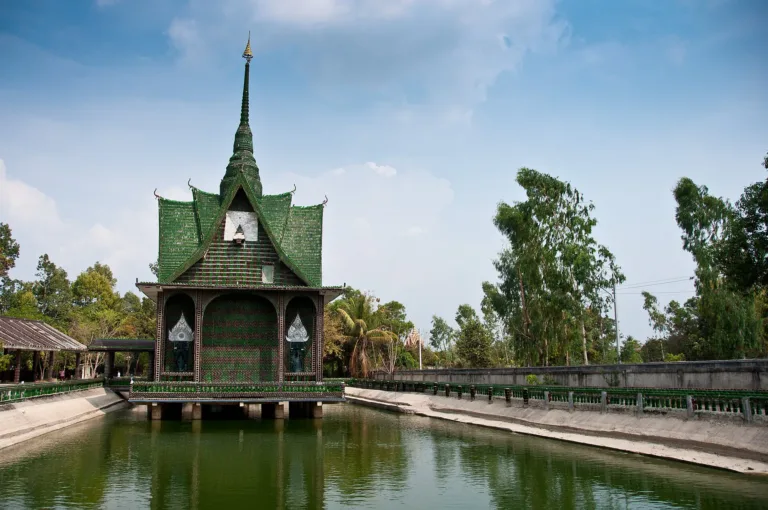
A temple in Khun Han, Sisaket, whose buildings are decorated with over 1.5 million glass bottles, begun in 1984 by Luang Pu Lot, with a water ordination hall, a white jade Buddha and bottle-cap mosaics.
Holiday / event — crowded · Hot (Afternoon) feels like 38°C · Late morning (09:00–12:00): rain ~15%
Dress modestly · Remove shoes before entering the sim · Do not pry or take bottles from buildings · Keep quiet in the sacred area
Daytime (temple hours)
Morning or late afternoon for the best light on the bottles
01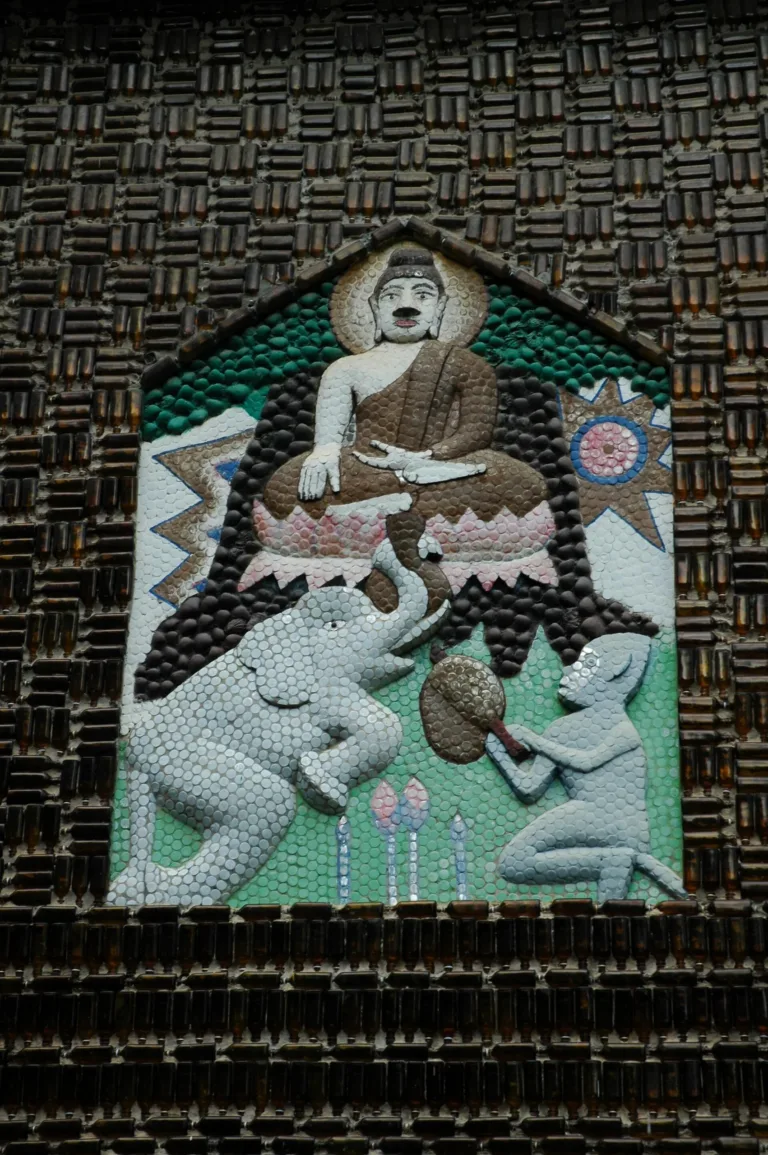 02
 03
 04
Tap a day card to see that day’s weather, rain, haze and hourly forecast
Best time to go Fine all day little rain through the day · light drizzle possible at times
Holiday — traffic on the way up and parking fills fast; leave early
Green band = hours used for the score
Best time to go Fine all day little rain through the day · light drizzle possible at times
Holiday — traffic on the way up and parking fills fast; leave early
Green band = hours used for the score
Best time to go Best window 06:00–13:00 Little rain
Holiday — traffic on the way up and parking fills fast; leave early
Green band = hours used for the score
Best time to go Best window 06:00–15:00 Little rain · light drizzle possible at times
No warnings today — normal road and weather conditions
Green band = hours used for the score
Best time to go Fine all day little rain through the day · light drizzle possible at times
No warnings today — normal road and weather conditions
Green band = hours used for the score
Best time to go Fine all day little rain through the day
No warnings today — normal road and weather conditions
Green band = hours used for the score
Best time to go Fine all day little rain through the day
No warnings today — normal road and weather conditions
Green band = hours used for the score
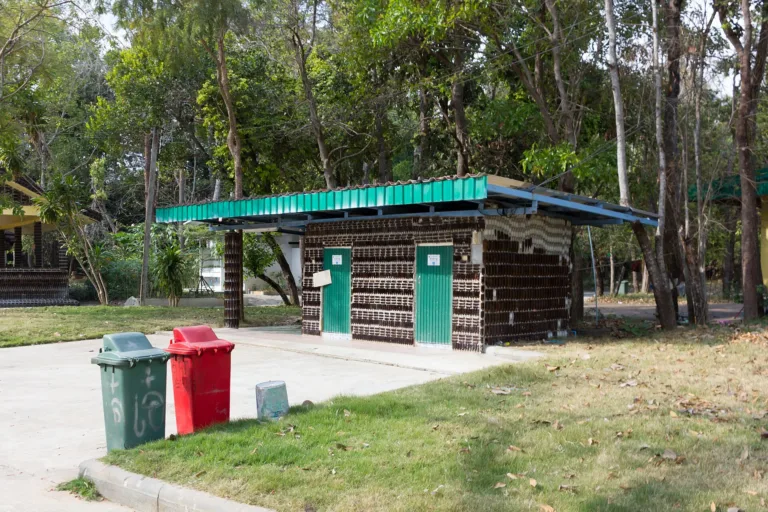
Wat Pa Maha Chedi Kaew, or Wat Lan Khuat, in Khun Han, Sisaket, is a temple built and decorated with over 1.5 million glass bottles.
Arrive Morning or late afternoon for the best light on the bottles
Photos from Wikimedia Commons and contributors · full credits inClassic page
Adults 0 THB · Car 0 THB · Time needed 1 hour
Long holidays and merit-making festivals
| Admission | Free |
Cash (donations) · Prices may change by season — check with the venue
Tap a month on the wheel to see weather, rain, haze and crowds from 10 years of records
Best time · Nov–Feb: cool weather, with sunlight making the bottles sparkle
Watch out · Apr–May: very hot
Oct by the records 22–30°C · avg rain 193 mm (20 rainy days) · clear 3 days · avg PM2.5 8
Wat Pa Maha Chedi Kaew, known locally as "Wat Lan Khuat" (Temple of a Million Bottles), is at Ban Don, Non Sung subdistrict, Khun Han district, Sisaket, near the Thai–Cambodian border. DASTA puts it about 61 km from Sisaket town via Highways 211 and 2111. Almost every building is decorated with glass bottles, which Wikipedia numbers at over 1.5 million.
The temple sits in a fairly young district. Thai Wikipedia says Khun Han was once part of Khukhan and Kantharalak districts. When the minor district was formed on 21 June 1955, its office was in Si subdistrict near Nong Si; "Si" did not sound appealing, so it took the name of Ban Khun Han, an old village dating to early Rattanakosin, though it lies outside that subdistrict. It became a full district on 22 July 1958, and Non Sung subdistrict, where the temple stands, was carved out of Bak Dong, Si and Kanthrom on 26 October 1971.
The temple began with Phra Khru Wiwek Thammachan, known as "Luang Pu Lot" (also spelled "Lort"), a wandering monk who pitched his umbrella-tent in the Nong Yai cemetery forest, today's temple grounds. Villagers kept coming to practise meditation with him, so he decided to found a temple in the cemetery. Thai Wikipedia gives the founding year as 1984.
The cemetery was littered with discarded bottles. Luang Pu saw their colours as beautiful and suitable for decorating buildings; DASTA and Manager Online (2019) add that they saved on paint and tiles. He gathered bottles from surrounding villages to build the first monk's hut, and once the temple became known, people from other provinces brought bottles to donate, and more buildings followed.
Foreign accounts tell the story from different angles. English Wikipedia says the monks began collecting bottles in 1984 and the main temple took two years to build, while Thai Wikipedia says the water ordination hall took one year. SPACES Archives and Atlas Obscura say the monks asked locals for empty bottles because they were tired of litter in the countryside; Buddhistdoor says it was only by the late 1990s that they had enough to use them seriously as building material. The Nation (2017) says the first bottle-decorated building went up in 1984.
Foreign sources add detail on the timing. Futility Closet says the main temple was finished in 1986, matching English Wikipedia's two-year build. English Wikipedia also says that once the monks began collecting bottles for building, the local government sent more, making the temple a community project rather than the monks' alone.
The most quoted words come via Reuters: SPACES Archives and Gadling cite Abbot San Kataboonyo saying, "The more bottles we get, the more buildings we make", a sign the temple has no plans to stop while bottles keep arriving.
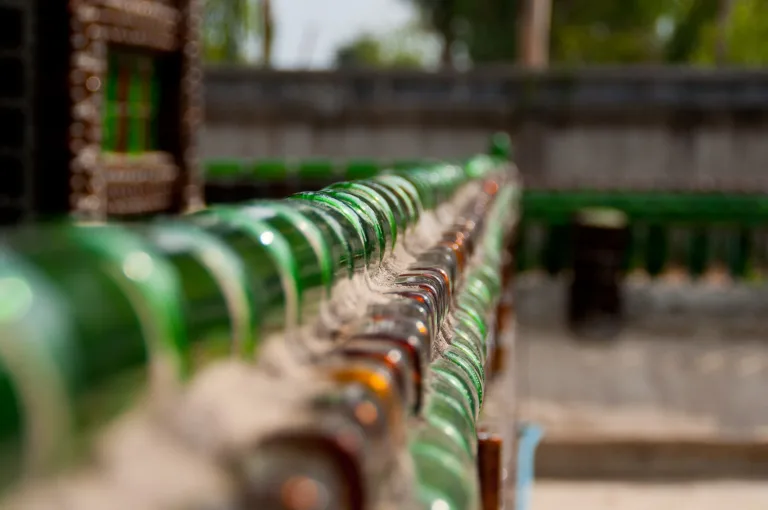
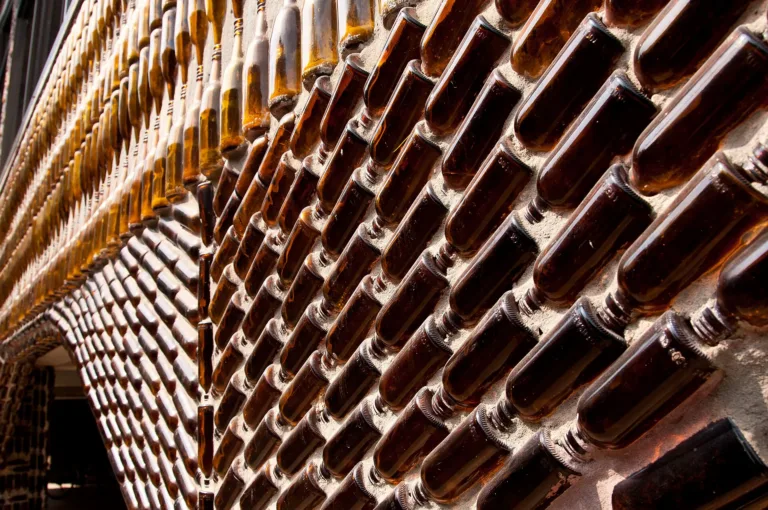
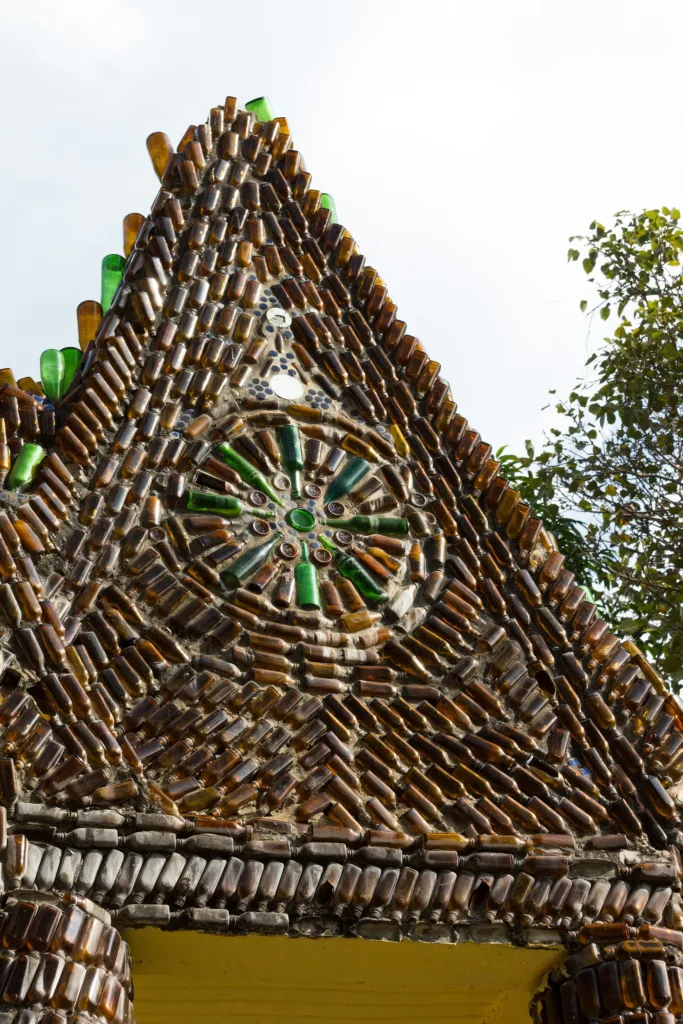
Each building starts with a concrete frame into which whole bottles and bottle bases are pressed to form walls, pillars, arches and walkways. Most are green and brown beer bottles; foreign sources name Heineken, Chang, Singha, Leo and energy-drink bottles. Bottle caps form mosaics of the Buddha, deities and scenes from his life. SPACES Archives notes that the monks arranged colours and positions to suit local taste, keeping vernacular forms such as soaring tiered roofs and buildings raised on stilts.
Why bottles? Ethical Traveler (2009) and Futility Closet relay the monks' explanation: glass gives good light, is easy to clean and does not fade, unlike paint or tiles that need frequent repair. Ethical Traveler also calls it the only temple in Thailand built entirely from recycled beer bottles, and the glass-industry magazine Glass International (2020) featured it, noting the temple still wants more bottles to keep building and to encourage a greener local lifestyle. Bottle counts vary: some sources say over a million, others over 1.5 million.
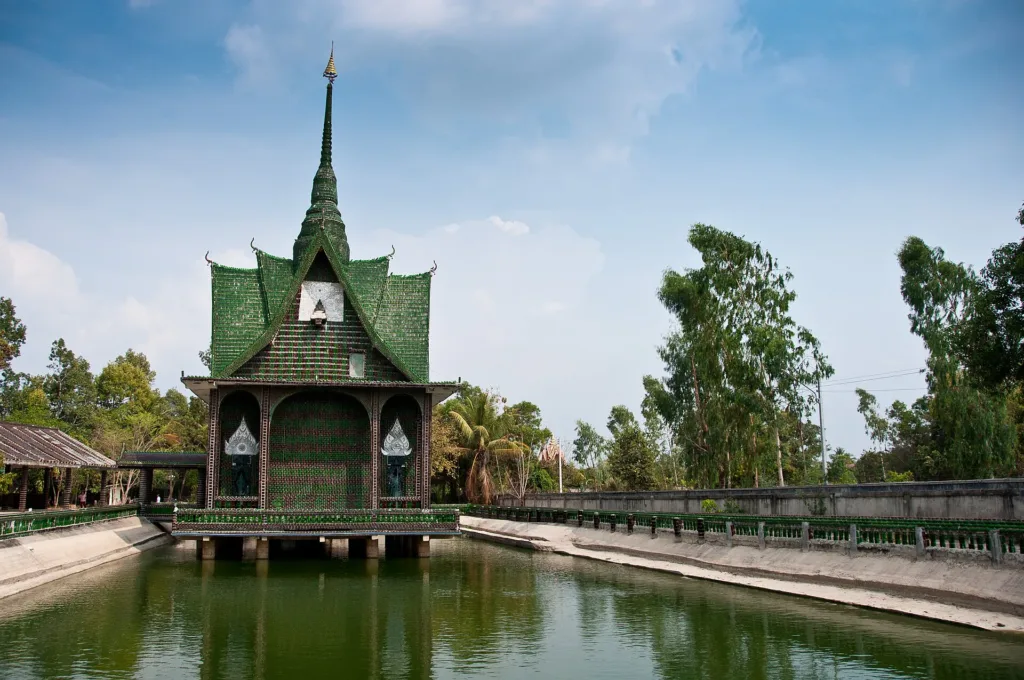
The highlight is the "sim klang nam", an ordination hall in a pond. Manager Online describes a cruciform building decorated with green and brown bottles on its roof, pillars, walls and floor, with clear glass windows holding three Buddha images on each side; The Nation says the water pavilion used almost 100,000 bottles. The main image is a white jade Buddha, which Manager Online says was imported from Myanmar and carved in Mae Sai; Thai Wikipedia says the wall behind it is decorated with colourful crown caps.
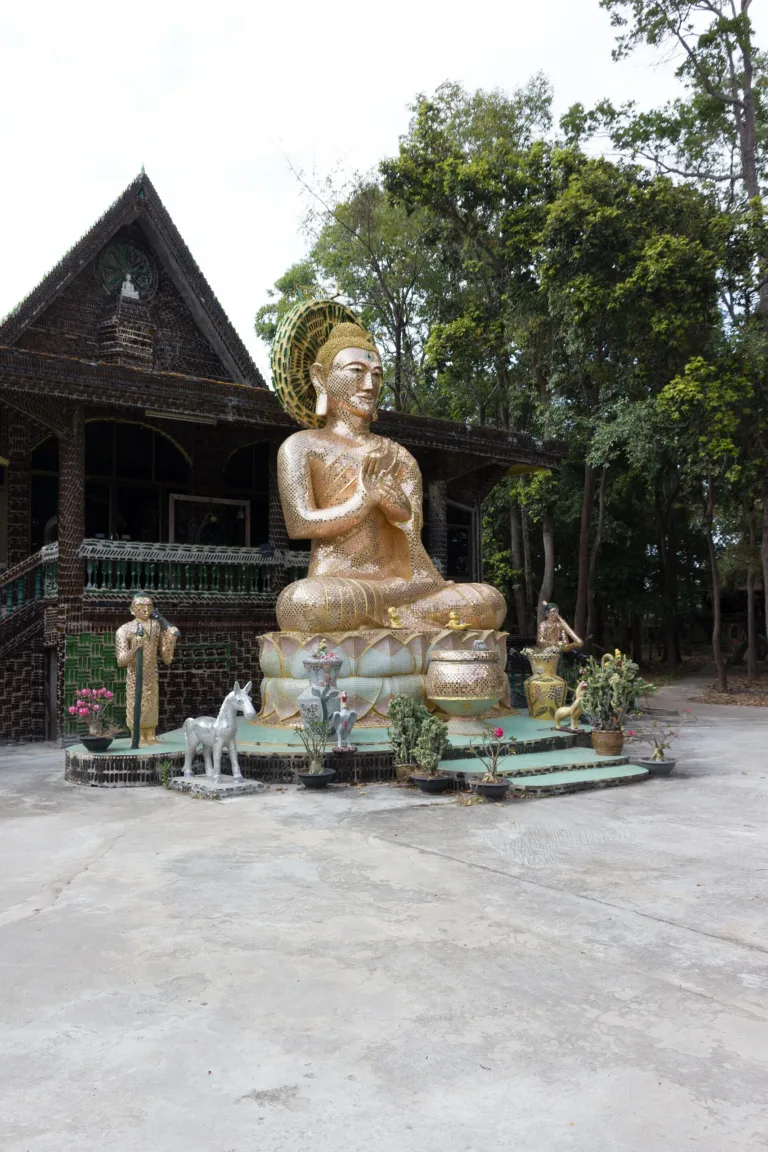
Beyond the sim are a multipurpose hall with a large reclining Buddha whose robe is made of brown bottles; the two-storey Sala Than Samoson Maha Chedi Kaew, with stairs up to a round chedi on a square base; a crematorium south of the hall; a bell tower; monks' huts; the gateway; the car park; and toilets. English Wikipedia says that by 2009 about 20 buildings had been built this way, including the local water tower and raised monks' quarters.
Wat Lan Khuat draws attention as recycled architecture. English Wikipedia quotes China Daily: the temple "has found an environmentally friendly way to utilize discarded bottles to reach nirvana", and notes that in 2015 the travel site When on Earth named it one of the ten leading examples of sustainable architecture. SPACES Archives, which documents self-taught art environments worldwide, added it to its collection in 2015.
Luang Pu Lot's idea has spread. In Sisaket itself, Wat Pa Nong Duan at Ban Nong Duan, Nong Hang, Uthumphon Phisai, is called "Wat Lan Khuat 2"; Daily News (2023) reports that monks and villagers have built it since 1998, and that its former abbot arranged the bottles as a Dhamma riddle: upside-down bottles stand for people without precepts and hard to teach, tilted ones for those ready to receive the Dhamma, and upright ones for enlightenment. Far away in Chanthaburi, the Trok Sano meditation centre decorated its buildings with 41,498 energy-drink bottles (Manager Online, 2012).
There is a parallel story from across the world. English Wikipedia recounts that in 1960 Alfred Heineken, visiting Curaçao, saw beaches littered with beer bottles and wanted "a brick that holds beer"; Dutch architect John Habraken designed the WOBO (World Bottle), with a trial run of about 60,000–100,000 bottles in 1963, but it never went into production. The temple's Wikipedia page remarks that what the brewer never achieved, the monks of Sisaket managed with ordinary bottles.
The temple is still growing. SPACES Archives (2015) reported a Buddha image over 15 feet tall under construction, among other projects. Admission is free; visitors may view the buildings or pray, and many still bring empty bottles to donate, a custom dating back to Luang Pu's time.
Arrived? Check in, collect a stamp and tell others what it is like right now
Check your location first, so you do not fill in the form for nothing
Location must be on and within 1 km · One check-in per place per day · come back on other days to check in again
Post photos from anywhere — no need to be here · Up to 20 photos at a time · JPG / PNG / WebP · GPS location data is removed automatically
From Sisaket take Highway 211, then 2111 to Khun Han; the te…
Sisaket–Khun Han via Highways 211 and 2111 · Fuel
Sisaket–Khun Han, then local transport · Per operator
Bangkok–Sisaket, then rent a car · Per class
Highways 211 and 2111
Car park in the temple (also bottle-decorated)
Petrol stations in Khun Han town
4G works
Daytime (temple hours)
around 61 km fromSisaket town
Wat Pa Maha Chedi Kaew
0 THB
Approx. nightly price for 2 adults (next week) · final price depends on your dates
Answers travellers want before they go — a one-minute read
Ban Don, Non Sung, Khun Han, Sisaket, about 61 km from town
Over 1.5 million
Phra Khru Wiwek Thammachan (Luang Pu Lot), starting in 1984
No, it is free
Yes, visitors often do
Mostly green and brown beer bottles, plus energy-drink bottles
Best day this week: Wednesday 28 Oct · Check in when you arrive to collect a stamp