 01
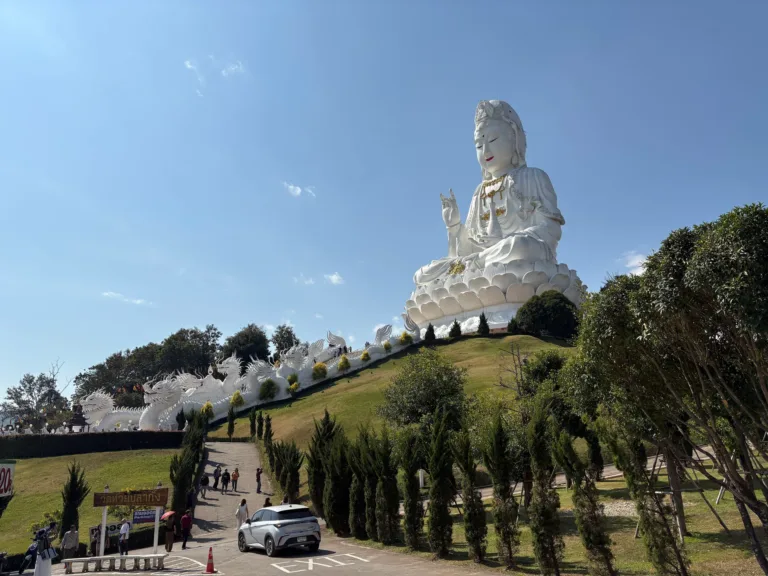
White Guan Yin statueAbout 69 m tall, with a lift to a viewing deck
Guan Yin temple · Chiang Rai
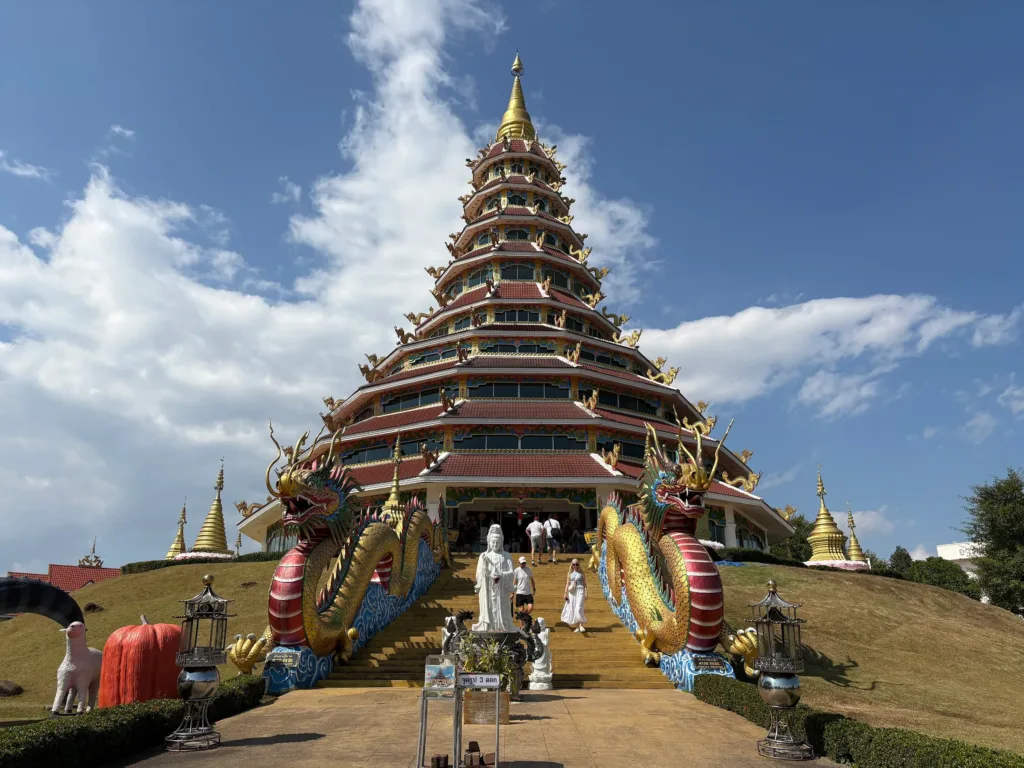
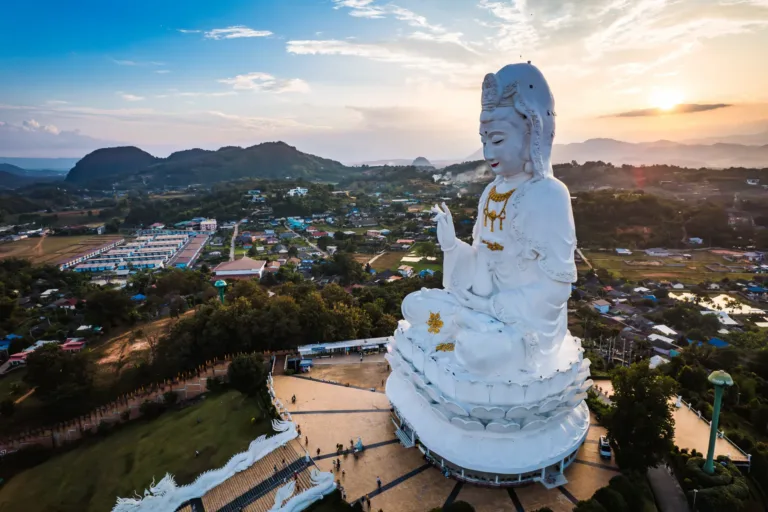
A hillside temple in Rim Kok, Chiang Rai, famous for a white Guan Yin statue about 69 metres tall with a lift to a viewing deck, and a nine-tier Chinese-Lanna pagoda. Free entry.
Holiday / event — crowded
Dress modestly, covering shoulders and knees · Remove shoes before entering the hall and pagoda · Keep noise down in meditation areas
Daily 07:00–21:00 (lift 07:00–18:00)
09:00 for a short lift queue
01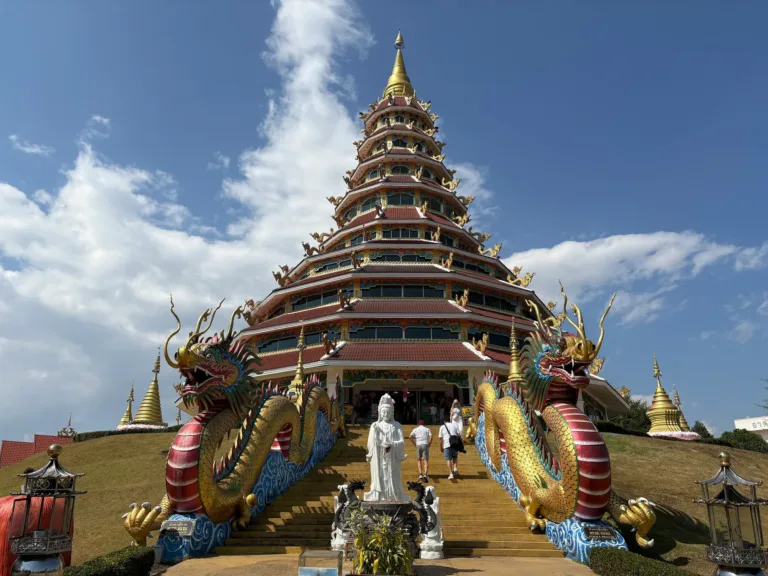 02
 03
 04
 05
Tap a day card to see that day’s weather, rain, haze and hourly forecast
Best time to go Daytime is over · see tomorrow
Holiday — traffic on the way up and parking fills fast; leave early
Green band = hours used for the score
Best time to go Fine all day little rain through the day
Holiday — traffic on the way up and parking fills fast; leave early
Green band = hours used for the score
Best time to go Fine all day little rain through the day
No warnings today — normal road and weather conditions
Green band = hours used for the score
Best time to go Fine all day little rain through the day
No warnings today — normal road and weather conditions
Green band = hours used for the score
Best time to go Fine all day little rain through the day
No warnings today — normal road and weather conditions
Green band = hours used for the score
Best time to go Fine all day little rain through the day
No warnings today — normal road and weather conditions
Green band = hours used for the score
Best time to go Fine all day little rain through the day
No warnings today — normal road and weather conditions
Green band = hours used for the score
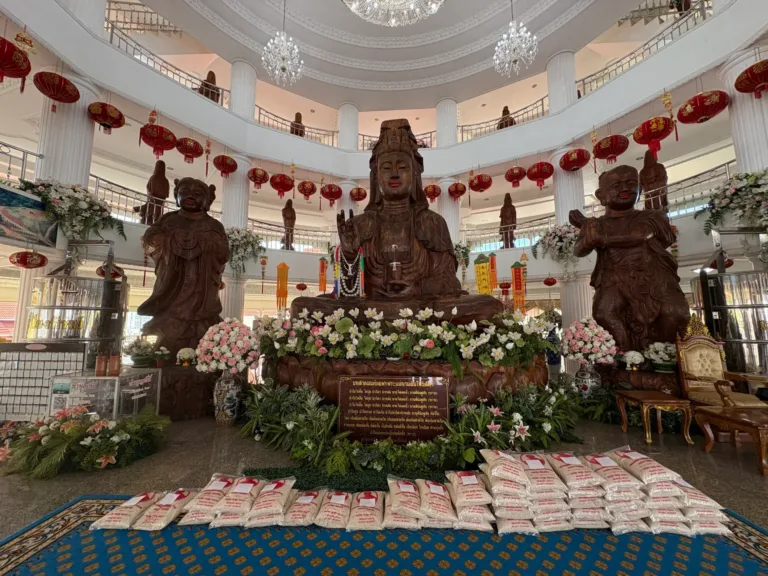
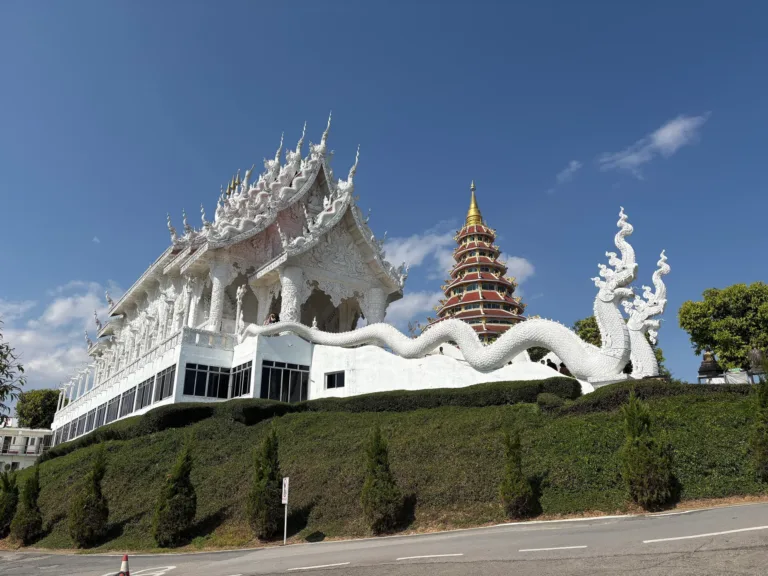
Wat Huay Pla Kang sits on a hill in Rim Kok, Mueang Chiang Rai, about 8 km from town. It was an abandoned temple until Phra Ajarn Phob Chok Tissawangso began rebuilding it in 2005, and it's now one of Chiang Rai's most visited temples.The star is a white Guan Yin statue about 69 metres tall, with a lift inside up to a viewing deck over the city. Next to it is the nine-tier Phob Chok Dhamma Chedi, with Chinese-style tiled roofs and twin dragons on the stairs, housing a sandalwood Guan Yin. There's also a white ordination hall.The temple also cares for hundreds of orphaned and hill-tribe children, so a visit supports its work too. Entry is free; the lift costs 20 baht for Thais and 40 baht for foreigners.
Arrive 09:00 for a short lift queue
Cover shoulders and knees for the hall and the statue interior; bring your own wrap
Midday tour coaches can mean waits of over 30 minutes
Free · Time needed 1–1.5 hours
11:00–14:00
| Viewing lift inside the Guan Yin, Thai visitor optional | 20 ฿/person |
| Viewing lift inside the Guan Yin, foreign visitor optional | 40 ฿/person |
Prices may change by season — check with the venue
Wat Huay Pla Kang is a new temple built on the ruins of an old abandoned one, on a hill in Rim Kok, Mueang Chiang Rai. In about twenty years, Phra Ajarn Phob Chok Tissawangso turned an overgrown hillside into a large temple with the nine-tier Phob Chok Dhamma Chedi, a towering white Guan Yin, a white ordination hall and a free hospital, and it is also home to hundreds of orphaned and hill-tribe children. It is both a Chiang Rai landmark and a story of faith that many people built together.
The name "Huay Pla Kang" comes from the surrounding community. Matichon reported that the community is named after the pla kang, a freshwater fish that looks like a snakehead but is smaller, which was once common in the local stream. When the fish became rare, the community began restocking it. The temple itself had long been abandoned, and there is no record of who first built it or when it fell into ruin.
The man who revived it is Phra Ajarn Phob Chok Tissawangso. Thairath reported that he was born on Saturday, 13 July 1959, the fourth child of a Chinese-Thai merchant family in Tha Muang, Kanchanaburi, and was ordained on 26 October 1997, aged 38, at a temple in Ratchaburi, before moving north to stay at a temple in Chiang Rai.
While there, he heard about an abandoned temple on an overgrown hill at Huay Pla Kang that no one visited. Several sources say he moved there on 19 November 2005, and villagers from Huay Pla Kang helped him clear the land, starting with a meditation hall and wooden huts with thatched roofs. Some English-language travel guides instead say villagers began building a monastery there in 2001.
At first it was a monastic residence, the Huay Pla Kang Samnak Song. On 24 July 2009 it was granted official temple status, with Phra Ajarn Phob Chok as its first abbot. He later received the ecclesiastical title "Phra Phaisan Prachathon", but most people still call him Luang Pho Phob Chok.
According to Thai media, construction of the Phob Chok Dhamma Chedi began on 26 April 2007. Its design came from the abbot's vision, a Bangkok engineer volunteered to build it, and a Taiwanese businessman paid for it. It has nine tiers with red Chinese-style tiled roofs and twelve small chedis around it, blending Chinese and Lanna styles. The ground floor holds a fragrant-wood Guan Yin about 7 metres wide and 7 metres tall, carved over 108 days from wood brought from China, Myanmar and India. The upper tiers hold other forms of Guan Yin, Buddha images, Luang Pu Thuat and, at the very top, an image of Shiva.
The huge white Guan Yin visible from afar was made in a Chinese sculptural style. Thairath reported that it was still under construction in 2015. Media later called it the "Phob Chok" Guan Yin; inside, a lift rises to the 25th floor at eye level, with white stucco decoration on the walls. Sources disagree on its height: many say about 69 metres, while others give 79 metres, or roughly a 25-storey building.
Alongside the building work, the temple began caring for children in its first year, starting with just two orphans. In 2015 Thairath reported that it supported more than 700 people, including 543 children from poor families and 72 elderly people without relatives. More than half the children were from hill tribes, mostly Akha and Lahu, living in a three-storey, 28-room girls' dormitory and 27 houses for boys. That same year, the number of people coming to make merit fell by around 80–90 percent.
The next major project was the Wat Huay Pla Kang Social Hospital at the temple entrance. Construction began on 11 November 2019 on a ship-shaped building 108 metres long and seven storeys high. It was first estimated at about 400 million baht, but material prices soared during COVID-19 and it ended up costing about 720–730 million baht in donations. The then Prime Minister visited on 30 November 2022, and the hospital opened on 1 December 2022, offering free care to the poor, with a focus on dentistry.
During COVID-19 in 2021, the temple ran a 20-baht car wash to give work to people who had lost their jobs and to former prisoners, while caring for more than 400 children. A report in late 2023 said the temple had joined the Sangha-abhibal programme for sick monks and ran shelters for disadvantaged children and homeless people.
In 2026, several news outlets reported that rising fuel prices and fewer tourists had cut donations, leaving the hospital, which sees about 300 patients a day, with enough operating funds for only about two months. Luang Pho Phob Chok said the hospital belongs to society. A visit to Wat Huay Pla Kang today means seeing both its architecture and social work that is still going on.
Arrived? Check in, collect a stamp and tell others what it is like right now
Check your location first, so you do not fill in the form for nothing
Location must be on and within 1 km · One check-in per place per day · come back on other days to check in again
Post photos from anywhere — no need to be here · Up to 20 photos at a time · JPG / PNG / WebP · GPS location data is removed automatically
The temple is in Rim Kok, Mueang Chiang Rai, about 8 km north of town.
North from Chiang Rai town to Rim Kok · Fuel
Often combined with the Blue and White Temples · As agreed
Paved road from town, climbing a hill
Car park in the temple grounds
Chiang Rai town
Daily 07:00–21:00 (lift 07:00–18:00)
about 8 km from Chiang Rai town
Wat Huay Pla Kang
Answers travellers want before they go — a one-minute read
Rim Kok, Mueang Chiang Rai, about 8 km north of town
About 69 metres, according to Thai sources
The temple is free; the viewing lift is 20 baht for Thais, 40 baht for foreigners
Daily 07:00–21:00; the lift runs until 18:00
Cover shoulders and knees; bring your own wrap
Phra Ajarn Phob Chok Tissawangso, from 2005
Best day this week: Monday 30 Nov · Check in when you arrive to collect a stamp
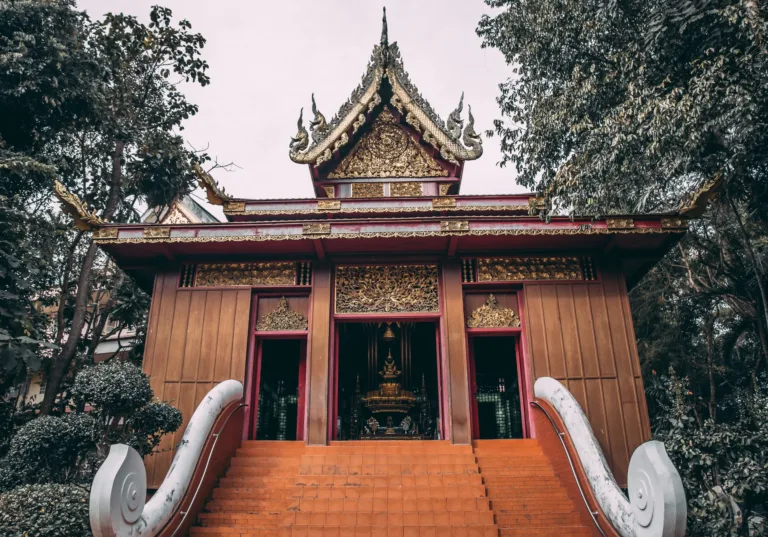 Wat Phra Kaew Chiang Rai
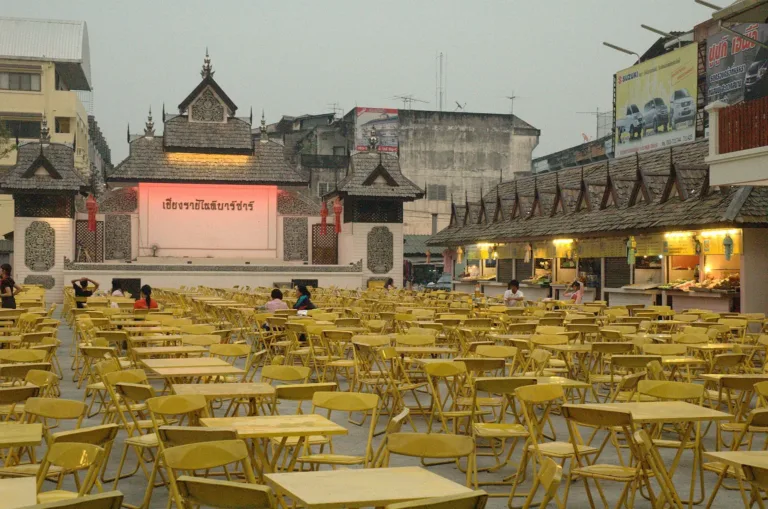 Chiang Rai Night Bazaar
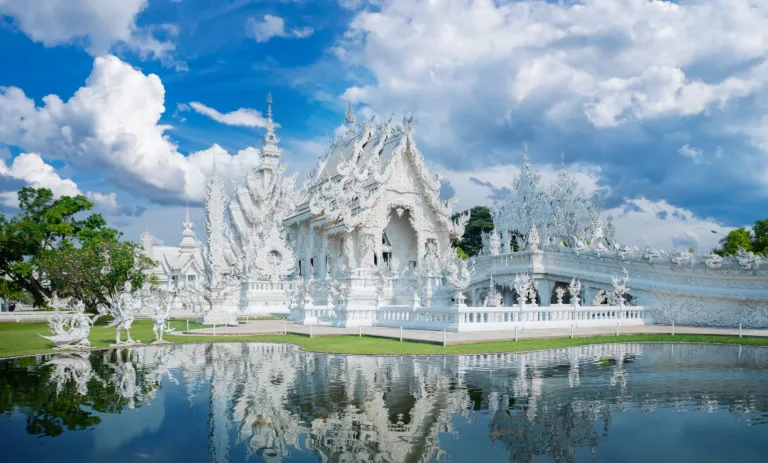 Wat Rong Khun (White Temple)
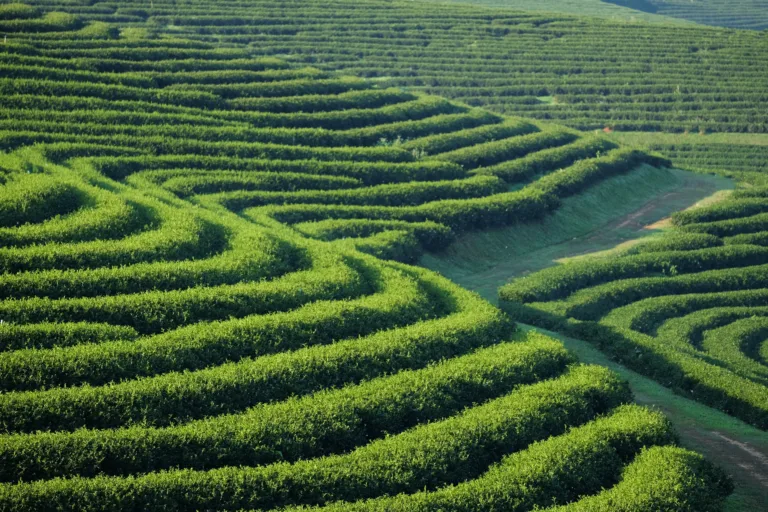 Choui Fong Tea Plantation