What to know before visiting the temple
Dress modestly, covering shoulders and knees · Take off shoes before entering the hall · Don't touch the murals or use flash
Daily, around 08:00–16:00
Buddhist holy days and festivals
7 days ahead
When to go
this week
Tap a day card to see that day’s weather, rain, haze and hourly forecast
Best time to go Daytime is over · see tomorrow
No official warnings, but watch for: Evening (16:00–19:00): rain ~37% · Possible thunder 17:00–21:00
Hour by hour
Green band = hours used for the score
Best time to go Best window 06:00–13:00 Little rain · light drizzle possible at times
Rain at times — slippery roads, allow extra travel time
Hour by hour
Green band = hours used for the score
Best time to go Best window 08:00–12:00 Little rain · light drizzle possible at times
No official warnings, but watch for: Late morning (09:00–12:00): rain ~33% · Possible thunder 14:00–15:00
Hour by hour
Green band = hours used for the score
Best time to go Best window 08:00–13:00 Little rain · light drizzle possible at times
Rain at times — slippery roads, allow extra travel time
Hour by hour
Green band = hours used for the score
Best time to go Best window 06:00–12:00 Little rain · light drizzle possible at times
No official warnings, but watch for: Late morning (09:00–12:00): rain ~25% · Possible thunder 13:00–14:00
Hour by hour
Green band = hours used for the score
Best time to go Best window 14:00–19:00 Little rain · light drizzle possible at times
No official warnings, but watch for: Late morning (09:00–12:00): rain ~43%
Hour by hour
Green band = hours used for the score
Best time to go Best window 06:00–09:00 Little rain · light drizzle possible at times
Thick morning fog with visibility under 1 km — use headlights and drive slowly
Hour by hour
Green band = hours used for the score
Wat Chonthara Singhe
Wat Chonthara Singhe, known locally as Wat Je He, sits in Moo 3, Je He subdistrict, Tak Bai, Narathiwat, on the Tak Bai River close to the Malaysian border. It was founded around 1860, late in King Rama IV's reign, by Phra Khru Opat Phutthakhun, better known as Luang Por Phut.It's nicknamed the temple that protected Thai land. During the 1909 boundary talks with Britain, Siam pointed to its clearly Thai art and architecture as proof that Tak Bai was Siamese, and the district stayed in Thailand rather than going to Kelantan.Don't miss the ordination hall from the Rama V era, painted inside with the life of the Buddha and the Three Worlds by southern-school artists, and the group of timber monks' houses mixing southern Thai, Chinese and Malay craft, which won an ASA conservation award in 2000.
- Morning light, cooler air
- Strong sun
- Afternoon light by the river
- Front of the ordination hallStucco gable and three-tiered roofmorning
- Timber monks' housesFretwork and painted detailsafternoon
Good to know here
Expect security checks; carry ID or your passport
Dress modestly; remove shoes before entering the hall
- Walk on to Ko Yao over the wooden bridge near the temple
- If you'd like to see the displays in the monks' houses, ask a monk or staff
- Go in the morning before the sun gets strong
No data yet check before you go · Time needed 1 hour
Buddhist holy days and festivals
- Kids Fine; keep them quiet inside the hall
- Seniors Good; flat grounds and short walks
- Wheelchair The grounds are fine, but the hall and houses have steps
- Pets A place of worship; don't bring pets
- Tak Bai marketSouthern Thai food
- Dress modestly, covering shoulders and knees
- Take off shoes before entering the hall
- Don't touch the murals or use flash
- This is a border area; check official safety advice before you go
- Carry identification
The story of this place
Wat Chonthara Singhe, still widely called Wat Je He by locals, is an old temple on the Tak Bai River in Tak Bai, Narathiwat. It was founded late in King Rama IV's reign, when Tak Bai still fell under the authority of Kelantan. It is known as "the temple that protected Thai land" because of a long-told story that its Thai art and the Buddhist community around it were among the reasons Siam cited when the border with Britain was drawn, so that Tak Bai stayed Thai after the 1909 treaty. Today the temple still keeps its Rama V-era ordination hall, its murals and a group of old timber monks' houses that tell the story of the southern border better than almost anywhere else.
Read more 10 more paragraphs
The founder was Phra Khru Opas Phutthakhun, known as Luang Por Phut (Phut Inthachoto). Local records and several travel sources say that because Tak Bai was then governed by Kelantan, he had to ask the ruler of Kelantan for the land. The founding year cited most often is 1860, as given by the Association of Siamese Architects and an article in Prince of Songkla University's Journal of Liberal Arts, but some sources give around 1870 and others 1873, the year the ordination hall was built.
The temple's original name was Wat Je He, after the subdistrict it stands in; some sources say it was also once called Wat Tha Phru, before the official name Wat Chonthara Singhe came into use. It gradually grew into the district's main temple. Several former abbots served as district and provincial heads of the Sangha, the temple is a regional Dhamma examination centre, and it seeded other temples nearby: Wat Kok Ma Fueang, founded in 1874, invited Phra Thammawinai (Chui) from here to become its first abbot.
The original ordination hall was built in 1873 under King Rama V. It is small but finely proportioned, with a three-tiered roof and a gable showing the god Indra riding the elephant Erawan. Inside, the principal Buddha image in the posture of subduing Mara sits on a tall pedestal. Some travel sources say the temple received its royal grant of consecrated boundary land in 1883.
The interior walls are painted with the life of the Buddha, the Three Worlds cosmology and assemblies of deities in the southern style. Tradition says the painter was a monk from Songkhla who spent a rains retreat at the temple. Alongside the religious scenes, the artist slipped in the clothing and daily life of people in Narathiwat at the time, making the murals both art and a rare social record.
The event that made the temple famous came late in King Rama V's reign, when Britain, expanding its power in the Malay Peninsula, negotiated with Siam over the Malay states. The treaty was signed in Bangkok in March 1909 by Prince Devawongse Varoprakar for Siam and Sir Ralph Paget for Britain, and ratifications were exchanged in London that July. Siam ceded Kedah, Kelantan, Terengganu and Perlis to Britain, and the eastern boundary was set along the Golok River to the sea at the mouth of the Tak Bai.
The most often told version says British surveyors had pushed the line as far as Ban Plak Lek, about 25 km from the temple, when King Chulalongkorn objected that the area had a Thai temple and a community that had long kept Thai culture. The British accepted, the line moved down to the Golok River, and Tak Bai stayed in Siam. Most sources tie this to the 1909 negotiations, though one gives 1898, while Kelantan-side records note that the ruler of Kelantan protested the loss of land north of the Golok in July 1909 but Britain refused to change it.
Soon after the treaty took effect, Tak Bai district was created on 12 August 1909, and Wat Je He became the leading temple of the new border district. In 1915 King Vajiravudh (Rama VI) toured Narathiwat aboard the royal ship Akkharatchawaradet and stayed at the temple's riverside pavilion.
The temple's timber monks' houses have drawn the attention of architecture scholars. Research from Silpakorn University says the old abbot's house cannot be dated with certainty, because records link it to different abbots: Phra Khru Narakhet Sangkhakit (1908–1912) or Phra Khru Phinit Samanakan (1920–1932). Kuti Sitthisanpradit was built in 1918, has a stucco Garuda on its roof and had its posts repaired in 1955 (some sources give 1955 as its build year), and Kuti Phra Khru Wimonsathapanakit was built in 1939. All are two-storey raised timber houses with fine fretwork; some hide an upper room for valuables, and they blend southern Thai craft with Chinese, Malay and Western influences.
In later years the temple received many royal visits. King Bhumibol Adulyadej (Rama IX) and Queen Sirikit came in 1976, and some sources say they had first visited in 1975. In 1991 Princess Maha Chakri Sirindhorn brought cadets of the Chulachomklao Royal Military Academy here on a study trip, and the temple was once honoured as a model development temple.
In 2000 the Fine Arts Department turned the old monks' houses into the Wat Chonthara Singhe Museum, and the same year the buildings won a conservation award from the Association of Siamese Architects. The museum displays a pulpit more than a century old, a scripture cabinet, local artefacts and life-size figures of the two signatories of the 1909 treaty. Restoration is carried out by the Fine Arts Department together with the abbot, and knowledgeable locals have noted that some decorative patterns changed after repairs, while villagers jointly built a mondop with a likeness of a former abbot outside the protected area.
- 1860Luang Por Phut founds Wat Je He on land requested from the ruler of Kelantan (some sources say 1870)
- 1873The original ordination hall is built under King Rama V, with murals by southern artists
- 1874Wat Kok Ma Fueang is founded and invites a monk from this temple as its first abbot
- 1908–1912Phra Khru Narakhet Sangkhakit (Phra Si Thong) serves as abbot
- 1909Siam signs a treaty with Britain; the border follows the Golok River and Tak Bai stays in Siam
- 1909Tak Bai district is created (12 August)
- 1915King Rama VI tours Narathiwat and stays at the temple's riverside pavilion
See 7 events
- 1918Kuti Sitthisanpradit is built
- 1920–1932Phra Khru Phinit Samanakan (Phra Palad Sao) serves as abbot
- 1939Kuti Phra Khru Wimonsathapanakit is built
- 1955The posts of Kuti Sitthisanpradit are repaired
- 1976King Rama IX and Queen Sirikit visit the temple
- 1991Princess Sirindhorn brings Chulachomklao Royal Military Academy cadets on a study visit
- 2000The Fine Arts Department opens the museum in the old monks' houses; ASA conservation award
Check-ins & visitor photos
Arrived? Check in, collect a stamp and tell others what it is like right now
Check your location first, so you do not fill in the form for nothing
Location must be on and within 1 km · One check-in per place per day · come back on other days to check in again
Post photos from anywhere — no need to be here · Up to 20 photos at a time · JPG / PNG / WebP · GPS location data is removed automatically
How to get there
The temple is in Moo 3, Je He, a few hundred metres from the Tak Bai market junction.
From Narathiwat town to Tak Bai; the temple is near the market junction · Fuel
Paved roads in Tak Bai town
Inside the temple grounds
Tak Bai town
Daily, around 08:00–16:00
Wat Chonthara Singhe
FAQ
Before you go: Wat Chonthara Singhe
Answers travellers want before they go — a one-minute read
Where is Wat Chonthara Singhe?
Moo 3, Je He, Tak Bai, Narathiwat, on the Tak Bai River
Why is it called the temple that protected Thai land?
In 1909 Siam used it as evidence that Tak Bai was Siamese during border talks with Britain
How old is it?
Founded around 1860 under King Rama IV; the ordination hall dates from 1873
What is there to see?
The hall and its murals, old timber houses, the Phra Narai tower, a chedi and a reclining Buddha
What's nearby?
Ko Yao, an island on the Tak Bai River within walking distance
Nearby places
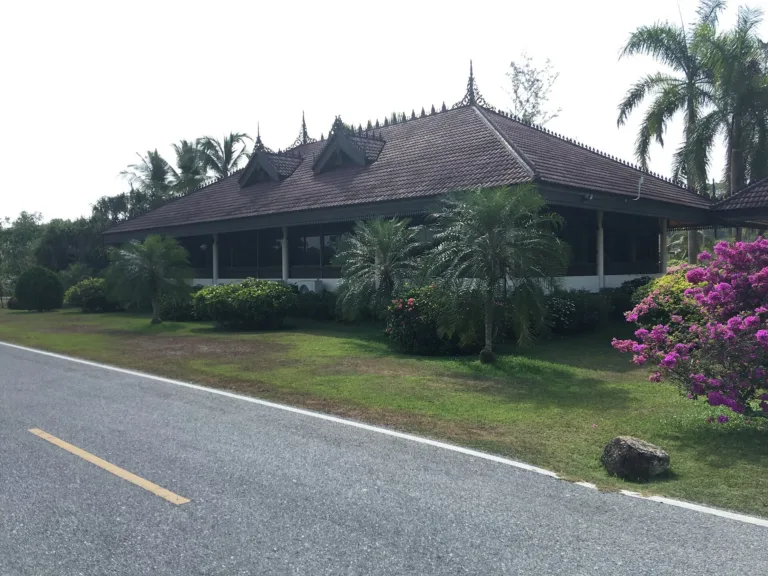 Thaksin Ratchaniwet Palace
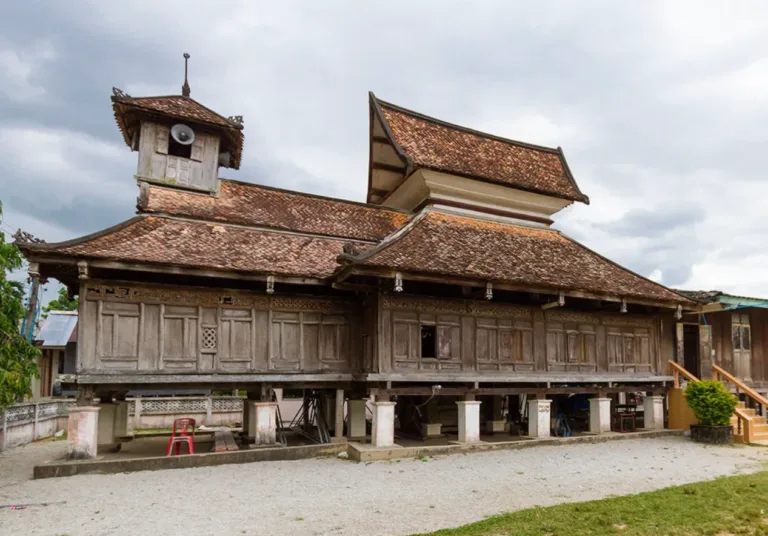 Talo Mano Mosque (300 Years Mosque)
Ready to go to Wat Chonthara Singhe?
Best day this week: Thursday 3 Dec · Check in when you arrive to collect a stamp