 01
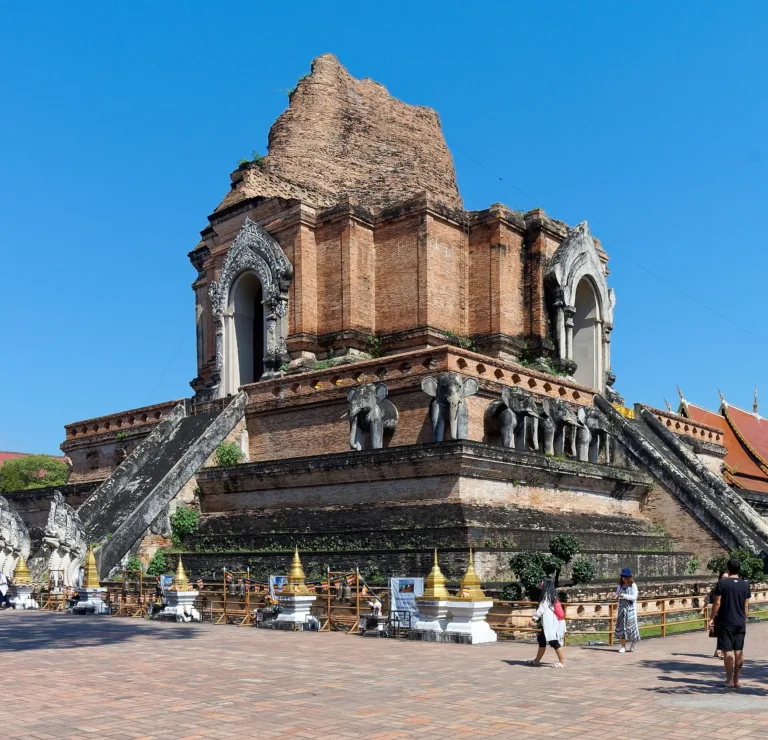
The great chediLanna's largest brick stupa, top lost in 1545
Royal temple · Old city Chiang Mai
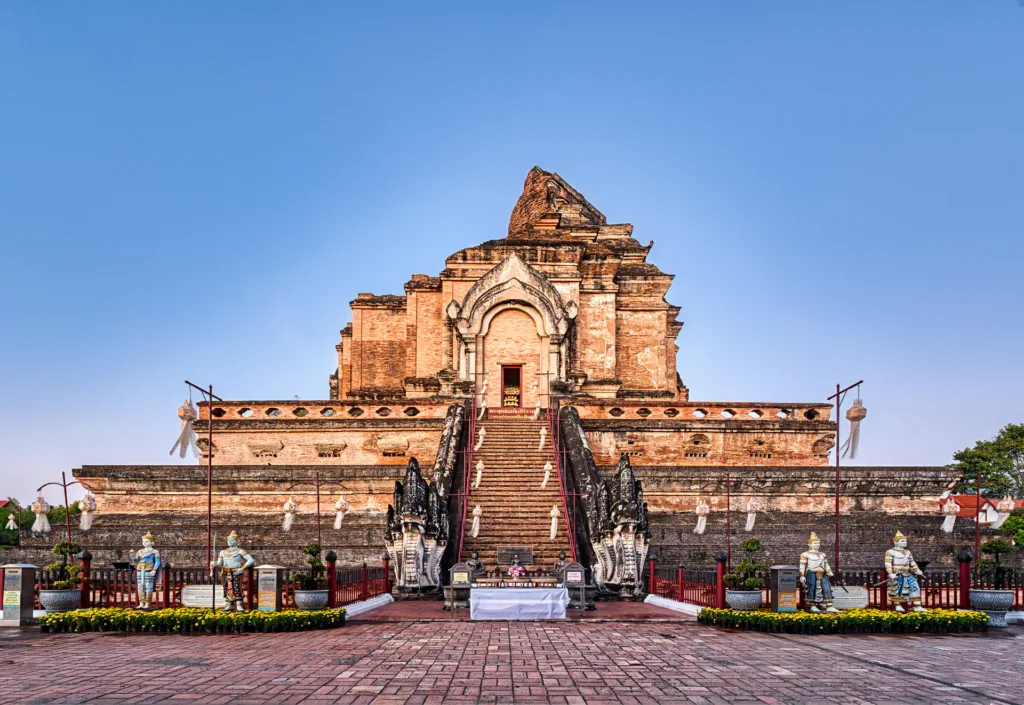
Royal temple in the heart of old Chiang Mai with the largest brick chedi in Lanna, begun around 1391 and broken by an earthquake in 1545. It once held the Emerald Buddha and still keeps the Inthakhin city pillar.
Holiday / event — crowded · Hot (Afternoon) feels like 38°C
Cover shoulders and knees · Take off shoes before entering the viharn · Walk clockwise around the chedi · Don't climb the naga stairs or the chedi base
About 6:00–18:00 (ticket booth may close earlier) · Monk Chat about 9:00–18:00
Before 9:00 for fewer people and softer sun
Khao Inthakhin (Sai Khan Dok) festival, 13th waning day of Lanna month 8 to 4th waxing day of month 9, around late May–early June
01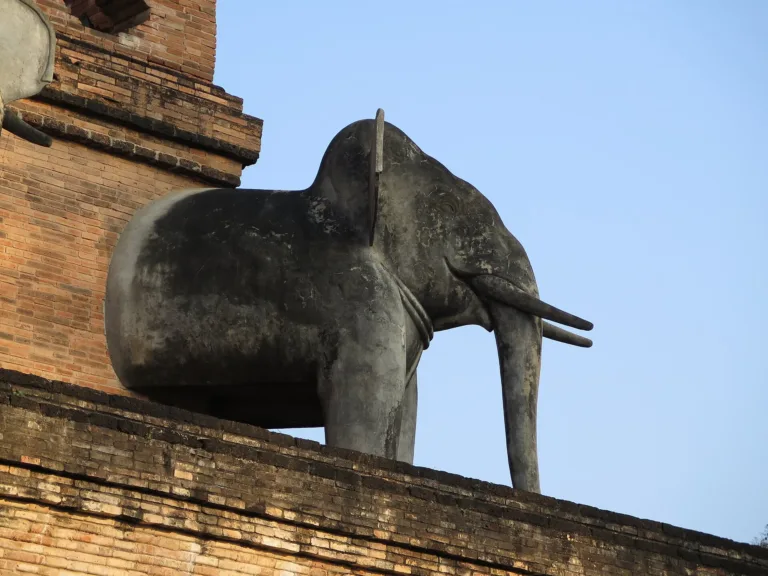 02
 03
 04
Tap a day card to see that day’s weather, rain, haze and hourly forecast
Best time to go Fine all day little rain through the day
Holiday — traffic on the way up and parking fills fast; leave early
Green band = hours used for the score
Best time to go Fine all day little rain through the day
Holiday — traffic on the way up and parking fills fast; leave early
Green band = hours used for the score
Best time to go Fine all day little rain through the day
Holiday — traffic on the way up and parking fills fast; leave early
Green band = hours used for the score
Best time to go Best window 06:00–15:00 Little rain · light drizzle possible at times
No warnings today — normal road and weather conditions
Green band = hours used for the score
Best time to go Best window 06:00–15:00 Little rain · light drizzle possible at times
No warnings today — normal road and weather conditions
Green band = hours used for the score
Best time to go Fine all day little rain through the day
No warnings today — normal road and weather conditions
Green band = hours used for the score
Best time to go Fine all day little rain through the day
No warnings today — normal road and weather conditions
Green band = hours used for the score
Wat Chedi Luang Varavihara, a royal temple in the centre of Chiang Mai old city, home to Lanna's largest brick chedi and the Inthakhin city pillar.
Arrive Before 9:00 for fewer people and softer sun
Photos from Wikimedia Commons and contributors · full credits inClassic page
Shoulders and knees must be covered; sarongs can be borrowed
Do not climb the naga stairs of the chedi
By tradition, women do not enter the shrine
No shade around the chedi; bring a hat and water
Adults 0 THB · Time needed 1–1.5 hours
Weekends Nov–Feb, Visakha Puja, Asalha Puja and the Sai Khan Dok festival
| Admission, foreign visitors optional | 40 ฿/person |
| Motorbike parking optional | 20 ฿/vehicle |
| Songthaew in the city optional | 30 ฿/person |
Admission is cash only · Prices may change by season — check with the venue
Khao Inthakhin (Sai Khan Dok) festival, 13th waning day of Lanna month 8 to 4th waxing day of month 9, around late May–early June
Tap a month on the wheel to see weather, rain, haze and crowds from 10 years of records
Best time · Nov–Feb is cool with clear skies, comfortable for walking around the open chedi · late May–early June brings the Sai Khan Dok / Inthakhin festival
Watch out · Mar–Apr is very hot with heavy PM2.5 haze and no shade around the chedi · Jul–Sep has frequent afternoon rain
Oct by the records 22–29°C · avg rain 179 mm (18 rainy days) · clear 8 days · avg PM2.5 15
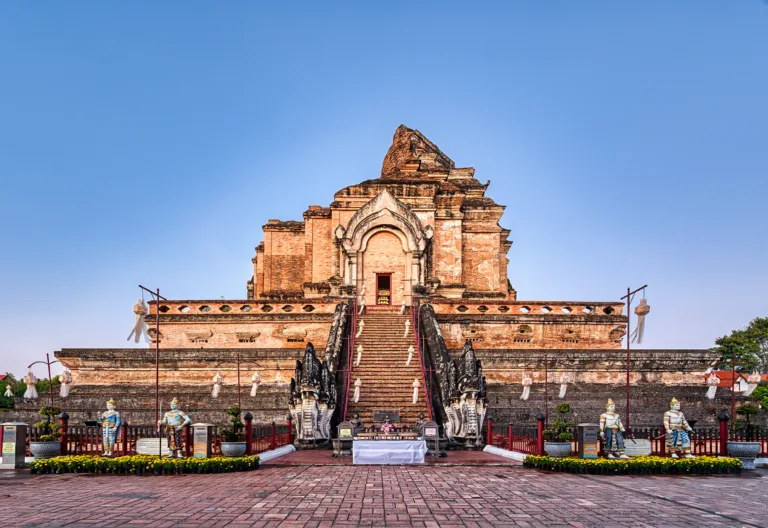
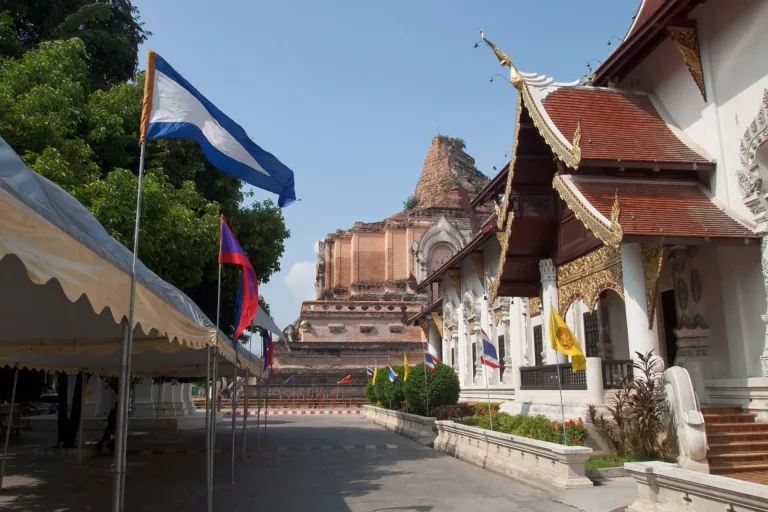
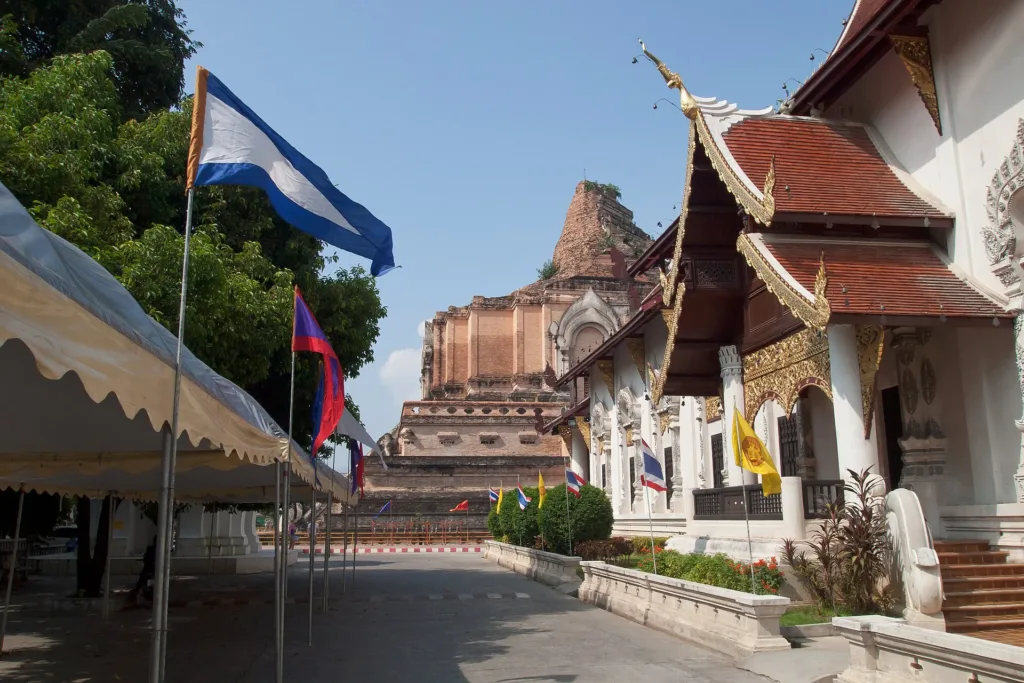
Wat Chedi Luang Varavihara is a second-class royal temple at 103 Phra Pokklao Road, in the middle of Chiang Mai's old walled city, about 1 km from Tha Phae Gate. Its grounds cover roughly 5 hectares, and at their heart stands the great chedi, known locally as "Ku Luang" — the largest brick stupa in Lanna. Its top collapsed in an earthquake in 1545, yet it still rises about 42 m on a base some 60 m wide. The temple also holds the Inthakhin, Chiang Mai's city pillar, and is the centre of the Thammayut order in northern Thailand.
The temple was once called Wat Chotikaram, "the radiant monastery". Two stories explain the name: one says an oil-soaked cloth was lit as a lamp on the chedi and its glow carried far; the other says the slender stupa looked like a candle stand. Lanna texts call the chedi "Ratchakut" or "Ku Luang", sometimes "Ratchakutakhan". It later became Wat Chedi Luang, since "luang" in northern Thai means great.
The temple's own legend reaches back before Chiang Mai existed. In the time of Emperor Ashoka, it says, eight missionary monks led by Sona and Uttara came to Suvarnabhumi and enshrined relics in a small chedi three cubits high on this spot. A 120-year-old man foretold that a great monastery called Chotikaram would rise here, and the Lua people built a chedi to honour it. There is no archaeological evidence for this, but it shows how long locals have regarded the site as sacred.
According to the Chiang Mai Chronicle, King Saen Mueang Ma, seventh ruler of the Mangrai dynasty, built the chedi in 1391 to enshrine relics and dedicate merit to his father, King Kue Na. He had been on the throne about 16 years. The texts disagree on the date, so scholars often give a range of 1385–1402. The king died before it was finished, and his queen, Tilokachuda, carried the work on.
The Jinakalamali tells it slightly differently: King Kue Na had wished for a great chedi, and when Saen Mueang Ma took the throne he ordered one so tall that his father in heaven could see it, covering the relic chamber with a great deal of sheet gold. Queen Tilokachuda continued but did not finish, so some versions credit King Sam Fang Kaen with completing it in about five years.
The biggest change came under King Tilokaraj. In 1479 he had the builder Muen Dam Phra Khot enlarge the chedi and change it from five spires to a single one. When finished it stood about 80–82 m tall (some sources say 90 m) on a base about 54 m across — the tallest structure in Lanna at the time, and the tallest in Chiang Mai for centuries.
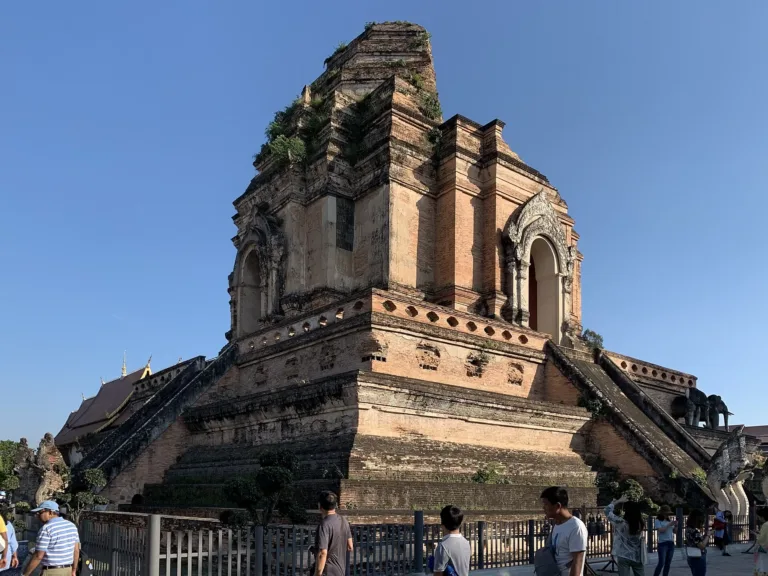
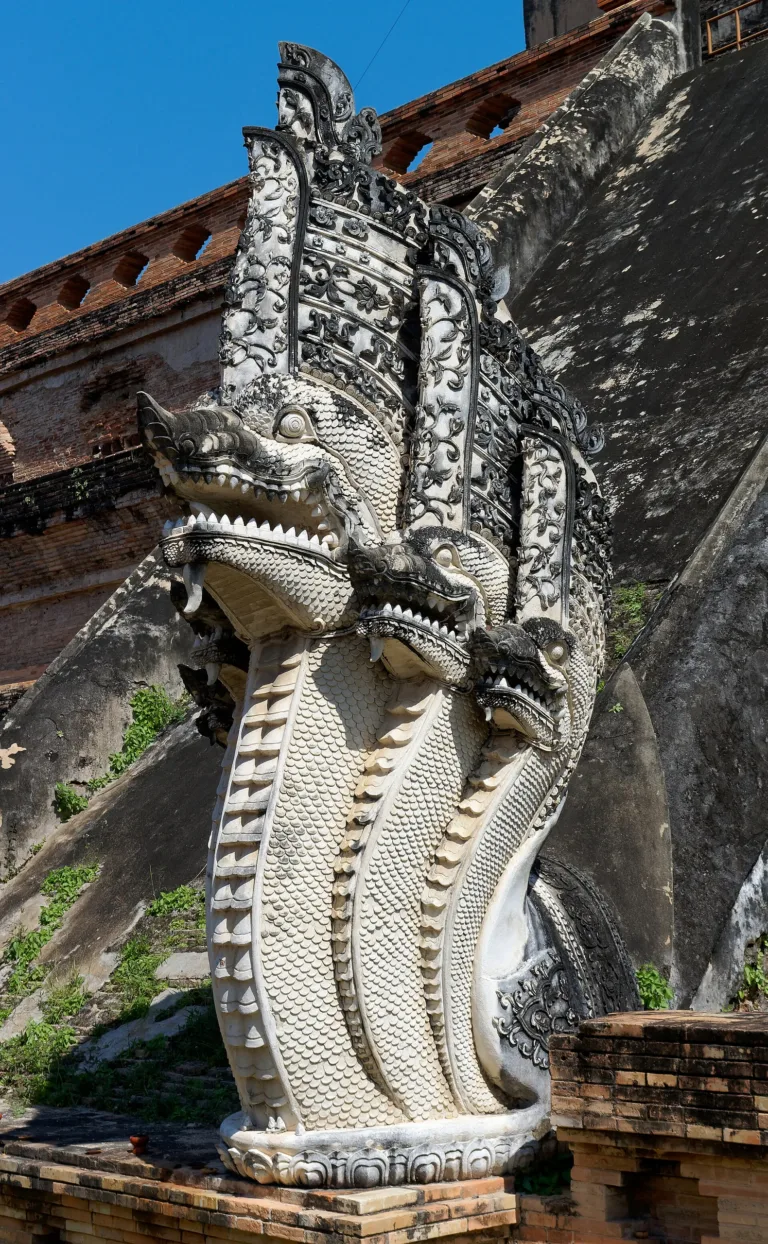
The Yonok Chronicle says the craftsmen modelled the work on the Lohaprasada and the Ratnamali (Ruwanwelisaya) stupa in Sri Lanka, and enshrined relics brought from Sri Lanka inside. Half-bodied stucco elephants emerge from the base as if carrying the stupa, a symbol of elephants supporting the faith. Twenty-eight remain today, most of them remade during restoration, and eight have their own names. Naga stairways on all four sides lead up to the niches halfway up the chedi.
A 2022 article in the Panidhana journal reads the enlargement as an expression of King Tilokaraj's "chakravartin" ideal. The single bell-shaped spire, the elephants and lions around the base, the meditating Buddha under a bodhi tree in the niches and the installation of the Emerald Buddha together recreate the Mahabodhi mandala, the centre of the Buddhist universe, reinforcing the king's standing as a righteous ruler. The authors stress that this is a symbolic interpretation, not a settled fact.
From 1468 to 1551 the Emerald Buddha sat in the eastern niche of the chedi. King Tilokaraj brought it from Lampang, and it stayed in Chiang Mai for about 80 years until 1551, when King Setthathirath, who briefly ruled Lanna, took it to Luang Prabang. It later moved to Vientiane and finally to Bangkok under King Rama I.
Later Lanna kings kept caring for the temple. King Yot Chiang Rai gilded the niches, and King Kaeo (Mueang Kaeo) restored the base, gilded the chedi, built a hall for the Emerald Buddha and added a triple wall around it. This was probably when the chedi looked its finest.
In the past several monastic communities surrounded the chedi, including Wat Ho Tham and Wat Sop Khamin (now usually written Wat Sukmin), which were later merged into Wat Chedi Luang. Research in the PCJ journal suggests the practice of several communities jointly caring for a great relic stupa goes back more than 500 years in Lanna, and that Wat Chedi Luang may once have been the chief temple of the Pa Daeng sect — though that last point remains a hypothesis.
In 1545, during the reign of Queen Chiraprapha, a strong earthquake struck Chiang Mai and brought down the top 30 m or so of the spire. It was never rebuilt, which is why the chedi stands about 42 m tall today.
Monks stayed on after Burma took Chiang Mai in 1558. An inscription on a Buddha image in the old ordination hall, dated 1587 under the Burmese-appointed ruler Narathamangcho, mentions the "head of Wat Chetiya Luang" and a Mahasangharaja who presided over the temple. The temple bell, cast in 1626, still hangs in the belfry northeast of the chedi. But no ruler in the Burmese period was able to rebuild the spire.
At the end of Burmese rule, war left Chiang Mai abandoned for about 20 years, until King Kawila, who had driven out the Burmese together with Siamese forces, revived the city in 1796. Wat Chedi Luang, at its centre, was restored along with it.
The Inthakhin legend says this land once belonged to the Lua, who were tormented by evil spirits. Indra told them to keep the precepts and stay truthful, then created wells of silver, gold and gems in the middle of the city, watched over by nine Lua families. When word of the wealth spread, other cities marched in to claim a share, so Indra sent two kumphan giants, Phaya Yakkharat and Phaya Amorathep, to carry the Inthakhin pillar down and plant it in the centre of Wiang Nopburi to protect the city.
Later the people grew greedy, and enemies disguised as traders came asking for treasure. Angered, the giants carried the pillar back to heaven and the three wells dried up. A grieving old Lua man became an ascetic and meditated under a yang tree for three years. A senior monk foretold disaster and advised the people to cast a huge cauldron filled with figures of animals and of people of many tongues, bury it, and set the pillar on top with offerings. That rite became the Sai Khan Dok festival still held today.
Tradition holds that in 1800 King Kawila moved the pillar from Wat Inthakhin Saduemueang (near today's Three Kings Monument) to Wat Chedi Luang, built a shrine over it, planted three yang trees beside it and added statues of the kumphan giants and the hermit. The trees, now over 200 years old, are seen as the city's guardians. But Matichon Weekly notes that scholars have found no firm evidence for the move, and still debate whether "inthakhin" in Lanna times meant a city pillar or a gate and boundary post.
The debate stems from another Inthakhin pillar found in a small room beside Tha Phae Gate. It bears a chant and the number 829, which in the Lesser Era would be 1467, under King Tilokaraj. It was moved to the Chiang Mai National Museum in 1986 before the gate was restored. Some scholars think the chant is much later, so the question remains open.
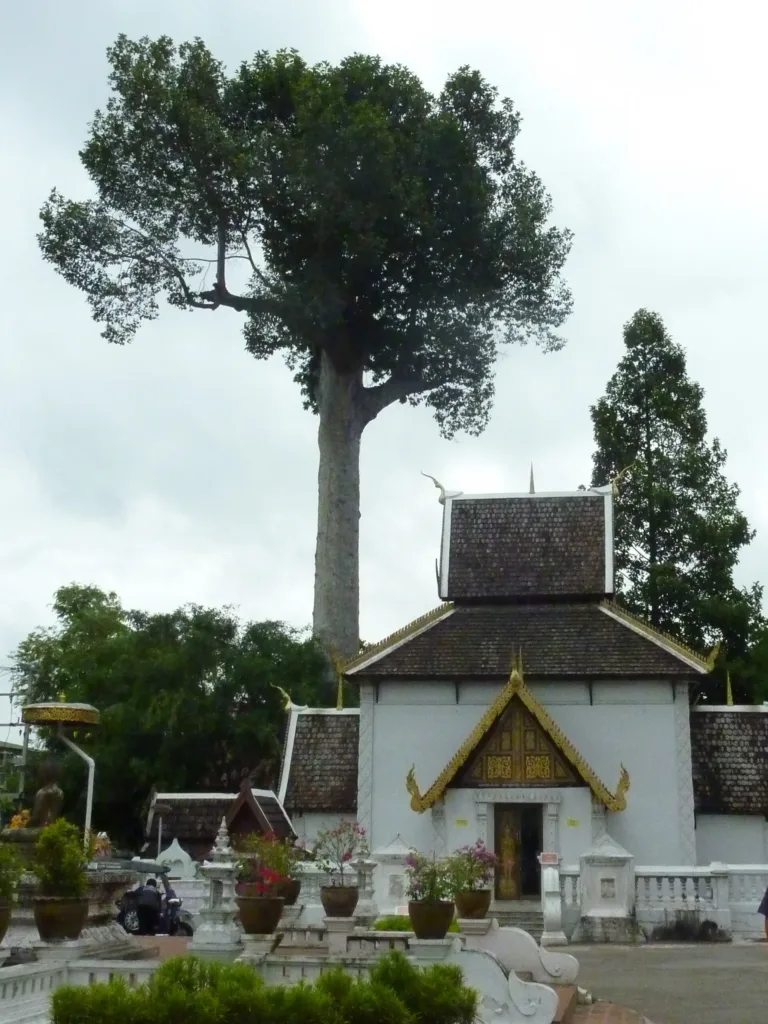
The Inthakhin shrine was repaired under King Inthawichayanon around 1880, and when it decayed Khruba Khao Pi built a new four-gabled Lanna shrine in 1953. The pillar itself lies beneath a throne holding a Buddha in the rain-calling posture; what you see is a brick pillar about 2 m tall decorated with coloured glass. By tradition, women do not enter the shrine.
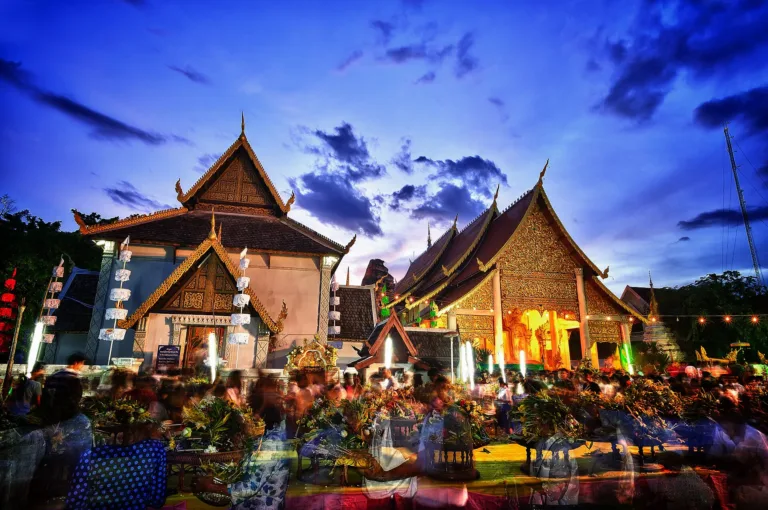
The Khao Inthakhin or Sai Khan Dok festival runs every year from the 13th waning day of the eighth Lanna month to the 4th waxing day of the ninth — roughly late May to early June — hence the saying "enter in month eight, leave in month nine". On the first day the Phra Chao Fon Saen Ha, the city's rain-calling Buddha, is paraded from Wat Chang Taem and kept at Wat Chedi Luang for people to bathe and ask for rain, while nine monks chant. People bring flowers, incense, candles and scented water to the bowls around the shrine. The festival paused during the Second World War and is now hosted by Chiang Mai municipality; in 2025 it ran 23–29 May, with the closing merit-making on the 30th.
Under the Chiang Mai princes, Phraya Kham Fan restored the ordination hall. Around 1880, according to a record by Phra Khru Yan Langka of Wat Thung Yu, King Inthawichayanon built an ordination hall and the reclining Buddha chapel, and repaired the Inthakhin pavilion and the kumphan shrine.
In the reign of King Rama V, the Thammayut order spread from Bangkok to Chiang Mai, and Wat Chedi Luang became its centre in the city. Silpa Wattanatham magazine notes that Khruba Siwichai (1878–1938), who restored a great many Lanna temples including Wat Phra That Haripunchai and Wat Phra Singh and led the building of the road up Doi Suthep, never worked on this central temple. Scholars suggest this is because the Thammayut arrived with central government power, unsettling the old Lanna sangha, and Khruba Siwichai himself faced several ecclesiastical charges at the time — though this remains conjecture.
Between 1928 and 1938 Chao Kaeo Nawarat, the last ruling prince of Chiang Mai, and Phra Upali Gunupamajarn (Chan Sirichanto) carried out a major restoration. The present Viharn Luang dates from 1928, and its naga stairway is often called the finest in Chiang Mai. Phra Upali also served as abbot in the early years of this period.
After Phra Upali died on 19 July 1932, Ajahn Mun Bhuridatto, whom he had invited to Chiang Mai, served as acting abbot and spent the 1932 rains retreat here. Once the retreat ended he gave up the post and went back to wandering in the forests. Luang Ta Ket, the only monk Ajahn Mun ever ordained himself, lived at Wat Chedi Luang until he died on 2 July 1969.
The temple has stayed closely tied to Ajahn Mun's forest tradition. Luang Pu Thet Thesrangsi stayed in 1933, Luang Pu Waen Suchinno was re-ordained here in 1937, and Luang Pu Jia Chunto came in 1940. Luang Ta Maha Bua visited on 1 February 2002 and laid the foundation stone of the Luang Pu Mun viharn the next day. The memorial Chaturamukh Burajarn viharn was dedicated on 13–14 January 2006.
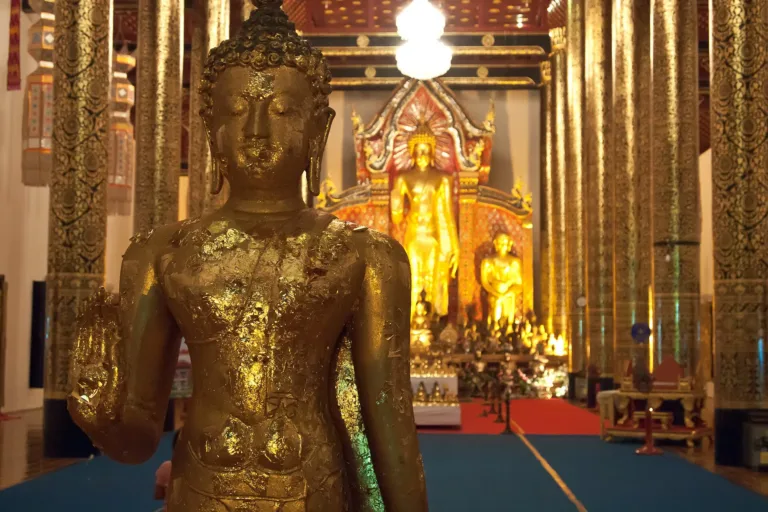
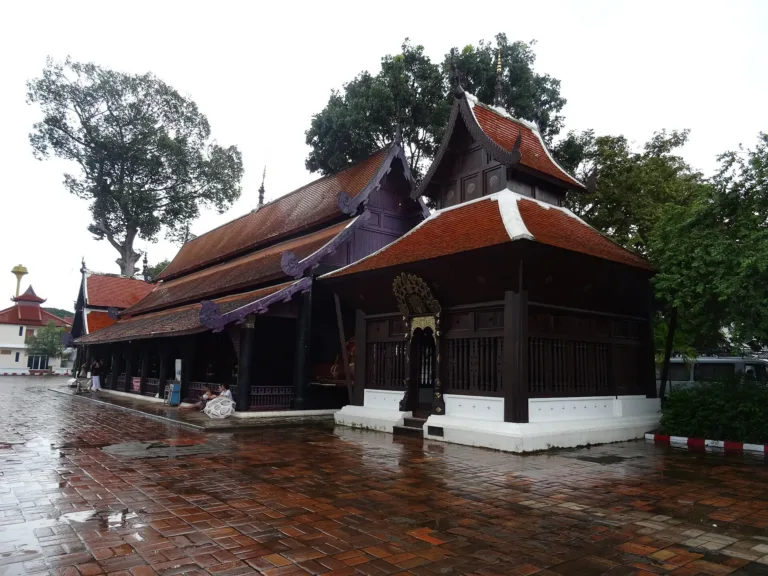
The Viharn Luang houses Phra Chao Attarot, a standing bronze Buddha in the 'calming the relatives' posture, about 8 m (18 cubits) tall. The temple's history says Queen Tilokachuda had it cast around the time the chedi was built (some sources say late 14th century). The grounds also include a reclining Buddha chapel near the front and an ordination hall.
The old ordination hall's main Buddha is a bronze image in the earth-touching posture, about 58 inches across the lap. Around 1947 it was coated in cement lotus petals and bronze-gold paint. When the temple restored it in 2021–2022 with permission from the Fine Arts Office, craftsmen chipped away the cement and found an inscription on the base dated 1587, naming the donor Panya Raksa with his wife and mother. Earlier, in 1992, a Buddha image inscribed with the year 930 (about 1568) was found in the chedi's southern niche.
The Fine Arts Department registered Wat Chedi Luang as an ancient monument on 19 April 1960, excavated it in 1986 and 1990, and restored the chedi between 1990 and 1992 at a cost of about 35 million baht, with support from UNESCO and Japan. The work uncovered the original naga stairs and tunnels inside the stupa.
The restoration drew heavy criticism, because the new niches and nagas look more Central Thai than Lanna. Only the north side keeps its original stucco. As you walk around, compare the north face with the others and the difference is easy to see.
In 1995, for the chedi's 600th anniversary, the temple placed a black jade Buddha, "Phra Phuttha Chaloem Sirirat", in the eastern niche — the spot where the Emerald Buddha once sat — in memory of its time here.
On 28 March 2025 a major earthquake in Myanmar shook Chiang Mai, and Wat Chedi Luang was one of eight ancient sites in the city reported damaged. The white chedi north of the ordination hall and the viharn walls cracked, though engineers found the cracks only in the plaster, and the great chedi lost a few bricks without structural harm. The governor and the Fine Arts Department oversaw repairs — a reminder of the 1545 quake that brought the spire down.
Wat Chedi Luang is still a living temple. It hosts the Lanna campus of Mahamakut Buddhist University and a daily Monk Chat where visitors can talk with monks and novices in English. There is also a chedi holding the ashes of former abbot Phra Phutthaphotchanawaraporn (Chan Kusalo), cremated in 2010, and a small museum.
To take in the whole story, start at the Viharn Luang to pay respect to Phra Chao Attarot, then walk clockwise around the chedi to see the elephants and the eastern niche that once held the Emerald Buddha. Continue to the Inthakhin shrine and the three yang trees, and finish at the reclining Buddha chapel and the Monk Chat corner. Morning light falls on the east face; in the evening the chedi is floodlit.
Arrived? Check in, collect a stamp and tell others what it is like right now
Check your location first, so you do not fill in the form for nothing
Location must be on and within 0.2 km · One check-in per place per day · come back on other days to check in again
Post photos from anywhere — no need to be here · Up to 20 photos at a time · JPG / PNG / WebP · GPS location data is removed automatically
From Tha Phae Gate along Ratchadamnoen Road, then left on Phra Pokklao Road · Free
Flag one down in town and ask for Wat Chedi Luang · 30–50 baht
Grab / Bolt from Nimman or the railway station · 60–120 baht
Rent in the old city and park at the temple · 20 baht parking
On Phra Pokklao Road between Ratchadamnoen and Ratchamanka roads. The main gate faces Phra Pokklao Road, with side gates on Ratchamanka Road.
Parking inside the temple (few car spaces, fills up at weekends); motorbikes about 20 baht
Strong 4G/5G throughout
About 6:00–18:00 (ticket booth may close earlier) · Monk Chat about 9:00–18:00
around 1 km fromTha Phae Gate
Wat Chedi Luang Varavihara
50 THB
Approx. nightly price for 2 adults (next week) · final price depends on your dates
Answers travellers want before they go — a one-minute read
Tradition says King Saen Mueang Ma began the chedi around 1391, and King Tilokaraj enlarged it in 1479
An earthquake in 1545 brought down the top 30 m, and it was never rebuilt
Yes, in the eastern niche from about 1468 to 1551, before it was taken to Luang Prabang
Free for Thais; about 50 baht for foreigners (40 baht at some times)
By tradition no, but anyone can leave flower offerings outside
From the 13th waning day of Lanna month 8 to the 4th waxing day of month 9, around late May–early June
Best day this week: Thursday 29 Oct · Check in when you arrive to collect a stamp