 01
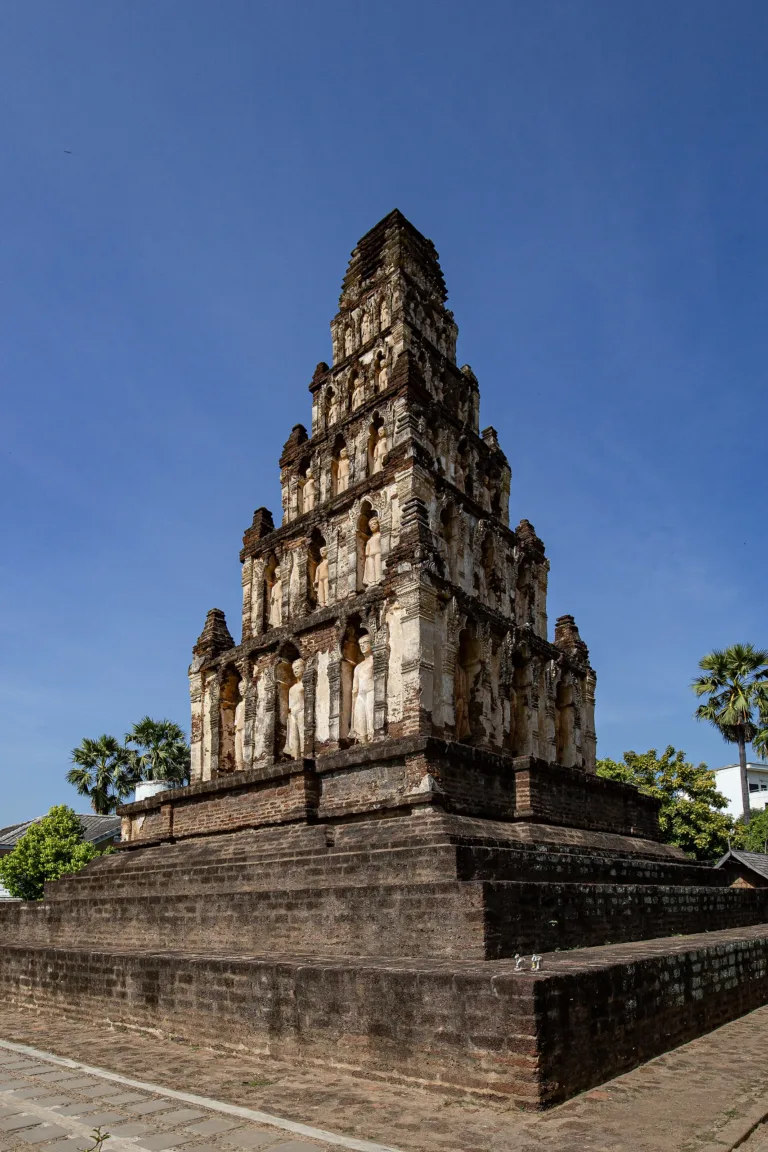
Ku Kut chediFive-tiered laterite stupa whose spire has been lost
LAMPHUN · HARIPUNCHAI
A Haripunchai-era temple with the Ku Kut chedi, 60 standing Buddhas, and the site of Kruba Sriwichai's royal cremation
Holiday / event — crowded · Hot (Afternoon) feels like 39°C
Open daily during daytime, no entry fee
Before 10:00 or after 15:30 for good light and cooler air
01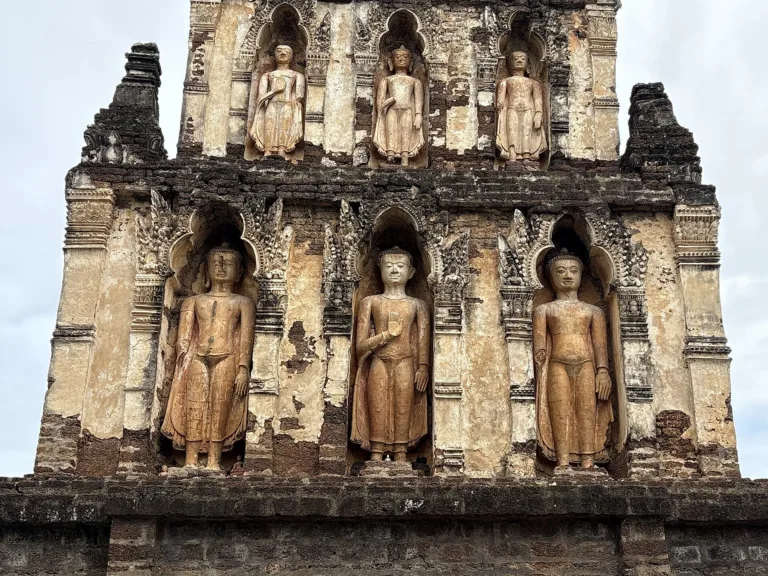 02
 03
 04
 05
Tap a day card to see that day’s weather, rain, haze and hourly forecast
Best time to go Fine all day little rain through the day
Holiday — traffic on the way up and parking fills fast; leave early
Green band = hours used for the score
Best time to go Fine all day little rain through the day
Holiday — traffic on the way up and parking fills fast; leave early
Green band = hours used for the score
Best time to go Fine all day little rain through the day
Holiday — traffic on the way up and parking fills fast; leave early
Green band = hours used for the score
Best time to go Best window 06:00–15:00 Little rain · light drizzle possible at times
No warnings today — normal road and weather conditions
Green band = hours used for the score
Best time to go Best window 08:00–17:00 Little rain · light drizzle possible at times
No warnings today — normal road and weather conditions
Green band = hours used for the score
Best time to go Fine all day little rain through the day · light drizzle possible at times
No warnings today — normal road and weather conditions
Green band = hours used for the score
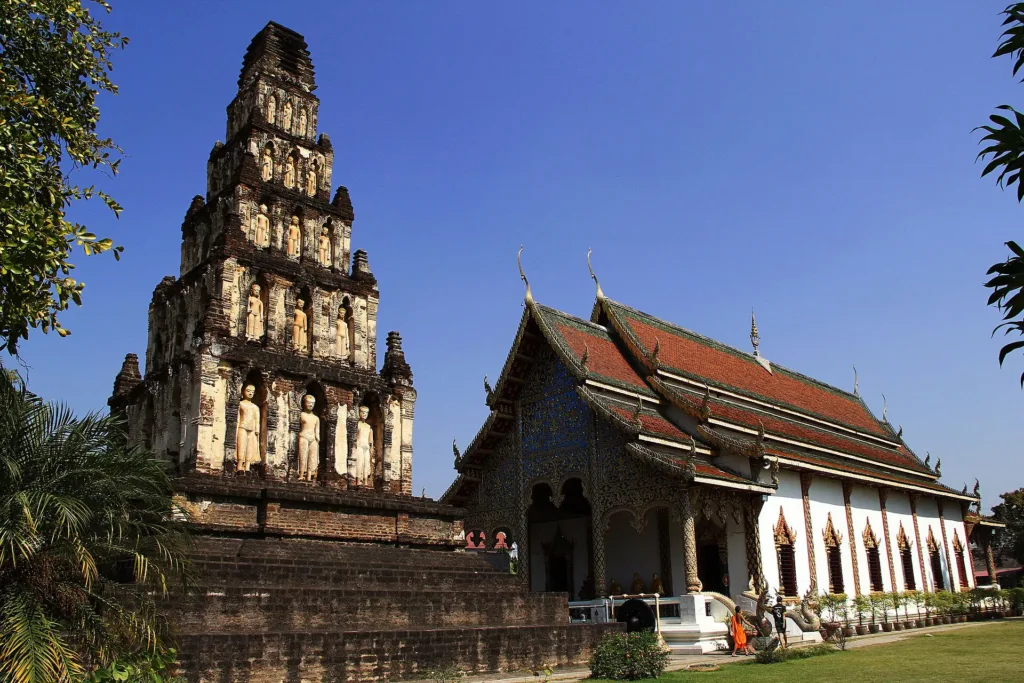
Wat Chamadevi, also called Wat Ku Kut, is an ancient Haripunchai-era temple on the west side of Lamphun town. It is home to the Ku Kut chedi, a five-tiered laterite stupa with 60 standing Buddha images set in its niches.
The temple also has an octagonal brick chedi and the residence of Kruba Sriwichai, who restored the temple in 1936 and whose royal cremation took place here in 1946. Entry is free and a visit takes 30 minutes to an hour.
Photos from Wikimedia Commons and contributors · full credits inClassic page
Do not climb or touch the chedi or the stucco Buddhas, which are very fragile
It is a temple, so cover shoulders and knees
The courtyard around the chedi has little shade and is very hot at midday
Adults 0 THB · Time needed 30 minutes – 1 hour
Weekends and long holidays, especially during the cool-season Lamphun–Chiang Mai travel period
| Flowers, incense and candles (optional donation) optional | 20 ฿/set |
Mostly cash · Prices may change by season — check with the venue
Tap a month on the wheel to see weather, rain, haze and crowds from 10 years of records
Best time · November to January is cool and clear. Soft morning and late-afternoon light brings out the stucco Buddhas in the niches, and walking around the temple is comfortable.
Watch out · March and April are very hot and Lamphun's haze is heavy, so the courtyard is scorching at midday. The rainy season brings afternoon showers.
Oct by the records 23–30°C · avg rain 192 mm (20 rainy days) · clear 7 days · avg PM2.5 12
Wat Chamadevi stands on Chamadevi Road in Mueang Nga subdistrict, about 1.5 km west of the Lamphun provincial hall. Locals know it as "Wat Ku Kut" or "Wat Ku Kuti", and the chronicles call it "Wat Mahaphon". In northern Thai, "kut" means truncated, because the main chedi has lost its spire. "Wat Chamadevi" is the official registered name; the Sirindhorn Anthropology Centre states that Prince Damrong Rajanubhab renamed it from Wat Ku Kut in 1937.
Some local documents say the temple was originally called "Wat Sangkharam" before villagers began calling it Wat Ku Kut after its broken-topped chedi. No contemporary evidence confirms who built it or when; most information comes from legends and chronicles written centuries later. Some local articles give a legendary founding date of around BE 1298 (about 755 CE) in Queen Chamadevi's time, and the various documents contradict one another considerably.
The name honours Queen Chamadevi, the first ruler of Haripunchai. According to legend, the hermit who founded Haripunchai invited a princess from Lavo (Lopburi) to rule the city, and some sources put her arrival around 679 CE. She bore twin sons, Mahantayot and Anantayot. Another legend tells how Khun Viranga, a Lua chief, asked for her hand; she challenged him to throw a spear from Doi Suthep into Haripunchai, and he failed three times. A mural of this story is in the temple vihara.
One tradition says that after Queen Chamadevi died, her sons built the temple and the "Suwan Chang Kot" chedi to hold her ashes, which would date it to around the 8th century CE. Another comes from the Jinakalamali chronicle: around 1073 CE (BE 1616) a Lavo army was defeated by King Athitayarat (some versions say Thittaraj) of Haripunchai, and the captives were made to build the "Mahaphon chedi". Scholars Santi Leksukhum and Piriya Krairiksh identify this with today's Wat Chamadevi.
Local chronicles tell the story of the Suwan Chang Kot chedi differently. The Chamadevi chronicle translated from Tai Yuan describes her cremation and the building of the Suwan Chang Kot chedi south of Haripunchai. The Mulasasana chronicle describes a procession of her ashes and the enshrining of her personal belongings and ornaments in the chedi. The Chamadevi Haripunchai Chiang Mai chronicle adds that her royal elephant collapsed and its tusks and bones were enshrined too. Some scholars, however, think the Suwan Chang Kot of legend may be a different monument from the Ku Kut chedi standing today.
Art-historical and epigraphic evidence suggests the chedi seen today was built or rebuilt around the 11th–12th century CE in the Haripunchai period. Saenoe Nildej dated Ku Kut to around the 11th century in a Lavo–Haripunchai style; Santi Leksukhum placed it in the reign of King Sabbadhisiddhi; while Prince Damrong had earlier proposed that it was a Lavo-style chedi built by Lavo craftsmen in Chamadevi's time.
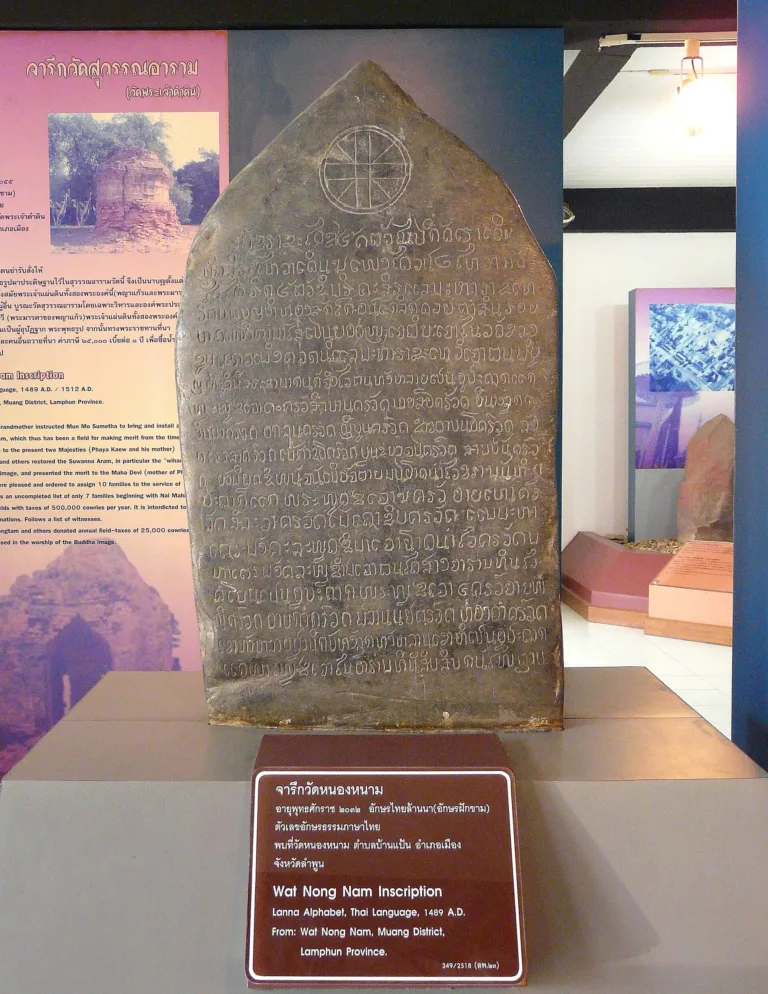
The key evidence is a Mon-language stone inscription found at the east base of Ku Kut, dating to around the mid-13th century CE. It records that King Sabbadhisiddhi built or restored a chedi that had collapsed in an earthquake; Piriya Krairiksh dates this major restoration to around 1218 CE. According to R. Halliday, the script of the Lamphun inscriptions resembles that of King Kyanzittha of Pagan (1084–1113). The inscription is now displayed at the Haripunchai National Museum.
The Wat Ku Kut inscription is one of seven Mon inscriptions from Lamphun studied by R. Halliday and rendered into Thai by M.C. Subhadradis Diskul. It mentions the restoration of a "Ratana chedi" that had collapsed in an earthquake, a well within the monastery, and a donation of land to the temple. Parts of the text are damaged, and it was published in Inscriptions in Thailand, vol. 2 (1986). The Wat Don inscription of the same king tells how he and his two sons, Mahanama and Kaccaya, were ordained under the royal preceptor, and how he built three chedis in front of Wat Chetawan and monks' quarters. Together they show Haripunchai as a flourishing Buddhist city in the 13th century.
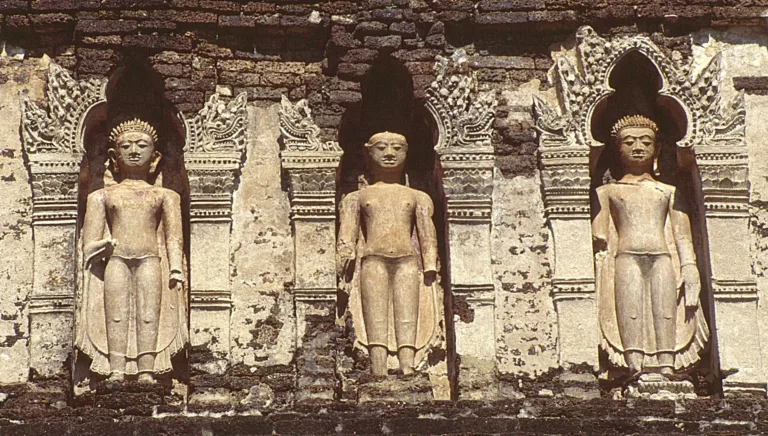
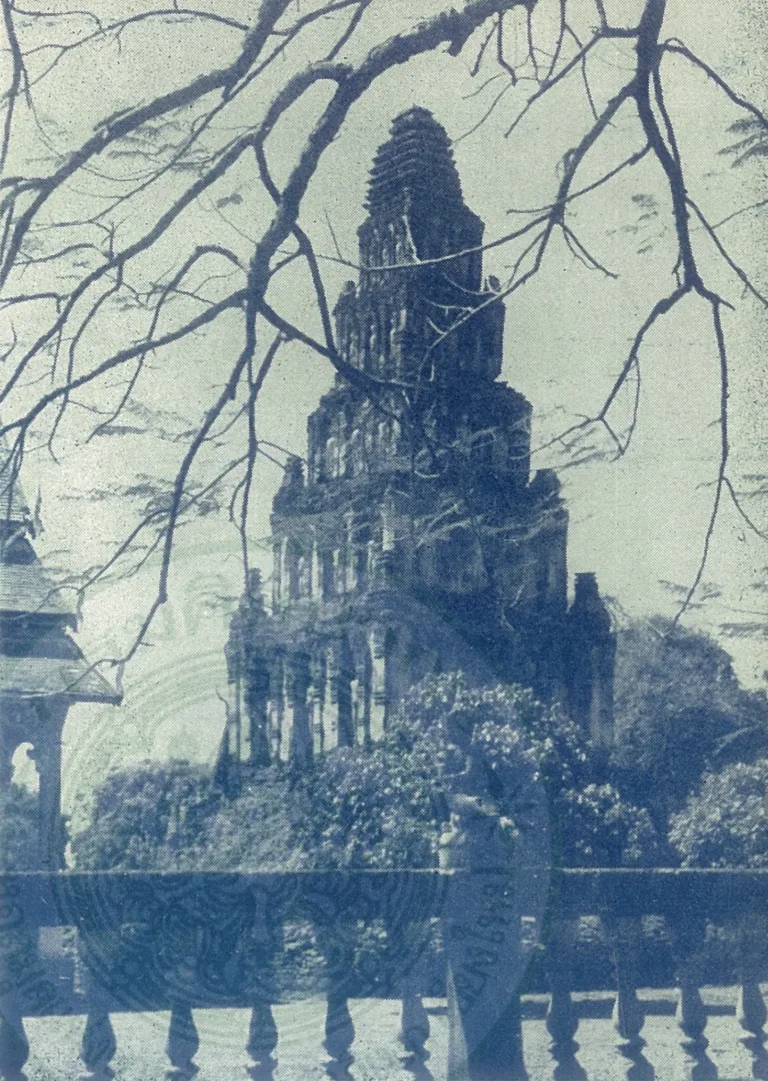
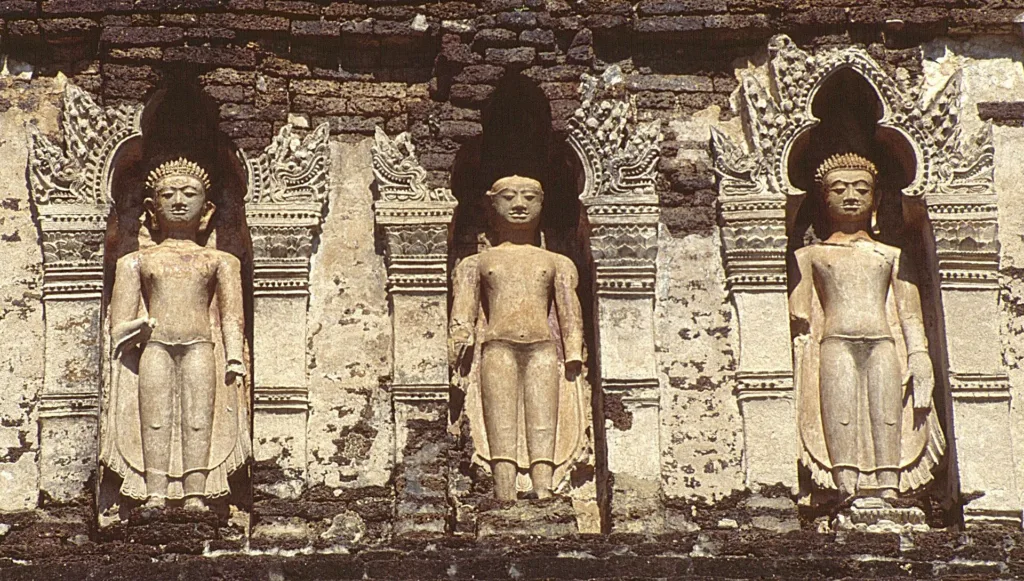
The Ku Kut or Suwan Chang Kot chedi is built of laterite. It is a square, prasat-style stupa rising in five stepped tiers like a pyramid. Each tier has three niches per side holding standing Buddhas, twelve per tier and sixty in all. Scholars read the number sixty in several ways, for example as past Buddhas, or as the first sixty arahants of the Buddha's life: the five ascetics, Yasa and his 54 companions. Small stupas mark each corner, and the main spire is lost; some suggest it ended in a lotus bud. The Buddhas show the gesture of dispelling fear (abhaya). Foreign travel sources give the chedi a height of about 21 m (no Fine Arts Department figure has been found), and some say its form was inspired by the Mahabodhi temple at Bodh Gaya. The design is comparable to the Suwanna (Pathumwadi) chedi at Wat Phra That Haripunchai, and the chedi at Wat Chedi Liam in Wiang Kum Kam, built by King Mangrai, is believed to have been modelled on it.
The second monument is the octagonal brick chedi, known as the "Rattana chedi". Its base resembles a Dvaravati moulded base, and the eight faces of its body each hold a standing Buddha in a niche. The niche arches are of a Burmese type ending in makara heads, and above them rose a round bell-shaped stupa whose top is also lost. Foreign travel sources give a height of about 11.5 m and date it to the early 13th century. Scholars compare it with Chedi No. 13 at U Thong and with a similar form at Wat Phra Kaeo in Sankhaburi. The names of the two chedis are often swapped, since it is still unsettled which one is the Rattana chedi built or restored by King Sabbadhisiddhi.
The Buddha images in the niches record repairs over many periods. The first generation had moulded terracotta heads on stucco bodies with wooden armatures for the hands, possibly in the teaching or calming-the-ocean gesture. The second generation is entirely stucco, with only the flame finial and hair curls in terracotta. A Fine Arts Department conservation project in 1991 found dozens of layers of whitewash over the original sculpture, and found that the Buddhas of the octagonal chedi had been repaired less than those of Ku Kut.
Besides the two ancient chedis, the temple has a vihara built in Kruba Sriwichai's time, housing the principal Buddha image. Its murals tell the history of Haripunchai, including its wars and the legend of Queen Chamadevi and Khun Viranga. The ordination hall has a Lanna-style gable, with a stone stele in Mon script nearby, and a later chedi holds golden Buddha images in niches on all four sides.
The temple was later abandoned for a long time. When Prince Damrong accompanied King Prajadhipok on his tour of the northern region around 1926, he surveyed Wat Ku Kut. Chao Chakkham Khachonsak, the last ruler of Lamphun, had the site cleared for the royal visit, and King Prajadhipok and Queen Rambai Barni viewed the ruins while the temple was still deserted (some documents date the renaming to Wat Chamadevi to that visit, others to 1937). The Fine Arts Department registered it as an ancient monument in the Royal Gazette on 8 March 1935. In 1936 Chao Chakkham Khachonsak, together with nobles, officials and the people of Lamphun, invited Kruba Sriwichai to restore it. He and local devotees cleared the overgrown ruins and built an ordination hall, a vihara and monks' quarters. When the work was finished around 1937 a celebration ran for 15 days and 15 nights, and it is said to be the last temple Kruba Sriwichai restored. The temple received its royal grant of consecrated ground on 2 September 1937, and the boundary stones of the ordination hall were consecrated on 1 December 1937. A photograph from 1954 still shows the Ku Kut chedi standing among trees before modern restoration.
Wat Chamadevi is also where Kruba Sriwichai's life ended in ceremony. He died at Wat Ban Pang in Li district on 21 February 1938 (some documents say 20 February or 22 March). His body lay at Wat Ban Pang for about a year and was then moved to Wat Chamadevi, where his royally sponsored cremation was held on 21 March 1946. Crowds scrambled for his relics, which were divided into seven parts; the first was enshrined at Wat Chamadevi, and his residence in the temple still draws worshippers. In 2023 there was a plan to nominate him to UNESCO as a person of world significance for his 150th birth anniversary in 2028.
Near the former cremation site stands a stupa holding Kruba Sriwichai's relics. In 1974 a wooden monks' house with a local-style tile roof was built at the request of Kruba Chaiyawongsaphatthana of Wat Phra Phutthabat Huai Tom, as his lodging while he built an ordination hall and the temple's south wall; it later housed monks and novices. In 2013 the abbot turned it into the "Hong Nitat Kruba Sriwichai" exhibition hall, with six rooms including a portrait statue of Kruba Sriwichai and photographs of him.
The Fine Arts Department restored the lower base of Ku Kut in 1961 and 1974, and added to its registration in the Royal Gazette on 25 September 1979. In 2009 Ku Kut and Kruba Sriwichai's residence were restored again under the department's supervision. Because of its importance, Muang Boran in Samut Prakan built a replica of the chedi, and some scholars consider it one of the most complete surviving records of Mon–Dvaravati art in Thailand.
Visitors can help protect the monument by dressing modestly, never climbing, touching or leaning on the chedis and the very fragile stucco Buddhas, and walking clockwise around them quietly.
Arrived? Check in, collect a stamp and tell others what it is like right now
Check your location first, so you do not fill in the form for nothing
Location must be on and within 0.5 km · One check-in per place per day · come back on other days to check in again
Post photos from anywhere — no need to be here · Up to 20 photos at a time · JPG / PNG / WebP · GPS location data is removed automatically
From Chiang Mai take the Chiang Mai–Lamphun road (Highway 10…
Highway 106 or Highway 11, about 28 km · Fuel
Chiang Mai–Lamphun, then a samlor in town · By distance
On Chamadevi Road, about 1.5 km west of the Lamphun provincial hall, on flat town roads
Parking inside the temple grounds
Petrol stations in Lamphun town
Excellent mobile signal, in town
Open daily during daytime, no entry fee
around 28 km fromChiang Mai city
Wat Chamadevi (Wat Ku Kut), Lamphun
0 THB
Approx. nightly price for 2 adults (next week) · final price depends on your dates
Best day this week: Monday 26 Oct · Check in when you arrive to collect a stamp