 01
That Kong Khao NoiLotus-bud stupa in the rice fields
A stupa in the fields and a moral tale · Yasothon
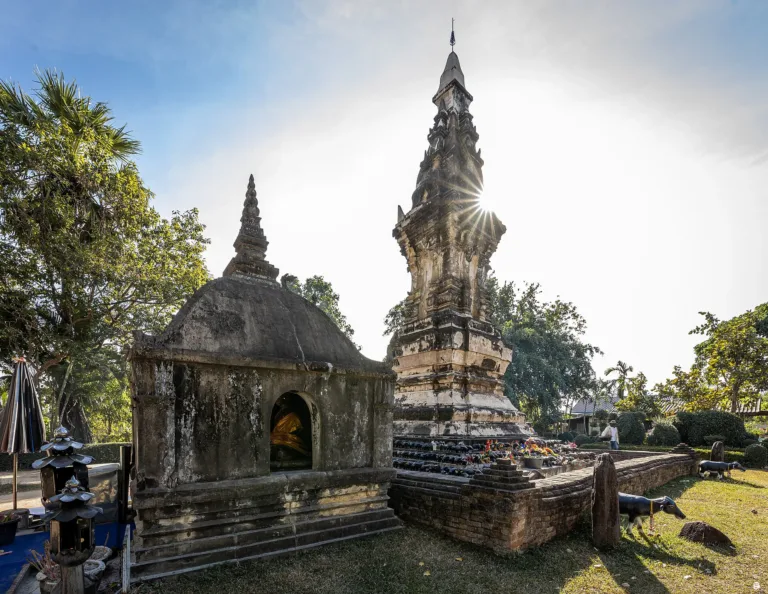
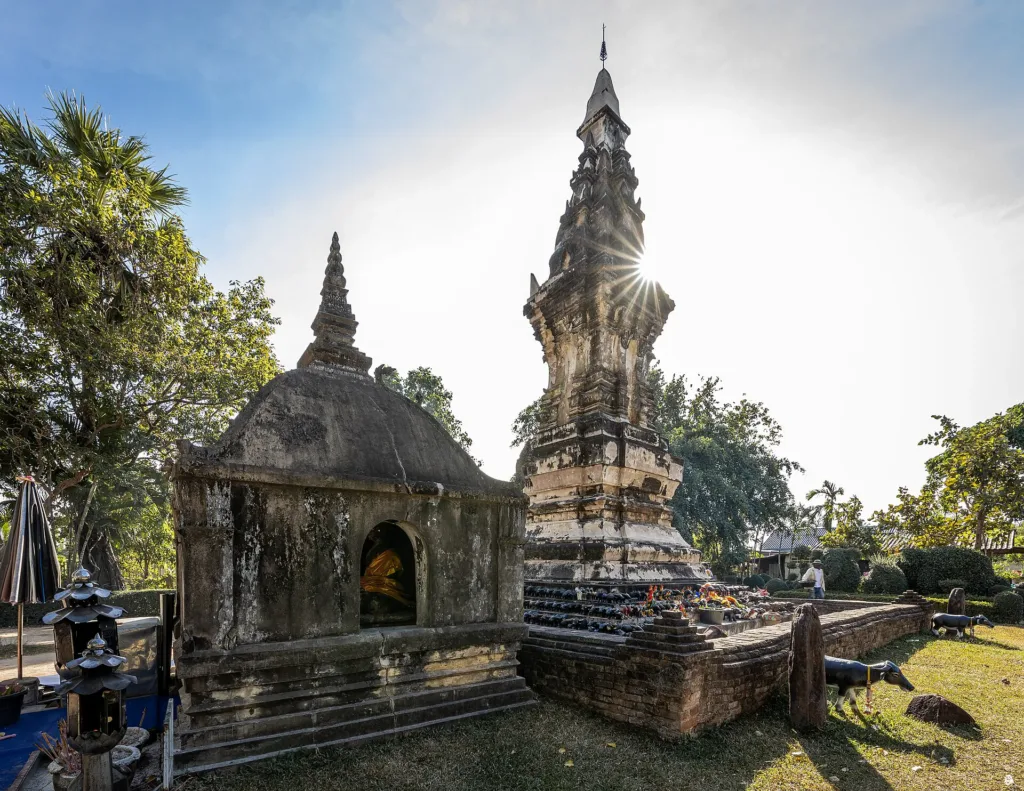
A brick lotus-bud stupa in the rice fields of Ban Tat Thong, Yasothon, tied to the Isan folk tale "Kong Khao Noi Kha Mae" and to the legend of building Phra That Phanom.
Hot (Afternoon) feels like 39°C
Dress modestly · Remove shoes to enter the ub mung shrine · Do not climb the stupa · Do not walk into villagers' rice fields
Daytime (outdoor monument)
Morning or evening to avoid the sun
Buddha bathing and gilding (April)
01 02
 03
Tap a day card to see that day’s weather, rain, haze and hourly forecast
Best time to go Fine all day little rain through the day
No warnings today — normal road and weather conditions
Green band = hours used for the score
Best time to go Fine all day little rain through the day
No warnings today — normal road and weather conditions
Green band = hours used for the score
Best time to go Fine all day little rain through the day
No warnings today — normal road and weather conditions
Green band = hours used for the score
Best time to go Best window 14:00–19:00 Little rain
No warnings today — normal road and weather conditions
Green band = hours used for the score
Best time to go Fine all day little rain through the day
No warnings today — normal road and weather conditions
Green band = hours used for the score
Best time to go Fine all day little rain through the day
No warnings today — normal road and weather conditions
Green band = hours used for the score
Best time to go Fine all day little rain through the day
No warnings today — normal road and weather conditions
Green band = hours used for the score
That Kong Khao Noi, or Phra That Tat Thong, is a brick-and-stucco lotus-bud stupa in the rice fields of Ban Tat Thong, about 9 km from Yasothon town, told alongside the Isan moral tale "Kong Khao Noi Kha Mae".
Arrive Morning or evening to avoid the sun
Photos from Wikimedia Commons and contributors · full credits inClassic page
Adults 0 THB · Car 0 THB · Time needed 30–60 minutes
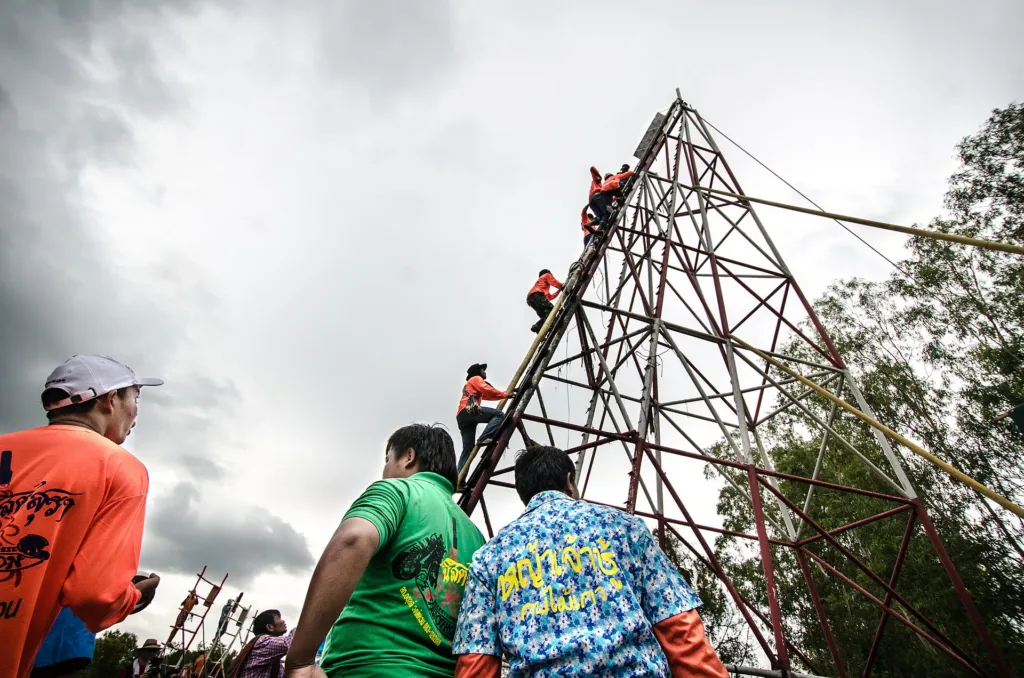
Songkran and the Yasothon rocket festival
| Entry | Free |
Cash · Prices may change by season — check with the venue
Buddha bathing and gilding (April)
Yasothon Hospital · Tourist Police 1155 · Emergency 1669
Tap a month on the wheel to see weather, rain, haze and crowds from 10 years of records
Best time · Nov–Jan: cool weather and golden fields at harvest
Watch out · Mar–May: very hot with no shade
Oct by the records 23–30°C · avg rain 175 mm (15 rainy days) · clear 4 days · avg PM2.5 7
That Kong Khao Noi, officially Phra That Tat Thong or Phra That Thad Thong, stands among the rice fields of Ban Tat Thong, Tat Thong subdistrict, Mueang Yasothon, about 9 km from town: take Highway 23 (Yasothon–Ubon Ratchathani) to km 194, then turn left for about 1 km.
Ban Tat Thong has been settled since prehistoric times through the Dvaravati period. Thai Wikipedia notes burials and pottery like that of the Thung Kula Ronghai plain, and an oval mound about 500 by 650 m ringed by a moat, now cut by the highway and densely built up. The Urangkhanithan chronicle of Phra That Phanom even mentions "the people of Sadao Tat Thong" bringing offerings to help build Phra That Phanom.
Ban Tat Thong's antiquity rests on more than its mound and moat. A Yasothon history article on GotoKnow, citing the Yasothon Provincial Office's 1986 official briefing, says a Fine Arts Department survey team dug up stone sema boundary markers at Ban Tat Thong, evidence of a long cultural continuity. The Dvaravati-era sema now standing around the stupa are traces of a religious site centuries older than the stupa itself.
Its architecture suggests the stupa was built in the 19th century (24th Buddhist century). A local tale says people from the Rattanaburi area gathered valuables to enshrine in Phra That Phanom, but on reaching Ban Tat Thong they met Ban Sadao villagers returning home because the restoration was finished. They built this stupa to hold their offerings instead, and the Sadao villagers brought the gold tray (thad thong) they had used to carry offerings to Phra That Phanom, giving the name Phra That Thad Thong or Tat Thong.
The stupa is a mondop-type brick-and-stucco structure with a square lotus-bud top on a square plan, unusual among stupas. The base is 2 m a side and about 1 m high; the middle has arched niches on all four sides that probably once held Buddha images, topped with "na nang" arches in floral stucco and pillars with a "sun-ray" pattern inlaid with glass. The square lotus-bud spire rises in three tiers. A 5 by 5 m brick wall surrounds it, along with Dvaravati-era sema stones and miniature lotus-bud stupas.
The travel site karnderntang.com adds that the stupa is about 10 m tall, with a two-tier "waisted bowl" base in Lan Xang style, but with small spires on all four sides of the top, unlike typical Lan Xang stupas. Its overall form resembles Phra That Si Khottabong in Laos and Phra That Phra Anon at Wat Mahathat in Yasothon town. Its age is debated: that site calls it "an ancient Khmer-era stupa", the provincial briefing cited on GotoKnow says it was "built in the Ayutthaya period", while the Fine Arts Department dating cited in the ONEP art-site database and Thai Wikipedia places it in the 19th century by style, which fits its Lan Xang–Isan lotus-bud form better.
In front stands an Isan-style "ub mung", a square shrine with a sloping dome roof, naga stucco along the ridges and a small stupa on top. Inside is a stucco Buddha in the subduing-Mara posture by local craftsmen, deeply revered. Every April villagers bathe and gild the image, believing that otherwise the year will be dry.
The folk tale that made the stupa famous tells of a young farmer, some say named Thong, ploughing in the midday heat, hungry and tired. His mother brought his rice late and the basket (kong khao) looked small; in anger he struck her and she died. Eating, he found the little basket held more rice than he could finish, was overcome with remorse, and built the stupa to atone. The tale is told to teach gratitude and self-restraint. Thai Wikipedia also notes a view that it should be called "That" rather than "Phra That", as it is not believed to hold Buddha relics, though this claim needs better sourcing.
The hero's name varies by teller: Sombun Sarathalai (1996) calls him "Thong", while the 1986 Yasothon provincial briefing calls him "Bunma". The plot is the same: hunger, a moment of rage and remorse that comes too late. Supakan Chanyanukul (2019) sums up its core lesson: acting without self-control leaves consequences that cannot be undone, even if one later repents. Ongart Harnchanawong's article states that the Ministry of Culture declared the Kong Khao Noi Kha Mae tale national intangible cultural heritage in 2013.
In the same subdistrict, Wat Thung Sadao at Ban Sadao has stupas that, per Thai Wikipedia, the Fine Arts Department believes are linked to the tale; villagers call one "That Luk Kha Mae" (the son-who-killed-his-mother stupa). There are two brick stupas, one complete and one reduced to its base; excavation found the base's altar platform extending under the complete stupa, showing the base is older. The complete stupa is an octagonal lotus-bud form in Isan style from about the 18th century, similar to stupas in Luang Prabang and Vientiane.
In 1982 villagers dug up four jars under the complete stupa at Wat Thung Sadao, holding carved wooden, silver-sheathed, bronze, lead and red-lacquered gilded terracotta Buddha images, votive tablets, bone fragments, tobacco pipes and Chinese ceramics, now kept at the temple. This led to a new suggestion that the Wat Thung Sadao stupa may be the "Kong Khao Noi" stupa of legend.
The Fine Arts Department registered both Phra That Tat Thong and the Wat Thung Sadao stupas as ancient monuments on 27 September 1936, and set the boundary of Phra That Tat Thong on 15 January 2009 at 1 rai 1 ngan 59 square wah. Phra That Tat Thong was last restored in 2002; at Wat Thung Sadao the complete "son" stupa was restored in 2012 and the "mother" base in 1994.
Besides the Fine Arts Department registration, That Kong Khao Noi is listed in the "art sites worth conserving" database of the Office of Natural Resources and Environmental Policy and Planning (ONEP). Area figures differ: ONEP and Thai Wikipedia give 1 rai 1 ngan 59 square wah, while karnderntang.com gives 1 rai 3 ngan 59 square wah. The Tat Thong Subdistrict Administrative Organization promotes both "That Kong Khao Noi (That Thad Thong)" and "That Luk Kha Mae at Wat Thung Sadao" as local attractions and holds a regular stupa-bathing ceremony.
The legend has also reached the cinema. A 2020 study by Ongart Harnchanawong in the Journal of Asian Art and Design examines the films "Kong Khao Noi Kha Mae" (1980) and "Khon Fai Bin" (2006), finding the character Thong shifts from a well-meaning man who errs, in realist tragedy, to a villain in action-fantasy, drawing on interviews with Wisit Sasanatieng and Chaloem Wongphim. It also cites Sombun Sarathalai (1996), who saw the tale as the highest wisdom of Isan ethics.
Ongart's article gives film details. "Kong Khao Noi Kha Mae" (1980) was directed by Isan-born Phongsak Chantarukha, with Piya Trakunrat as Thong, set in rural Isan around the late Ayutthaya period; it won the Suphannahong award for best film promoting youth. "Khon Fai Bin" (2006), written and directed by Chaloem Wongphim, is set in 1855, the Bowring Treaty era when outside capital entered Isan; "Kong Khao Noi" becomes a bandit who escapes execution and works with a financier, and Chaloem won the Suphannahong for best director. The tale has inspired other art too, such as Boonmun Khumsaad's painting "Tattadtong Kongkhao Noi No.1" (1990) at the Art Centre, Silpakorn University, and the contemporary dance "Once Upon a Time" staged at Suan Sunandha Rajabhat University on 30 Nov 2017.
Arrived? Check in, collect a stamp and tell others what it is like right now
Check your location first, so you do not fill in the form for nothing
Location must be on and within 1 km · One check-in per place per day · come back on other days to check in again
Post photos from anywhere — no need to be here · Up to 20 photos at a time · JPG / PNG / WebP · GPS location data is removed automatically
Highway 23 (Yasothon–Ubon Ratchathani) to km 194, then left …
Yasothon town–Ban Tat Thong via Highway 23 · Fuel
Bangkok–Yasothon, then hire a car · Per operator
Bangkok–Ubon Ratchathani, then about 1.5 hrs by road · Per airline
Highway 23, then about 1 km of village road
Roadside parking at the monument
Petrol stations in Yasothon town and on Highway 23
4G works
Daytime (outdoor monument)
around 9 km fromYasothon town
Phra That Kong Khao Noi
0 THB
Approx. nightly price for 2 adults (next week) · final price depends on your dates
Answers travellers want before they go — a one-minute read
Ban Tat Thong, Tat Thong, Mueang Yasothon, about 9 km from town
It is a moral folk tale; the architecture dates the stupa to about the 19th century
By legend, villagers used a gold tray (thad thong) to hold the offerings enshrined in it
A stupa at Wat Thung Sadao nearby that the Fine Arts Department links to the tale
No
Best day this week: Thursday 29 Oct · Check in when you arrive to collect a stamp