 01
Golden central domeA symmetrical, Mughal-inspired hall
Central mosque · Hat Yai, Songkhla
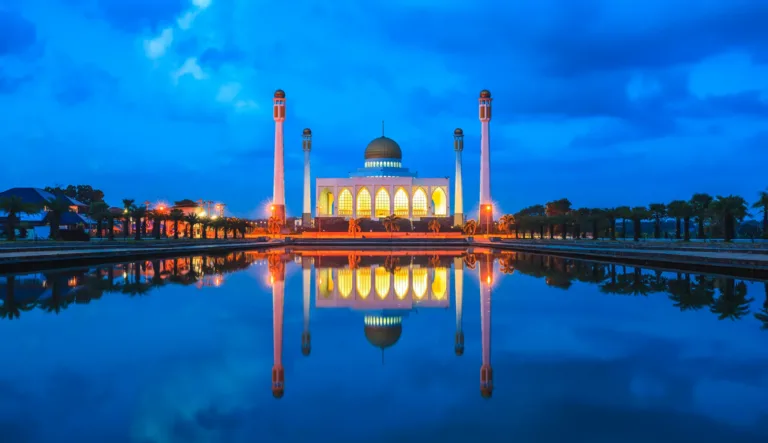
A golden-domed mosque with four minarets and a long reflecting pool, nicknamed Thailand's Taj Mahal, in Khlong Hae, Hat Yai. Free for visitors of all faiths; closed Fridays.
Holiday / event — crowded · Evening (16:00–19:00): rain ~14%
Cover shoulders and knees · Remove shoes before entering the hall · Keep quiet during prayers
Saturday–Thursday 08:30–15:30 (closed Fridays)
01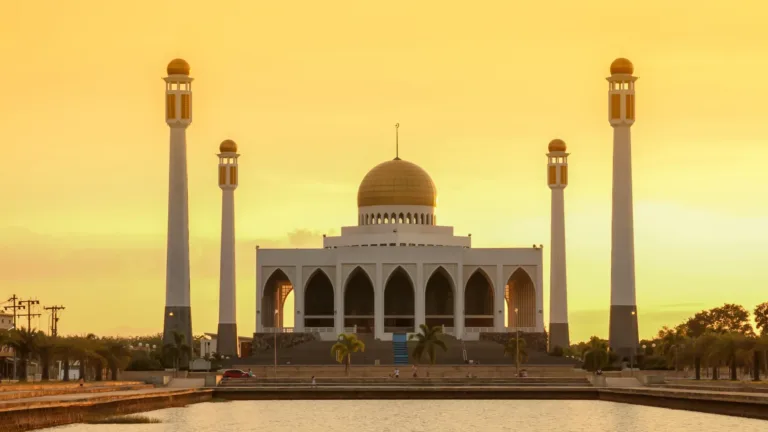 02
 03
Tap a day card to see that day’s weather, rain, haze and hourly forecast
Best time to go Daytime is over · see tomorrow
Holiday — traffic on the way up and parking fills fast; leave early
Green band = hours used for the score
Best time to go Best window 16:00–19:00 Little rain · light drizzle possible at times
Rain at times — slippery roads, allow extra travel time
Holiday — traffic on the way up and parking fills fast; leave early
Green band = hours used for the score
Best time to go Best window 06:00–13:00 Little rain · light drizzle possible at times
Thick morning fog with visibility under 1 km — use headlights and drive slowly
Green band = hours used for the score
Best time to go Best window 06:00–13:00 Little rain · light drizzle possible at times
No warnings today — normal road and weather conditions
Green band = hours used for the score
Best time to go Best window 06:00–11:00 Little rain · light drizzle possible at times
No official warnings, but watch for: Evening (16:00–19:00): rain ~41% · Possible thunder 11:00–14:00
Green band = hours used for the score
Best time to go Best window 17:00–19:00 Little rain · light drizzle possible at times
Rain at times — slippery roads, allow extra travel time
Green band = hours used for the score
Best time to go Best window 08:00–14:00 Little rain · light drizzle possible at times
No official warnings, but watch for: Late morning (09:00–12:00): rain ~39% · Possible thunder 14:00–19:00
Green band = hours used for the score
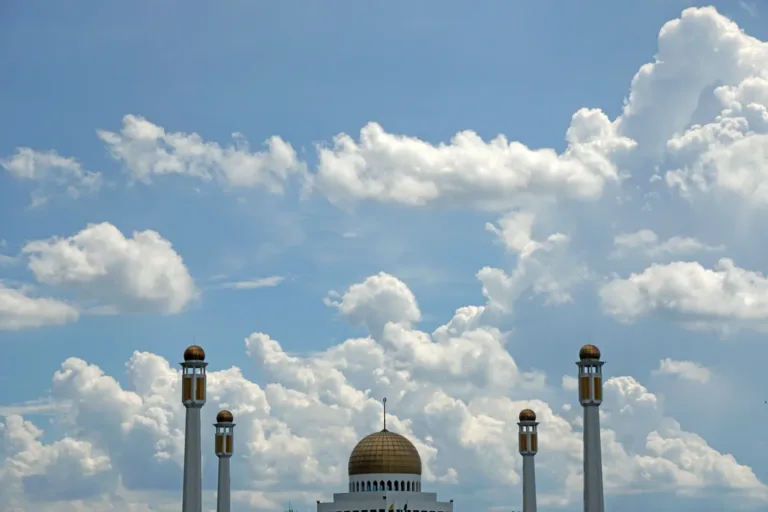
Songkhla Central Mosque stands on Lopburi Ramesuan Road in Khlong Hae, Hat Yai, roughly halfway between Hat Yai and Songkhla town. It's the spiritual heart of the province's Muslim community and is often called the Taj Mahal of Thailand.Construction began around 2001, driven by Aziz Phitakkumpon while he chaired the Songkhla Provincial Islamic Committee, before he became Thailand's 18th Chularatchamontri. The Mughal-inspired design has a golden central dome, four detached minarets and a long pool that mirrors the building.Visitors of any faith may enter free of charge. Dress modestly and respect prayer times. The pool edge and marble walkways out front are the favourite photo spots.
Friday is the main prayer day and the mosque is closed to visitors
It's on the highway between Hat Yai and Songkhla, so arrange return transport
Free · Time needed 1 hour
Songkhla Central Mosque, officially the Songkhla Provincial Central Mosque (registration no. 352), stands beside Lopburi Ramesuan Road in Khlong Hae, Hat Yai. The golden-domed mosque by its reflecting pool took nearly twenty years to realise: from a first idea around 1991, through years without funding, to donations from many quarters. The driving force was Aziz Phitakkumpon, chairman of the Songkhla Provincial Islamic Committee, who later became Thailand's 18th Chularatchamontri, the country's highest Muslim leader. Its Mughal-inspired design earned it the nickname "the Taj Mahal of Thailand", and today it is also the final resting place of the man who founded it.
Aziz Phitakkumpon was born on 6 March 1947 in Hua Khao, Singhanakhon district, Songkhla. His published biography traces his lineage to Sultan Sulaiman Shah, who governed Songkhla in the reigns of King Songtham and King Prasat Thong of Ayutthaya. He studied religion at pondok schools in Chana and in Pattani, and in 1987 he was elected unanimously as chairman of the Songkhla Provincial Islamic Committee, a post he was re-elected to many times.
According to the mosque's own history, around 1991 the committee under his leadership began planning a provincial central mosque. They wanted Songkhla to have one like the other southern border provinces, some of which had long had theirs, such as Pattani Central Mosque, built in 1954. The committee also had no office of its own. The first proposal to the Religious Affairs Department received no budget, so the idea had to wait several years.
The chance came in 1999, when five donors offered 5 rai of land on Lopburi Ramesuan Road in Khlong Hae, roughly halfway between Hat Yai and Songkhla town. In 2000 the project was approved by the Interior Ministry and the Cabinet, though still without funds. In 2001 it was finally allocated 38.5 million baht, with help from Prai Pattano, then mayor of Hat Yai, and the plans were adjusted to fit the budget.
The architects were Sathaporn Sirilim and Mana Yuentrakul. The first design was a three-storey building: parking for about 76 cars on the ground floor, the provincial Islamic committee's office and a hall for about 800 people on the second, and a prayer hall for about 2,500 to 3,000 worshippers on top. Around it were gardens, a pool and a waterfall flowing from the middle of the stairs into the pool. When the 5 rai proved too small, the committee took on debt of about 7 million baht to buy more land and widen the access road, bringing the site to about 7.5 rai.
The first of 433 piles, each 17 metres long, was driven on 18 January 2002, and building work officially began late that year. Sources therefore give different start dates: some count from 2001, the year the budget came through, while some foreign travel sites say the mosque was completed in 2001, which does not match the mosque's own record.
The main structure was finished in 2005, and more funds arrived in stages: for offices, a meeting room and electrical and plumbing systems, a provincial budget for landscaping and roads, money from the Songkhla Provincial Administrative Organisation for parking, and from the Department of Local Administration for restrooms. Even so, money ran short and work stalled. The turning point came when Sonthi Techanan became governor of Songkhla on 15 November 2006 and pushed a fundraising drive, collecting about 3 million baht from mosques in every district, plus 100,000 baht each from the 30 members of the provincial Islamic committee.
In 2007 support came from many more bodies, including the Southern Border Provinces Administrative Centre, the Hat Yai and Songkhla city municipalities, the Songkhla Provincial Administrative Organisation, PTT, EGAT, Chinese associations in Hat Yai and local mosques, to fit out the interior, build the minarets and fountain pool and landscape the grounds. The mosque's record puts the total at about 77 million baht, making it a place of worship built with help from people of other faiths and many sectors.
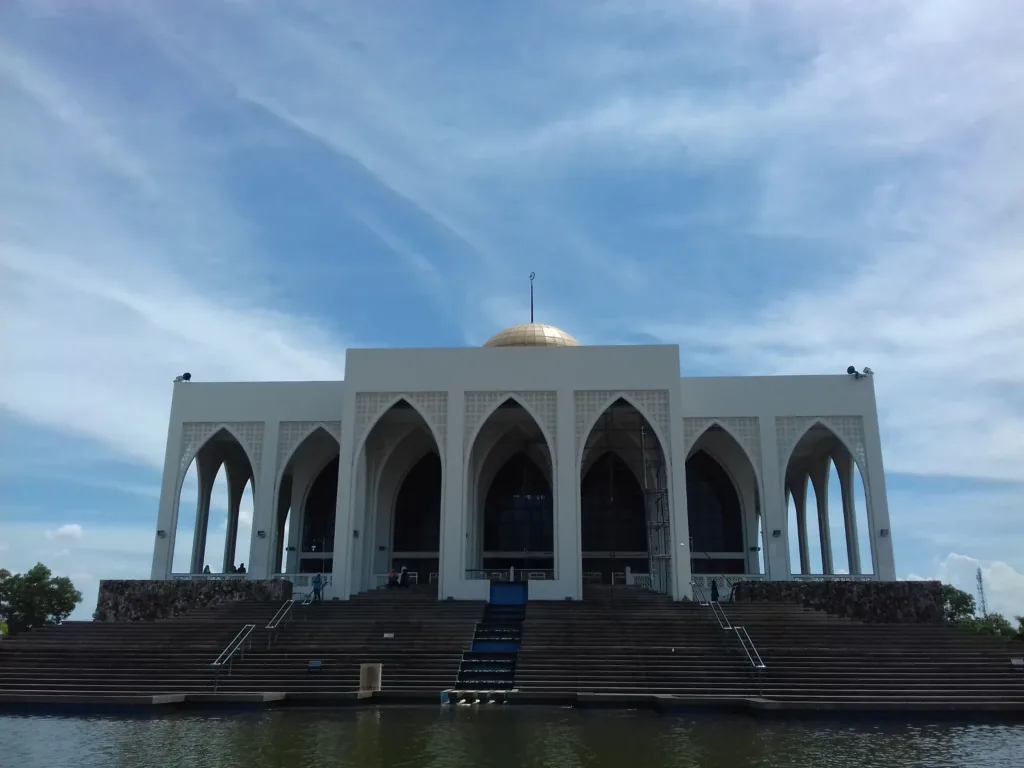
The result is a symmetrical building in the Mughal tradition: a golden dome rising from the centre of a square hall, four minarets standing apart from the building, and a long rectangular pool in front. The building's reflection in the pool is why people call it the Taj Mahal of Thailand, and landscaping added later gave the grounds the look they have today.
On 16 May 2010 Aziz Phitakkumpon received the most votes from provincial Islamic committees across the country, and on 6 June 2010 he was royally appointed as the 18th Chularatchamontri, succeeding Sawat Sumalayasak. Over these years the mosque became more widely known, both as the centre of religious life for Songkhla's Muslims and as a place where people of other faiths, Malaysian visitors, couples and new graduates come to take photos.
Chularatchamontri Aziz Phitakkumpon passed away on 22 October 2023 at Chulalongkorn Hospital, aged 76. The next day the funeral prayer (janazah) was held at Songkhla Central Mosque and he was buried in the mosque's cemetery, with General Surayud Chulanont, President of the Privy Council, placing the royally granted burial soil on the King's behalf. He is the first and only person the Songkhla Provincial Islamic Committee has specially permitted to be buried there, as Thailand's highest Muslim leader and the man who saw the mosque completed. Some media noted that he was the first national Muslim leader to be buried at a provincial central mosque.
Today the mosque still serves its original purpose as a place of prayer and gathering for Songkhla's Muslims and the home of the provincial Islamic committee, and it welcomes visitors of all faiths. People from Thailand and abroad come to pay their respects at the Chularatchamontri's grave. Visitors should dress modestly and behave quietly, out of respect for the mosque and for the man who rests here.
Arrived? Check in, collect a stamp and tell others what it is like right now
Check your location first, so you do not fill in the form for nothing
Location must be on and within 1 km · One check-in per place per day · come back on other days to check in again
Post photos from anywhere — no need to be here · Up to 20 photos at a time · JPG / PNG / WebP · GPS location data is removed automatically
The mosque is at 352 Lopburi Ramesuan Road, Khlong Hae, Hat Yai, on the road between Hat Yai and Songkhla town.
Lopburi Ramesuan Rd on the Hat Yai–Songkhla route · Fuel
From central Hat Yai; book the return · By distance
Lopburi Ramesuan Road on the Hat Yai–Songkhla highway
Saturday–Thursday 08:30–15:30 (closed Fridays)
Songkhla Central Mosque
Answers travellers want before they go — a one-minute read
Saturday–Thursday 08:30–15:30, closed Fridays
No, it's free
Yes, visitors of all faiths are welcome; dress modestly
Its Mughal-style hall, golden dome, four minarets and reflecting pool recall the Taj Mahal
352 Lopburi Ramesuan Road, Khlong Hae, Hat Yai
Best day this week: Tuesday 1 Dec · Check in when you arrive to collect a stamp
 Hat Yai Municipal Park (Khao Kho Hong)
 Songkhla Old Town