 01
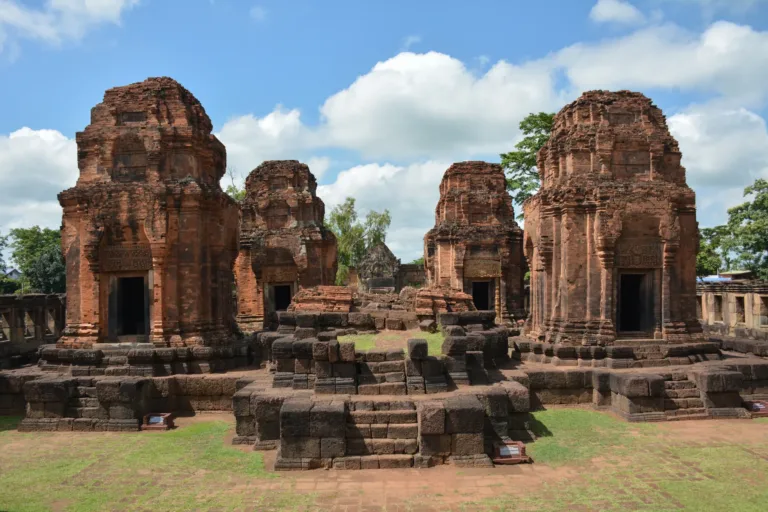
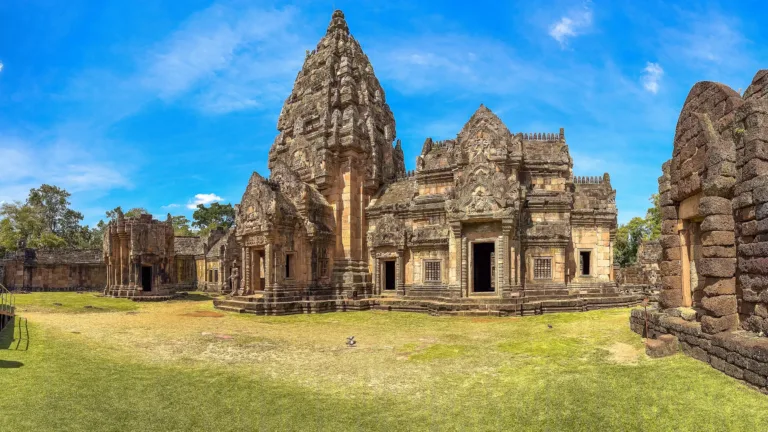
Five brick towersIn two rows on a laterite platform; the central tower once held a Shiva lingam
Khmer temple · Prakhon Chai
A lowland Khmer temple in Prakhon Chai, Buriram, built around the late 10th–early 11th centuries for Shiva, with five brick towers ringed by naga-edged ponds. About 8 km from Phanom Rung.
Good weather, little rain
Daily 08:00–18:00
45 minutes–1 hour
Naga pond rim — Towers reflected in the pond
Thais 20 THB · Foreigners 120 THB
01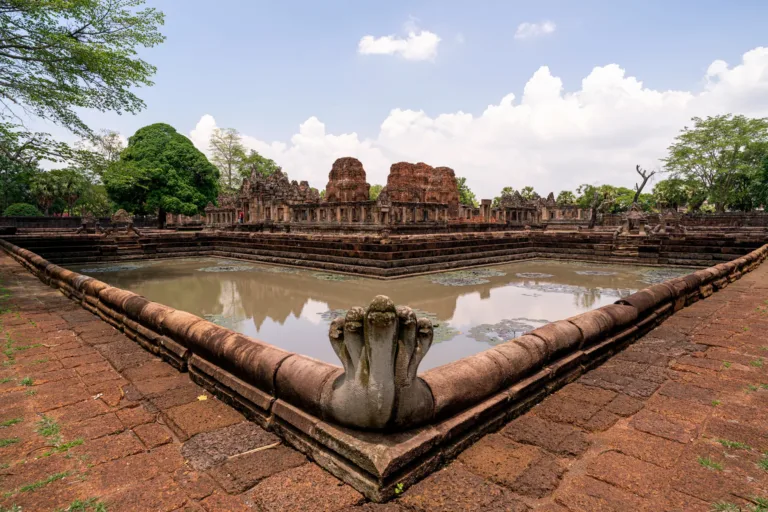 02
 03
Tap a day card to see that day’s weather, rain, haze and hourly forecast
Best time to go Daytime is over · see tomorrow
No warnings today — normal road and weather conditions
Green band = hours used for the score
Best time to go Fine all day little rain through the day
No warnings today — normal road and weather conditions
Green band = hours used for the score
Best time to go Fine all day little rain through the day
No warnings today — normal road and weather conditions
Green band = hours used for the score
Best time to go Fine all day little rain through the day
No warnings today — normal road and weather conditions
Green band = hours used for the score
Best time to go Fine all day little rain through the day
No warnings today — normal road and weather conditions
Green band = hours used for the score
Best time to go Fine all day little rain through the day
No warnings today — normal road and weather conditions
Green band = hours used for the score
Best time to go Fine all day little rain through the day
No warnings today — normal road and weather conditions
Green band = hours used for the score
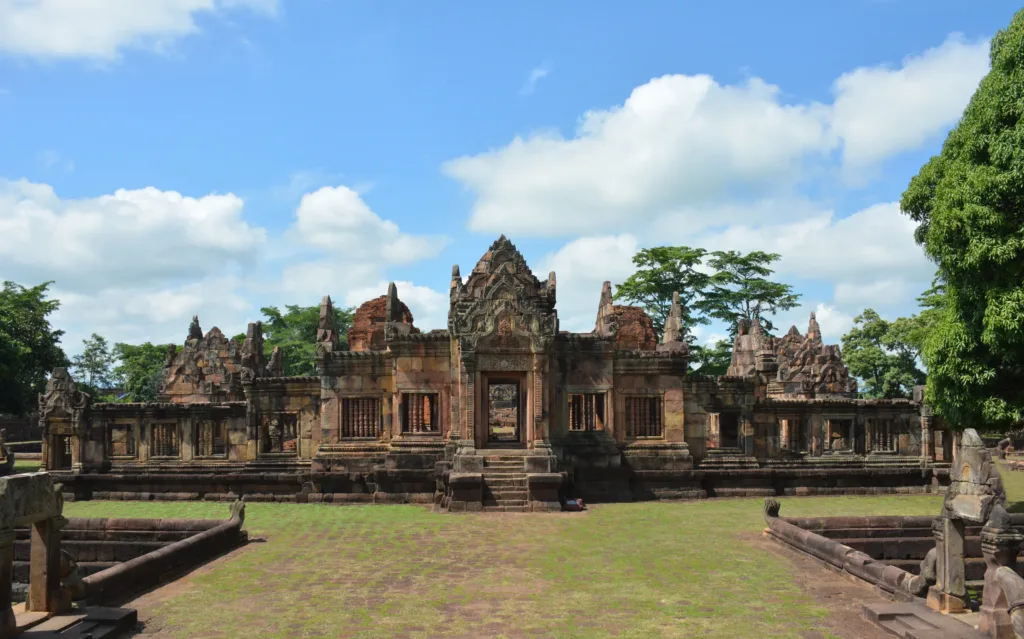
Prasat Mueang Tam is in Chorakhe Mak, Prakhon Chai District, Buriram, about 8 km southeast of Phanom Rung. The name means 'lowland town', in contrast to Phanom Rung on its volcano summit.Built around the late 10th to early 11th centuries in the Khleang and Baphuon styles, it's a Hindu temple dedicated mainly to Shiva. The flat, concentric plan has five brick towers in two rows on a laterite platform, surrounded by walls and naga-edged ponds, and faces east.It's open daily 08:00–18:00, and you can buy a combined ticket with Phanom Rung Historical Park. Allow about 45 minutes to an hour.
Arrive Morning, for cooler air and good light on the ponds
The grounds are open-air; bring a hat and water
If you're also visiting Phanom Rung, the combo ticket is better value
Thais 20 THB · Foreigners 120 THB · Time needed 45 minutes–1 hour
Weekend late mornings
| Entry, Thai adult | 20 ฿/person |
| Entry, foreign adult | 120 ฿/person |
| Combined Phanom Rung + Mueang Tam, Thai optional | 30 ฿/person |
| Combined Phanom Rung + Mueang Tam, foreign optional | 250 ฿/person |
Cash · Prices may change by season — check with the venue
Prasat Mueang Tam is a Khmer Hindu temple built on the flat land of Ban Khok Mueang in Chorakhe Mak, Prakhon Chai District, about 8 km southeast of Phanom Rung on its volcano summit. "Mueang Tam" means "the lowland town", in contrast to the hilltop Phanom Rung. Built around the late 10th to 11th centuries for Shiva, it has five brick towers ringed by two walls and naga-edged ponds at all four corners. After centuries of abandonment it was restored and opened as part of Phanom Rung Historical Park in 1997, and today it is on the UNESCO World Heritage Tentative List together with Phanom Rung and Prasat Plai Bat.
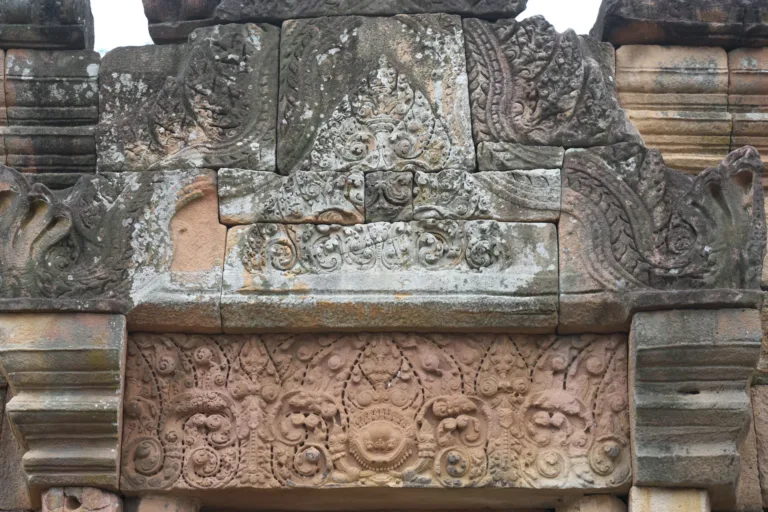
No inscription records when the temple was built or by whom, so scholars date it by its art, which mixes features of the Khmer Khleang style (around 965–1012) and the Baphuon style (around 1007–1082). The kala-face lintels are the best dating evidence, but the blend of styles rules out an exact year. Most Thai sources therefore place it broadly in the 16th–17th Buddhist centuries; some say it dates to the reign of Suryavarman I of Angkor, roughly a century earlier than Angkor Wat.
The only written evidence is a brief inscription in Old Khmer script, in Sanskrit and Khmer, carved on four pieces of sandstone: two on a gateway and two on a tower door frame, five lines in all. It names a few people and holy places and is dated to around the 10th–11th century. Its reading was published in Silpakorn magazine in 1991.
The temple is laid out in concentric rings on level ground and faces east. At its centre five brick towers stand on a single laterite base, three in front and two behind, with the main tower in the middle of the front row. There are two libraries, an inner sandstone gallery and an outer laterite wall, both with gateways on all four sides. Shiva was the main deity, but the carvings show Vishnu was worshipped as well.
Between the two walls lie four L-shaped ponds, one at each corner, so the towers seem to rise from an island. Thailand's submission to UNESCO compares this to Shiva's home on Mount Kailash and its four great rivers, while other sources liken the ponds to the ocean around Mount Meru. The pond rims are carved as naga bodies, ending at the corners in plain five-headed nagas with no crowns or ornaments, known as "bald-headed nagas", a hallmark of the Baphuon style.
The pediments and lintels tell Hindu stories: Shiva and Uma riding the bull Nandi (Umamaheshvara) on the front north tower, Indra above a kala face on the front south tower, Krishna lifting Mount Govardhana on the rear north tower and Varuna on a hamsa on the rear south tower. The lintels of both libraries show a seated figure holding a lotus above a kala in Baphuon style, while several lintels on the outer gateways were never finished.
North of the temple lies a large baray, known locally as "Thale Mueang Tam" (the Mueang Tam Sea), about 510 m wide and 1,090 m long and holding around 1.5 million cubic metres. The World Heritage submission explains that water from Phanom Rung and Plai Bat ran along natural channels into this reservoir to irrigate the surrounding rice fields. Some scholars think the great baray is later than the temple, while a smaller pond to the east is probably contemporary with it.
Around the 12th–13th century the temple lost its importance and was eventually abandoned. Only around 1947 did villagers move back to settle the area, forming the Ban Khok Mueang community that still surrounds the temple today.
In the modern era, Prasat Mueang Tam was registered as an ancient monument in the Royal Gazette (vol. 52, part 75) on 8 March 1936 (2478 in the old Thai calendar). The Fine Arts Department began studying and restoring it in 1987, according to the park's signage (some sources say 1988). During excavation in 1989 a large sandstone Shiva lingam was found in the main tower, confirming that the temple was built for Shiva; it is now displayed at the Phanom Rung Historical Park information centre.
Restoration was completed in 1996. Four of the brick towers were reassembled in full, but the main tower had collapsed long before and could not be rebuilt, leaving only its laterite base and sandstone fragments. The same year a protected zone of about 538 rai (some 86 hectares) was declared, covering the Mueang Tam baray and the Kuti Ruesi Khok Mueang ruin, and on 10 November 1997 Prasat Mueang Tam officially opened as part of Phanom Rung Historical Park.
On 9 July 2019 the 43rd session of the World Heritage Committee in Baku added the "Ensemble of Phanom Rung, Muang Tam and Plai Bat Sanctuaries" to the Tentative List, and early the next year Thailand was reported to be preparing the full nomination. During COVID-19 the temple closed temporarily from 26 April to 9 May 2021, and in 2023 it served as a period backdrop for the Thai TV drama Phromlikhit (Love Destiny 2).
Arrived? Check in, collect a stamp and tell others what it is like right now
Check your location first, so you do not fill in the form for nothing
Location must be on and within 1.5 km · One check-in per place per day · come back on other days to check in again
Post photos from anywhere — no need to be here · Up to 20 photos at a time · JPG / PNG / WebP · GPS location data is removed automatically
The temple is in Chorakhe Mak, Prakhon Chai, about 8 km southeast of Phanom Rung.
About 8 km from Phanom Rung · Fuel
Good paved roads
Good
Daily 08:00–18:00
about 8 km from Phanom Rung
Prasat Mueang Tam
120 THB
Answers travellers want before they go — a one-minute read
Thai 20 THB, foreigners 120 THB
Yes, 30 THB for Thais and 250 THB for foreigners
Daily 08:00–18:00
About 8 km to the southeast
Mainly Shiva
Best day this week: Saturday 28 Nov · Check in when you arrive to collect a stamp
 Phanom Rung Historical Park
 Chang Arena