 01
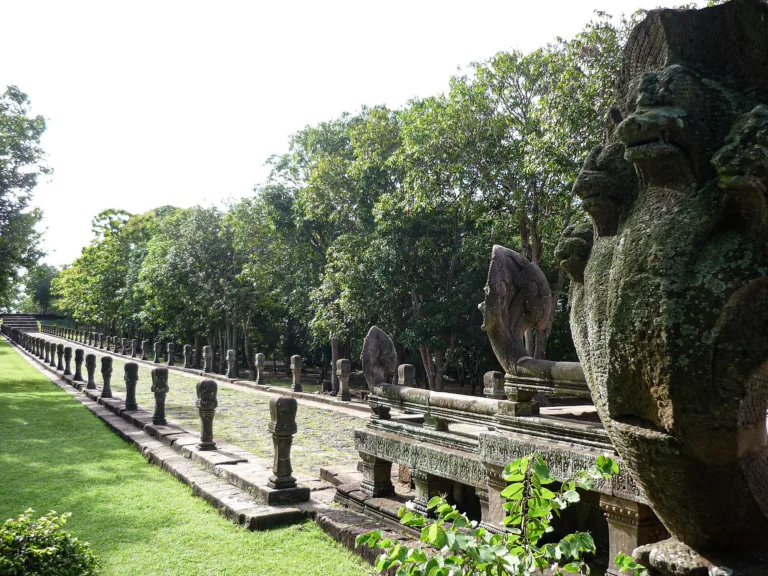
Naga bridge and processional wayLotus-bud posts leading to the temple
A temple on a volcano · Buriram
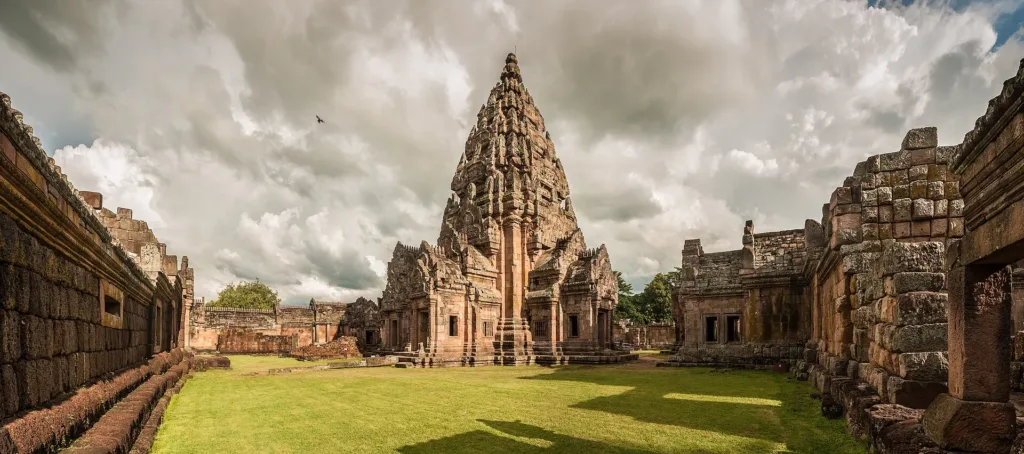
A pink-sandstone Khmer sanctuary on an extinct volcano in Buriram, built between the 10th and 13th centuries, with the reclining-Vishnu lintel returned from Chicago and the sun shining through 15 doorways.
Holiday / event — crowded · Hot (Afternoon) feels like 37°C
06:00–18:00
1.5–2 hours
Lotus-bud post walkway — Leading lines to the temple
20 THB
01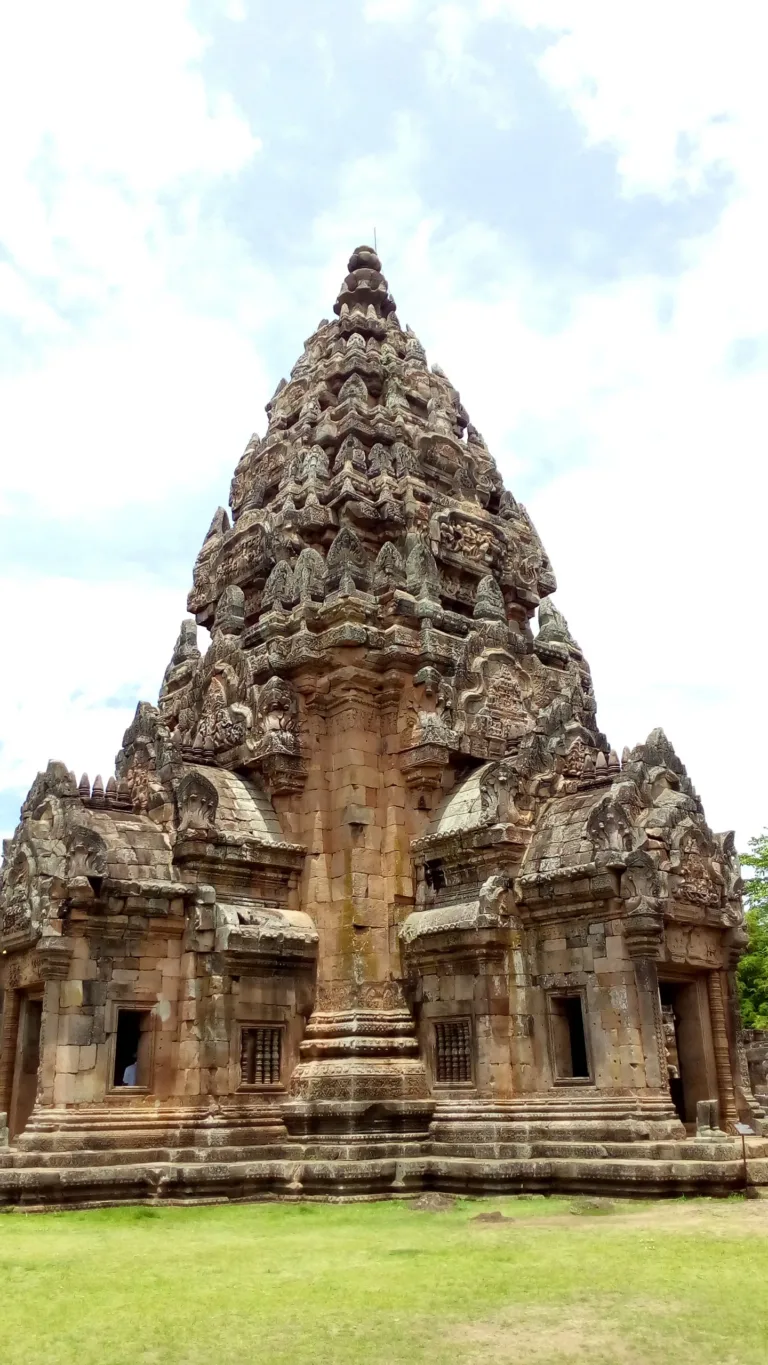 02
 03
 04
Tap a day card to see that day’s weather, rain, haze and hourly forecast
Best time to go Fine all day little rain through the day · light drizzle possible at times
Holiday — traffic on the way up and parking fills fast; leave early
Green band = hours used for the score
Best time to go Fine all day little rain through the day · light drizzle possible at times
Holiday — traffic on the way up and parking fills fast; leave early
Green band = hours used for the score
Best time to go Fine all day little rain through the day · light drizzle possible at times
Holiday — traffic on the way up and parking fills fast; leave early
Green band = hours used for the score
Best time to go Best window 06:00–14:00 Little rain · light drizzle possible at times
No warnings today — normal road and weather conditions
Green band = hours used for the score
Best time to go Best window 09:00–19:00 Little rain · light drizzle possible at times
No warnings today — normal road and weather conditions
Green band = hours used for the score
Best time to go Fine all day little rain through the day
No warnings today — normal road and weather conditions
Green band = hours used for the score
Best time to go Fine all day little rain through the day
No warnings today — normal road and weather conditions
Green band = hours used for the score
Phanom Rung Historical Park is a Khmer sanctuary on an extinct volcano in Chaloem Phra Kiat, Buriram, famed for its naga bridges, the reclining-Vishnu lintel and the sun shining through 15 doorways.
Arrive Early morning to avoid the sun and catch soft light
Photos from Wikimedia Commons and contributors · full credits inClassic page
Adults 20 THB · Time needed 1.5–2 hours
15-door sun days and the early-April festival
| Admission, Thai | 20 ฿/person |
| Admission, foreigner | 200 ฿/person |
Cash · Prices may change by season — check with the venue
Phanom Rung hill-climbing festival, early April (with sunrise through 15 doors)
Tap a month on the wheel to see weather, rain, haze and crowds from 10 years of records
Best time · Nov–Feb: cool weather; early April: the hill-climbing festival and sunrise through 15 doors
Watch out · May: very hot, with strong midday sun on the stone terraces
Oct by the records 22–29°C · avg rain 184 mm (20 rainy days) · clear 3 days · avg PM2.5 8
Phanom Rung Historical Park, or Prasat Hin Phanom Rung, stands at Ban Don Nong Nae, Ta Pek subdistrict, Chaloem Phra Kiat district, Buriram, about 77 km south of town, under the Fine Arts Department. The temple crowns an extinct volcano about 200 m above the plain; Thai Wikipedia gives about 350 m above sea level, English Wikipedia about 386–402 m. "Phanom Rung" comes from the Khmer "Vnam Rung" in the inscriptions, meaning "great mountain". It is the province's key symbol and even appears behind the crest of Buriram United football club.
Before the temple, the summit may already have been a local sacred place. Turning it into a Khmer-style sanctuary for "Kamraten Jagat Vnam Rung", the god of Phanom Rung, meaning Shiva, likely reflects local leaders binding themselves to Khmer kings through religion. The surrounding community was large: part of the old crater served as a hilltop baray, with two more barays at the foot of the hill, the Nong Bua Rai pond and hermit cells that served as a hospital. In 2018 a Fine Arts Department LiDAR survey found eight groups of remains on and below the hill, believed to be villages, yogis' hermitages and the homes of temple servants (Thai Post).
Phanom Rung was built over several eras. The first phase was a brick shrine in Koh Ker style around the 10th century; the bases of two brick sanctuaries northeast of the main tower survive, which Silpa Watthanatham says are about 200 years older than it. Thai Wikipedia, summarising Old Khmer and Sanskrit inscriptions, says King Rajendravarman II of Angkor (r. 944–968) founded a shrine to Shiva here and King Jayavarman V (r. 968–1001) donated land and servants to it. The small Prang Noi to the southwest followed in the 11th century.
The main sanctuary seen today dates from the 12th century. Thai Wikipedia and Khaosod name its builder as Narendraditya, a prince of the Mahidharapura dynasty who ruled this region and was an ancestor of Suryavarman II, builder of Angkor Wat; he lived here as a yogi, and Phanom Rung inscriptions 7 and 9 also mention his son Hiranya, who carried the work on. English Wikipedia credits the main sanctuary to Suryavarman II himself; the two views sit in the same period and dynasty.
Inscriptions are the key to Phanom Rung's history. Matichon reports that nine inscriptions, in Old Khmer and Sanskrit, were found during restoration. Princess Maha Chakri Sirindhorn read and translated them in her master's thesis "Inscriptions Found at Prasat Phanom Rung" (1976–78, Oriental Epigraphy, Silpakorn University). Two more were read in 1999–2000 (Phanom Rung inscriptions 3 and 8), and in 2023 Silpakorn University published her revised work, "Prasat Phanom Rung and the Inscriptions Found at Prasat Phanom Rung", for its 80th anniversary, launched on 16 May 2024.
The most important is Phanom Rung inscription 7 (Br.1, K.384). The Sirindhorn Anthropology Centre database describes it as Sanskrit in Old Khmer script on a four-sided, sema-shaped grey slate stele of 76 lines, now in the National Library, edited and translated by George Cœdès; it praises King Suryavarman II and his lineage. Matichon (2024) summarises K.384 as a eulogy of Narendraditya, a close relative of Suryavarman II and a warrior in his army who renounced the world to live as an ascetic at Phanom Rung. It was composed by his son and disciple Hiranya, who made offerings to the sanctuary and a golden image of his father in the form of Shiva. The same article notes that some verses do not state outright that Narendraditya built the temple, so scholars see Phanom Rung in this period mainly as his place of austerities; the main sanctuary, galleries, naga bridges and walkway are in Angkor Wat style, from the late 12th century.
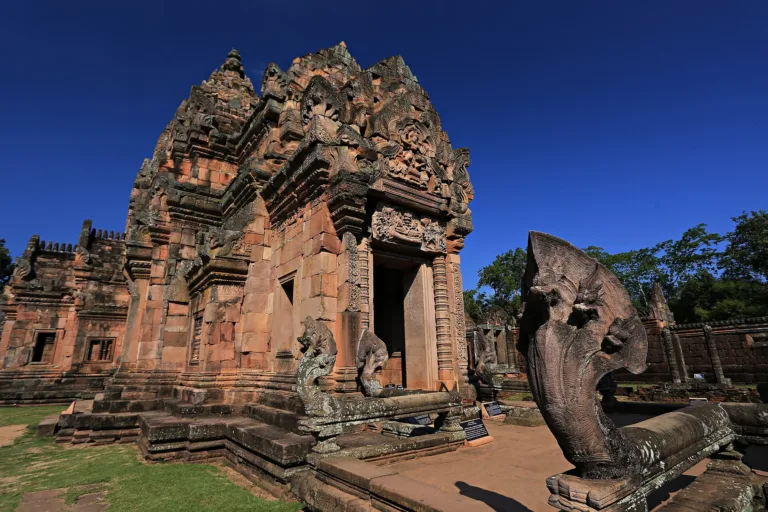
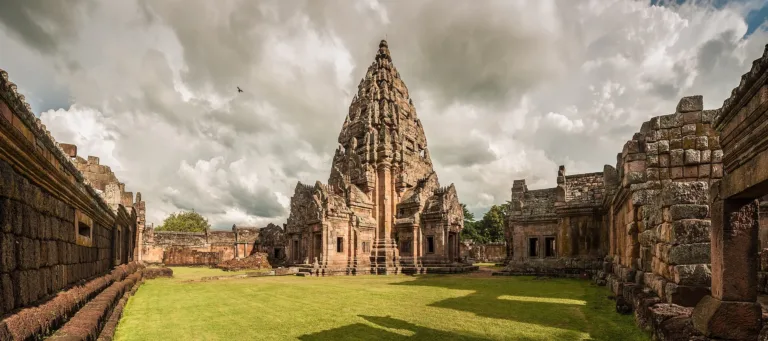
The plan runs in a straight line from the foot of the hill to the east-facing main sanctuary. It starts with a stairway and the "royal changing pavilion", believed to be where the king prepared before rites, then a 160 m processional way lined with lotus-bud posts, 35 on each side, leading to the first cruciform naga bridge with five-headed naga balustrades, symbolising the link between the human and divine worlds. At its centre is a carved eight-petalled lotus, perhaps for the eight guardian deities of the directions. North of the walkway is a laterite pavilion known as the "White Elephant Hall"; then come stairs with five landings up to the summit terrace and a second naga bridge before the eastern gallery gate.
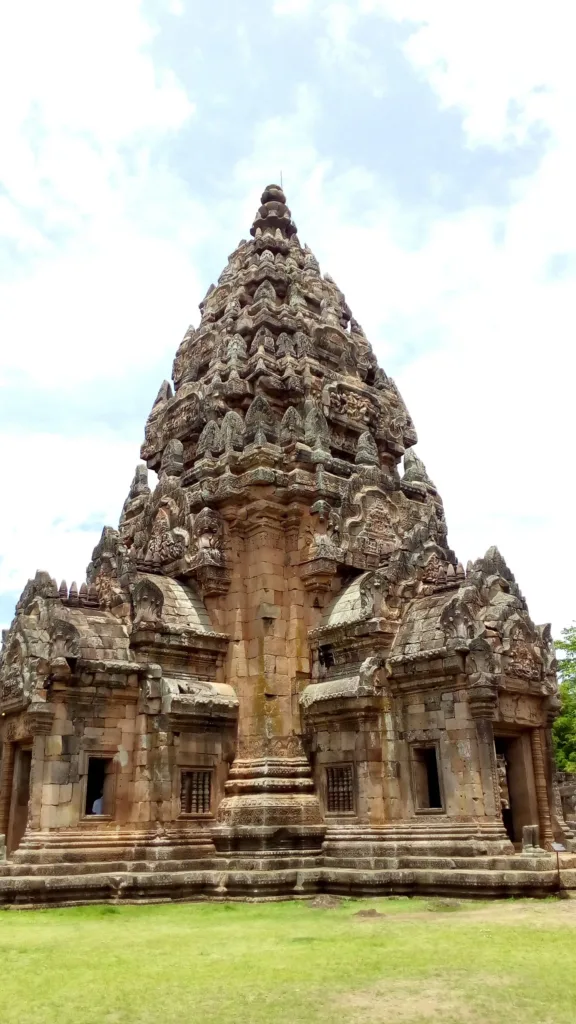
The main sanctuary, in pink sandstone on a square indented plan, is 8.20 m wide and 27 m tall, fronted by a mandapa joined by an antarala. The central garbhagriha once held a Shiva linga, now lost; only the somasutra channel that drained the lustral water remains. Nearby stands Nandi, Shiva's bull. A long gallery encloses the courtyard, and the eastern gallery pediment shows a hermit, read as Shiva the healer and perhaps also Narendraditya himself.
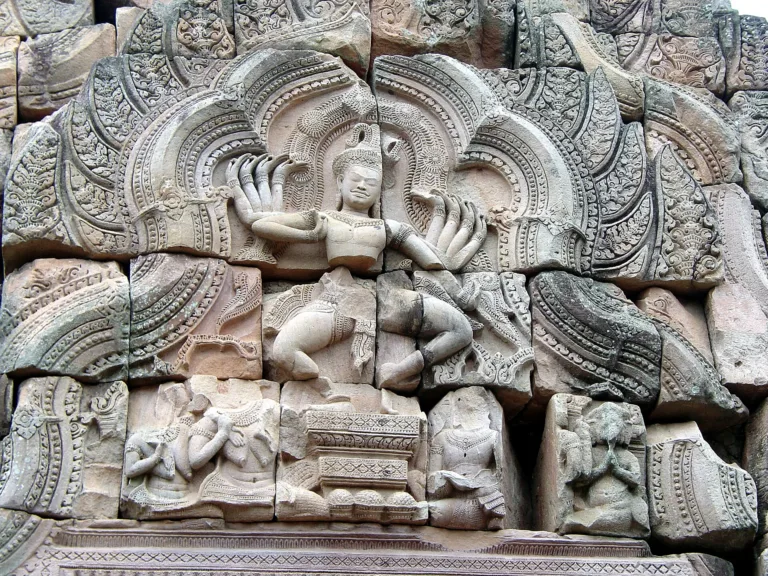
The lintels and pediments of the main sanctuary are carved with Hindu stories: Shiva Nataraja dancing, Vishnu reclining on the cosmic ocean, avatars of Vishnu such as Rama and Krishna, rituals and scenes of hermits' daily lives, along with floral motifs and guardian deities. These carvings are the evidence that dates the main sanctuary, stairway and naga bridges to the 12th century.
Under Jayavarman VII (r. 1181–1218), two laterite libraries were built in front of the main sanctuary to keep scriptures, contemporary with the White Elephant Hall. Khaosod adds a pavilion, a hospital (arogyasala) and a dharmasala rest house at the foot of the hill; English Wikipedia identifies the rest house as Prasat Ban Bu, on the road linking Angkor and Phimai. As the Khmer empire turned to Mahayana Buddhism, the Hindu sanctuary was adapted into a Buddhist temple.
Phanom Rung also sat on Jayavarman VII's "royal road" network. Silpa Watthanatham summarises the Preah Khan inscription: the king built three roads from Angkor with "houses of fire", or rest houses, at intervals; the Angkor–Phimai road had 17, of which only 8 have been found in Thailand, and Cœdès estimated he built about 121 rest houses and 102 hospitals. French scholars traced the route from Angkor through the Ta Muen pass and Phanom Rung to Phimai; both a rest house and a hospital were found at the foot of Phanom Rung, and at Muang Tam traces of an ancient road run from the baray towards Phanom Rung. Still, the researcher argues it is not proven that the road ran its full length in Thailand; it may have been a planned route marked out by rest houses first.
After Khmer power waned and Sukhothai and Ayutthaya rose, Phanom Rung still appears in Thai records. Khaosod cites the Ayutthaya chronicles saying that in 1438 King Borommarachathirat II (Chao Sam Phraya) prepared an army to attack Phimai and Phanom Rung, and in King Narai's reign the town of Nang Rong, about 20 km west of the temple, is mentioned.
Phanom Rung was registered as an ancient monument in the Royal Gazette, vol. 52, part 75; Silpa Watthanatham gives the year as 1935, while Thai Wikipedia writes 1932. The Fine Arts Department began restoration in 1971 by anastylosis: dismantling the structure with every stone numbered, rebuilding strong foundations and reassembling the original pieces. The work took 17 years, and Princess Maha Chakri Sirindhorn formally opened the historical park on 21 May 1988, Thai Heritage Conservation Day.
The man who laid the foundations of the restoration was Pierre Pichard, a French architect born on 22 February 1936. Silpa Watthanatham says he began work in Thailand at Phimai in 1966 under Bernard-Philippe Groslier and was invited to oversee Phanom Rung's restoration in 1972, when Chuea Sariman was director-general of the Fine Arts Department; his phase of the project ran 1972–78. He introduced anastylosis to Thai restoration for the first time, returning as many original pieces as possible and using as little new material as possible. He later headed the École française d'Extrême-Orient (EFEO) Bangkok centre and died on 22 August 2024, aged 88.
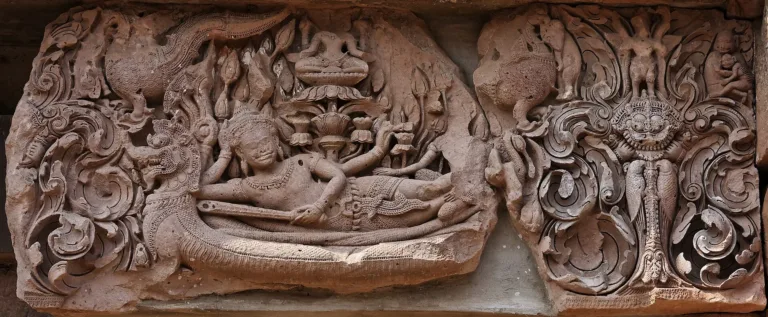
At that opening one gap remained: the reclining-Vishnu (Narai Banthomsin) lintel above the eastern mandapa door. Thai Wikipedia says it was stolen around 1960 during the Vietnam War era, and the Art Institute of Chicago acquired it in 1967. The Fine Arts Department seized some fragments at an antique shop in Ratchaprasong in 1965. In 1973 Prof. M.C. Subhadradis Diskul, dean of archaeology at Silpakorn University, and Hiram Woodward Jr., a former Peace Corps volunteer, found the lintel on display in Chicago, and he formally advised the Fine Arts Department to seek its return.
In 1988 the campaign became national, in Bangkok, the provinces and among Thais in Chicago. The band Carabao wrote the song "Thap Lang" and named its ninth album after it. In Buriram, Assoc. Prof. Wanchai Wattanakul, rector of Buriram Teachers' College, led a rally of over 15,000 people that petitioned the US ambassador through governor Phon Udomphong. English Wikipedia says the Art Institute agreed in October 1988 to return it in exchange for a donation from Chicago's Elizabeth F. Cheney Foundation. The lintel flew on United Airlines on 9 November, reached Bangkok on 10 November and was reinstalled on 7 December 1988.
Matichon (2024) adds that the lintel dates from around 1107, was smuggled to the United States around 1965 and was found on display in Chicago in 1973. The Fine Arts Department sought its return in 1973–78 and a House of Representatives committee tried again in 1988, both without success. According to the article, what turned the tide was the campaigning and marches of Thais in the United States, especially in Chicago, which led to mediation and the eventual return.
The lintel shows Vishnu reclining on his right side on the serpent Ananta, which lies on a makara in the Ocean of Milk. A lotus stem rises from his navel with Brahma seated on the flower; his hands hold the mace, conch and discus, the front right hand supporting his head. He wears a conical crown and pleated cloth with a double fishtail hem, and Lakshmi sits at his feet. In Chicago it was displayed as "the Birth of Brahma with Reclining Vishnu on a Makara".
The repatriation story did not end with the lintel. A pilaster fragment of Krishna lifting Mount Govardhana, about 95 cm tall, from the left side of the eastern mandapa doorframe, believed smuggled out in 1965 and donated to the Art Institute of Chicago in 1966, had been misattributed to Cambodia until AIC researcher Dr Nicolas Revire visited the site and confirmed its origin. The Institute's trustees deaccessioned it on 11 June 2024 and the Fine Arts Department announced its return the following week, to be reunited with the doorframe beside the lintel.
Phanom Rung's most famous spectacle is the sun shining through all 15 doorways four times a year: rising in early April and early September (e.g. 8–10 Sep 2025 at about 05:57) and setting in early March and early October (around 5–7 Oct at about 17:55). Silpa Watthanatham explains that the axis is offset about 5.5° north. Before restoration, collapsed roofs blocked the doorways, so no one saw it until restoration staff noticed it after the work was finished; in 2003 Danish architect Asger Mollerup calculated the dates precisely. No inscription or carving mentions the phenomenon.
The Phanom Rung hill-climbing festival has two origins. Thai Wikipedia says villagers began climbing on the full moon of the fifth lunar month in 1942 to gild a replica Buddha footprint in the Prang Noi, while Silpa Watthanatham says the government first staged it as an official festival in 1991, moving it to the first weekend of April. It features a re-enacted procession of Queen Bhupatindralakshmi, Narendraditya's mother, and of ten divine mounts. The 2026 festival ran 3–5 April, matching the sunrise through the doors at about 05:50–06:10 (Naewna).
The temple has also suffered modern damage. On the night of 19 May 2008 vandals smashed guardian and mount statues and moved the linga; the park chief said only four of eleven naga heads damaged were originals, the rest replicas over 20 years old, and repairs began on 26 May. On world recognition, the Fine Arts Department director-general announced on 9 July 2019 that the 43rd World Heritage Committee in Baku had accepted the group of Phanom Rung, Muang Tam and Plai Bat sanctuaries onto the Tentative List (Khaosod).
Arrived? Check in, collect a stamp and tell others what it is like right now
Check your location first, so you do not fill in the form for nothing
Location must be on and within 1.5 km · One check-in per place per day · come back on other days to check in again
Post photos from anywhere — no need to be here · Up to 20 photos at a time · JPG / PNG / WebP · GPS location data is removed automatically
From Buriram take Hwy 218 about 50 km, left on Hwy 24 to Ban…
Buriram–Phanom Rung via Hwy 218/24/2117 · Fuel
Buriram–Chanthaburi bus to Ban Ta Ko, then songthaew or motorbike taxi · Per operator
Bangkok–Buriram, then about 1.5 hrs by road · Per airline
Hwy 218 → 24 → 2117, or Hwy 2445 → 2075 → 2117
Car park at the entrance (vehicle fee per park rules)
Petrol stations at Ban Ta Ko (Hwy 24) and Prakhon Chai
4G works
06:00–18:00
around 77 km fromBuriram town
Phanom Rung Historical Park
200 THB
Approx. nightly price for 2 adults (next week) · final price depends on your dates
Answers travellers want before they go — a one-minute read
Ta Pek, Chaloem Phra Kiat, Buriram, about 77 km from town
It was built over several eras; the main sanctuary dates from the 12th century and is credited to Narendraditya of the Mahidharapura dynasty
Four times a year: sunrise in early April and early September, sunset in early March and early October; exact dates shift each year
It reached Thailand on 10 Nov 1988 and was reinstalled on 7 Dec 1988
Thai 20 baht, foreigners 200 baht (check current rates)
Daily 06:00–18:00
Best day this week: Wednesday 28 Oct · Check in when you arrive to collect a stamp