Rainy season, safety and preparation
May, Jul – Oct
Little public transport — Hiring a car from Phu Wiang or Wiang Kao town is easier
Half a day to a full day
7 days ahead
When to go
this week
Tap a day card to see that day’s weather, rain, haze and hourly forecast
Best time to go Daytime is over · see tomorrow
No warnings today — normal road and weather conditions
Hour by hour
Green band = hours used for the score
Best time to go Fine all day little rain through the day
No warnings today — normal road and weather conditions
Hour by hour
Green band = hours used for the score
Best time to go Fine all day little rain through the day
No warnings today — normal road and weather conditions
Hour by hour
Green band = hours used for the score
Best time to go Fine all day little rain through the day
No warnings today — normal road and weather conditions
Hour by hour
Green band = hours used for the score
Best time to go Fine all day little rain through the day
No warnings today — normal road and weather conditions
Hour by hour
Green band = hours used for the score
Best time to go Fine all day little rain through the day
No warnings today — normal road and weather conditions
Hour by hour
Green band = hours used for the score
Best time to go Fine all day little rain through the day
No warnings today — normal road and weather conditions
Hour by hour
Green band = hours used for the score
Starry sky
How likely
Scored from cloud cover at every level and tonight’s moonlight — the darker the sky, the clearer the Milky Way · tap another night below for the next 7 nights
Phu Wiang National Park
Phu Wiang National Park is in Nai Mueang, Wiang Kao District, Khon Kaen, about 86 km from the city. Covering some 325 km², its mountains form a ring around a central basin. It became Thailand's 71st national park on 8 December 1991.It's best known as a major dinosaur site: the Phu Pratu Ti Ma quarry yielded Phuwiangosaurus sirindhornae, a long-necked plant-eater, and Hin Lat Pa Chat has dinosaur footprints. You'll also find a reclining Buddha carved into a cliff, red handprint art at Tham Fa Mue Daeng, and the Tat Fa, Tat Klang and Tat Thap Phraya Suea waterfalls.It's open daily 08:30–16:30. Entry is 40 THB for Thais and 200 THB for foreigners, and there are a few bungalows and campsites.
- Cool; visit the dig sites
- Strong sun; rest at a waterfall
- Softer light for remaining stops
Arrive Before 10:00 to fit in several stops
- Phu Pratu Ti Ma quarryBones in the pitlate morning
- Tat Fa waterfallFalls framed by forestafternoon
Good to know here
Hiring a car from Phu Wiang or Wiang Kao town is easier
About 19 km from HQ; a 4WD is recommended, about 1 hr
At Tham Fa Mue Daeng
- Hire a car from the district town if you're not driving, so you can see several sites in a day
- Bring cash, water and a hat
- Contact the park ahead to stay or camp at Tat Fa or Pha Chom Tawan
- Visit the Phu Wiang Dinosaur Museum to see the finds
Thais 40 THB · Foreigners 200 THB · Time needed Half a day to a full day
Cool-season weekends
| Park entry, Thai adult | 40 ฿/person |
| Park entry, Thai child optional | 20 ฿/person |
| Park entry, foreign adult | 200 ฿/person |
| Park entry, foreign child optional | 100 ฿/person |
Cash · Prices may change by season — check with the venue
- Kids Kids love the dinosaurs; the main pit is a short walk
- Seniors Main sites are reachable by car, some with sloping paths
- Wheelchair Natural, sloping trails; not suitable
- Pets National park; leave pets at home
- Stay on marked trails
- Don't touch or mark the ancient paintings
- Don't take rocks or fossils
- Some park routes need a 4WD
- Carry water; midday is hot
- Some roads are slippery in the rains
The story of this place
Phu Wiang is a ring of sandstone ridges enclosing a central basin on the Khorat Plateau in western Khon Kaen, rising to about 844 metres on the outer rim. It is where Thailand's first dinosaur bone was found in 1976, and it has been the starting point of Thai palaeontology for almost fifty years: at least five dinosaur species new to science have been named from fossils dug up in these hills. About 203,125 rai of the area was declared Thailand's 71st national park on 8 December 1991, and today Phu Wiang is the heart of the Khon Kaen Geopark, which is on its way to becoming a UNESCO Global Geopark.
Read more 10 more paragraphs
Phu Wiang's story begins with its rocks. The red sedimentary layers of the Khorat Group beneath it are more than 4,000 metres thick. The outer rim is Phra Wihan Formation sandstone, a white-to-yellowish quartz sandstone laid down by braided rivers, while the inner basin is the red sandstone and mudstone of the Sao Khua Formation. Researchers describe this as the floodplain of meandering rivers in a semi-arid climate with two seasons, conditions that preserved animal bones exceptionally well.
The age of the rocks is given differently in different sources. Most palaeontological studies place the Sao Khua Formation in the Early Cretaceous, around 130 million years ago, while some geological documents for Khon Kaen place the Phu Wiang rocks in the Jurassic. Either way, all agree it is the age of the dinosaurs.
Long before anyone knew about dinosaurs, people lived around Phu Wiang. Northwest of the range lies the ancient town of Non Mueang, a moated settlement of about 216 rai. Archaeological evidence shows it was occupied from the late prehistoric period, around 2,500 years ago, and continued through the Dvaravati and Khmer periods. The Choen River linked the community to routes toward the Mekong, the Pa Sak valley and the Chi–Mun basin.
The most striking trace of that era is a reclining Buddha carved into a sandstone cliff of Phu Wiang, on the Ban Chai So side in Chum Phae district. The Buddha lies on his right side with his head to the north. Art historians regard it as one of the clearest examples of Isan Dvaravati art. A Sanskrit inscription in post-Pallava script, dated to around the 8th–9th century CE, records that the townspeople made the image together.
A new chapter opened in 1976, when the Department of Mineral Resources was surveying the area for uranium. Geologist Sudham Yaemniyom found a large bone sticking out of the Huai Pratu Ti Ma stream bed. French experts confirmed it was the end of a sauropod thigh bone, the first dinosaur bone ever found in Thailand. The uranium survey itself turned out not to be economically viable.
The find led to joint Thai–French expeditions. At Phu Pratu Ti Ma, later called Site 1, the teams found dinosaur bones along with crocodile teeth, turtle shells and fish remains. A partly articulated sauropod skeleton was excavated in the early 1980s; some sources give 1982, others 1987. The same locality yielded teeth of a fish-eating dinosaur that was named Siamosaurus suteethorni in 1986.
The Site 1 sauropod was named a new genus and species in 1994, Phuwiangosaurus sirindhornae, in honour of Princess Maha Chakri Sirindhorn. This long-necked plant-eater became a symbol of Khon Kaen and appears in the provincial motto. Meanwhile several sauropod neck vertebrae were found at Site 2, Tham Chia, and local schoolboys discovered juvenile sauropod bones at Site 4.
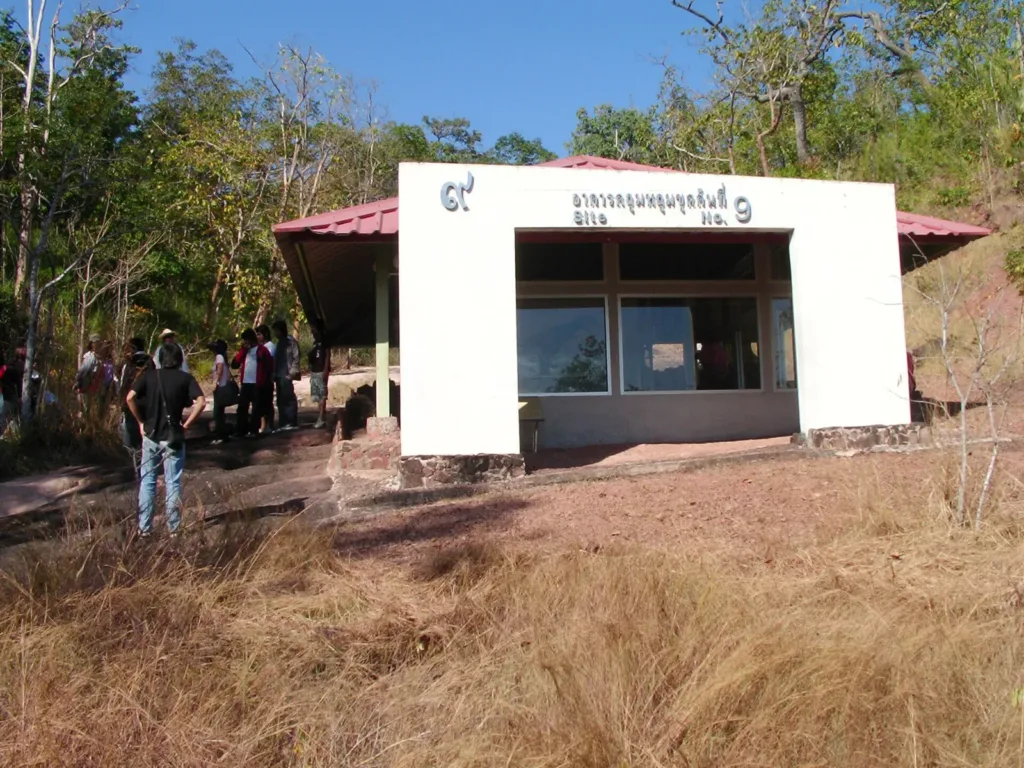
Meat-eaters followed. In 1993 a large theropod skeleton was found at Site 9, Hin Lat Yao, and named Siamotyrannus isanensis in 1996. An ostrich-like dinosaur from Site 5 was named Kinnareemimus khonkaenensis in 2009, and bones collected at Pit 9B since 1993 were finally named Phuwiangvenator yaemniyomi in 2019, a hunter about 5–6 metres long named in honour of the man who found the first bone in 1976.
After the park was declared, the main excavation sites, Sites 1, 2, 3 and 9, were fitted with protective shelters and walkways for visitors. The Department of Mineral Resources, the Tourism Authority of Thailand and Khon Kaen province together set up the Phu Wiang Fossil Research Center and Dinosaur Museum in Wiang Kao district. The park's forest is also home to the yoni pisat tree, a rare species found in Khon Kaen only at Phu Wiang. Locals call it ma kok khok and link its fruit to an Isan folk tale: legend says the heroine Orapim left part of her body with this tree while fleeing danger in the forest.
In February 2024, excavation resumed in the park after a pause of about 30 years, at Site 3, less than 200 metres from where the first bone was found, in a joint effort by the park, Mahasarakham University, the regional Department of Mineral Resources office and the Khon Kaen Geopark. The team has uncovered vertebrae, ribs and teeth of a sauropod estimated at around 20 metres long, and studies continue to determine whether it is a new species. In November 2026 the UNESCO Global Geoparks Council approved Khon Kaen Geopark, covering Wiang Kao and Phu Wiang districts, with formal designation expected in 2027.
- 1976A geologist surveying for uranium finds Thailand's first dinosaur bone at Huai Pratu Ti Ma
- 1978The first scientific reports on the Phu Wiang sauropod bone are published
- 1982Thai–French teams excavate a sauropod skeleton at Site 1, Phu Pratu Ti Ma (some sources say 1987)
- 1986Siamosaurus suteethorni is named from teeth found at Phu Pratu Ti Ma
- 1990Local schoolboys find juvenile sauropod bones at Site 4
- 19918 Dec: declared Phu Wiang National Park, Thailand's 71st
- 1993A large theropod skeleton is found at Site 9, Hin Lat Yao
See 7 events
- 1994Phuwiangosaurus sirindhornae is named as a new species from Site 1
- 1996Siamotyrannus isanensis is named from the Site 9 remains
- 1997An ostrich-like dinosaur from Site 5 is first reported
- 2009Kinnareemimus khonkaenensis is named
- 2019Phuwiangvenator yaemniyomi is named from Pit 9B, honouring the finder of the first bone
- 2024Feb: excavation resumes at Site 3 after about 30 years, revealing a large sauropod
- 2026Nov: the UNESCO Global Geoparks Council approves Khon Kaen Geopark
Check-ins & visitor photos
Arrived? Check in, collect a stamp and tell others what it is like right now
Check your location first, so you do not fill in the form for nothing
Location must be on and within 3 km · One check-in per place per day · come back on other days to check in again
Post photos from anywhere — no need to be here · Up to 20 photos at a time · JPG / PNG / WebP · GPS location data is removed automatically
How to get there
The park is in Nai Mueang, Wiang Kao, about 86 km from Khon Kaen city.
Khon Kaen–Highway 12–Phu Wiang junction–Highway 2038 · Fuel
From Phu Wiang or Wiang Kao town · As agreed
Highway 12, then Highway 2038 for about 38 km, paved; some park tracks need a 4WD
Car park at the park headquarters
Daily 08:30–16:30
about 86 km from Khon Kaen city
Phu Wiang National Park
200 THB
FAQ
Before you go: Phu Wiang National Park
Answers travellers want before they go — a one-minute read
Where is Phu Wiang National Park?
Nai Mueang, Wiang Kao District, Khon Kaen, about 86 km from the city
How much is entry?
Thai adults 40 THB, children 20 THB; foreign adults 200 THB, children 100 THB
What are the hours?
Daily 08:30–16:30
Where can I see dinosaurs?
At the Phu Pratu Ti Ma quarry and the Hin Lat Pa Chat footprints
Which dinosaurs were found?
Phuwiangosaurus sirindhornae, Siamosaurus suteethorni, Siamotyrannus isanensis
Can I stay overnight?
A few bungalows and campsites; contact the park in advance
 Hin Chang Si Viewpoint
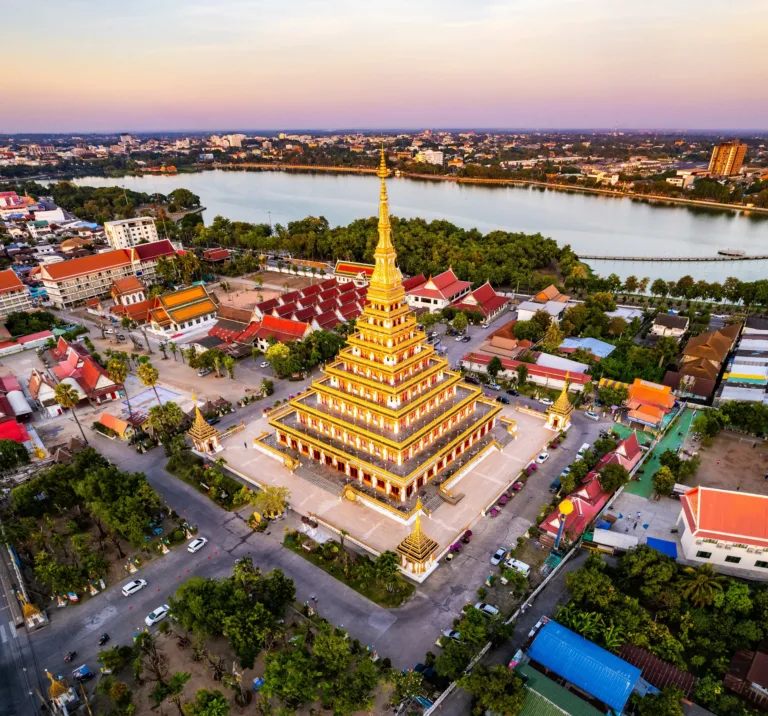 Phra Mahathat Kaen Nakhon (Wat Nong Waeng)
 Bueng Kaen Nakhon
Ready to go to Phu Wiang National Park?
Best day this week: Saturday 28 Nov · Check in when you arrive to collect a stamp