 01
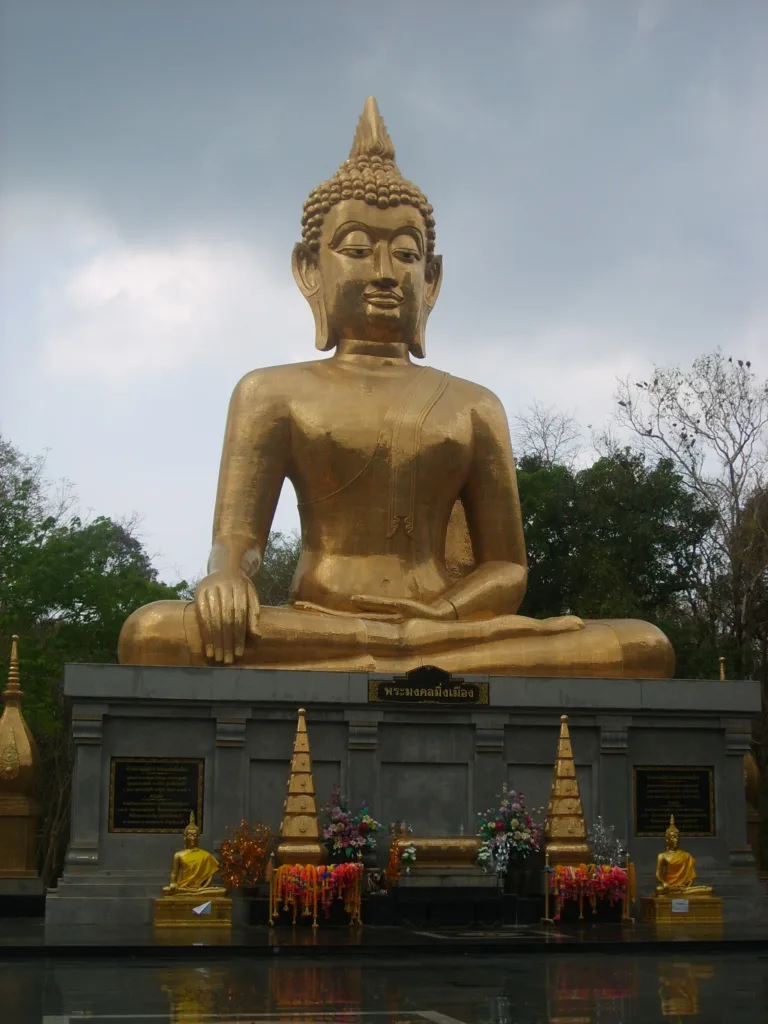
Phra Mongkhon Ming MueangGolden subduing-Mara Buddha, 20 m tall
The town's Great Buddha on a rock hill · Amnat Charoen
A huge golden subduing-Mara Buddha on Khao Dan Phra Bat, the guardian image of Amnat Charoen, completed in 1965, with ancient red-sandstone "Phra Lahai" images and shady rock pavement.
Holiday / event — crowded · Hot (Afternoon) feels like 39°C
Dress modestly · Remove shoes on the worship platform · Do not climb the image · Do not feed monkeys or wildlife
About 06:00–18:00 (outdoor site)
Morning or evening to avoid the sun
Phra Mongkhon Ming Mueang worship fair, full moon of the 3rd lunar month (Makha Bucha)
01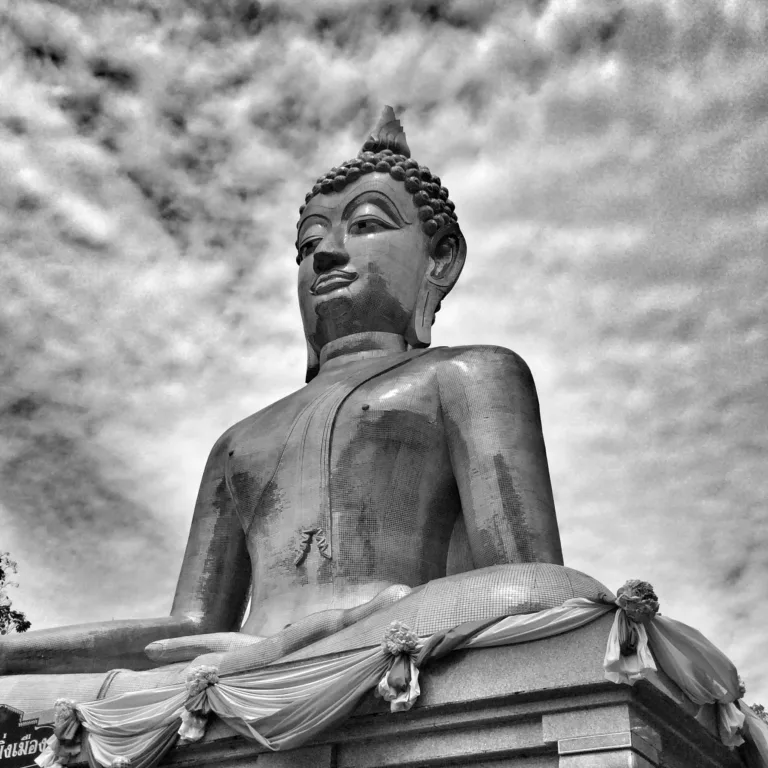 0203
Tap a day card to see that day’s weather, rain, haze and hourly forecast
Best time to go Fine all day little rain through the day
Holiday — traffic on the way up and parking fills fast; leave early
Green band = hours used for the score
Best time to go Fine all day little rain through the day
Holiday — traffic on the way up and parking fills fast; leave early
Green band = hours used for the score
Best time to go Fine all day little rain through the day
Holiday — traffic on the way up and parking fills fast; leave early
Green band = hours used for the score
Best time to go Fine all day little rain through the day · light drizzle possible at times
No warnings today — normal road and weather conditions
Green band = hours used for the score
Best time to go Fine all day little rain through the day · light drizzle possible at times
Strong gusts, about 54 km/h
No warnings today — normal road and weather conditions
Green band = hours used for the score
Best time to go Fine all day little rain through the day
No warnings today — normal road and weather conditions
Green band = hours used for the score
Best time to go Fine all day little rain through the day
No warnings today — normal road and weather conditions
Green band = hours used for the score
Phra Mongkhon Ming Mueang, or "Phra Yai", is the guardian Buddha image of Amnat Charoen, set in the Buddha Park on Khao Dan Phra Bat about 3 km from town: 11 m across the lap and 20 m tall.
Arrive Morning or evening to avoid the sun
Photos from Wikimedia Commons and contributors · full credits inClassic page
Adults 0 THB · Car 0 THB · Time needed 30–60 minutes
Makha Bucha fair and long holidays
Phra Mongkhon Ming Mueang worship fair, full moon of the 3rd lunar month (Makha Bucha)
Amnat Charoen Hospital · Tourist Police 1155 · Emergency 1669
Tap a month on the wheel to see weather, rain, haze and crowds from 10 years of records
Best time · Nov–Feb: cool weather and the Makha Bucha worship fair
Watch out · Mar–May: the rock pavement gets very hot at midday
Oct by the records 23–30°C · avg rain 141 mm (15 rainy days) · clear 5 days · avg PM2.5 7
Phra Mongkhon Ming Mueang, known locally as "Phra Yai" (the Great Buddha), sits in the Buddha Park on Khao Dan Phra Bat, Bung subdistrict, Mueang Amnat Charoen, about 3 km north of the central clock tower along Chayangkun Road (Highway 212). It is the guardian image and provincial Buddha image of Amnat Charoen. Park size figures differ: the provincial PR office gives about 36 rai, while Naewna (2026) says nearly 100 rai.
"Khao Dan" is a low hill near the province's centre with natural sandstone pavement (hin dan) amid forest and streams. The site is-trip says the rock belongs to the red sandstone group, mapped geologically as pebbly sandstone. A natural Buddha footprint on the rock at the top gives the name "Khao Dan Phra Bat"; Naewna also mentions an "inscribed footprint" on the rock hill behind as evidence it has long been a Buddhist site.
Thai Wikipedia says Khao Dan Phra Bat shows evidence of religious use for over 2,000 years. Large natural stones shaped like sema markers, a mortar and "luk nimit" spheres were dug from a natural pond and set near the image. Villagers, believing guardian spirits protect the place, consecrated them as natural sema stones marking the town's sacred boundary. The province's Wikipedia page lists the "sema group of the Phra Mongkhon Ming Mueang park" among its archaeological sites.
Behind the Great Buddha sit "Phra Lahai" or "Phra Khi Lai", two red sandstone Buddha images wrapped in yellow robes. ONEP's art-site database and DASTA say they were found in a pond in 1962 while the area was improved for a weir; Naewna says they were found while building the Huai Pla Daek (Phutthauthayan) reservoir opposite. "Lahai" in Isan means not beautiful by the canons of Buddha imagery, and the carving looks unfinished. People ask them for luck and, when wishes come true, return with chicken figurines, so many lie around them.
Their age is debated: Thai Wikipedia calls them Dvaravati, Naewna (2026) dates them to late Dvaravati around the 4th–7th centuries CE (10th–12th Buddhist century), while is-trip calls them local art of the 9th–15th centuries CE (15th–20th Buddhist century). All agree they are far older than the Great Buddha and trace Buddhism on Khao Dan Phra Bat before it.
The Great Buddha began with Phra Khru Thatsana Prakat (Bu Chanthasiri), then abbot of Wat Samran Niwet, who conceived it around 1955 according to is-trip (the provincial PR site spells his title "Phra Khru That Prakat"). He wanted a large image as a spiritual centre, to enshrine Buddha relics, damaged antiquities such as Buddha heads and old sema stones and other sacred objects beneath its base, and to honour Somdet Phra Maha Wirawong (Uan Tisso), the first Sangha Nayok, and Phra Ajarn Di Channo, part of whose ashes were placed in the base.
The man the Great Buddha honours is Somdet Phra Maha Wirawong (Uan Tisso), a senior monk from Ubon Ratchathani. Thai Wikipedia gives his birth name as Uan Saenthawisuk, born 21 March 1867 at Ban Khaen, Don Mot Daeng, Ubon. He led Wat Supattanaram (Ubon), Wat Sutthachinda (Nakhon Ratchasima), Wat Borommaniwat and Wat Phra Si Mahathat (Bangkok), and was Thailand's first Sangha Nayok under the Sangha Act of 1941. Silpa Watthanatham notes his key role in spreading Thammayut education and temples across Isan and his elevation to Somdet rank in 1939. He died on 26 January 1956, just as the Great Buddha project was taking shape, so enshrining his ashes in the base makes the image both the town's guardian Buddha and a memorial to a great Isan elder.
Construction began in 1960, when Amnat Charoen was still a district of Ubon Ratchathani, which is why Thai Wikipedia credits the people and government offices of Ubon. According to the provincial PR office, the foundation stone was laid on 1 September 1962 in heavy rain, and Chao Khun Phra Thammabandit had the ceremony continue through the downpour.
When funds ran short, Col. Pin Muthukan took the matter to Gen. Praphas Charusathien, who donated personally and drew in other donors, so work continued until completion on 31 March 1965 (Naewna). The provincial PR site gives the cost of the renewed building effort as about 332,800 baht.
The people behind the key funding were national figures. Col. Pin Muthukan was himself a son of Amnat Charoen: Matichon (2019) says he was born in 1916 at Ban Kham Phra to a farming family, studied as a Thammayut novice, left the robes to become an army chaplain and became a hugely popular preacher, giving the radio series on the 25th Buddhist century in 1956–57. He became Director-General of the Religious Affairs Department in 1963 and died in 1972. Field Marshal Praphas Charusathien (then a general) was, per Thai Wikipedia, Minister of Interior from 1957 through the Sarit and Thanom governments, spanning the years of construction.
The designer was teacher Chit (Prakit) Buaboot and the builder was craftsman Kham Mao Phakdipanya of Roi Et, who is-trip says had worked with the Fine Arts Department. The image is a reinforced-concrete shell over an older stucco image, whose base DASTA gives as 8.4 m wide, 12.6 m long and 5.2 m high, faced with gold mosaic. It is in the subduing-Mara posture facing east, 11 m across the lap and 20 m from the ground to the flame finial; is-trip says it was then the largest outdoor Buddha in Isan.
Its style is described in several ways. Most sources, including ONEP, DASTA and Naewna, cite northern Indian Pala influence, which reached Isan around the 7th–11th centuries CE. The provincial PR site says the craftsmen copied Phra Phuttha Chinnarat and gives several lap widths (9, 10 or 11 m), while is-trip sees a local Isan character. ONEP records the belief that it holds Buddha relics received from India.
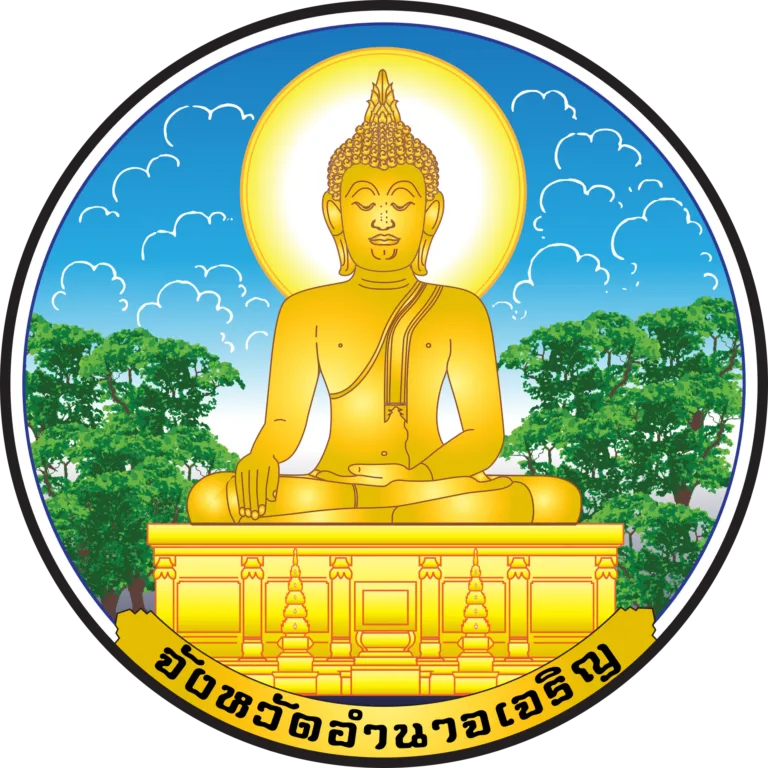
When Amnat Charoen split from Ubon Ratchathani to become a province in 1993, the Great Buddha became its main symbol. The provincial seal shows Phra Mongkhon Ming Mueang with six-coloured rays around the head, flanked by trees and clouds, and the provincial motto opens "Phra Mongkhon Ming Mueang, prosperous land of seven rivers". The town name goes back to 1858, when King Mongkut raised Ban Kho Yai (now in Lue Amnat district) to the town of "Amnat Charoen".
The annual Phra Mongkhon Ming Mueang worship fair falls on the full moon of the third lunar month, Makha Bucha day. The provincial PR site says it lasts five days and nights, and Naewna says it has been held for at least 40 years. The 2024 fair ran 18–24 February with offerings to the guardian spirits, dance offerings, alms-giving, candlelit circumambulation, exhibitions and an OTOP market.
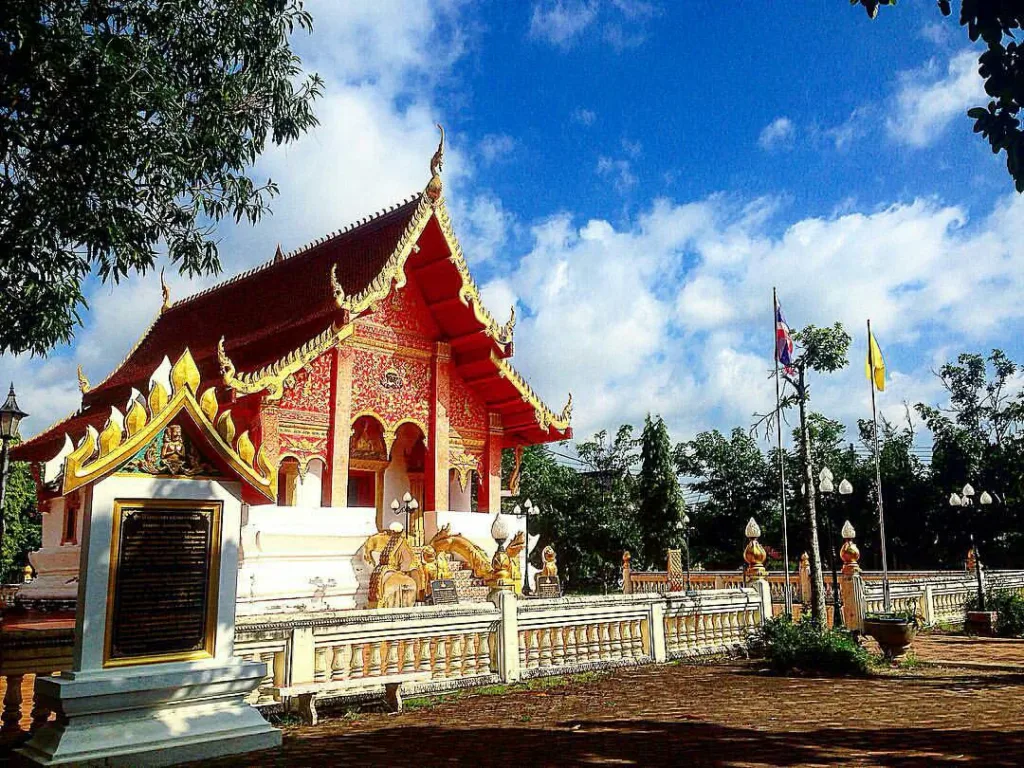
Dozens of amulet stalls run by the provincial amulet club line the front of the image; Naewna notes the first-edition Phra Mongkhon Ming Mueang coin of 1968 is the rarest and most sought after. The forest behind the park is conserved, with caves, wooden buildings and a small monastery, and the Phutthauthayan reservoir opposite supplies farms and the town's tap water.
The Phutthauthayan reservoir, formed by damming Huai Pla Daek, is both a vital water source and a flood risk. Naewna reported on 10 September 2025 that the 19.325-million-cubic-metre reservoir had filled after heavy rain and was spilling over its spillway, and community leaders warned three riverside communities in Amnat Charoen municipality to move valuables to higher ground. Faith in Phra Lahai remains strong: Naewna (2023) notes that people whose wishes come true leave not only chicken figurines but also zebras and elephants all around the back of the image.
Arrived? Check in, collect a stamp and tell others what it is like right now
Check your location first, so you do not fill in the form for nothing
Location must be on and within 1 km · One check-in per place per day · come back on other days to check in again
Post photos from anywhere — no need to be here · Up to 20 photos at a time · JPG / PNG / WebP · GPS location data is removed automatically
From the central clock tower go north on Chayangkun Road abo…
Amnat Charoen town–Buddha Park via Chayangkun Road · Fuel
Bangkok–Amnat Charoen, then local transport · Per operator
Bangkok–Ubon Ratchathani, then about 1.5 hrs by road · Per airline
Chayangkun Road (Highway 212), paved all the way
Car park in front of the Buddha Park
Petrol stations in town and on Highway 212
Good 4G
About 06:00–18:00 (outdoor site)
around 3 km fromAmnat Charoen town
Phra Mongkhon Ming Mueang
0 THB
Approx. nightly price for 2 adults (next week) · final price depends on your dates
Answers travellers want before they go — a one-minute read
Khao Dan Phra Bat, Bung, Mueang Amnat Charoen, about 3 km north of town on Chayangkun Road
Begun 1960, foundation stone 1962, completed 31 March 1965
11 m across the lap and 20 m from the ground to the flame finial
Two ancient red-sandstone Buddha images found in a pond in 1962, asked for luck and thanked with chicken figurines
Full moon of the 3rd lunar month, at Makha Bucha
No
Best day this week: Thursday 29 Oct · Check in when you arrive to collect a stamp