 01
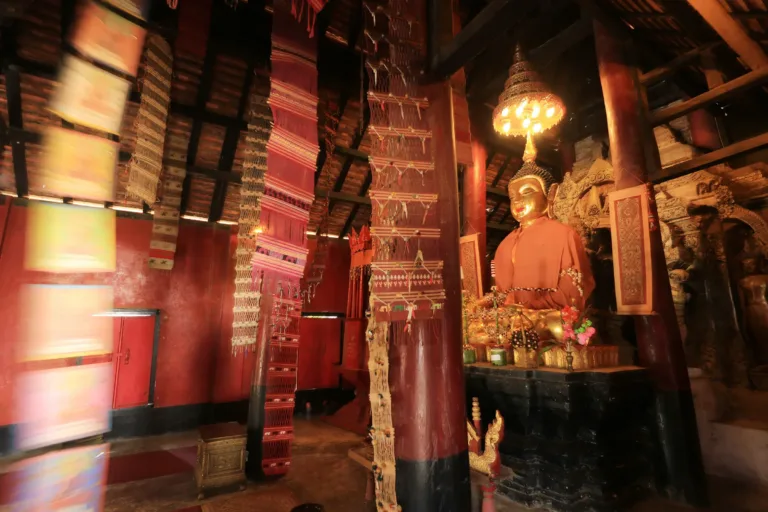
Wat Yang LuangA Bagan and Chiang Saen style shrine (Kijakut) behind the main Buddha in a teak viharn
Weaving community · Mae Chaem, Chiang Mai
A small valley town west of Doi Inthanon, home of GI-registered tin chok sarongs. Watch weavers at Ban Thong Fai and visit Wat Yang Luang and the murals of Wat Pa Daet.
Good weather, little rain
During the tin chok festival, usually in February
Half a day to 1 day
Ku Phra Chao, Wat Yang Luang — Close doors and windows leaving one gap of light to see the inverted shadow (ask first)
The town can be visited any day · Wat Yang Luang about 06:00–18:00 · Wat Phuttha En 07:00–18:00 · Wat Kong Kan 09:00–17:00
Free
01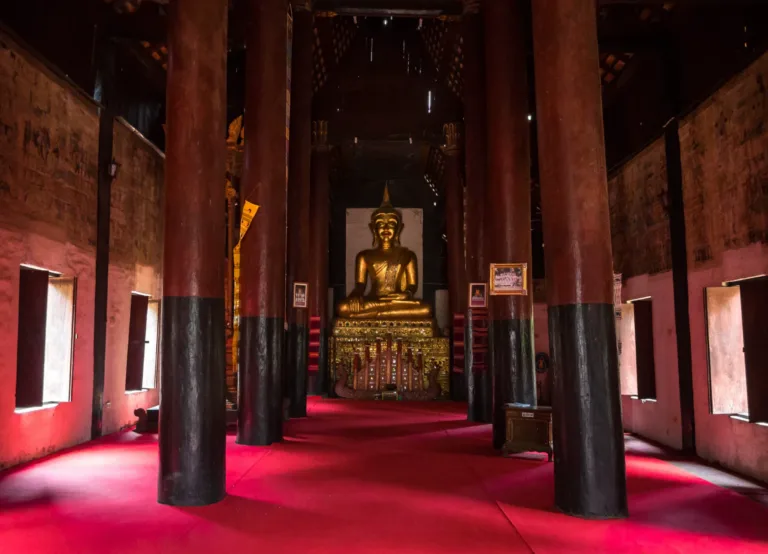 02
 03
Tap a day card to see that day’s weather, rain, haze and hourly forecast
Best time to go Daytime is over · see tomorrow
No warnings today — normal road and weather conditions
Green band = hours used for the score
Best time to go Fine all day little rain through the day
No warnings today — normal road and weather conditions
Green band = hours used for the score
Best time to go Fine all day little rain through the day
No warnings today — normal road and weather conditions
Green band = hours used for the score
Best time to go Fine all day little rain through the day
No warnings today — normal road and weather conditions
Green band = hours used for the score
Best time to go Fine all day little rain through the day
No warnings today — normal road and weather conditions
Green band = hours used for the score
Best time to go Fine all day little rain through the day
No warnings today — normal road and weather conditions
Green band = hours used for the score
Best time to go Fine all day little rain through the day
No warnings today — normal road and weather conditions
Green band = hours used for the score
Mae Chaem is a small riverside town in a valley on the western side of Doi Inthanon. Its Tai Yuan families have woven tin chok sarongs for generations, and Mae Chaem tin chok has been a registered Geographical Indication since 2005. There are 16 main patterns, and the supplementary weft is worked from the back so neatly that both sides look almost the same.Old Lanna temples sit close together in and around town. Wat Yang Luang has a Bagan and Chiang Saen style shrine, the Ku Phra Chao, behind its main Buddha, while Wat Pa Daet has a Lanna viharn with murals showing local life more than a century ago. Nearby, Wat Phuttha En has an ordination hall standing in a pond, and Wat Kong Kan has a wooden viharn with an old shingle roof.To see weaving, stop at Ban Thong Fai in Chang Khoeng, home of the Mae Chaem Tin Chok Handicraft Centre, or at weavers' homes where looms sit under the raised houses. The best time is the cool season from November to February, especially during the tin chok festival, usually in February, with ethnic costume parades and a craft market.Mae Chaem pairs well with the Pa Bong Piang rice terraces and Ob Luang National Park. You can come on a long day trip from Chiang Mai, but a night in town makes it far more relaxed.
Most are private houses, so ask before going in or taking photos
Pieces made with nylon or chemical dyes are worth less than naturally dyed cotton, so ask about materials first
Free · Time needed Half a day to 1 day
During the tin chok festival, usually in February
| Songthaew/minivan Chiang Mai–Chom Thong optional | 70–150 ฿/person |
| Songthaew Chom Thong–Mae Chaem optional | 50–80 ฿/person |
Prices may change by season — check with the venue
Mae Chaem Tin Chok Festival (around February to early March, dates change yearly) · Chula Kathin at Wat Yang Luang (around late October–November)
Mae Chaem is a small town on a narrow strip of flat land along the Mae Chaem River, in a valley on the western side of Doi Inthanon. Its Tai Yuan families have woven tin chok sarongs for generations, and Mae Chaem tin chok cloth was registered as a Geographical Indication in 2005. Around the town stand old Lanna temples such as Wat Yang Luang and Wat Pa Daet, which preserve Bagan-style architecture, Tai Yai craftsmanship and murals of local life from more than a century ago.
Only legend explains the town's name. A 2021 study of Mae Chaem tin chok patterns by Chutima Ngampipat notes that no historical evidence confirms how the town began. The story goes that two lion brothers fought over the land, so a Paccekabuddha (solitary Buddha) drew a line with a stick; it became the Huai Chang Khoeng stream, meaning "split in half". Later, while the Buddha rested at Don Sakan, poor villagers could offer him only half a fish, and the place became known as Mueang Chaem, "the town of scarcity", a name that later shifted to Mae Chaem.
A community history compiled in a Chulalongkorn University thesis says the area was first home to the Lua. Around BE 1800 (mid-13th century CE) more Tai Yuan arrived and Lua power declined. When Chiang Mai fell to Burma in 1558/59, Mae Chaem suffered and declined too, and only after Phraya Kawila retook Chiang Mai in 1774/75 did people regroup and rebuild the community. Some textile experts believe the tin chok technique came with Tai Yuan settlers from Chiang Saen during this repopulation of Chiang Mai.
The town's layout reflects Lanna settlement wisdom. Isara Guntang (2014) explains that the limited floodplain was given over to rice, extended by terraces up the hillsides, with a mueang fai weir system that both irrigated the fields and slowed flash floods. Houses sat on natural ridges or at the foot of the hills out of reach of floodwater, giving rise to ridge villages and hill-foot villages, each with a guardian-spirit shrine in a grove of big trees. Wat Chang Khoeng, on the largest ridge of Ban Luang, served as the main temple, and that area later grew into the town's government and market centre.
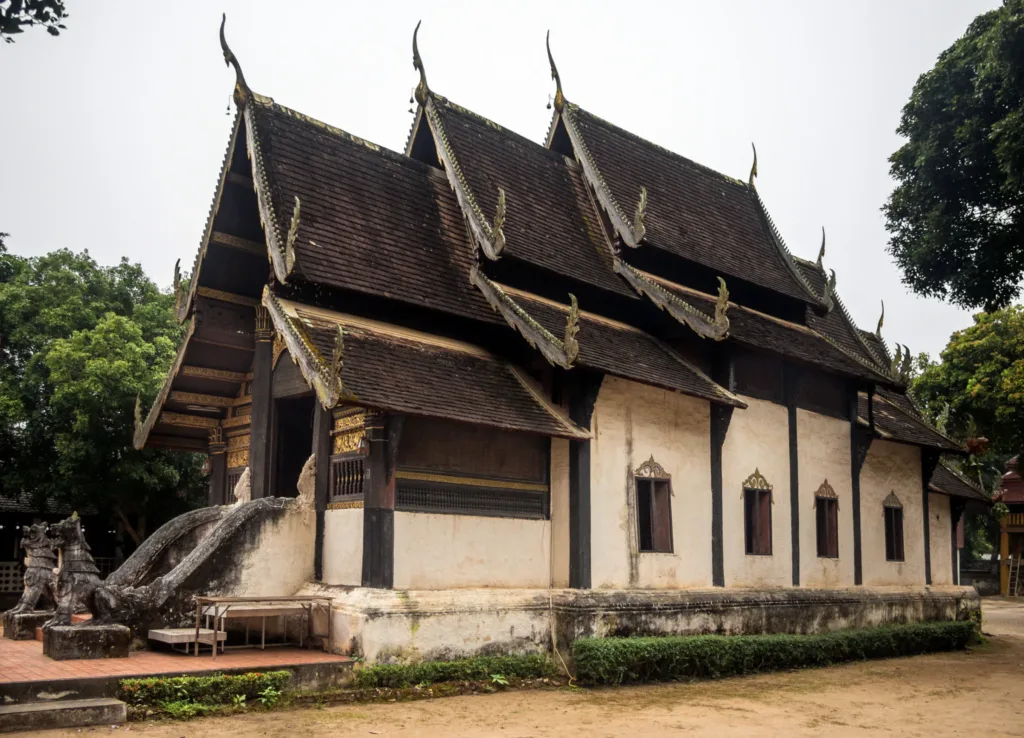
Wat Yang Luang, at the southern end of town, is one of the oldest temples. Travel sources say it was founded by the Yang (Karen) people in the 24th Buddhist century, according to an inscription on a Buddha image pedestal in front of the Ku Phra Chao, and that it was restored in 1864/65. Behind the main Buddha in the teak viharn is the Ku Phra Chao, or Kijakut, a Bagan and Chiang Saen style shrine that locals regard as a gateway to heaven, with wall paintings of three monks believed to be the Buddha and two disciples. The temple also hosts the Chula Kathin rite at the end of the rainy season, when cotton is spun and woven into a robe within a single day.
Wat Pa Daet was first called Wat Mai Mueang Mae Chaem or Wat Nuea, the "northern temple", paired with Wat Yang Luang as the southern one. Its founding date is disputed: The Nation gives 1827; a 2020 Naewna feature gives BE 2370 for its founding but also says the temple was built in BE 2400, under King Rama IV; and the Chulalongkorn thesis says it was built with help from foreign logging companies that came in BE 2434 (1891/92). According to Naewna, the viharn was completed and celebrated in 1885/86, the scripture library was built in 1907/08, the temple received a royal boundary grant in 1987, and the Fine Arts Department's Chiang Mai office shored up and repaired the viharn from 2018.
The Wat Pa Daet murals fill eight panels, painted in dry pigment by folk artists, reportedly Tai Yai, with captions in Lanna script. They show the Three Worlds cosmology, the life of the Buddha, the Vessantara and Vidhura stories, and scenes of Mae Chaem life such as rice farming and local dress. The GI registration notes that tin chok cloth appears in these murals, and The Nation describes figures in Mae Chaem sarongs in the scene of the Buddha's birth.
As an administrative unit, Mueang Chaem district was created in 1908 from the subdistricts of Mae Thap, Tha Pha, Chang Khoeng and Mae Suek, split from Chom Thong. It was renamed Chang Khoeng in 1917 after the subdistrict of its office, reduced to a minor district under Chom Thong in 1938, renamed Mae Chaem in 1939 and made a full district again in 1956. In 2009 its northern part became the new Galyani Vadhana district.
Tin chok was more than clothing. The GI registration traces its known origin to Ban A-ham in Tha Pha subdistrict, where the craft passed down through families descended from local rulers and later settlers. Pieces brocaded with gold and silver thread were woven as tribute for the rulers of Chiang Mai, while commoners used cotton, so the cloth signalled status and was worn for major merit-making. There are 16 main patterns, such as Lak Kon Luang, Chiang Saen Luang and Kut Kho Bet. The supplementary weft is worked from the back and tied off so neatly that both sides look almost the same, and a finely patterned sarong can take nearly three weeks.
According to the GI document, once a road reached Mae Chaem in 1963 many people stopped wearing tin chok every day. After the first royal visit to Mae Chaem in 1974, weavers were trained in a faster method. A revival of Lanna-style dress in 1986–1987 renewed interest in old patterns, and an annual tin chok festival has been held in Mae Chaem since 1994.
Today Mae Chaem tin chok holds GI registration dated 4 August 2005. Ban Thong Fai in Chang Khoeng subdistrict won an outstanding handicraft village award in 1998 and opened the Mae Chaem Tin Chok Handicraft Centre in 2009. In 2016 a Ban Thong Fai family showed two old tin chok sarongs kept for five generations; experts estimated they date from the Chiang Saen era, though this is unconfirmed. The 21st tin chok festival was held on the field in front of the district office in 2014, and the 30th ran from 13 to 17 February 2025.
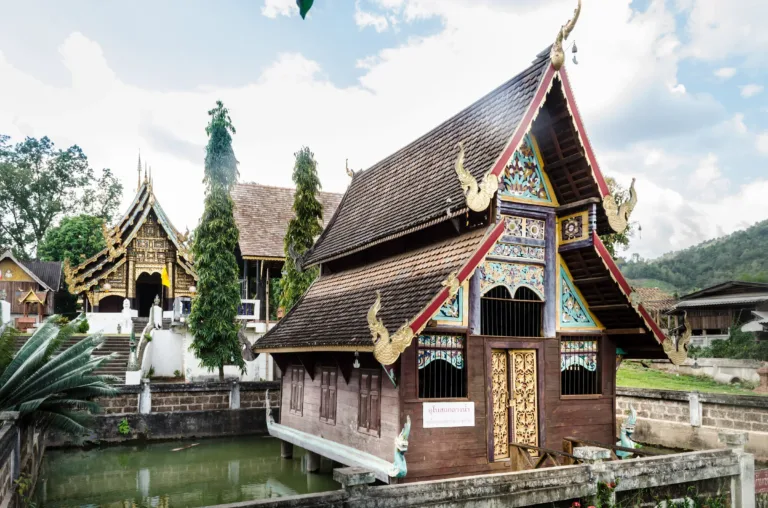
The temples near town have their own legends. Wat Phuttha En has an ordination hall standing in a pond, one of only two left in northern Thailand, and legend says a sacred well at its gate sprang up where the Buddha spat out water. Wat Kong Kan was once called Wat Si Mueang Ma; legend tells of a novice of unknown origin who helped finish the face of its great Buddha image, Phra Chao Ton Luang, and villagers came to believe he was the god Indra. The temple was abandoned in troubled times and later restored, and its name refers to the shoulder poles used to carry offerings, which were stacked in piles.
Arrived? Check in, collect a stamp and tell others what it is like right now
Check your location first, so you do not fill in the form for nothing
Location must be on and within 2 km · One check-in per place per day · come back on other days to check in again
Post photos from anywhere — no need to be here · Up to 20 photos at a time · JPG / PNG / WebP · GPS location data is removed automatically
There are two main routes from Chiang Mai: over Doi Inthanon or around via Hot district.
Highway 108 to Chom Thong, road 1009 to the Mae Chaem junction at km 38, then left about 22 km · Fuel
Highway 108 to Hot, then turn off to Mae Chaem · Fuel
Songthaew or minivan to Chom Thong, then a local songthaew to Mae Chaem · About 70–150 + 50–80 baht/person
Paved but winding mountain roads, with many bends over Doi Inthanon
The town can be visited any day · Wat Yang Luang about 06:00–18:00 · Wat Phuttha En 07:00–18:00 · Wat Kong Kan 09:00–17:00
Mae Chaem
Answers travellers want before they go — a one-minute read
The weft is worked from the back and tied off neatly so both sides look almost the same; there are 16 main patterns, and it was registered as a Geographical Indication on 4 August 2005
At Ban Thong Fai in Chang Khoeng, home of the Mae Chaem Tin Chok Handicraft Centre, and at weavers' homes with looms under the house; ask before going in
It depends on pattern, colour and material; one travel guide puts prices from about 1,800 baht, and finely detailed pieces cost much more
It is held every year around February to early March; in 2025 it ran 13–17 February. Dates change, so check first
The Pa Bong Piang rice terraces, Ob Luang National Park and Doi Inthanon, all on the same route
Dress modestly since most stops are temples: cover shoulders and knees, and take off your shoes before entering a viharn
Best day this week: Saturday 28 Nov · Check in when you arrive to collect a stamp
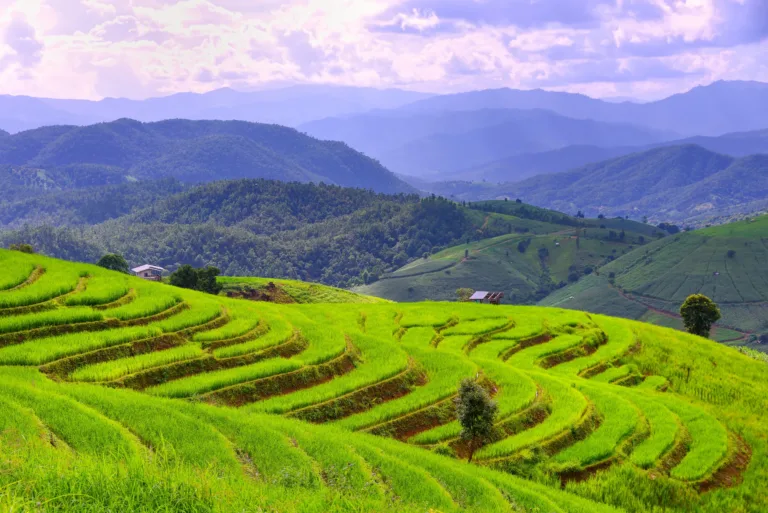 Pa Bong Piang Rice Terraces
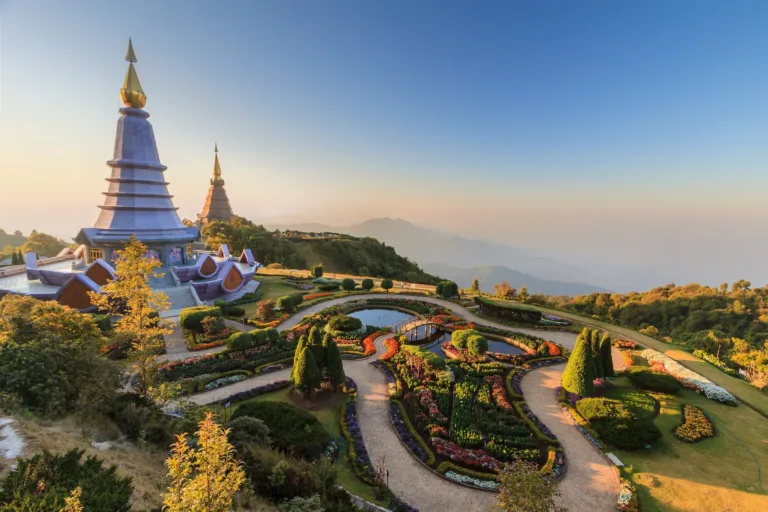 Twin Royal Chedis of Doi Inthanon
 Kew Mae Pan Nature Trail
 Doi Inthanon