Opening hours, time needed and photo spots
All day
1 hour
Portal by the station — A train emerging
Free
7 days ahead
When to go
this week
Tap a day card to see that day’s weather, rain, haze and hourly forecast
Best time to go Fine all day little rain through the day
Holiday — traffic on the way up and parking fills fast; leave early
Hour by hour
Green band = hours used for the score
Best time to go Fine all day little rain through the day
Holiday — traffic on the way up and parking fills fast; leave early
Hour by hour
Green band = hours used for the score
Best time to go Fine all day little rain through the day
Holiday — traffic on the way up and parking fills fast; leave early
Hour by hour
Green band = hours used for the score
Best time to go Best window 06:00–14:00 Little rain · light drizzle possible at times
No warnings today — normal road and weather conditions
Hour by hour
Green band = hours used for the score
Best time to go Best window 07:00–13:00 Little rain · light drizzle possible at times
No warnings today — normal road and weather conditions
Hour by hour
Green band = hours used for the score
Best time to go Fine all day little rain through the day
No warnings today — normal road and weather conditions
Hour by hour
Green band = hours used for the score
Best time to go Fine all day little rain through the day
No warnings today — normal road and weather conditions
Hour by hour
Green band = hours used for the score
Khun Tan Tunnel
Khun Tan Tunnel, Ban Khun Tan, Mae Tha, Lamphun.
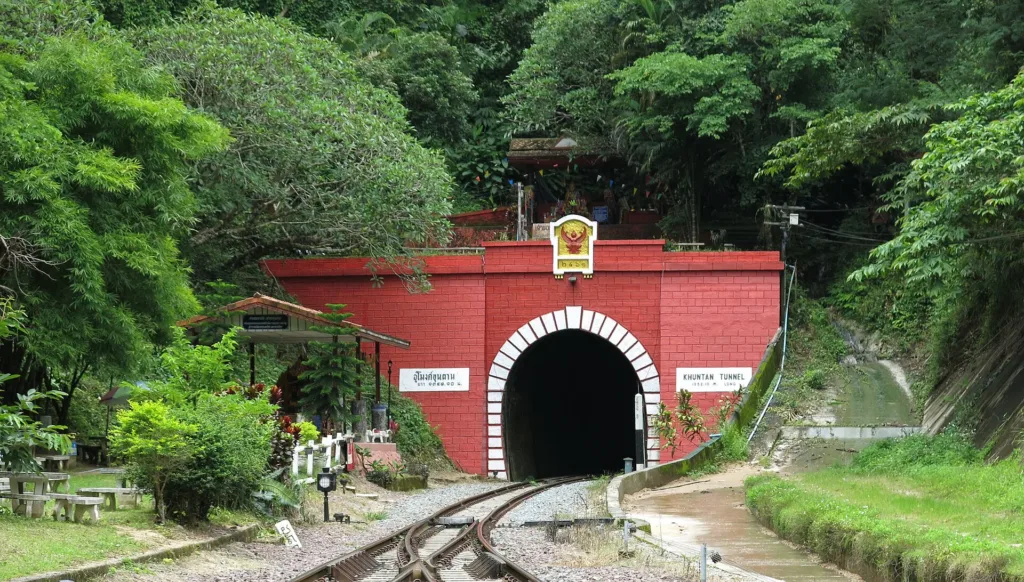
- Morning light on the portal
- Harsh sun
- Evening light
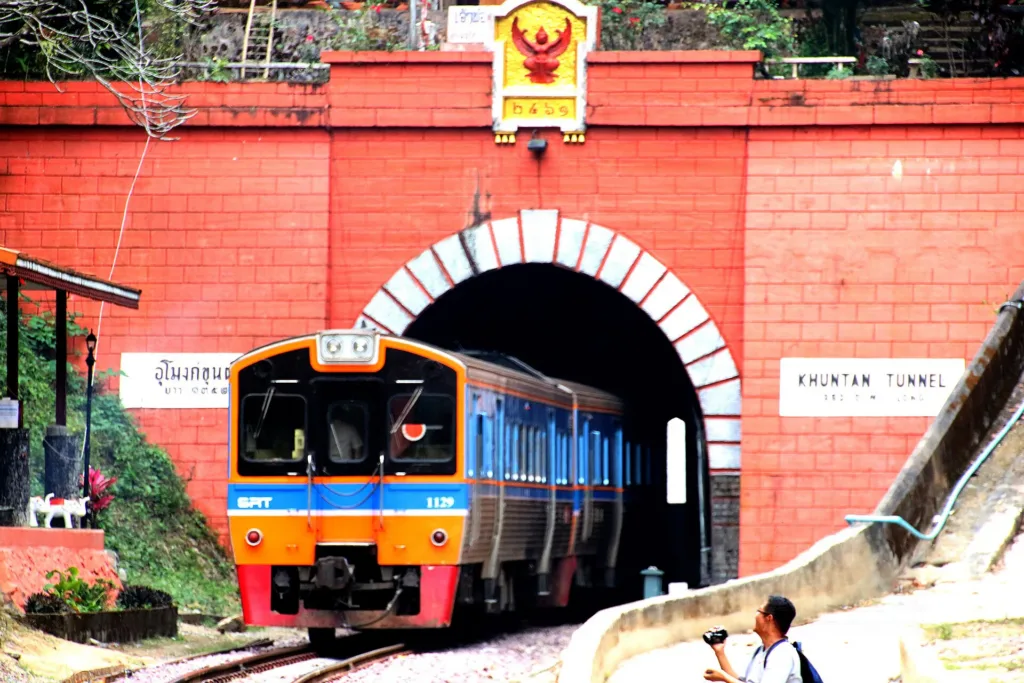
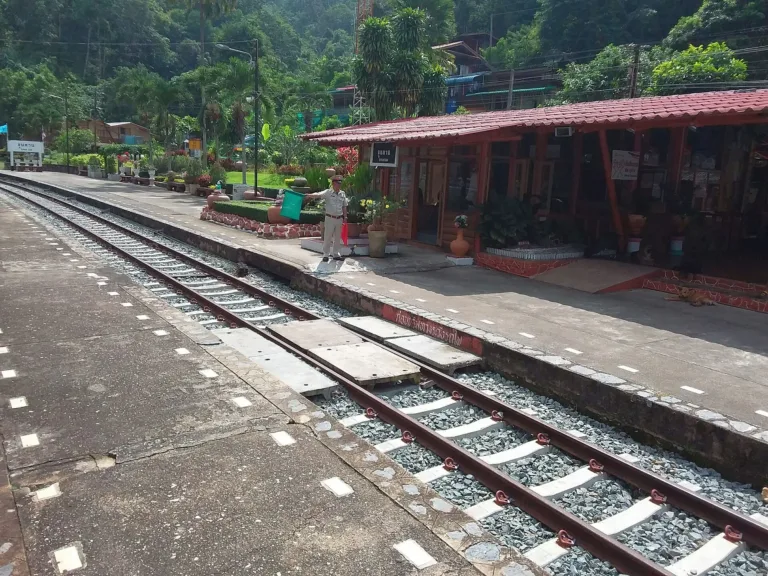
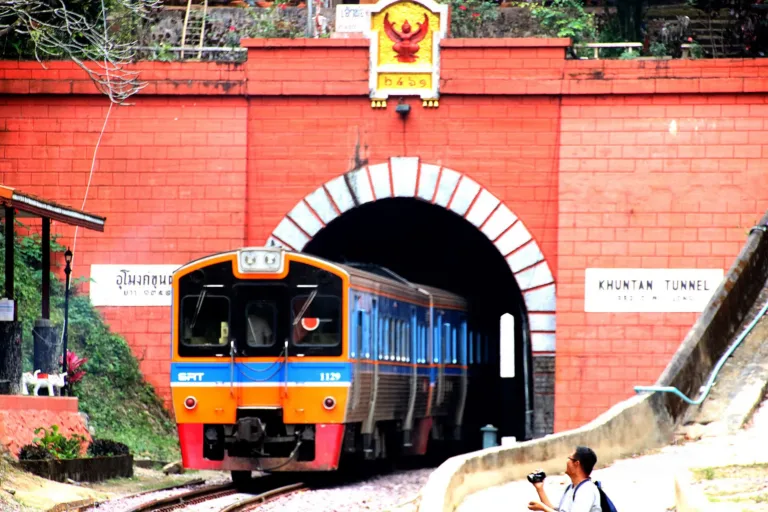
- Portal by the stationA train emergingLate morning
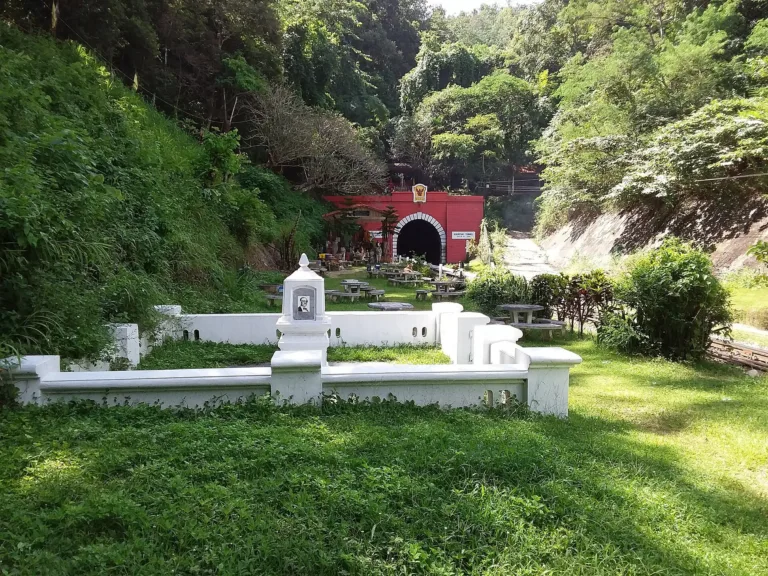
- Eisenhofer memorialThe stupa before the portalMorning
- Khun Tan platformA mountain stationEvening
Gallery
Photos from Wikimedia Commons and contributors · full credits inClassic page
Good to know here
Never walk into the tunnel or along the tracks
Landslides and train delays possible
- Check train times on 1690
- Wait to photograph a train leaving the tunnel
- See the old photos at the station
- Combine with Doi Khun Tan or the Tha Chomphu bridge
Adults 0 THB · Time needed 1 hour
Cool-season holidays
- Kids Yes, with supervision near the track
- Seniors Yes, from the platform
- Wheelchair Platform partly accessible
- Pets Yes, on a lead
- Noodle shop by Khun Tan stationNoodles
- Village grocerySnacks
- Always give way to trains
- Be respectful at the memorial and shrine
- Never walk into the tunnel
- Don't stand on the tracks
- Active railway
- Landslide risk in the rains
Best months
Tap a month on the wheel to see weather, rain, haze and crowds from 10 years of records
Best time · Nov–Feb is cool; combine with Doi Khun Tan
Watch out · Aug–Sep heavy rain; past landslides and suspended trains
16°Jan
18°Feb
21°Mar
22°Apr
22°May
22°Jun
22°Jul
22°Aug
21°Sep
21°Oct
19°Nov
17°Dec
Oct by the records 21–28°C · avg rain 202 mm (24 rainy days) · clear 6 days · avg PM2.5 12
The story of this place
The Khun Tan Tunnel — usually spelled "Khun Tan" by the railway — carries the Northern Line under the Khun Tan range between Mae Tan Noi station in Hang Chat, Lampang, and Khun Tan station in Mae Tha, Lamphun, at about km 681.58–682.94 from Bangkok. The north portal is only about 100–200 m from Khun Tan station.
Read more 15 more paragraphs
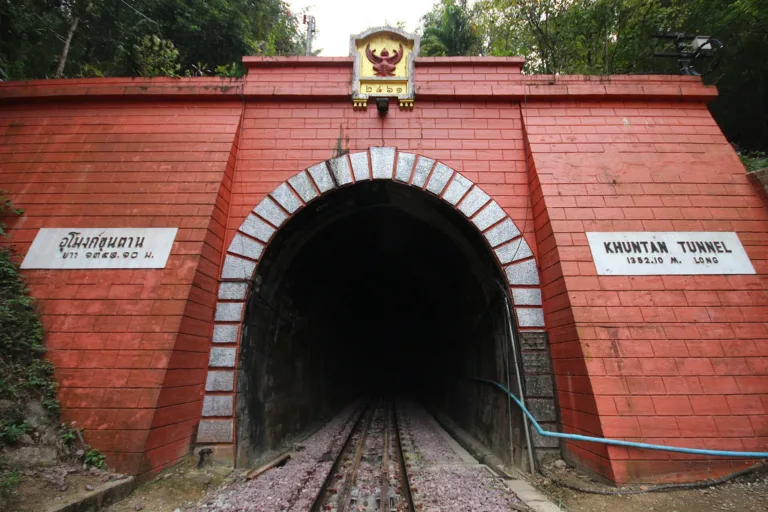
Its length is given several ways: most Thai sources, including Silpa Watthanatham and Lamphun province, say 1,352.10 m, while a 2018 Burapha University study and the kilometre markers give 1,362.10 m. The bore is 5.20 m wide and 5.40 m high, arched and lined with reinforced concrete; over 60,000 m³ of earth and rock were removed.
Boring began in 1907, late in Rama V's reign, and finished in 1918 under Rama VI, about 11 years and roughly 1.36 million baht funded by foreign loans. It was designed for standard gauge and later used for metre gauge, leaving generous clearance. No formal opening date has been confirmed; claims of 1 January 1918, 1921 or 1925 lack support.
Silpa Watthanatham has published two old photos: an inspection by the Minister of Communications in 1911 and a royal visit at the north portal in 1916, whose caption does not name the visitor.
The boring from 1914 to 1917 was directed by Emil Eisenhofer (1879–1962), a German engineer with a firm hired by the Siamese government, who suffered malaria on the job. When Siam declared war on Germany in July 1917 he and other German engineers were arrested, held about six months, then interned in India for about two years before returning to Germany in 1920; Thai engineers finished the work.
Eisenhofer returned to Thailand in 1929 and lived there until his death in 1962. His ashes rest in a small stupa near the portal by Khun Tan station, built by the railway as a memorial. In front of the tunnel is the shrine of Chao Pho Khun Tan, where people pay respects before travelling.
Locals called Eisenhofer "Mr. Hofer". His wife is buried with him at the memorial by the north portal. He also built Ban Pin station in Phrae, which opened in 1914.
Several groups did the work: Silpa Watthanatham says Chinese labourers handled the earthworks while Shan and Isan workers drilled the tunnel, and some accounts mention Lao workers partly paid in opium. Workers died of malaria, cholera, dust-related lung disease and tiger attacks, but figures of "over a thousand" or "thousands" of deaths are unverified anecdote.
Silpa Watthanatham says workers received one tube of opium per shift, deducted from their wages and arranged legally through the government of the time.
Before the railway, Bangkok to Chiang Mai by the Ping River took one to two months. Once the tunnel was done, the line ran on from Lampang to Chiang Mai on 1 January 1922, cutting the trip to three nights by ordinary train or about 24 hours by express.
The portal is red brick with a Garuda emblem above the entrance — the only Thai railway tunnel with one, according to Lamphun's tourism office.
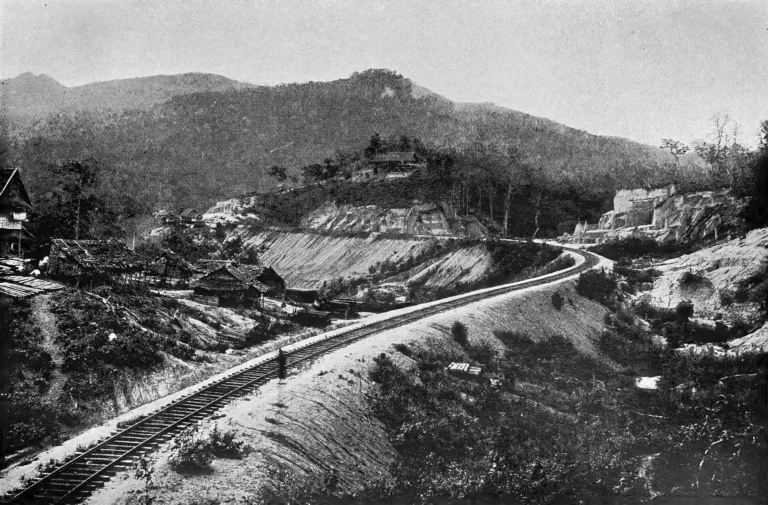
Khun Tan station (code KhN.) at km 683.14 sits at about 578 m, often called the highest railway station in Thailand. The original building served from 1918 to 1960; the present one was finished in 1959 and opened in 1960. Black-and-white construction photos are displayed at the station.
Khun Tan was Thailand's longest railway tunnel from 1918 until 28 July 2024, when the 5.41 km Pha Sadet tunnel opened on the Map Kabao–Thanon Chira Junction double track in Saraburi. The Ngao tunnel of about 6.2 km on the Den Chai–Chiang Rai–Chiang Khong line is targeted for around 2028, while a 7,272 m new tunnel near Khun Tan for a Den Chai–Chiang Mai double track was still at the environmental-review stage in 2023.
Rains have brought repeated landslides. On 7 September 2012 a flash flood washed out about 36 m of track between Khun Tan and Tha Chomphu. On 22 September 2024 a landslide at the portal and flash floods halted Lampang–Chiang Mai trains from 23 September, with buses replacing them. On 14 June 2026 a landslide at the north portal closed the line from 17:18 until about 19:40 the same day.
No Second World War event specific to the tunnel has been found, though the Northern Line as a whole suffered Allied bombing. Eisenhofer's arrest belongs to the First World War, not the Second.
The tunnel is an active line: never walk into it or along the tracks. View and photograph it from the Khun Tan platform and the area in front of the portal; it is free and open all day. Special express, rapid and local trains stop at Khun Tan — check times with the SRT on 1690 before you go.
- 1907Boring begins, late in Rama V's reign
- 1911Minister of Communications inspects the works (photo)
- 1914–1917Emil Eisenhofer directs the boring
- 1914Ban Pin station, built by Eisenhofer, opens
- 1916A royal visit at the north portal (photo; visitor unnamed)
- Jul 1917Siam declares war; German engineers arrested
- 1918Tunnel finished; first Khun Tan station building in use
See 10 events
- 1 Jan 1922Railway reaches Chiang Mai
- 1929Eisenhofer returns to Thailand
- 1960Present Khun Tan station building opens
- 1962Eisenhofer dies; ashes enshrined by the tunnel
- 7 Sep 2012Flash flood washes out track between Khun Tan and Tha Chomphu
- 6–7 Apr 2016Burapha University inspects the tunnel
- Mar 20237,272 m new tunnel near Khun Tan at EIA stage
- 28 Jul 2024Pha Sadet tunnel opens; Khun Tan no longer the longest
- 22 Sep 2024Landslide at the portal halts Lampang–Chiang Mai trains
- 14 Jun 2026Landslide at the north portal; line reopened the same day
Check-ins & visitor photos
Arrived? Check in, collect a stamp and tell others what it is like right now
Check your location first, so you do not fill in the form for nothing
Location must be on and within 1.5 km · One check-in per place per day · come back on other days to check in again
Post photos from anywhere — no need to be here · Up to 20 photos at a time · JPG / PNG / WebP · GPS location data is removed automatically
How to get there
Steep, winding road up to the station
Khun Tan station · By class
Highway 11, Mae Tha junction · Fuel
Highway 11, turn at the Mae Tha junction and follow Doi Khun Tan signs, or take the train to Khun Tan
Around Khun Tan station
Mae Tha town
Moderate
All day
Khun Tan Tunnel
0 THB
Stays near Khun Tan Tunnel
Approx. nightly price for 2 adults (next week) · final price depends on your dates
FAQ
Before you goKhun Tan Tunnel
Answers travellers want before they go — a one-minute read
How long is the tunnel?
About 1,352 m; some sources say 1,362 m
Is it still Thailand's longest?
No; the 5.41 km Pha Sadet tunnel opened in 2024
Can I walk inside?
No, trains still use it
When was it built?
1907–1918
Who directed the boring?
German engineer Emil Eisenhofer
Is there a fee?
No
Khun Tal or Khun Tan?
The same name; the railway usually writes Khun Tan
Ready to go to Khun Tan Tunnel?
Best day this week: Thursday 29 Oct · Check in when you arrive to collect a stamp