 01
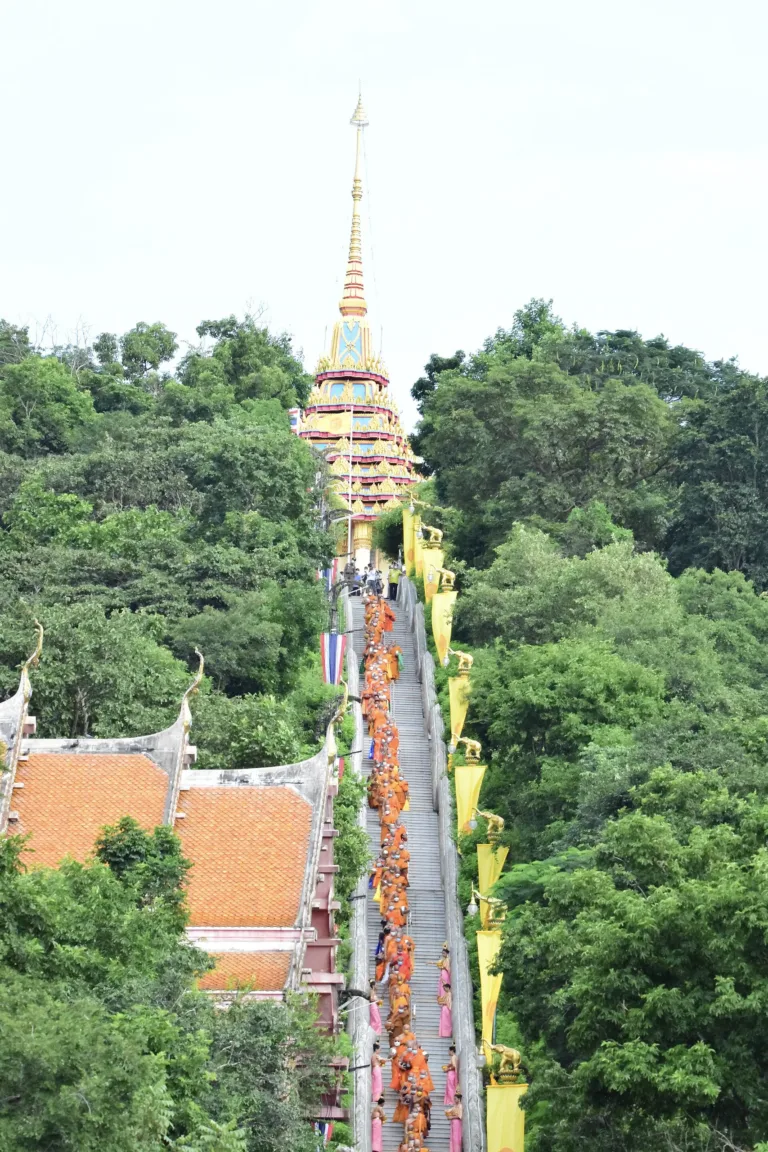
Naga stairwayAbout 449 steps from the temple to the mondop
UTHAI THANI · MUEANG
A lone hill in Uthai Thani town with a 449-step naga stairway, a Buddha footprint mondop and the statue of King Rama I’s father
Holiday / event — crowded · Hot (Afternoon) feels like 40°C
Open daily; visit from morning until dusk
Climb before 09:00 or after 16:00 when the sun is gentler, and stay for sunset
Tak Bat Devo (1st waning day of the 11th lunar month, around Oct) · Statue ceremony 6 Apr · Phra Phuttha Mongkhon Saksit festival (3rd–4th waxing days of the 4th lunar month)
01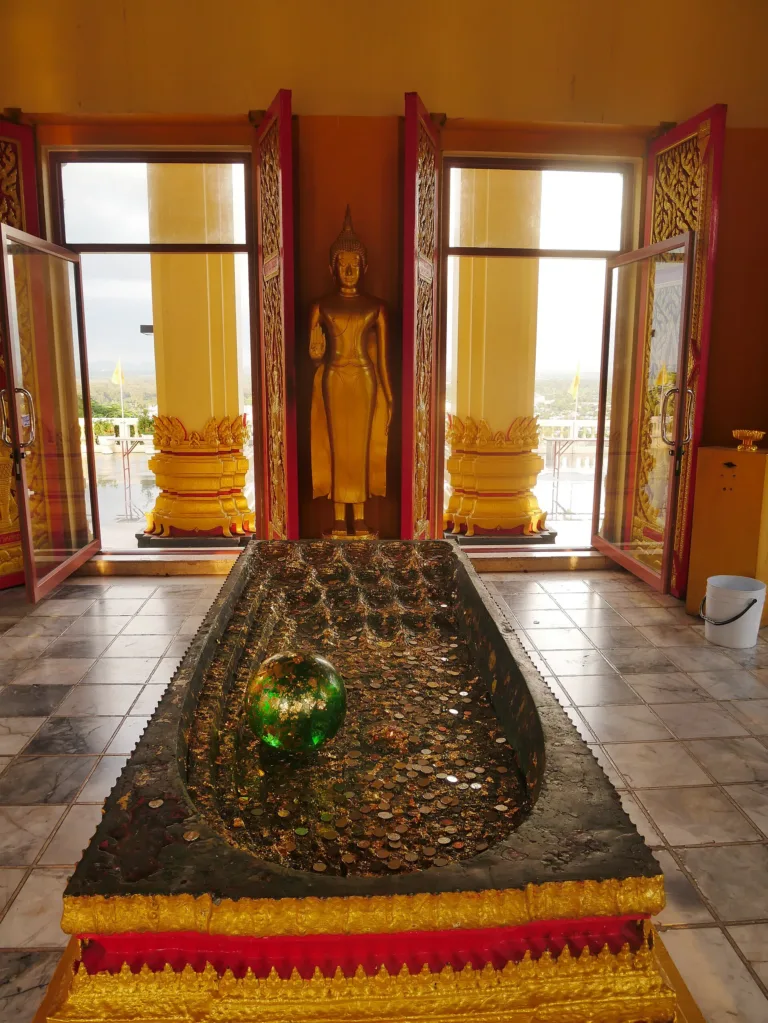 02
 03
 04
 05
Tap a day card to see that day’s weather, rain, haze and hourly forecast
Best time to go Fine all day little rain through the day
Holiday — traffic on the way up and parking fills fast; leave early
Green band = hours used for the score
Best time to go Fine all day little rain through the day
Holiday — traffic on the way up and parking fills fast; leave early
Green band = hours used for the score
Best time to go Fine all day little rain through the day
Holiday — traffic on the way up and parking fills fast; leave early
Green band = hours used for the score
Best time to go Best window 06:00–14:00 Little rain
No warnings today — normal road and weather conditions
Green band = hours used for the score
Best time to go Best window 06:00–15:00 Little rain · light drizzle possible at times
No warnings today — normal road and weather conditions
Green band = hours used for the score
Best time to go Fine all day little rain through the day
No warnings today — normal road and weather conditions
Green band = hours used for the score
Best time to go Fine all day little rain through the day
No warnings today — normal road and weather conditions
Green band = hours used for the score
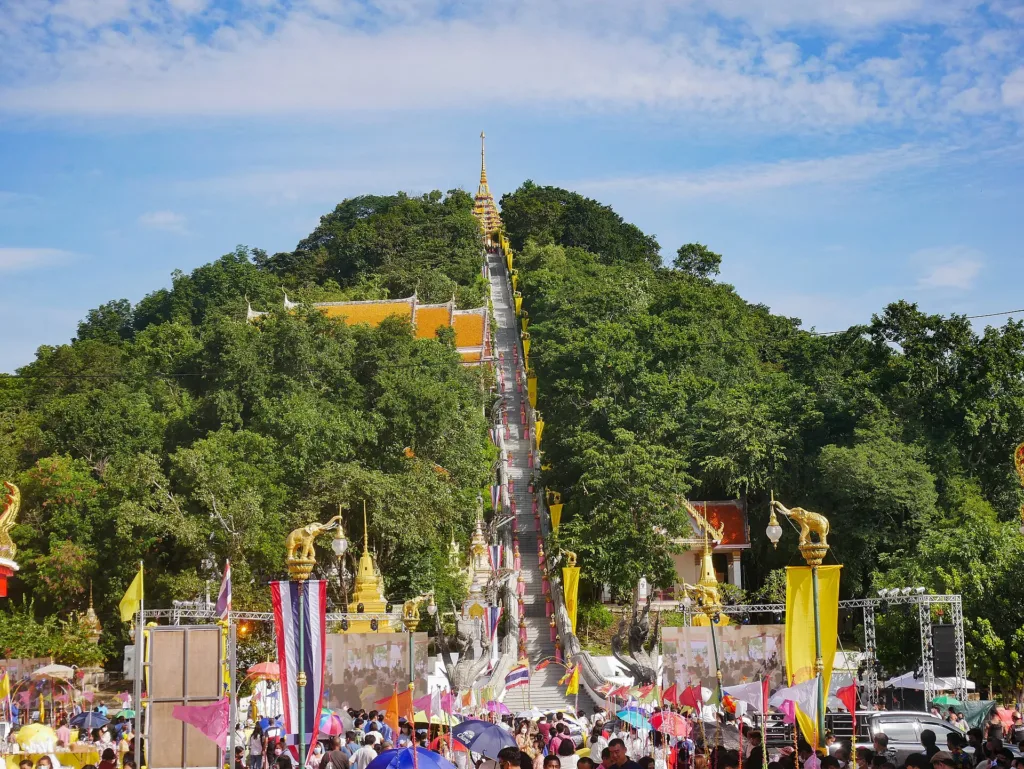
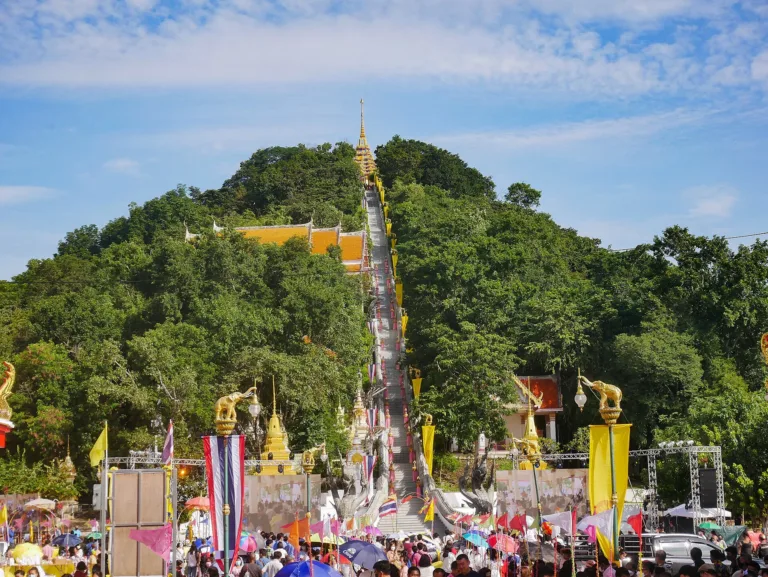
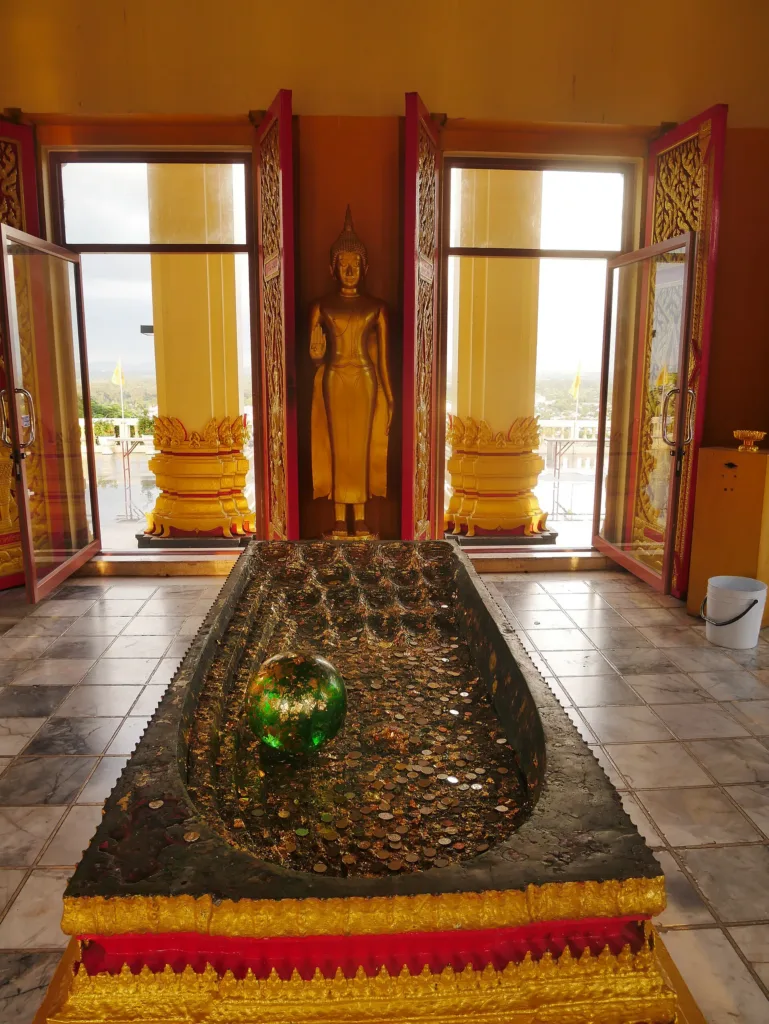
Khao Sakae Krang rises in the middle of Uthai Thani town. A naga staircase of about 449 steps climbs from Wat Sangkat Rattana Khiri to a mondop with a replica Buddha footprint, a great bell and the statue of King Rama I’s father.
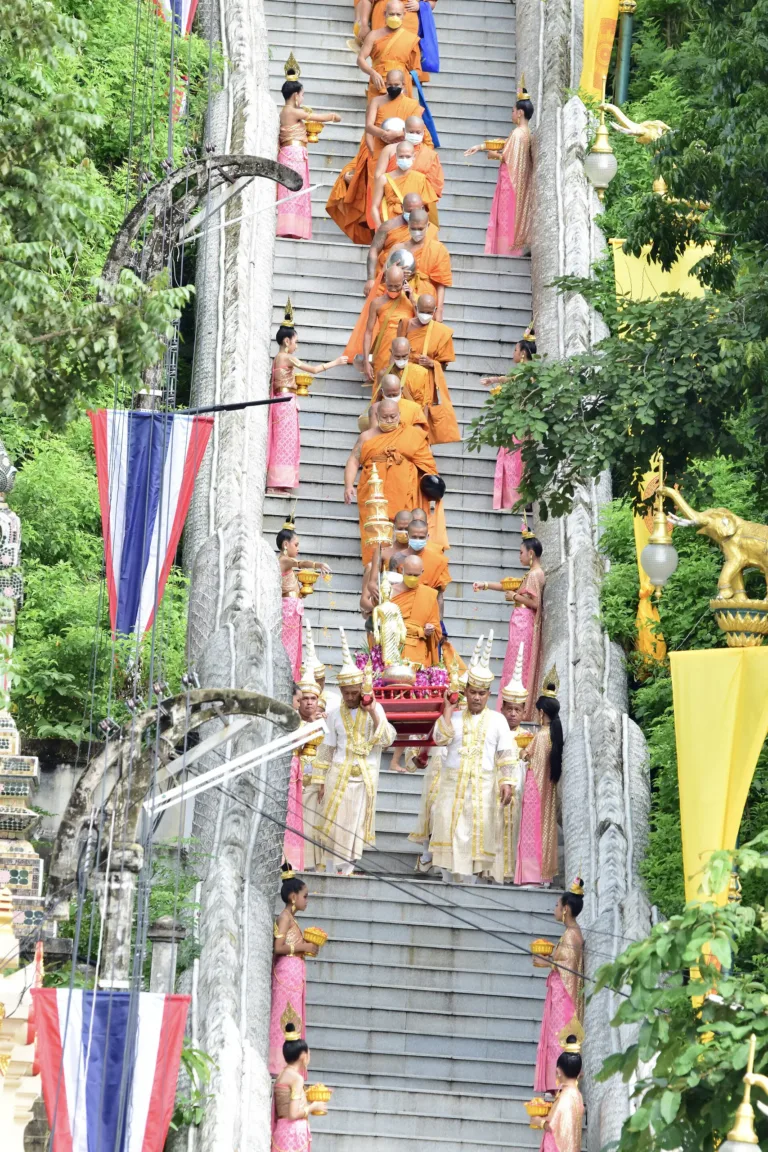
It is famous for Tak Bat Devo at the end of Buddhist Lent, when about 500 monks walk down the stairs to receive alms.
Photos from Wikimedia Commons and contributors · full credits inClassic page
About 449 steps; rest along the way and carry water
Midday is very hot, especially Mar – May
Roads around the temple partly close at Tak Bat Devo and parking fills up
Religious site; dress modestly
Adults 0 THB · Car 0 THB · Time needed 1–2 hours
Tak Bat Devo (around Oct) and 6 April
| Temple and hill entry | Free |
| Offerings / flowers and incense optional | Pay as you like |
Mainly cash · Prices may change by season — check with the venue
Tak Bat Devo (1st waning day of the 11th lunar month, around Oct) · Statue ceremony 6 Apr · Phra Phuttha Mongkhon Saksit festival (3rd–4th waxing days of the 4th lunar month)
Tap a month on the wheel to see weather, rain, haze and crowds from 10 years of records
Best time · Nov – Feb: cool, comfortable climbing and clear skies; also Tak Bat Devo around October and the 6 April ceremony when the golden silk-cotton blooms
Watch out · Mar – May: very hot, so climb early or late; stairs are slippery in the rains
Oct by the records 24–31°C · avg rain 226 mm (20 rainy days) · clear 4 days · avg PM2.5 11
Khao Sakae Krang is a lone hill in the middle of Uthai Thani town, near the Sakae Krang River. At its foot stands Wat Sangkat Rattana Khiri, from which a naga staircase of about 449 steps (some sources say 499) climbs to the summit. On top are a mondop sheltering a replica Buddha footprint, a great bell, and a statue of Somdet Phra Pathom Borom Maha Chanok, father of King Rama I. The mondop on this hill also appears on Uthai Thani’s provincial seal.
English Wikipedia summarises Uthai Thani’s history this way: the area was first settled by Mon and Lawa people; in the Sukhothai period there was a town called Mueang U Thai, later abandoned when the river changed course; in the Ayutthaya period Karen people revived the town on its present site as a frontier outpost; King Rama I renamed U Thai as Uthai Thani; and in 1892 King Chulalongkorn placed it under Monthon Nakhon Sawan.
Today’s Uthai Thani town was once “Ban Sakae Krang”. A Naewna article marking 190 years of the community says that around 1833, under Rama III, a new governor of U Thai Thani found river transport at Sakae Krang far easier than at the old town on high ground away from the river, and moved his homes and town office here. The name comes from a great sakae tree in the middle of the settlement. The sakae forest had earlier been cut for charcoal to smelt iron at Tha Sung; when smelting ended, Chinese workers and villagers from Nong Tao, Nong Kae, Thap Than, Krok Phra and elsewhere settled here, forming a large market where merchants built granaries to buy rice carted to the riverbank. Chinese speakers called it “Sikiangkang”. In 1848 the town was redivided into four districts, with Ban Sakae Krang becoming Uthai Mai district. In 2026 the province held the 4th “Wichitthani Thin Ni Uthai” festival to mark 193 years of Ban Sakae Krang.
The town’s name has several explanations. Silpa Wattanatham suggests it may come from “U Thai”, a homeland of Thai people amid other peoples; old documents spell it “U Thai” or “U Thai Thani”, and some historians think the switch to “Uthai Thani” happened under Rama VI, which differs from the claim that Rama I renamed it. In the Ayutthaya period it was an outer frontier town watching for Burmese armies, with key outposts such as Dan Mueang Uthai (Khlong Khai), Dan Thap Salao, Dan Mae Klong and Dan Nong Luang in today’s Umphang district.
The hill’s bond with the Chakri dynasty comes from Somdet Phra Pathom Borom Maha Chanok, born Thong Di at Ban Sakae Krang. He served Ayutthaya as Luang Phiphit Akson and later Phra Akson Sunthon, secretary of the Ministry of the Interior. When the Burmese besieged Ayutthaya he took his family to serve in Phitsanulok, rose to Chao Phraya Chakri Si Ongkharak and died there. His sons included Thong Duang, born 20 March 1736, later King Rama I, and Bunma, born 8 September 1743, later the Front Palace prince Maha Sura Singhanat.
When Chao Phraya Maha Kasatsuek (Thong Duang) took the throne on 6 April 1782, he took the title “Chao Phraya Chakri” as the dynasty’s name, and in 1795 he raised his father’s remains to the rank of “Somdet Phra Chanok Athibodi”. Uthai Thani is therefore called “the city of the Chakri father”. Some popular historians, such as Rom Bunnag, also argue that the family descended from Kosa Pan, citing King Mongkut’s 1853 letter to Sir John Bowring, though this is the author’s interpretation.
Wat Sangkat Rattana Khiri was founded by Phra Khru Praphai Khunachan (Chai), abbot of Wat Thung Kaeo (Wat Mani Thudong), who found ancient ruins on top of “Khao Kaeo”, as the hill was then called, believed it had once been a temple and led local Buddhists in building a path and stairs. Sources disagree on the date: some say work began in 1890, while the ONEP heritage database says it was finished in 1900. He later became Phra Sunthon Muni (Chai Khangkhasaro), head monk of Uthai Thani. The temple was originally named Wat Sangkat Rattana Khiri Mongkhon Praphai Uthai Khet; “Sangkat” refers to Sankassa, where the Buddha descended from heaven.
Several early works survive. The great bronze bell in front of the mondop was cast in 1900; it is 141 cm tall, 120 cm across and weighs about two tonnes, and visitors strike it for good luck. In 1903 Khun Kop Kaikit (Ui Sun Sae Tang) built the Phra Phuttha Rattana Muni vihara, a Chinese-style masonry hall with stucco vines and dragons, housing seven Buddha images, including an emerald-coloured image said to come from China, and five brass chedis holding relics. In 1905 the mondop and a shelter were built on the summit; tourism sources say the footprint replica came from Wat Chanthararam.
The temple kept growing. A Thai-style bell pavilion with Chinese decoration was built in 1921 and hung with a medium bronze bell cast in 1922. That year Khun Kop Kaikit and the congregation built a Thai–Chinese preaching hall with Ramakien scenes on its gable, and King Vajiravudh (Rama VI) visited Uthai Thani and paid homage at the footprint on the hill.
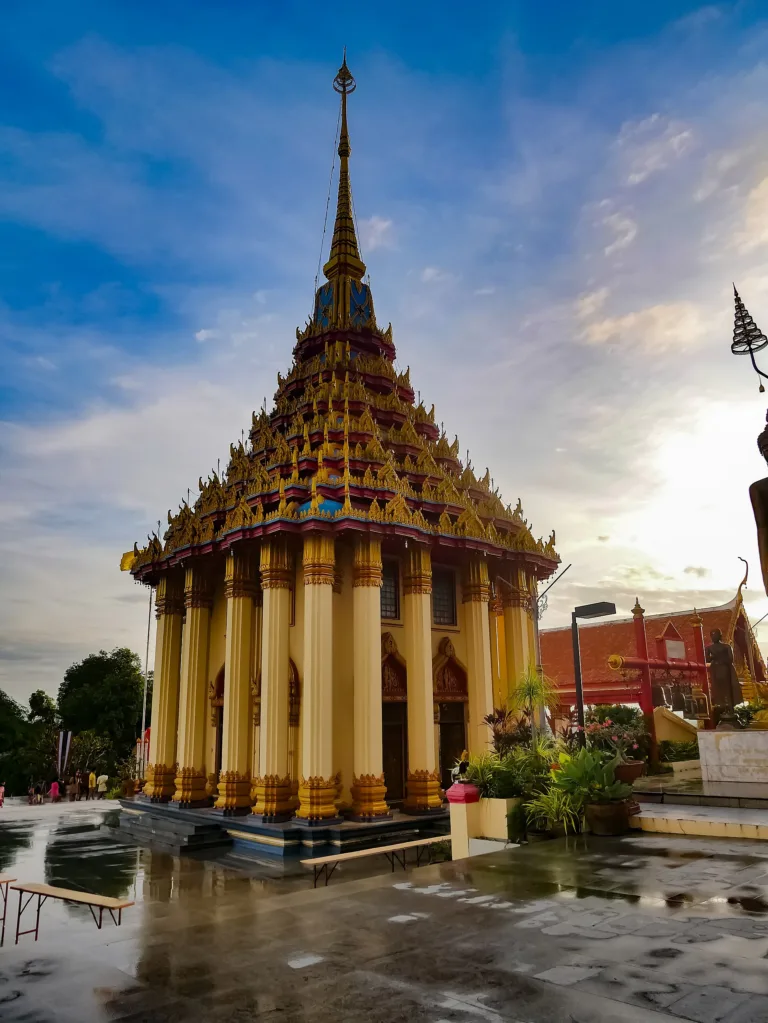
The first mondop was destroyed by a forest fire, dated 1935 in a book cited by ONEP, and a new one was built by Chao Khun Sunthon Muni (Phut), then the provincial head monk. The present mondop was begun in 1954 and completed in 1968 with donations from Uthai Thani people and the patronage of Field Marshal Plaek Phibunsongkhram. It copies the mondop of Phra Phutthabat in Saraburi, and its doors are carved with the guardians of the four directions. The dates in the documents do not fully agree.
The summit also holds a “fundamental origin point” survey marker used to calculate and set map coordinates. ONEP describes it as one of three such markers in Asia, the others being in India and Vietnam. Tourism sources say it lies about 200 m behind the statue and dates from 1932; the forest path to it takes about 20 minutes.
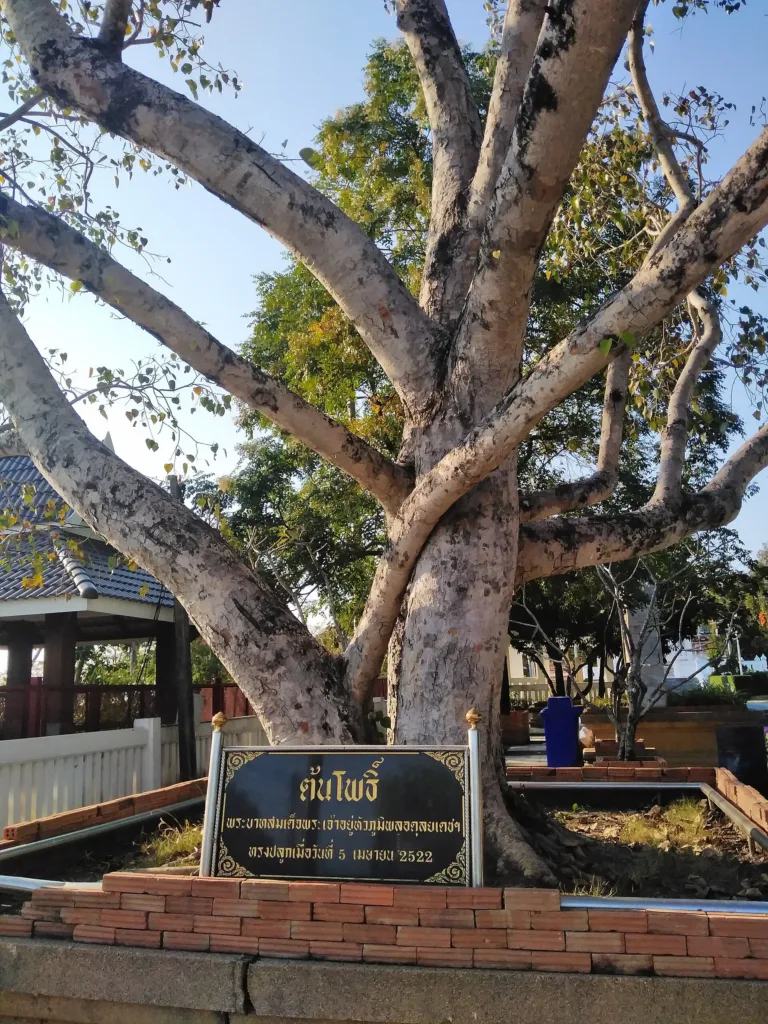
The statue of Somdet Phra Pathom Borom Maha Chanok is a seated bronze twice life-size, housed in a cruciform pavilion on the summit with stone tablets recounting his life on both sides of the base. Work began on 6 October 1976, the statue was cast at the Fine Arts Department on 10 July 1978 and installed on 28 January 1979, and King Bhumibol Adulyadej unveiled it on 5 April 1979. Nearby a bodhi tree carries a sign saying the King planted it.
Every 6 April, Chakri Day, the province holds a ceremony honouring the statue, when the yellow flowers of the golden silk-cotton tree (suphannika), the provincial flower, bloom across the hill. At the 7 April 2025 commemoration at Sakae Krang junction, more than 6,000 people danced on Highway 333 in front of the statue.
Besides the 6 April ceremony, the province holds an annual festival honouring the Chakri father; in 2023, for example, it ran from 1 to 9 April at Bueng Phra Chanok in Mueang Uthai Thani.
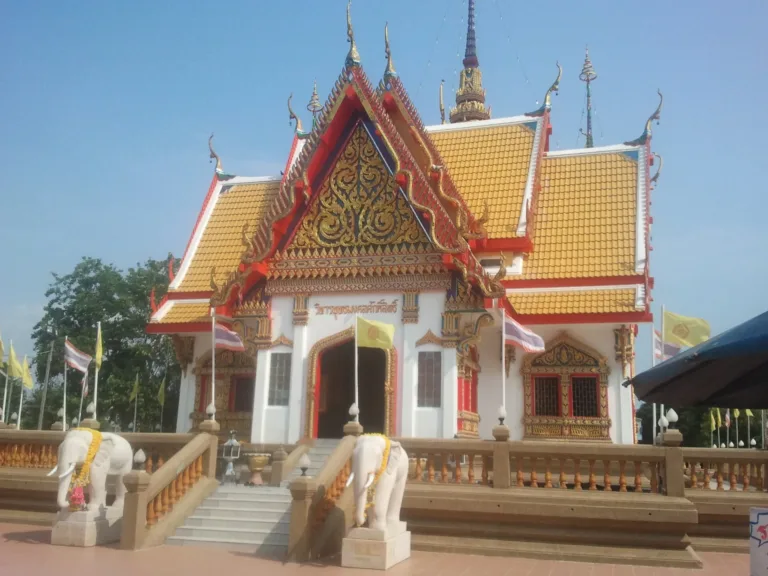
Phra Phuttha Mongkhon Saksit, Uthai Thani’s guardian Buddha, is a bronze image in the subduing-Mara posture in Sukhothai style, believed to date from King Lithai’s reign, some 600–700 years ago. Local tradition says that around 1792–1799 King Rama I sent damaged small images to provincial towns and Uthai Thani received three; this one stood at Wat Khwit by the Sakae Krang River until that temple merged with Wat Thung Kaeo and it moved to Wat Sangkat Rattana Khiri. Some records say it came directly from Sukhothai. It now sits in a vihara built in 1977, with a festival on the 3rd–4th waxing days of the 4th lunar month.
The best-known event is Tak Bat Devo, held on the first waning day of the 11th lunar month, the day after the end of Buddhist Lent. It re-enacts the Buddha’s descent from Tavatimsa heaven to Sankassa on a stairway created by Indra, with the hill’s staircase standing in for the heavenly one. About 500 monks walk down from the summit to receive alms in the temple yard, where people offer “khao tom luk yon”, leaf-wrapped sticky rice. The festival also features floats on the Buddha’s life from every district, a light-and-sound show on the eve, and altar tables inlaid with ivory, a local hallmark from the days when families used elephants in trade and logging.
The “khao tom luk yon” offered to the monks is sticky rice wrapped in leaves into a long or oval shape with a leafy tail. According to the Tourism Authority of Thailand, the custom recalls the day of the Buddha’s descent, when crowds were so thick that people threw food into his bowl from a distance. In 2025 the festival ran on 7–8 October: a light-and-sound show in the temple yard on the eve, then a monastic ceremony at the cruciform pavilion and alms-giving at 09:00 the next morning, followed by a procession of Buddha-life floats from every district and a ceremony at the ivory-inlaid altar tables in Uthai Thani market, which organisers call the only one in the world.
There are two ways up: climb the staircase from Wat Sangkat Rattana Khiri, or drive the road branching from Highway 3220 about 2 km to the statue terrace, then walk about 200 m to the summit on a gentle path. Step counts differ: most sources say 449, some articles 499.
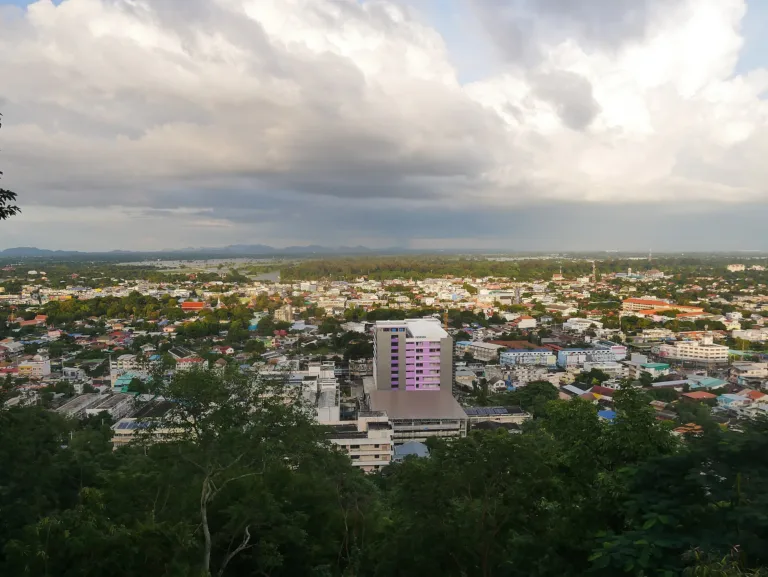
The summit looks out over Uthai Thani town and the Sakae Krang River, with rice fields and ponds on the other side. Early mornings bring views of the town at dawn, and evenings are good for sunset.
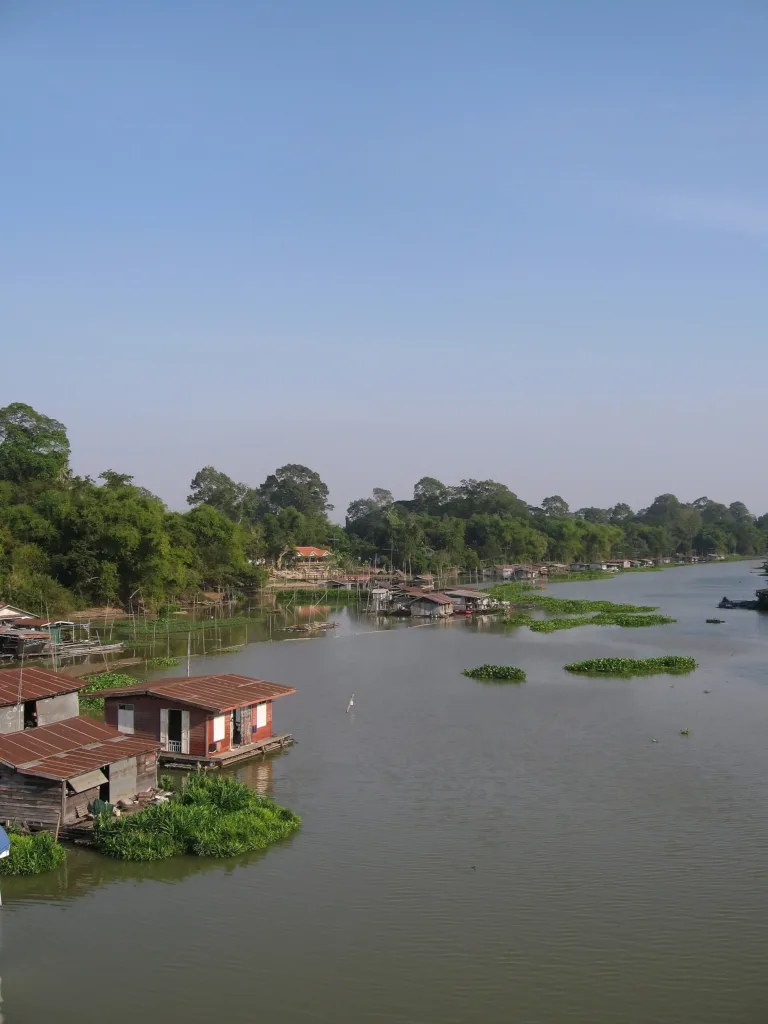
Below the hill, the Sakae Krang River still has a floating-house community that the Minister of Culture described as probably the last in Thailand. Every morning around 07:00 monks from Wat Uposatharam (Wat Bot) paddle out to collect alms along the river. The temple was founded in 1781 as Wat Bot Manorom and was visited by King Chulalongkorn; its ordination hall holds five Maravijaya Buddha images known locally as “Phra Chao Ha Phra Ong”, and a two-storey octagonal mondop with European touches was built by Luang Phitak Phasa in 1899. Nearby in the market stands the Pung Thao Kong shrine, restored by the community after its foundations were damaged in 1994.
Khao Sakae Krang is a religious site and home to a royal statue, so dress modestly, behave respectfully in the mondop and pavilion, do not write on old structures and take your rubbish with you.
Arrived? Check in, collect a stamp and tell others what it is like right now
Check your location first, so you do not fill in the form for nothing
Location must be on and within 0.8 km · One check-in per place per day · come back on other days to check in again
Post photos from anywhere — no need to be here · Up to 20 photos at a time · JPG / PNG / WebP · GPS location data is removed automatically
From Bangkok take Highway 32 towards Chai Nat Turn onto High…
Highway 32 → 333 · Fuel
Temple yard to summit · Free
From Bangkok take Highway 32 via Ayutthaya, Ang Thong, Sing Buri and Chai Nat, turn onto Highway 333 at Tha Nam Oi junction, cross the Chao Phraya and drive about 16 km to town
Wat Sangkat Rattana Khiri yard at the foot of the hill, and the statue terrace on top
Petrol stations in Uthai Thani town
Good mobile signal on and below the hill
Open daily; visit from morning until dusk
around 220 km fromBangkok
Wat Sangkat Rattana Khiri, Khao Sakae Krang
0 THB
Approx. nightly price for 2 adults (next week) · final price depends on your dates
Best day this week: Wednesday 28 Oct · Check in when you arrive to collect a stamp