 01
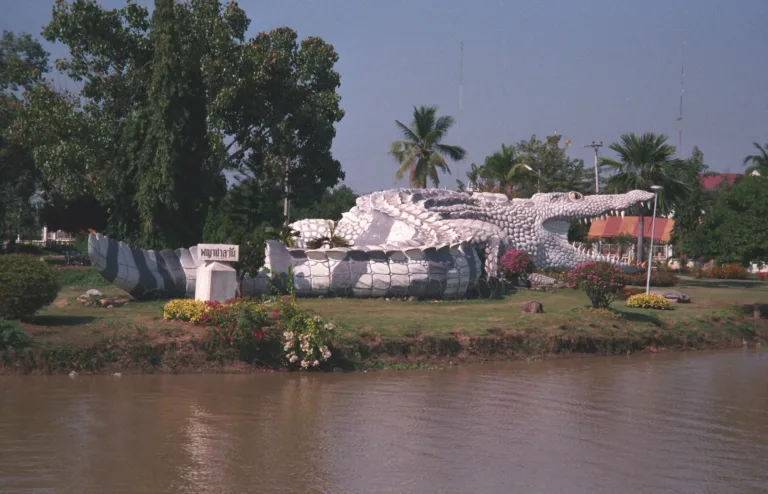
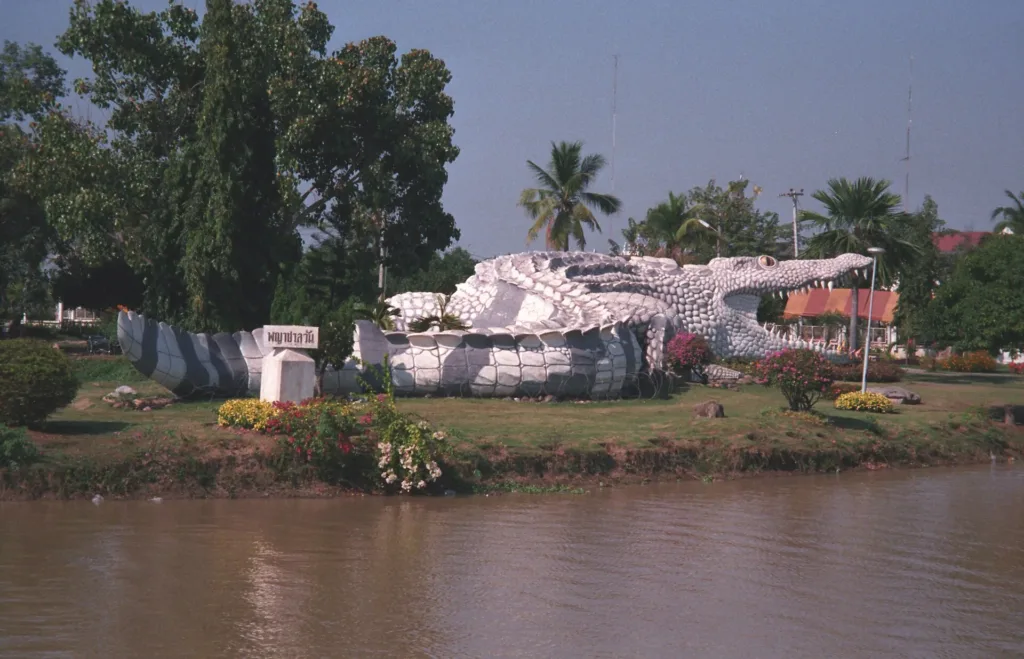
Phraya ChalawanA 38 m crocodile sculpture
PHICHIT · MUEANG
A large natural freshwater lake beside Phichit town, with a 38 m Chalawan crocodile sculpture, an aquarium and a 10.28 km cycle loop
Holiday / event — crowded · Hot (Afternoon) feels like 41°C
Jun – Sep
Crocodile ponds — No feeding or throwing objects in; crocodiles have fallen ill from plastic
1–3 hours
Good mobile signal
01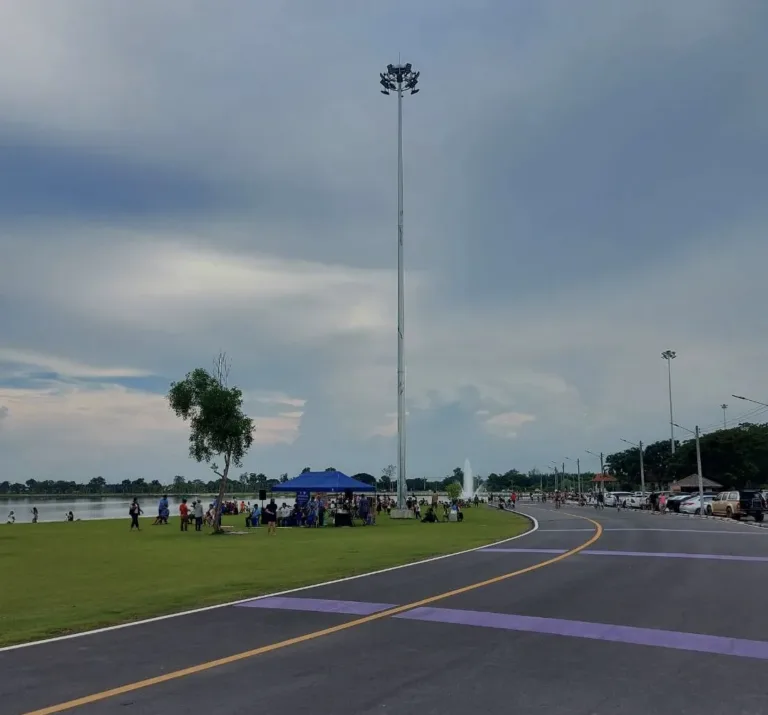 02
 03
Tap a day card to see that day’s weather, rain, haze and hourly forecast
Best time to go Fine all day little rain through the day
Holiday — traffic on the way up and parking fills fast; leave early
Green band = hours used for the score
Best time to go Fine all day little rain through the day
Holiday — traffic on the way up and parking fills fast; leave early
Green band = hours used for the score
Best time to go Fine all day little rain through the day
Holiday — traffic on the way up and parking fills fast; leave early
Green band = hours used for the score
Best time to go Best window 06:00–14:00 Little rain · light drizzle possible at times
No warnings today — normal road and weather conditions
Green band = hours used for the score
Best time to go Best window 06:00–14:00 Little rain · light drizzle possible at times
No warnings today — normal road and weather conditions
Green band = hours used for the score
Best time to go Fine all day little rain through the day
No warnings today — normal road and weather conditions
Green band = hours used for the score
Best time to go Fine all day little rain through the day
No warnings today — normal road and weather conditions
Green band = hours used for the score
Scored from cloud cover at every level and tonight’s moonlight — the darker the sky, the clearer the Milky Way · tap another night below for the next 7 nights
Bueng Si Fai is a natural freshwater lake of about 5,390 rai right beside Phichit town, home to the 38 m Phraya Chalawan crocodile sculpture, a free aquarium and Somdet Phra Srinagarindra Park.
After years of shrinkage and dredging, it reopened in 2024 with a 10.28 km cycle lane and the Saranchit Mongkhon Suk cycling park.
Photos from Wikimedia Commons and contributors · full credits inClassic page
No feeding or throwing objects in; crocodiles have fallen ill from plastic
Watch small children by the lake
Little shade on the loop; bring water and a hat
Walk on the footpath, not in the cycle lane
Adults 0 THB · Car 0 THB · Time needed 1–3 hours
Holiday evenings and festivals
| Bueng Si Fai and park | Free |
| Chalerm Prakiat Aquarium optional | Pay as you like |
Mainly cash · Prices may change by season — check with the venue
Tap a month on the wheel to see weather, rain, haze and crowds from 10 years of records
Best time · Nov – Feb: cool, clear and full of migratory birds — great for cycling and sunsets; the lake is fullest at the end of the rains
Watch out · Mar – May: very hot; come early or late, as the shoreline has little shade at midday
Oct by the records 24–31°C · avg rain 193 mm (22 rainy days) · clear 6 days · avg PM2.5 12
Bueng Si Fai is a large natural freshwater lake in Mueang Phichit district, right beside the town and touching the subdistricts of Nai Mueang, Tha Luang, Mueang Kao, Rong Chang and Khlong Khachen. Today it covers about 5,390 rai (around 8.6 km²) with an average depth of 1.5–2 m. Rankings vary: some reports call it Thailand’s third-largest natural freshwater lake, others the third-largest in the North and fifth in the country.
English Wikipedia says the lake formed from Nan River water pooling in low ground. As for the name “Si Fai”, the government and media sources found so far give no clear explanation of its origin.
A 2025 study in the MCU Journal of Social Development explains that Bueng Si Fai formed when the Nan River changed course: flood sediment sealed off the old channel, building natural levees and leaving an oxbow lake that holds water all year. A 2016 Naresuan University thesis places it about 1 km west of the provincial hall, describes a trapezoid wider in the north than the south, ranks it Thailand’s fourth-largest wetland after Bueng Boraphet, Nong Han and Kwan Phayao, and puts its former extent at about 18,000 rai. Enclosed by embankments and roads, it has become a semi-closed freshwater system that floodwater can enter only through culverts, and in the dry season it drops to about 1 m deep.
The lake has long been tied to Phichit. Several media sources say that in the Ayutthaya period King Borommatrailokanat, seeing Phichit’s many marshes and ponds — above all Bueng Si Fai, which held water all year — called the town “Okhaburi”, the city of waters.
The lake was once much larger, though sources disagree on how large — over 10,000 rai, about 12,000 rai, or more than 30,000 rai. The main cause of its shrinkage was the Sirikit Dam on the Nan River, which cut the seasonal floods that used to fill the lake, allowing farms and homes to encroach on its edges while sediment made it ever shallower.
The state has tried several times to protect its boundaries. In 1978 the Fisheries Department built an earth embankment around the lake to stop encroachment, and in 1991 boundary posts were set and a public-land certificate issued under the Marine Department. Some 13 agencies, including fisheries, irrigation, temples and schools, now occupy about 500 rai around the shore.
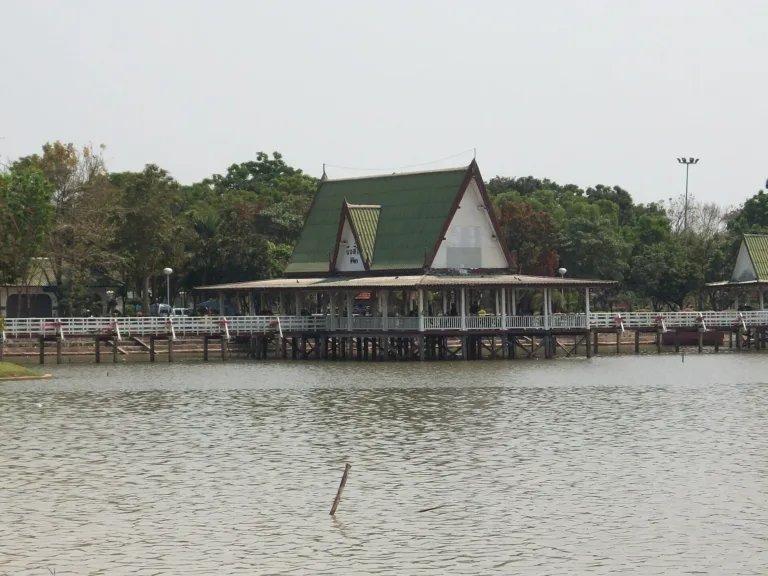
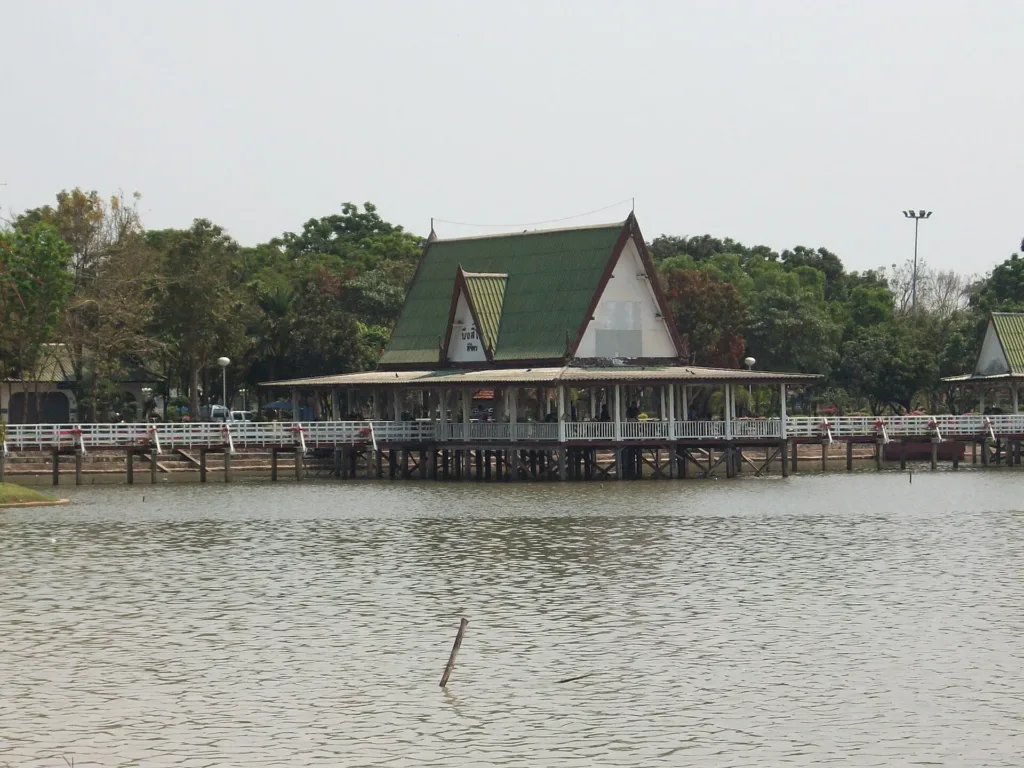
On the town side lies Somdet Phra Srinagarindra Park Phichit, a 170-rai public park built in 1984 in honour of the Princess Mother, with a bridge leading out to a large pavilion over the water — a favourite sunset spot.
The lake’s emblem is the sculpture of Phraya Chalawan, the giant crocodile from the tale of Krai Thong, which King Rama II turned into a lakhon nok drama and which gave Phichit its nickname “City of Chalawan”. The statue is about 38 m long, 6 m wide and 5 m high, with a 25–30-seat meeting room inside; Manager Online calls it the largest crocodile statue in the world.
The Chalerm Prakiat Aquarium is a nine-sided building projecting into the lake, run by the Inland Fisheries Research and Development Center, Region 3 (Phichit). It shows more than 20 species of freshwater fish, including rarities such as the giant freshwater stingray and the Siamese crocodile. Tourism listings give its hours as Tuesday–Friday 09:30–16:30 and Saturday–Sunday 09:00–17:30.
There are also crocodile ponds by the lake. Visitors once bought chicken carcasses to feed them, but 2024 information says feeding is now banned. In June 2020 photos of an emaciated crocodile went viral; fisheries officials found 84 crocodiles in the pond, most healthy, and said the thin one had fallen ill from eating plastic thrown in by visitors — an earlier dead crocodile had been found with plastic inside.
A 2020 inspection found that the crocodile pond, run by the Inland Aquaculture Research and Development Center, Region 3 (Phichit), had a food budget of 5,000 baht a year for fresh chicken carcasses — one meal lasts a crocodile about seven days — with the oldest animal about 20 and the largest nearly 300 kg. The park had been closed for several months and was due to reopen on 1 July 2020. A 2019 article said nearly 50 crocodiles could be seen hauled out in the evenings, and that the four mid-lake pavilions had once served as Phichit’s polling booths.
The lake matters ecologically. A cabinet resolution of 3 November 2009 set measures for wetland conservation, and Bueng Si Fai is one of 69 sites on Thailand’s register of wetlands of international importance. Surveys have recorded at least 80 bird species, over 35 of them waterbirds, at least 33 fish species and 49 plant species, with many migratory birds arriving in the cool season.
The Naresuan University thesis also found weeds covering about 85% of the surface, leaving 15% open water, and recorded at least 83 bird species, 35 of them waterbirds, some listed as endangered or vulnerable. Comparing Landsat images from 2004 and 2015, it found flooded swamp had shrunk by 0.69 km², man-made water bodies had grown by 0.60 km² and built-up land by 0.09 km².
The first restoration was carried out by the Department of Water Resources in fiscal years 2009–2013, with Chiang Mai University studying the environmental impact and designing the work from 29 September 2010 to 17 January 2012. On about 700 rai along the south side it dredged channels, built bio-swales planted with native vegetation to filter runoff, dug a deep channel with a wooden bridge for canoeing and nature study, and added sluice gates, raising storage by about 558,500 m³ and helping some 250 households. Residents also set up the Facebook page “Phichit people bring Bueng Si Fai back to life”.
The lake has weathered several crises. In March 2001 Queen Sirikit made a private visit to see it. In 2013 a severe drought left it nearly dry, and in 2017 a fire broke out on the central island from accumulated dry weeds.
Major development plans were debated for years. In November 2016 the province and the Department of Water Resources endorsed a 253-million-baht plan to turn it into a retention basin, while residents asked for its natural state to be restored. A broader plan of about 900 million baht in 2017 stalled after complaints about a 580-million-baht aquarium upgrade; the province held a public consultation, receiving 180,000 of 200,000 questionnaires back, and reshaped the plan so the Marine Department would dredge for about 341 million baht, the province would build a cycle lane and the aquarium would wait. The municipality also rebuilt the four mid-lake pavilions as Thai-style houses.
The Marine Department dredged the lake in fiscal years 2017–2020. In mid-2020 the government ordered the work speeded up; the Marine Department offered the lake’s soil for sale at 2 baht per cubic metre, with about 6 million m³ available, while the Royal Irrigation Department diverted water from the Naresuan Dam through irrigation canals into the lake. Dredged soil was used to build cycle paths, walkways and running tracks around the shore.
The result is a renewed Bueng Si Fai under the “Bueng Si Fai Development Project in honour of the King”, marking his 6th-cycle birthday on 28 July 2024. King Vajiralongkorn and Queen Suthida opened it on 23 March 2024 and named the cycling park “Saranchit Mongkhon Suk”, with a BMX track, a balance-bike course for children and a pump track surfaced to UCI standards; both rode in the park and planted a bunnak tree, the provincial tree. There is now a 10.28 km cycle lane round the lake, and in 2023–2024 the lake was filled to about 12.64 million m³, up from around 2 million m³ before.
A 2025 study interviewing 37 community committee members, entrepreneurs and provincial officials found the shore still used for fishing, farming, tourism and community activities, but with land-use conflicts, polluted water, weeds and encroachment. The researchers proposed a Saturday lakeside market, a self-sufficiency market and a “Bueng Si Fai volunteers” group.
Today Bueng Si Fai is a water source, a place to exercise and an event venue — it hosted the KiteXballoon kite and balloon festival on 24–25 February 2024. Please don’t litter or throw anything into the crocodile ponds or the lake, follow the cycle-lane rules and watch small children near the water.
Arrived? Check in, collect a stamp and tell others what it is like right now
Check your location first, so you do not fill in the form for nothing
Location must be on and within 2 km · One check-in per place per day · come back on other days to check in again
Post photos from anywhere — no need to be here · Up to 20 photos at a time · JPG / PNG / WebP · GPS location data is removed automatically
From Bangkok take Highways 1 and 32 to Nakhon Sawan Continue…
Highway 1 → 32 → 117 · Fuel
Then a local taxi · By distance
From Bangkok take Highways 1 and 32 to Nakhon Sawan, then Highway 117 and turn into Phichit town; the lake adjoins the municipality
Several lakeside car parks and inside Somdet Phra Srinagarindra Park
Petrol stations in Phichit town
Good mobile signal
Lakeside open daily · Aquarium Tue–Fri 09:30–16:30, Sat–Sun 09:00–17:30
around 345 km fromBangkok
Bueng Si Fai
0 THB
Approx. nightly price for 2 adults (next week) · final price depends on your dates
Best day this week: Thursday 29 Oct · Check in when you arrive to collect a stamp