 01
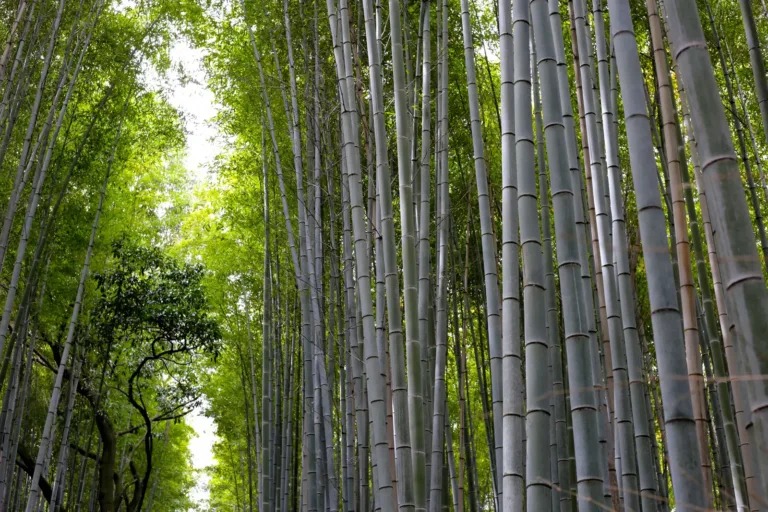
About 400 m bamboo pathFrom Nonomiya Shrine past Tenryu-ji's north gate to Okochi Sanso
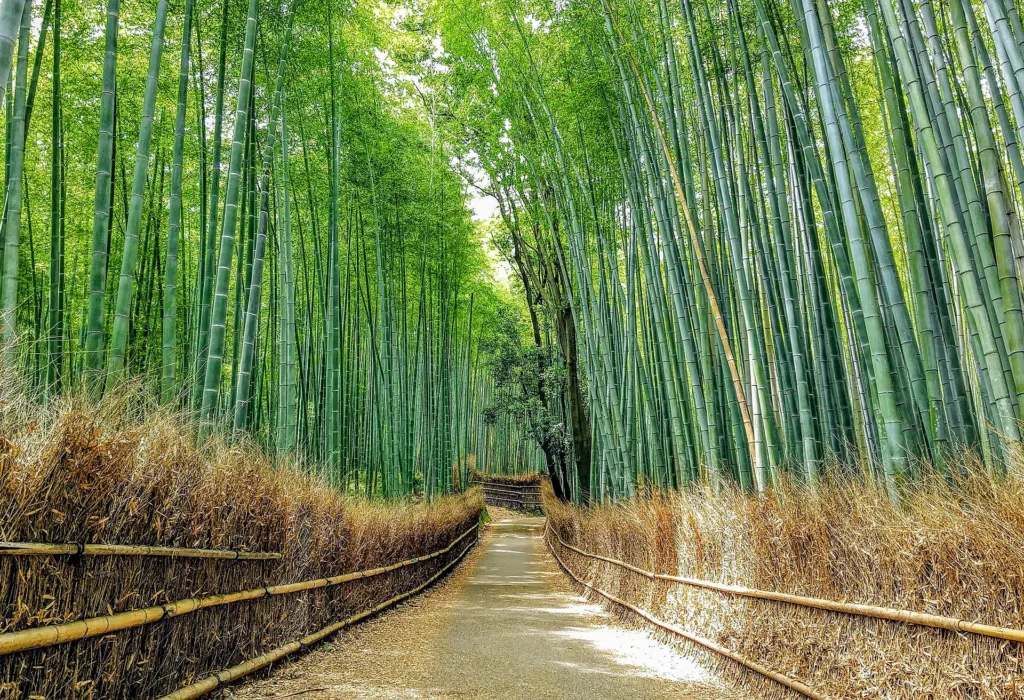
Kyoto's path through the bamboo
Arashiyama Bamboo Grove in Sagano, Kyoto: a 400 m path under towering bamboo from Nonomiya Shrine to Okochi Sanso. Free and open all day, next to Tenryu-ji and Togetsukyo Bridge. Come early for fewer people.
Holiday / event — crowded · Late morning (09:00–12:00): rain ~14%
Apr – Oct
Bamboo path — Narrow and crowded late morning; rickshaws pass
30 min to half a day
Good
01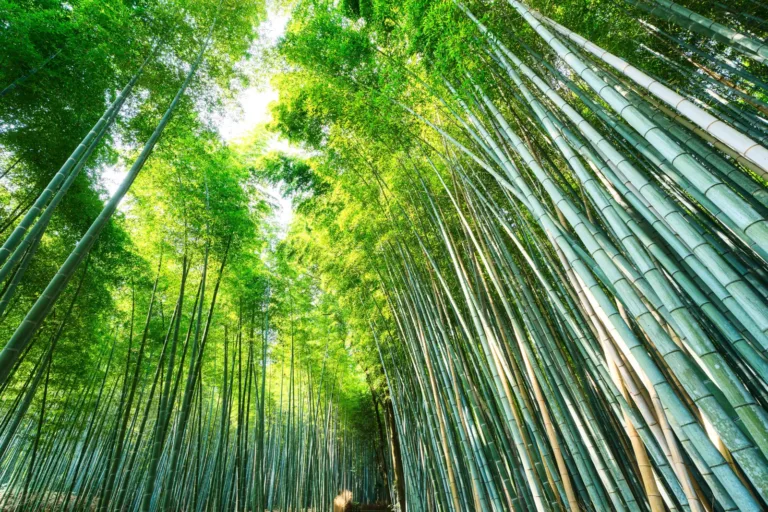 02
 03
 04
Tap a day card to see that day’s weather, rain, haze and hourly forecast
Best time to go Daytime is over · see tomorrow
Holiday — traffic on the way up and parking fills fast; leave early
Green band = hours used for the score
Best time to go Fine all day little rain through the day · light drizzle possible at times
Holiday — traffic on the way up and parking fills fast; leave early
Green band = hours used for the score
Best time to go Fine all day little rain through the day
Thick morning fog with visibility under 1 km — use headlights and drive slowly
Green band = hours used for the score
Best time to go Fine all day little rain through the day
No warnings today — normal road and weather conditions
Green band = hours used for the score
Best time to go Fine all day little rain through the day
Thick morning fog with visibility under 1 km — use headlights and drive slowly
Green band = hours used for the score
Best time to go Fine all day little rain through the day
No official warnings, but watch for: PM2.5 dust 45
Green band = hours used for the score
Best time to go Fine all day little rain through the day
No warnings today — normal road and weather conditions
Green band = hours used for the score
Scored from cloud cover at every level and tonight’s moonlight — the darker the sky, the clearer the Milky Way · tap another night below for the next 7 nights
Arashiyama Bamboo Grove, Sagano, Ukyo-ku, Kyoto
Arrive 08:00
Narrow and crowded late morning; rickshaws pass
Do not write on or carve the stalks
Free · Time needed 30 min to half a day
10:00–16:00 daily · cherry blossom and autumn seasons · Golden Week in early May
Dec: some years there are illumination events in Arashiyama
Tap a month on the wheel to see weather, rain, haze and crowds from 10 years of records
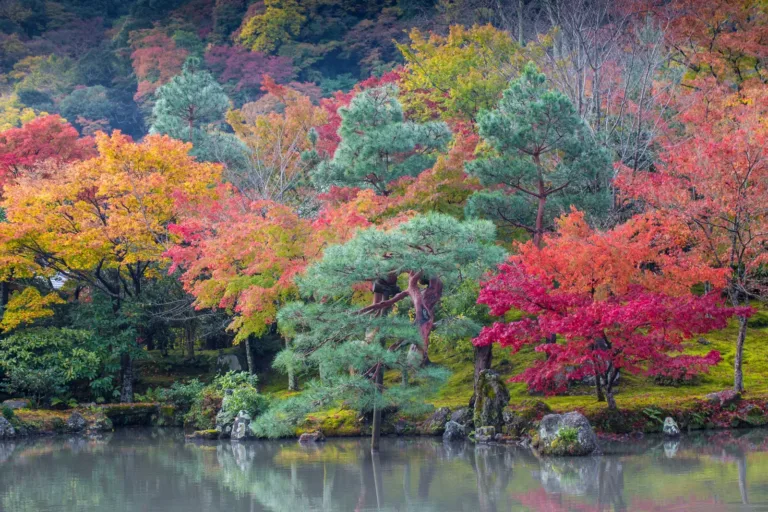
Best time · Apr cherry blossoms around Arashiyama · mid to late Nov autumn colors · come at 07:00–08:00 for few people and light through the bamboo
Watch out · Jul–Aug hot and humid · late morning to afternoon crowds · muddy after heavy rain
Nov by the records 7–17°C · avg rain 68 mm (7 rainy days) · clear 14 days · avg PM2.5 10
The Arashiyama Bamboo Grove, known in Japanese as Chikurin no Komichi (the bamboo path), lies in Sagano at the foot of the hills on Kyoto's western edge. Since the Heian period this has been a retreat for the imperial court, and the grove is surrounded by Tenryu-ji, a World Heritage temple, Nonomiya Shrine from The Tale of Genji, and the villa of a famous samurai-film star. No one can say for certain when the bamboo first grew this thick, but the sound of wind in the Sagano bamboo was chosen in 1996 as one of the "100 Soundscapes of Japan" worth preserving, and the grove has become one of Kyoto's best-known images worldwide.
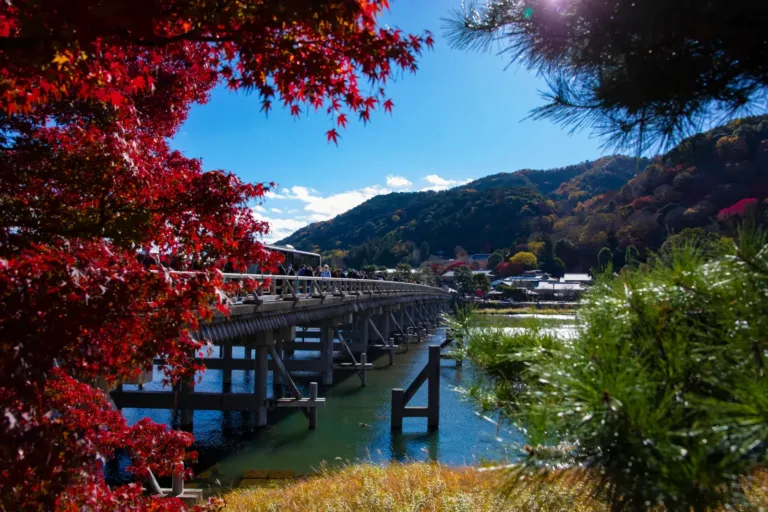
Before the court arrived, the riverside land here was opened up by the Hata, an immigrant clan from the mainland skilled in irrigation. In the late 5th century they built the Kadono Oi weir across the river to bring water to the plain. Just upstream of Togetsukyo Bridge a line of wooden posts still recalls the weir, though its original form is gone.
After the capital moved to Heian-kyo, Sagano became a hunting and pleasure ground for emperors and courtiers. Emperor Saga built his Saga-in villa here, and in 876, after his death, his daughter turned it into the temple Daikaku-ji. On the site of today's Tenryu-ji, Saga's empress Tachibana no Kachiko founded Danrin-ji in the 9th century, regarded as Japan's first Zen temple.
Nonomiya Shrine, where the bamboo path begins, is an ancient shrine founded after the move of the capital. Princesses chosen as saio, who served the Grand Shrine of Ise on the emperor's behalf, came here to purify themselves before setting out; some sources say for as long as three years. Over some 660 years about 64 princesses went through this rite, until the custom ended in the Nanboku-cho period. The shrine is the setting of a farewell scene in the "Sakaki" chapter of The Tale of Genji, and its dark torii of unbarked wood is considered the oldest style of torii in Japan.
South of the grove, Togetsukyo Bridge dates back to 834–848, when the monk Dosho built the first bridge. Tradition says the name, "moon-crossing bridge", came from Emperor Kameyama in the Kamakura period, who watched the moon pass across the sky above it. Later the wealthy merchant Suminokura Ryoi, who paid to open up the Oi River, built a bridge at the present site. In 1932 a flood swept half of it away, and in 1934 it was rebuilt in reinforced concrete, 155 m long, with wooden railings to suit the scenery.
The former Danrin-ji land later became a detached palace of Emperors Go-Saga and Kameyama. In 1339 the shogun Ashikaga Takauji founded Tenryu-ji there in memory of Emperor Go-Daigo, with Muso Soseki as its first abbot. Construction was funded by two trading ships sent to China; the temple was formally opened in 1345 and ranked first among Kyoto's Five Mountains.
Tenryu-ji suffered eight major fires between 1358 and 1864. Full restoration began after 1585 with the support of Toyotomi Hideyoshi. In 1877 the Meiji government confiscated most of the temple's land in Sagano, leaving it with less than a tenth, so most of the buildings seen today date from the Meiji era. Only Muso Soseki's Sogenchi pond garden keeps its original form, and it was the first site the Japanese government designated as a Special Place of Scenic Beauty. The temple was inscribed as a World Heritage Site in 1994.
As for the bamboo itself, a widely told story says the monk Doyu brought it back from Tang China in 801, while another holds that the monk Dogen brought it from China in the Kamakura period; neither is proven. Sources also differ on the species, some naming moso and others madake bamboo. Most give the path's length as about 400 m, though some say about 200 m. The path is lined with hogaki fences woven from bamboo branches, and because Sagano lies in a special historic landscape preservation district, the grove is regularly thinned and the fences repaired.
In the modern era, Arashiyama was designated a Historic Site and Place of Scenic Beauty in 1927, and in 1934 locals founded the Kyoto Arashiyama Hoshokai, the first society of its kind in Japan. At the far end of the bamboo path is Okochi Sanso, the villa of Denjiro Okochi, the samurai-film star famed as Tange Sazen. He began building it on the slopes of Mt Ogura in 1931, at the age of 34, and kept adding to it for about 30 years until he died there in 1962. Its gardens cover about 2 hectares, and it is a registered cultural property.
The "100 Soundscapes of Japan" list that includes the Sagano bamboo was selected by Japan's Environment Agency in 1996. From 2005 the bamboo path and Togetsukyo Bridge were lit up each December for the Arashiyama Hanatouro, which was held for the last time in 2021. The local rickshaw company Ebisuya turned the bamboo north of Nonomiya Shrine into an extra trail, completed in 2015 and maintained under an agreement with Kyoto City.
Popularity has also brought problems. In 2025 a survey found hundreds of stalks carved or scratched with graffiti, damage that cannot be repaired. That November about 20 stalks along a 30 m stretch were cut down to keep visitors out of reach. Walking through without touching the bamboo is the simplest way to help protect the grove.
Arrived? Check in, collect a stamp and tell others what it is like right now
Check your location first, so you do not fill in the form for nothing
Location must be on and within 3 km · One check-in per place per day · come back on other days to check in again
Post photos from anywhere — no need to be here · Up to 20 photos at a time · JPG / PNG / WebP · GPS location data is removed automatically
Smooth paved path with a gentle slope near Okochi Sanso
Kyoto Station → Saga-Arashiyama Station, about 13 min walk · Ticket or IC card
Arashiyama Station, about 10 min walk · Ticket or IC card
Arashiyama Station (south of the river), about 20 min walk · Ticket or IC card
From Kyoto Station take the JR Sagano Line to Saga-Arashiyama Station, about 13 minutes on foot, or the Randen (Keifuku) Line to Arashiyama Station, about 10 minutes on foot.
Private car parks around Arashiyama fill up fast on weekends; take the train
Good
Open all day, every day
about 10 km from Kyoto Station
Arashiyama Bamboo Grove
Approx. nightly price for 2 adults (next week) · final price depends on your dates
Answers travellers want before they go — a one-minute read
The bamboo path is free; Tenryu-ji and Okochi Sanso charge separately
About 400 m, around 30 minutes with photos
Early morning 07:00–08:00; busiest late morning to afternoon
JR Sagano Line to Saga-Arashiyama, about 13 minutes on foot
Tenryu-ji, Nonomiya Shrine, Okochi Sanso and Togetsukyo Bridge
Best day this week: Monday 30 Nov · Check in when you arrive to collect a stamp
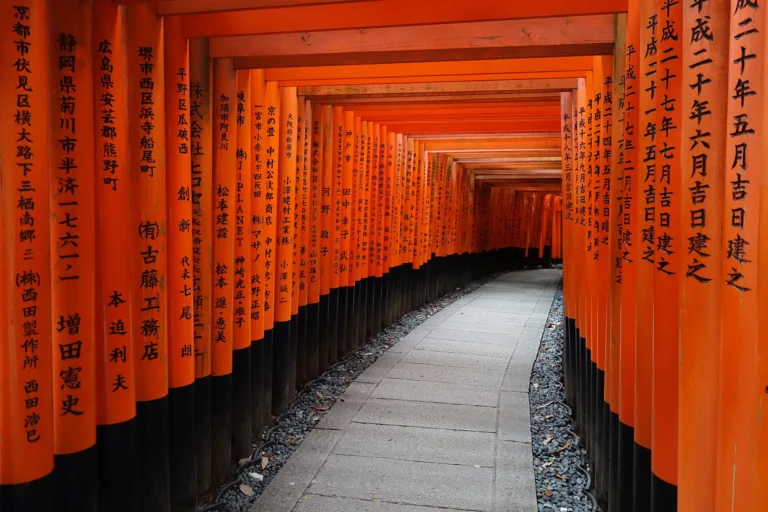 Fushimi Inari Taisha