 01
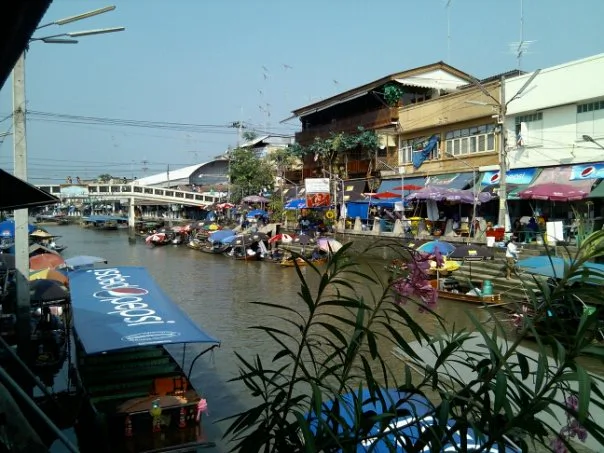
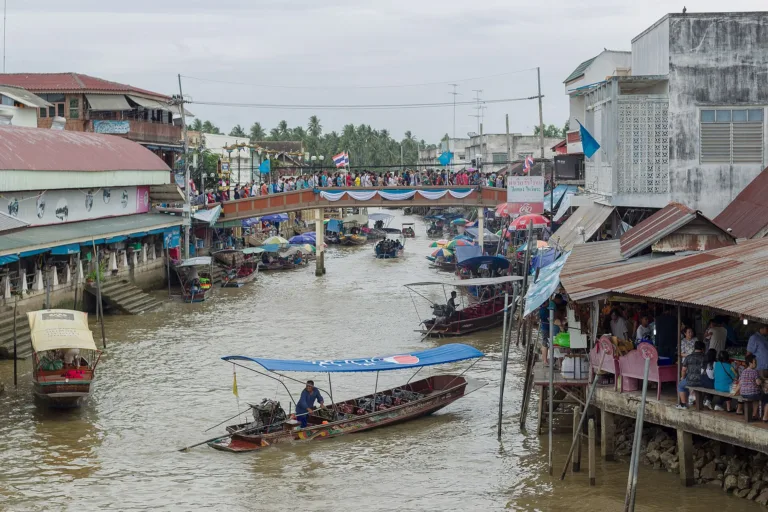
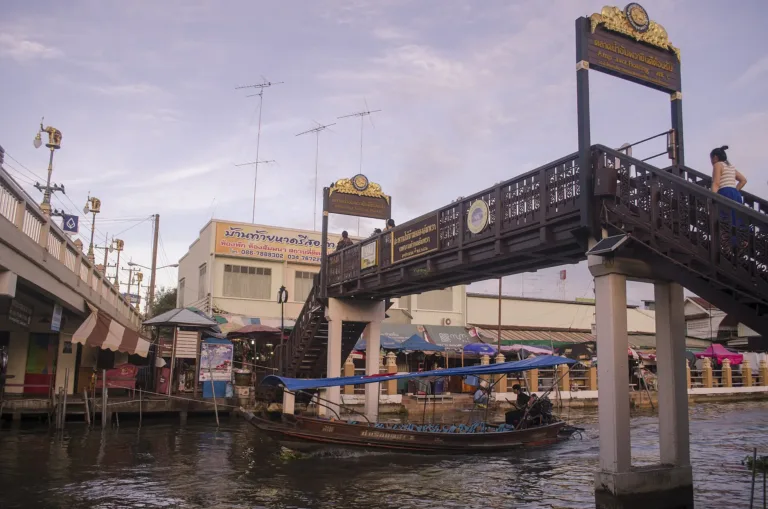
Evening canal marketShops in wooden shophouses on both banks and food boats, lively from late afternoon into the night
Samut Songkhram · Evening floating market
An evening floating market on Khlong Amphawa in Samut Songkhram, the birthplace of King Rama II, busiest Friday to Sunday with firefly boat trips after dark.
Holiday / event — crowded · Possible thunder 15:00–16:00 · Hot (Afternoon) feels like 41°C
Shops mainly Fri–Sun, afternoon to about 9 pm (some sources say from 8 am). Rama II Memorial Park 8:30 am–4:30 pm, closed Mondays
Free
3–5 hours (including the firefly boat)
Saturday 4–8 pm and long weekends
01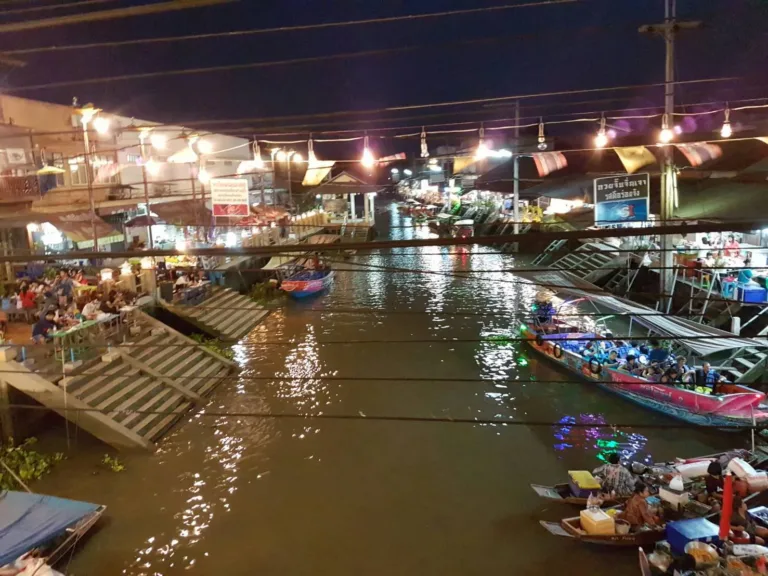 02
 03
 04
 05
Tap a day card to see that day’s weather, rain, haze and hourly forecast
Best time to go Best window 06:00–15:00 Little rain · light drizzle possible at times
Holiday — traffic on the way up and parking fills fast; leave early
Green band = hours used for the score
Best time to go Best window 06:00–12:00 Little rain
Holiday — traffic on the way up and parking fills fast; leave early
Green band = hours used for the score
Best time to go Fine all day little rain through the day · light drizzle possible at times
Holiday — traffic on the way up and parking fills fast; leave early
Green band = hours used for the score
Best time to go Fine all day little rain through the day · light drizzle possible at times
No warnings today — normal road and weather conditions
Green band = hours used for the score
Best time to go Best window 06:00–12:00 Little rain · light drizzle possible at times
No warnings today — normal road and weather conditions
Green band = hours used for the score
Best time to go Fine all day little rain through the day · light drizzle possible at times
No warnings today — normal road and weather conditions
Green band = hours used for the score
Best time to go Fine all day little rain through the day
No warnings today — normal road and weather conditions
Green band = hours used for the score
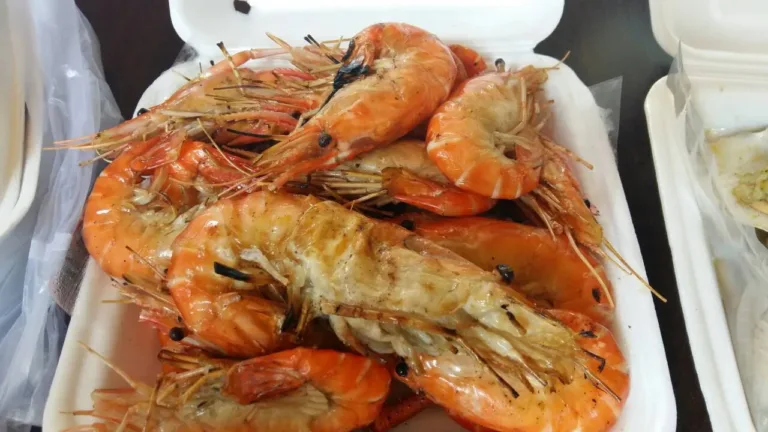
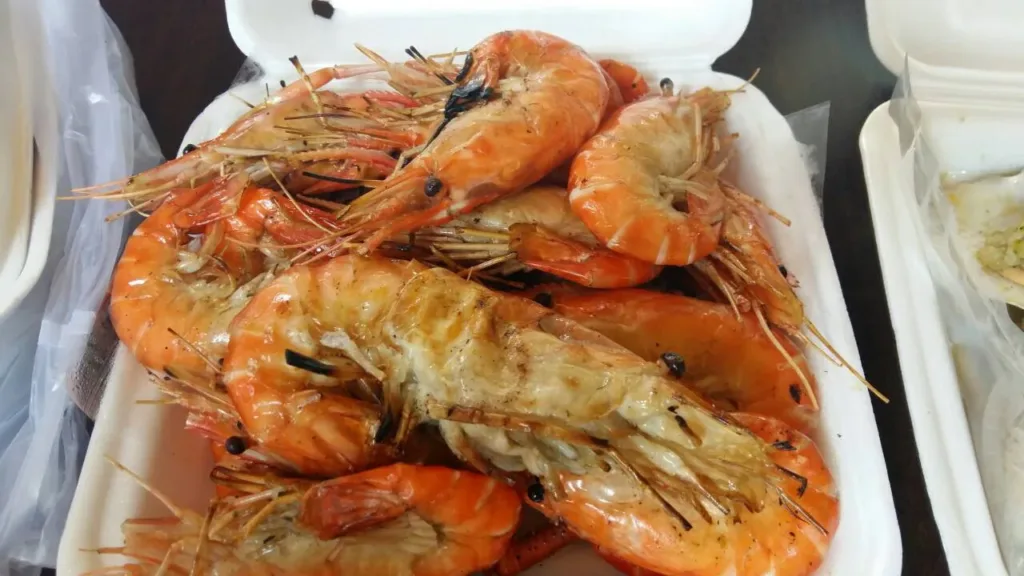
Amphawa Floating Market is an evening market along Khlong Amphawa in Samut Songkhram, about 75 km from Bangkok. Wooden shophouses line both banks, boat vendors grill seafood at the landing steps, and firefly boats leave after dark. The town is the birthplace of King Rama II, and the market was revived by the municipality in 2004.
Arrive 4 pm (weekends)
Photos from Wikimedia Commons and contributors · full credits inClassic page
Adults 0 THB · Time needed 3–5 hours (including the firefly boat)
Saturday 4–8 pm and long weekends
| Firefly boat (per person) optional | 60 ฿/baht |
| Firefly boat charter optional | 600 ฿/baht/boat |
| Five-temple boat trip (per person) optional | 50 ฿/baht |
| Five-temple boat charter optional | 500 ฿/baht/boat |
| Rama II Park, adult optional | 40 ฿/baht |
| Rama II Park, child up to 135 cm optional | 20 ฿/baht |
Mostly cash; many shops accept PromptPay transfers · Prices may change by season — check with the venue
Rama II commemorative festival at the King Rama II Memorial Park in February (7–8 Feb in 2026)
Somdet Phra Phutthaloetla Hospital (Samut Songkhram town) · Emergency 1669 · Tourist Police 1155
Tap a month on the wheel to see weather, rain, haze and crowds from 10 years of records
Best time · November to February is cooler and drier. Arrive around 3–4 pm to walk the market, then take a firefly boat after sunset.
Watch out · Long weekends and Saturday evenings are packed, with heavy traffic and full car parks. Most shops close Monday to Thursday.
Oct by the records 24–31°C · avg rain 245 mm (24 rainy days) · clear 1 days · avg PM2.5 26
Amphawa Floating Market lines Khlong Amphawa in Amphawa subdistrict municipality, Samut Songkhram. The canal branches off the Mae Klong River and has been the community's main thoroughfare for centuries. In the Ayutthaya period the area was called "Khwaeng Bang Chang", a district that prospered from both farming and trade.
A Chulalongkorn University thesis on Khlong Amphawa says Khwaeng Bang Chang once belonged to Ratchaburi, with no clear founding date. Villagers grew vegetables, chillies, shallots, garlic and coconuts for sale, and the Bang Chang market, also called the Amphawa water market, was the trading hub. Houses stood in long lines along rivers and canals, raised on stilts with orchards behind, and settlers included Thai, Chinese, Khmer and Lao people.
Local accounts say that by the reign of King Prasat Thong there was already a "Bang Chang market" here, run by a member of the wealthy Bang Chang family. That family later became the royal maternal lineage "Na Bang Chang", and its descendants still run businesses in Amphawa today.
The same study describes the Bang Chang family as Mon merchants, and notes that when Queen Amarindra's relatives became the Bang Chang royal in-law family, they were the first such lineage of the Rattanakosin era.
Around 1760 (B.E. 2303), late in the Ayutthaya period, Thongduang, the deputy governor of Ratchaburi (later King Rama I), married Nak, daughter of the Bang Chang family, and settled here. After their first house behind Wat Chulamani burned, they moved to land behind Wat Amphawan Chetiyaram.
During the war that ended Ayutthaya in 1767, the family fled to safety, and in that period their son Chim was born in Amphawa. He became King Phra Phutthaloetla Naphalai, Rama II, the poet-king behind the dance-drama Inao and parts of Khun Chang Khun Phaen. Amphawa is therefore honoured as Rama II's birthplace.
When Rama I took the throne, Nak was raised to Queen Amarindra. Many of her Bang Chang relatives kept orchards along the canal, giving rise to the saying "Bang Chang, the outer orchards; Bangkok, the inner orchards", which paired Amphawa's coconut and fruit gardens with those of Thonburi. The phrase fell out of use in the reign of Rama IV.
Under Rama V, when Samut Songkhram was merged into Monthon Ratchaburi, a district was created and named after Khlong Amphawa, while "Bang Chang" became the name of a subdistrict.
Several kings visited Amphawa. The Chulalongkorn thesis says Rama III restored Wat Amphawan Chetiyaram, and an action plan by Thailand's Office of Natural Resources and Environmental Policy and Planning (ONEP) records visits by Rama V in 1904 and 1909.
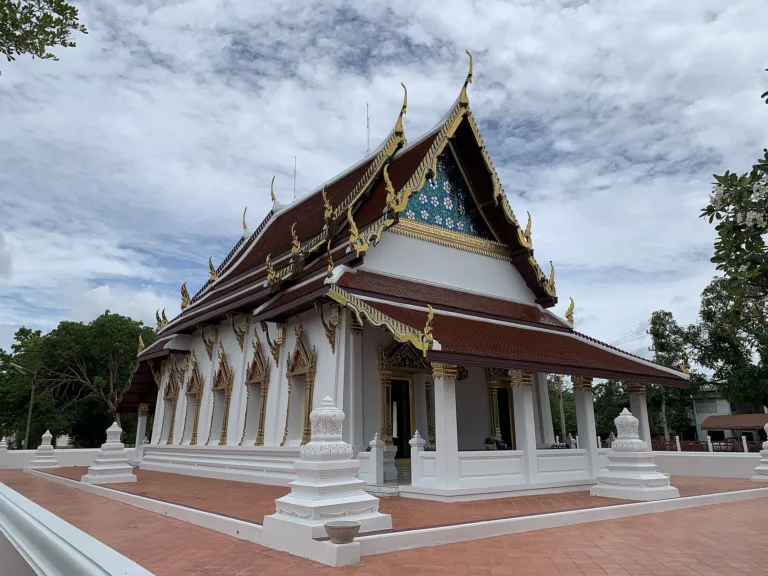
Wat Amphawan Chetiyaram, the royal temple beside the market, stands on the family's former residence. Khaosod reports that Rama III had a prang built there as a memorial to Rama II. The grounds also hold a bodhi tree planted by King Bhumibol and sandalwood trees planted by Queen Sirikit and Princess Maha Chakri Sirindhorn.
Wat Amphawan Chetiyaram is a registered ancient monument, and other old temples tied to the community's history include Wat Phumarin Kuti Thong, Wat Bang Kaphom and Wat Dao Dueng. On 2 November 2025 a royal kathin robe-offering ceremony was held at Wat Amphawan, with the procession starting from the Rama II park.
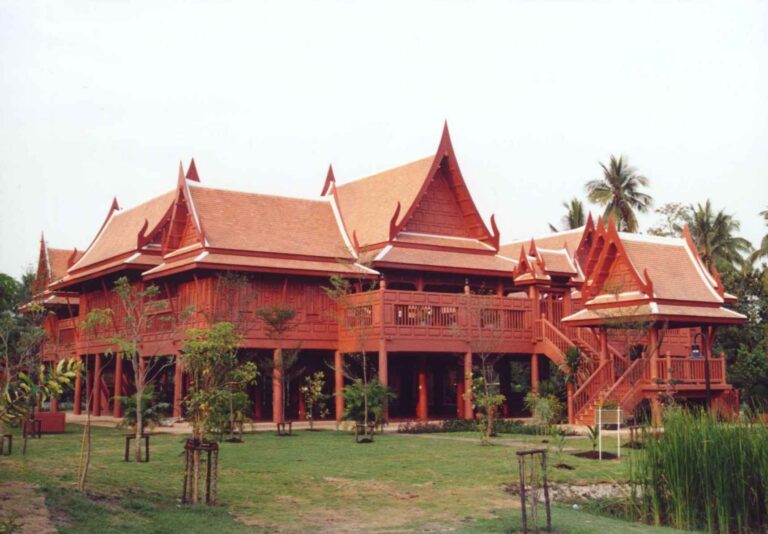
Next door is the King Rama II Memorial Park, run by the King Rama II Memorial Foundation under royal patronage. It holds a statue of Rama II, a group of traditional Thai houses arranged as an ethnology museum, and an open-air theatre used for khon and lakhon nai performances.
Each February, near Rama II's birth anniversary on 24 February, the Rama II Foundation, Samut Songkhram province, the Fine Arts Department and TAT hold a commemorative festival at the park. Princess Maha Chakri Sirindhorn often presides, as on 7 February 2015 and as scheduled for 7 February 2026. The programme includes lakhon nai from Inao and khon from the Ramakien. The park houses museums on Rama II's life, early Rattanakosin life and Amphawa lifeways, plus a garden of plants from Thai literature. Organisers note that UNESCO honoured Rama II as a world figure in arts and culture.
Life on the canal has always revolved around coconuts and sugar. Amphawa's coconut groves supplied the Mae Klong area's famous coconut sugar, and produce moved by boat, so houses faced the water and rows of wooden shophouses lined both banks, many of which still stand.
The Bangkok Post recorded that Amphawa residents once carried coconuts and produce by boat to Bangkok, a two-day trip. ONEP's plan describes the wooden shophouses as continuous rows on both banks facing the canal, with hipped, single-gable and twin-gable roofs, and distinctive old shop signs in Thai and gold Chinese lettering on dark boards.
ICCROM notes that in the 1980s, as roads and cars replaced boats, the canal economy and the traditional wooden houses declined. Chiang Mai CityLife wrote that the floating market lay dormant for more than 30 years before its revival.
The Chulalongkorn thesis traces the shift: from the 1950s roads began replacing waterways; after the Thonburi–Pak Tho highway (Rama II Road) opened in 1973, trade moved to the roadside; and by 1993 the area's floating-market role had passed to Damnoen Saduak, leaving Amphawa's canal trade in decline.
In 2004 Lt. Patcharodom Unsuwan, then mayor of Amphawa municipality, revived the market as an evening market. Damnoen Saduak was a morning market aimed at foreigners, so Amphawa targeted Bangkok families who could drive down at weekends. MGR Online reported a starting budget of under 200,000 baht, with more than 80 percent of businesses owned by locals.
ONEP notes that after the market began in 2004 it grew very fast. In 2005 a replica Amphawa floating market was shown at an event at Muang Thong Thani, raising its profile, and lodging, homestays, restaurants and souvenir shops followed. By 2010 farmland in the roughly 2.5 sq km municipality had shrunk, and the inner canal banks had become almost entirely commercial.
The same year, the Thai Cultural Environment Project (TCEP) restored some wooden buildings and the canalside landscape. ICCROM lists the results as 17 local houses restored, cultural heritage atlases for the province and the Amphawa community, and greater local awareness of the value of conservation.
Another key force is the Amphawa Chaipattana Nurak project. At Princess Maha Chakri Sirindhorn's initiative, the Chaipattana Foundation developed about 21 rai of land donated by local resident Prayong Nakawarang for the community's benefit. Today it demonstrates traditional coconut and palm sugar making and sells community products.
AsiaNews reported in December 2008 that UNESCO gave its 2008 Asia-Pacific Award to Princess Maha Chakri Sirindhorn for the Amphawa Chaipattana Nurak project, which aimed to return the canal's wooden houses to their original structure while protecting the surroundings. The name means "victory through development and conservation". The Chaipattana Foundation itself was registered on 14 June 1998.
In 2008 Amphawa received an Honourable Mention in the UNESCO Asia-Pacific Awards for Cultural Heritage Conservation for its canal community conservation work, making it a model for community-based tourism.
The fireflies that made Amphawa famous are Pteroptyx malaccae, which flash in unison and live in lamphu trees along the brackish Mae Klong. Chiang Mai CityLife reported in 2014 that firefly boat tours began in 2004 with the market and had grown to more than 20 operators; one ran 18 boats making two to three trips a night between 6 and 9 pm.
Night tourism hit the community directly. A 2007 Burapha University study found conflict in canal communities over firefly tourism. Silpakorn University researchers found that paddle boats gave way to noisy long-tail boats, residents went to bed around 11 pm, spotlights and flashes disturbed them, and some households built sea walls or moved houses back from eroding banks. Chiang Mai CityLife reported that some residents cut down lamphu trees, and scientists blamed land development and light pollution for falling firefly numbers.
Rapid popularity raised concerns about crowding and commercialisation. In September 2012 locals, media and artists held a seminar titled "Is Amphawa really that beautiful?" and an exhibition, "Amphawa Lost", at the Chaipattana project to examine tourism's impact on the community.
The Bangkok Post reported around the same time that a four-storey hotel on a roughly 7-rai canal plot sparked protests after some old teak houses were demolished. Local authorities said it broke no law, and the owner promised to revise the design and keep the wooden houses; the "Amphawa Lost" exhibition later moved to Ratchaburi. (The plot size differs from The Nation's 3 rai for Chuchai Buri, so it is unclear whether this is the same project.)
Around the same time, from 2012, the Chuchai Buri Sri Amphawa resort and mall drew objections that its buildings clashed with the canal's wooden houses. The owner shifted to a more Asian design and restored the old shophouses. The Nation reported it took four and a half years and about 600 million baht, opening in March 2016.
A 2014 community forum recorded by ONEP listed the canal's problems: bank erosion, silting, rubbish, boat noise, crowding, unregulated signs, no controls on building style, and fading participation in traditions. Amphawa's first comprehensive town plan was issued in 2002, covering 14.94 sq km; the current one, issued on 3 May 2017, covers the whole district, about 170 sq km.
In 2026 the market faced new pressure. Matichon reported on 4 April 2026 that rising fuel prices cut tour boat trips from 40–50 a day to no more than 10, yet many piers kept firefly boat fares at 60 baht per person and the five-temple trip at 50 baht.
In July 2026 Daily News reported that Lt. Patcharodom, now adviser to the Chaipattana project, is promoting "Amphawa Old Town" so visitors see Amphawa as a historic town rather than just a market. Plans include the Amphawa River Heritage canal lighting and reusing empty shophouses behind the municipal office for vendors, to ease crowding, traffic and waste.
Arrived? Check in, collect a stamp and tell others what it is like right now
Check your location first, so you do not fill in the form for nothing
Location must be on and within 1 km · One check-in per place per day · come back on other days to check in again
Post photos from anywhere — no need to be here · Up to 20 photos at a time · JPG / PNG / WebP · GPS location data is removed automatically
From Bangkok take Rama II Road to Samut Songkhram, turn righ…
Rama II Rd → Hwy 325 → Amphawa · Fuel + parking
Bangkok to Mae Klong, then songthaew to Amphawa · Estimate 100–150 baht
Mae Klong line (Wongwian Yai–Mahachai–Mae Klong), then songthaew · Cheap
Rama II Road (Hwy 35), then Hwy 325 to Amphawa
Private lots around the market and temple grounds, roughly 20–50 baht (estimate); full quickly on Saturday evenings
Stations on Rama II Road and Hwy 325 before town
Good signal on all networks
Shops mainly Fri–Sun, afternoon to about 9 pm (some sources say from 8 am). Rama II Memorial Park 8:30 am–4:30 pm, closed Mondays
around 75 km fromBangkok
Amphawa Floating Market
0 THB
Approx. nightly price for 2 adults (next week) · final price depends on your dates
Answers travellers want before they go — a one-minute read
Most shops open Friday to Sunday, afternoon to about 9 pm; few open on weekdays
Matichon reported (Apr 2026) about 60 baht per person or 600 baht per boat
No
It is the birthplace of King Rama II and home of the Bang Chang royal maternal family
It was revived as an evening market in 2004 by Amphawa municipality
Best day this week: Monday 26 Oct · Check in when you arrive to collect a stamp