 01
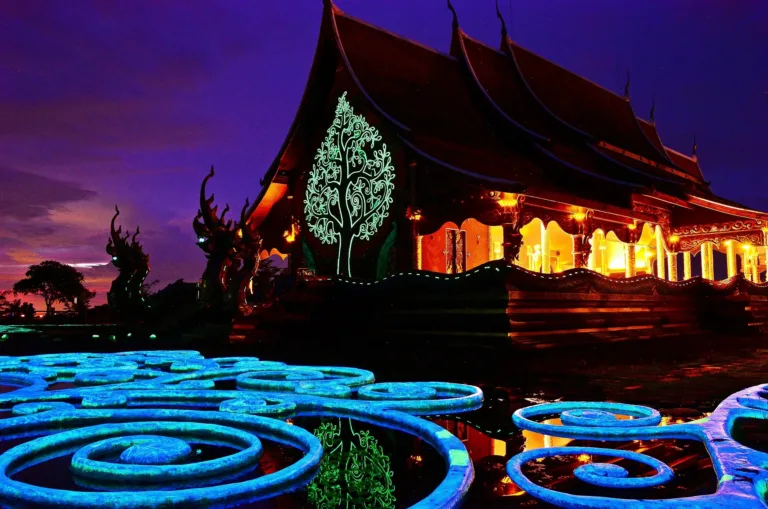
Glowing Tree of LifeThe back wall of the hall glows blue-green at night
Glowing temple · Sirindhorn
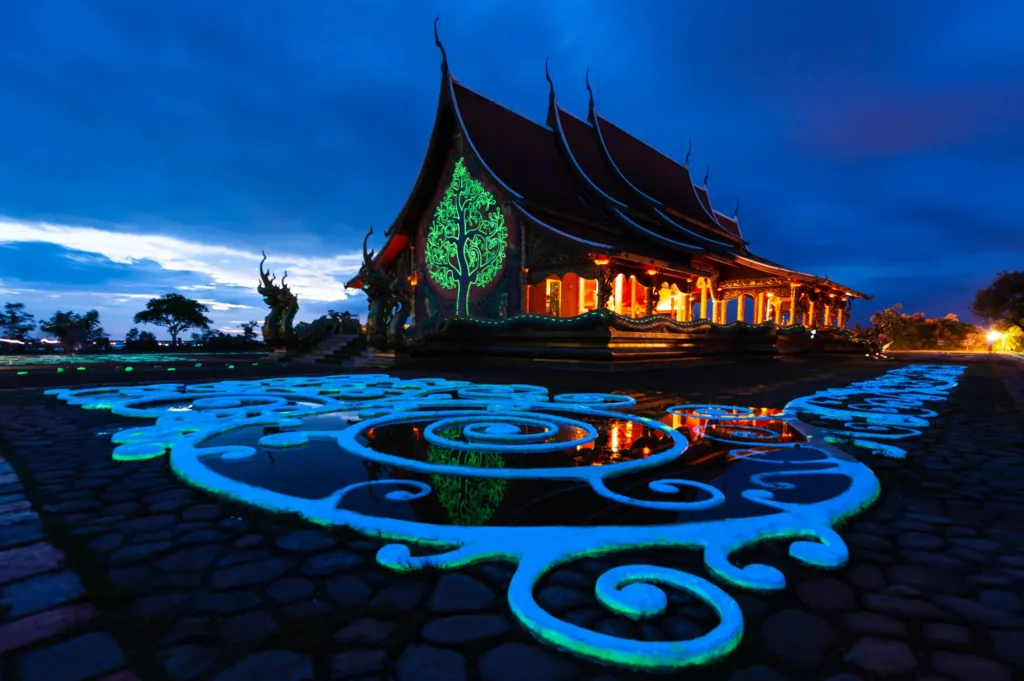
A hilltop temple near Chong Mek in Sirindhorn, Ubon Ratchathani, famous for the Tree of Life mural behind its ordination hall that glows blue-green after dark.
Warning: Strong gusts, about 56 km/h · Holiday / event — crowded
Cover shoulders and knees · Remove shoes before entering the hall · Keep quiet and don't flash at people praying
Daily, roughly 06:00–20:00 (glow clearest around 19:30)
About an hour before sunset, then stay until dark
01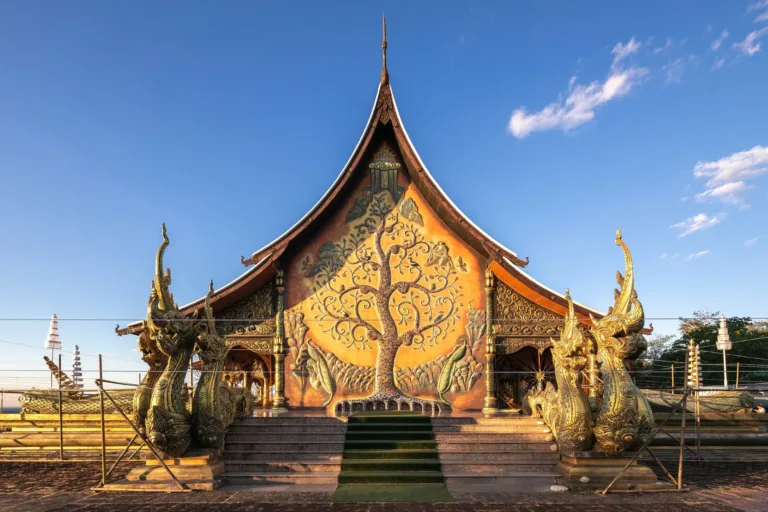 02
 03
Tap a day card to see that day’s weather, rain, haze and hourly forecast
Best time to go Daytime is over · see tomorrow
Strong gusts, about 56 km/h
Holiday — traffic on the way up and parking fills fast; leave early
Green band = hours used for the score
Best time to go Fine all day little rain through the day
Holiday — traffic on the way up and parking fills fast; leave early
Green band = hours used for the score
Best time to go Best window 06:00–17:00 Little rain
No official warnings, but watch for: Possible thunder 17:00–18:00
Green band = hours used for the score
Best time to go Fine all day little rain through the day
No warnings today — normal road and weather conditions
Green band = hours used for the score
Best time to go Fine all day little rain through the day
No warnings today — normal road and weather conditions
Green band = hours used for the score
Best time to go Fine all day little rain through the day
No warnings today — normal road and weather conditions
Green band = hours used for the score
Best time to go Fine all day little rain through the day
No warnings today — normal road and weather conditions
Green band = hours used for the score
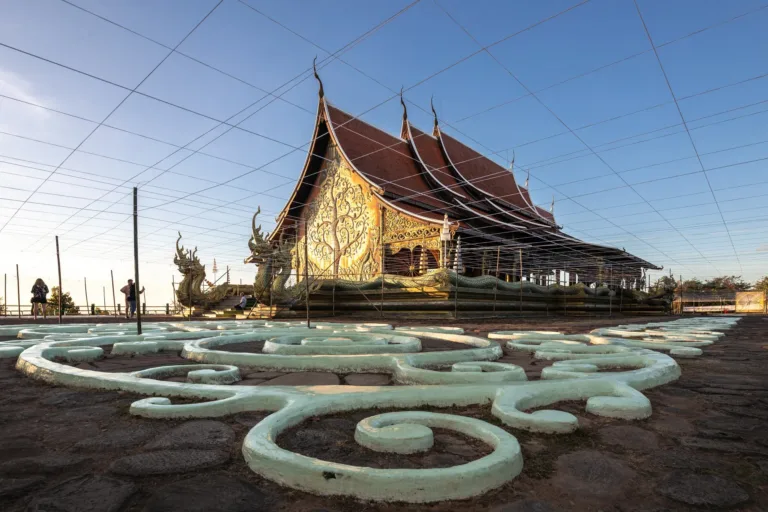
Wat Sirindhorn Wararam Phu Phrao, or Wat Phu Phrao, sits on a hill in Sirindhorn District, close to the Chong Mek border crossing into Laos. People call it the Glowing Temple: the back wall of the ordination hall carries a Tree of Life mural in phosphorescent paint that soaks up sunlight by day and glows blue-green once it's dark.The hall's design takes its cue from Wat Xieng Thong in Luang Prabang, and floral and vine patterns around the grounds use the same glowing paint, giving the place a mythical Himaphan forest feel at night.Arrive about an hour before sunset to see the temple and view in daylight, then wait for full darkness. The glow is clearest around 19:30 and brightest after a sunny day.
Arrive About an hour before sunset, then stay until dark
The glow shows best around 19:30 and depends on the day's sun
Bring a torch for the walk back
Drive or arrange a ride back in advance
No data yet check before you go · Time needed 1–2 hours
Early evening 18:30–20:00 on holidays
Wat Sirindhorn Wararam Phu Phrao, better known as Wat Phu Phrao or the Glowing Temple, sits on Phu Phrao hill in Sirindhorn District, Ubon Ratchathani, looking down over a reservoir and the Chong Mek crossing on the Thai–Lao border. It began some 70 years ago as the camp of a wandering forest monk from Laos, lay abandoned for decades, and was revived from 1999 into a temple with a grand Lan Xang-style ordination hall and the glowing Tree of Life that has made it famous far beyond the province.
Before the temple, Phu Phrao was forested hill country with high cliffs. The soil was rich but there was no water, so nobody settled there. The name "Phu Phrao" (Coconut Hill) comes from coconut-shaped rocks on the hill; legend says they were coconuts made by a hermit, and villagers regarded the stones as sacred.
Around 1952–1955, Phra Ajahn Bunmak Thitipanyo, a meditation monk from Champasak in Laos, crossed into Thailand on a wandering (thudong) journey and camped on Phu Phrao. He built a sala, marked out boundaries and vowed to found a temple here as a place where Thai and Lao people could make merit together. He asked the military and district authorities for the land and was granted about 500 rai. Locals simply called it Wat Phu Phrao. Some sources put his request for the temple land later, around 1973.
Phra Ajahn Bunmak later returned to Laos and the hilltop temple was left empty — by one account for about 26 years. He died in Champasak in 1981, aged 72. Meanwhile the land around the hill changed: the Sirindhorn Dam was built on the Lam Dom Noi River between 1968 and 1971, and around 1992 Sirindhorn District was created out of Phibun Mangsahan, named in honour of Princess Maha Chakri Sirindhorn. The temple took the district's name and became Wat Sirindhorn Wararam.
On 17 September 1999, Phra Khru Kamonphawanakon (Sithon Kamalo), a disciple of Phra Ajahn Bunmak, led monks and lay followers up the hill to restore the abandoned temple and revive it as a meditation centre. Today the temple has the Kamalo Bhikkhu reservoir of about 40 rai, a pond of roughly 40 × 80 m and a water-catching ditch about 1 km long on the eastern slope, answering the lack of water that had always kept people off the hill.
Official recognition followed within a few years. Permission to build came on 9 August 2001, the temple was formally established on 2 May 2002, and on 26 July 2004 it received a royally granted consecrated boundary (wisungkhamsima). It belongs to the Thammayut order. Some sources say the full name Wat Sirindhorn Wararam Phu Phrao dates from that year. The records also differ on its size: the establishment entry lists 15 rai, while the temple's history speaks of about 500. In the same period a hall of revered teachers was built, housing a Buddha image donated in 2000, a Chiang Saen-style bronze Buddha from 2002 and portraits of great Isan forest monks such as Luang Pu Sao, Luang Pu Man and Luang Pu Bunmak.
Structural design of the present ordination hall began in 2005, with the Rotary Club of Samut Chedi sponsoring the hall and its principal Buddha image. Phra Khru Kamonphawanakon shaped the plan but died on 21 July 2006, before it was finished; his royally sponsored cremation took place on 29 July that year. His successor as abbot, Phra Khru Panyawarobon (Parinya Tissawaro), carried the building and decoration forward.
The hall takes its cue from Wat Xieng Thong in Luang Prabang but is much wider and more than twice as long as its model, blending Lanna and Lan Xang art. In 2006–2007 teams of craftsmen added the chofa finials, bargeboards, carvings and stucco work. Hand-carved pillars show lotuses and animals, the walls are finished in gold tones, and the grounds are laid out to evoke the mythical Himaphan forest and Mount Meru.
In 2007 a bronze replica of the Phra Buddha Chinnarat, 2.50 m across the lap and 3.10 m high, was installed as the principal image. In 2012 its arched frame was removed and replaced with a lit stucco Bodhi tree. The image was gilded for the first time in 2019 and again in 2023, when its flame finial was replaced with a lotus bud carved from yellow jade and it was given the name Phra Phutthabhavana Thitiwarobon.
What made the temple famous is the kalpavriksha on the back wall of the hall — the wish-granting tree that the Traiphum cosmology places in the northern continent of Uttarakuru. It was designed by craftsman Khanakorn Parinyapunno, a school friend of the abbot, who has said he was inspired by the Tree of Life in the film Avatar. The work is a mosaic containing phosphorescent material that soaks up sunlight by day and slowly releases a green glow after dark; some sources describe it as a painting in luminous paint. A 2024 article said the tree had been glowing for more than ten years, losing about 0.3% of its brightness each year.
Beyond the tree, the temple has stained glass, cartoon-character sculptures and a path with reliefs inspired by Egyptian and Maya glyphs, which helped turn it into a favourite night-time spot for photographers and visitors. A 2022 Thai PBS report described Wat Phu Phrao as playing an important role in community development and bringing income to villagers around Chong Mek. It remains a working temple where locals make merit and meditate, as well as an evening stop for people visiting the Sirindhorn Dam and the Chong Mek border.
Arrived? Check in, collect a stamp and tell others what it is like right now
Check your location first, so you do not fill in the form for nothing
Location must be on and within 1 km · One check-in per place per day · come back on other days to check in again
Post photos from anywhere — no need to be here · Up to 20 photos at a time · JPG / PNG / WebP · GPS location data is removed automatically
The temple is on a hill in Sirindhorn District near Chong Mek, about 1–1.5 hours from Ubon Ratchathani town.
Ubon town–Highway 217–Sirindhorn · Fuel
Book your ride back; there's almost no public transport after dark · As agreed
Paved; Highway 217 towards Chong Mek, then up the hill to the temple
Daily, roughly 06:00–20:00 (glow clearest around 19:30)
Wat Sirindhorn Wararam Phu Phrao
Answers travellers want before they go — a one-minute read
Once it's fully dark, clearest around 19:30
The paint charges from sunlight; cloudy days mean less glow
On a hill in Sirindhorn District near Chong Mek, Ubon Ratchathani
About 1–1.5 hours by car
Modest clothes covering shoulders and knees; shoes off inside the hall
Best day this week: Tuesday 1 Dec · Check in when you arrive to collect a stamp
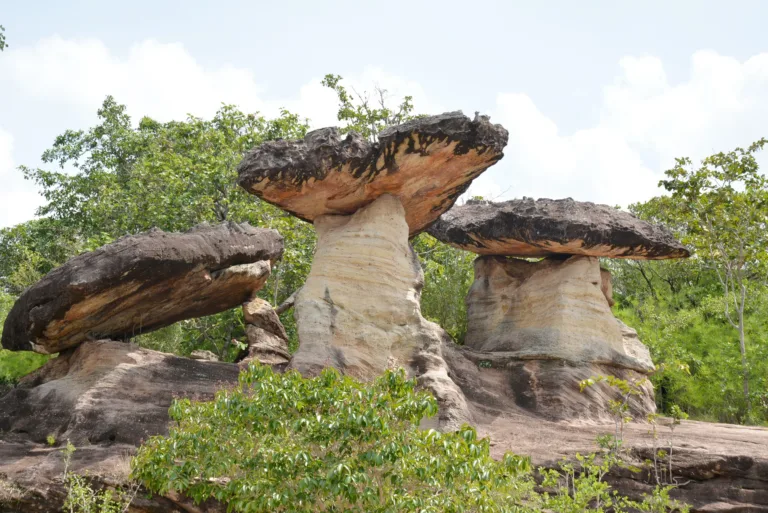 Pha Taem National Park
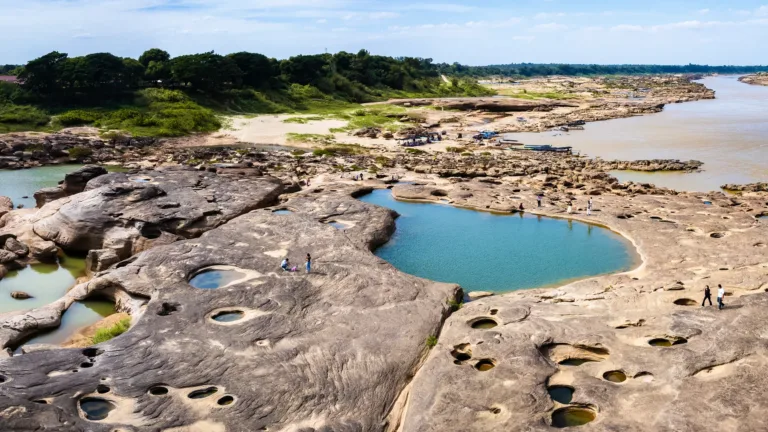 Sam Phan Bok
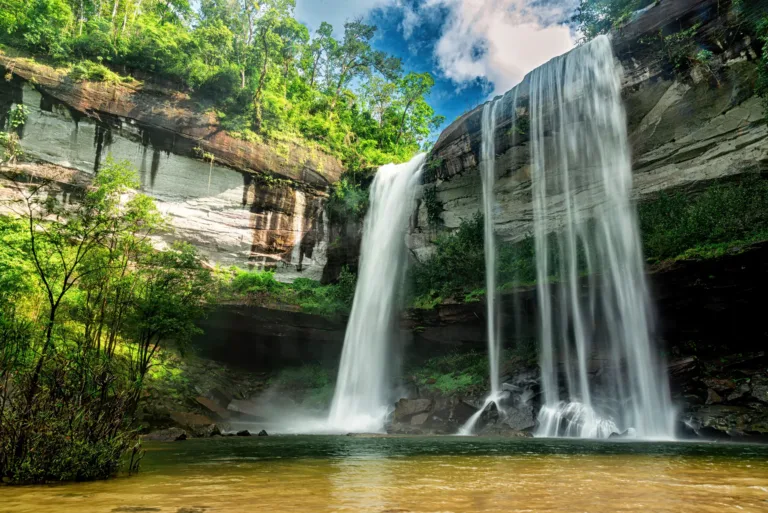 Phu Chong Na Yoi National Park